

TL;DR:
- Compensation in Georgia injury cases varies from a few thousand to millions depending on injury severity and damage types.
- Types of damages include compensatory, punitive, and nominal, with different rules, standards, and caps.
- Effective claim outcomes rely on thorough documentation, understanding liability, and expert legal guidance.
After a serious accident in Georgia, most victims assume they’ll receive “compensation” as a single, simple check. The reality is more layered. Payouts in Georgia injury cases can range from a few thousand dollars for minor fender-benders to millions for catastrophic injuries or gross negligence, and the difference often comes down to which type of compensation applies to your situation. Compensatory, punitive, and even nominal damages each follow different rules, different standards of proof, and different caps under Georgia law. This guide breaks down every major compensation category, shows you real settlement benchmarks, and explains exactly how courts and insurers calculate what your case is worth.
Table of Contents
- The main types of compensation in Georgia injury cases
- Compensatory damages explained: Special vs. general
- Punitive damages: Georgia’s rules and limits
- How compensation gets calculated in real Georgia cases
- What most accident victims miss about injury compensation
- Get help with your Georgia injury claim
- Frequently asked questions
Key Takeaways
| Point | Details |
|---|---|
| Compensation has categories | Georgia law separates compensatory and punitive damages, each with specific criteria and limits. |
| Real case values vary | Injury settlements range from thousands to millions depending on severity, cause, and strength of evidence. |
| Punitive damages have caps | You can only get punitive damages in extreme cases, and Georgia generally sets a $250,000 limit. |
| Documentation is crucial | Careful records of losses and suffering make a big difference in maximizing your compensation. |
The main types of compensation in Georgia injury cases
Georgia law organizes injury compensation into three broad categories. Understanding which one applies to your case is the first step toward knowing what you can realistically expect.
Compensatory damages are the foundation of nearly every personal injury claim. They exist to replace what you actually lost, whether that’s money spent on medical care, income you couldn’t earn, or the physical and emotional toll of the injury itself. Compensatory damages split into two subtypes: special damages (economic losses) and general damages (non-economic losses). More on those in the next section.
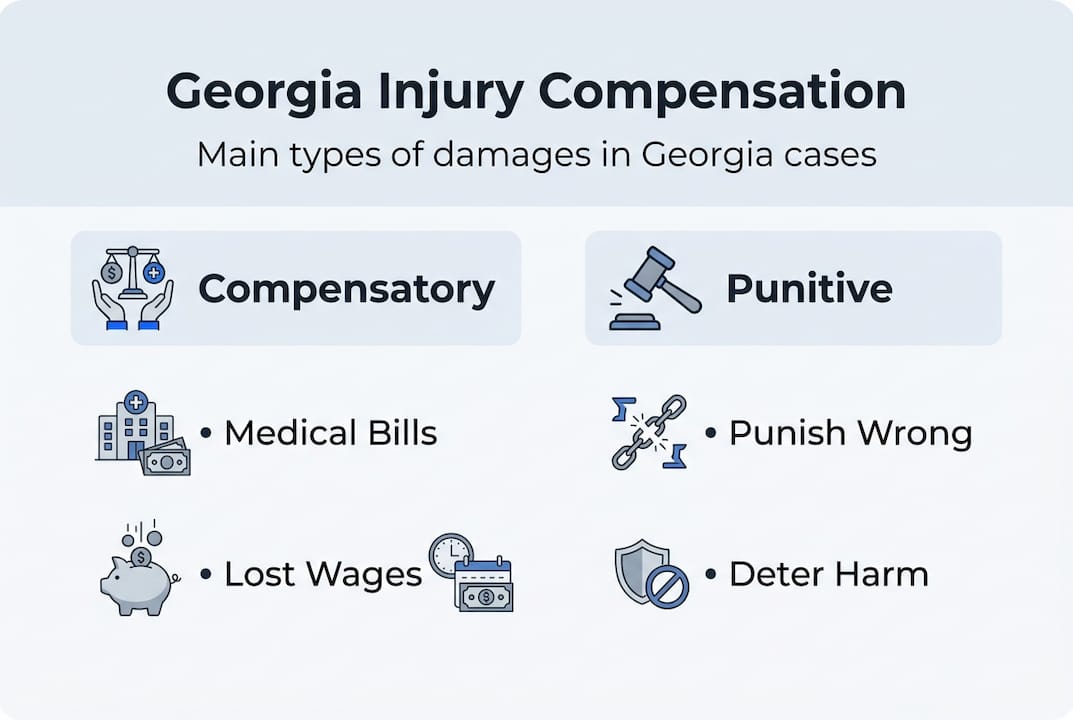
Punitive damages work differently. They are not designed to compensate you. Instead, they exist to punish a defendant whose behavior was especially reckless or intentional. Under Georgia law, punitive damages punish egregious conduct such as willful misconduct, gross negligence, DUI-related crashes, or intentional harm, and they must be proven by clear and convincing evidence. This is a higher bar than the standard “preponderance of the evidence” used for compensatory claims.
Nominal damages are rare in personal injury cases. Courts award a symbolic amount, sometimes just one dollar, when a legal right was violated but no measurable harm occurred. For most accident victims in Georgia, nominal damages are not a realistic goal.
Here is a quick look at which case types most commonly involve each category:
- Auto accidents (standard negligence): Compensatory damages are almost always available. Punitive damages apply if the at-fault driver was intoxicated or acted with reckless disregard.
- Medical malpractice: Compensatory damages cover medical costs and lost income. Punitive damages are rare but possible when a provider acted with conscious indifference to patient safety.
- DUI crashes: Strong candidates for punitive damages because intoxicated driving meets Georgia’s threshold for willful or wanton misconduct.
- Intentional harm (assault, road rage): Both compensatory and punitive damages may apply.
You can review injury claim examples from South Atlanta cases to see how these categories play out in practice.
Compensatory damages explained: Special vs. general
Now that you know the main categories, let’s look closer at the core of most claims: compensatory damages.
Think of compensatory damages as two buckets. One holds everything with a price tag attached. The other holds everything that hurts but doesn’t come with a receipt.
Special damages (economic losses) are straightforward to document. They include:
- Medical bills (emergency care, surgery, physical therapy, future treatment)
- Lost wages and lost earning capacity
- Property damage (vehicle repair or replacement)
- Out-of-pocket costs (transportation to appointments, home care, medical equipment)
General damages (non-economic losses) are harder to quantify but often represent the largest portion of a settlement. They include pain and suffering, emotional distress, loss of enjoyment of life, and loss of consortium for a spouse or family member.
To prove special damages, you need documentation: bills, pay stubs, employer letters, and receipts. To prove general damages, you rely on medical records, expert testimony, personal journals, and witness statements about how your life changed after the injury.
Here are typical settlement ranges based on injury severity in Georgia:
| Injury severity | Auto accident range | Medical malpractice range |
|---|---|---|
| Minor | $10,000 to $25,000 | $50,000 to $150,000 |
| Moderate | $25,000 to $200,000 | $100,000 to $500,000 |
| Serious | $100,000 to $500,000+ | $500,000 to $1,000,000+ |
| Catastrophic | Millions | Millions |
These figures reflect Georgia settlement benchmarks across injury types, though averages are often skewed upward by outlier verdicts. Median values tend to be lower. A traumatic brain injury case, for example, might settle well above $500,000 when future care costs are factored in, while a soft tissue whiplash case might resolve for $15,000 to $30,000.
The gap between those numbers is not random. It reflects the strength of your documentation, the clarity of liability, and how well your attorney presents the full scope of your losses.
Punitive damages: Georgia’s rules and limits
While compensatory damages are common, punitive awards are much rarer and follow strict rules in Georgia.
Georgia courts require a separate phase of trial just to determine whether punitive damages are appropriate. This is called a bifurcated trial. First, the jury decides liability and compensatory damages. Then, in a second phase, the same jury hears evidence about the defendant’s conduct and decides whether punitive damages are warranted.
The standard of proof is higher than in most civil cases. You must show by clear and convincing evidence that the defendant acted with willful misconduct, malice, fraud, wantonness, oppression, or that entire want of care that raises the presumption of conscious indifference.
Here is how Georgia’s punitive damage caps break down:
| Situation | Punitive cap |
|---|---|
| General personal injury | $250,000 |
| DUI-related crashes | No cap |
| Product liability cases | No cap |
| Specific intent to harm | No cap |
The $250,000 cap applies to most standard negligence cases. But if the defendant was driving drunk, or if a defective product caused your injury, that cap disappears entirely. This distinction matters enormously for victims of DUI crashes or dangerous consumer products.
Georgia law note: Under O.C.G.A. § 51-12-5.1, 75% of any punitive award (after attorney fees) goes to the State of Georgia’s general fund in most cases, not to the victim. This is a critical detail that surprises many clients.
Pro Tip: Punitive claims require a very specific litigation strategy. Evidence of prior bad acts, internal company records, or blood alcohol results must be preserved early. Missing this window can eliminate your punitive claim entirely. Learn more about punitive damages law and how an attorney can help with maximizing punitive claims before evidence disappears.
How compensation gets calculated in real Georgia cases
Now that you understand damage types and legal nuances, let’s see how compensation is actually determined and paid out in Georgia.
Calculating a fair settlement is not guesswork. It follows a structured process:
- Document all economic losses. Gather every medical bill, pharmacy receipt, lost wage statement, and repair estimate. This becomes the floor of your claim.
- Establish liability. Prove the other party was negligent or at fault. Georgia follows a modified comparative fault rule: if you are 50% or more at fault, you recover nothing. If you are less than 50% at fault, your award is reduced by your percentage of fault.
- Calculate general damages. Attorneys and insurers often use a multiplier method, multiplying your special damages by a factor of 1.5 to 5 depending on injury severity. Serious, permanent injuries justify higher multipliers.
- Apply insurance limits. Even a strong case can be capped by the at-fault driver’s policy limits. Uninsured/underinsured motorist coverage on your own policy may fill the gap.
- Factor in future costs. Ongoing medical care, future lost earnings, and long-term disability must be projected and included.
To put this in context, Georgia injury payouts show that minor auto accident cases typically settle between $10,000 and $25,000, while catastrophic cases involving paralysis or permanent brain damage can reach into the millions. Medical malpractice cases tend to start higher because the injuries are often severe and the defendants are well-insured.
Consider two scenarios. A rear-end collision with soft tissue injuries and $8,000 in medical bills might settle for $20,000 to $35,000 after applying a moderate multiplier. A surgical error leaving a patient permanently disabled could result in a $1.5 million settlement once future care costs and lost lifetime earnings are calculated.

Pro Tip: Keep a daily pain journal starting the day after your accident. Write down your pain levels, activities you could not do, and how the injury affected your relationships. This simple habit creates powerful evidence for general damages. You can also review Georgia accident claims to understand what documentation other victims used successfully.
What most accident victims miss about injury compensation
Most people who come to us after an accident are focused on one number. They want to know the maximum payout. That instinct is understandable, but it can actually work against you.
Chasing the biggest headline number sometimes means overlooking what matters most for your actual recovery. Future medical care costs, for example, are often undervalued in early settlement offers. An insurer might offer $80,000 quickly, which sounds substantial, but if your injury requires $150,000 in future surgeries, that settlement leaves you financially exposed for years.
The right strategy means looking carefully at every damage category, not just the obvious ones. Emotional distress, loss of enjoyment of life, and the impact on your family relationships are real losses that deserve real compensation. They just require a different kind of evidence and a different kind of advocacy.
We have seen cases where understanding the importance of injury lawyers changed the entire outcome. One client initially received a $45,000 offer for a moderate back injury. After a thorough review of future care needs and general damages, the final recovery was more than three times that amount. The difference was not luck. It was knowing which damages to claim and how to prove them.
Get help with your Georgia injury claim
If you’re facing questions about your own compensation or what your injury case could be worth, expert help is available.
Navigating Georgia’s compensation rules on your own is difficult. Insurance companies have teams of adjusters and attorneys working to minimize what they pay you. You deserve someone equally dedicated in your corner.

At The Jewkes Firm, our Georgia personal injury lawyers know how to identify every type of damage that applies to your case, build the evidence needed to prove it, and fight for the maximum compensation you deserve. We serve clients across South Atlanta and surrounding Georgia counties. We work on a contingency fee basis, meaning you pay nothing unless we win. Contact us today for a FREE CONSULTATION and let us review your case personally.
Frequently asked questions
What’s the difference between compensatory and punitive damages?
Compensatory damages pay for your actual losses, including medical bills, lost wages, and pain and suffering. Punitive damages punish egregious conduct such as willful misconduct or DUI-related harm, and they are designed to deter future wrongdoing rather than reimburse the victim.
How much compensation can I expect for an auto accident in Georgia?
It depends heavily on injury severity and liability. Minor injuries typically settle between $10,000 and $25,000, while serious or catastrophic cases can reach hundreds of thousands or millions of dollars.
Are punitive damages capped in Georgia?
Yes, in most personal injury cases punitive damages are capped at $250,000, but there is no cap in DUI crashes, product liability cases, or cases involving specific intent to harm.
What documents or evidence do I need to claim compensation?
You will need medical bills, treatment records, lost wage documentation, police reports, photos of the scene and injuries, and personal journals detailing how the injury affected your daily life. The stronger your documentation, the stronger your claim.