
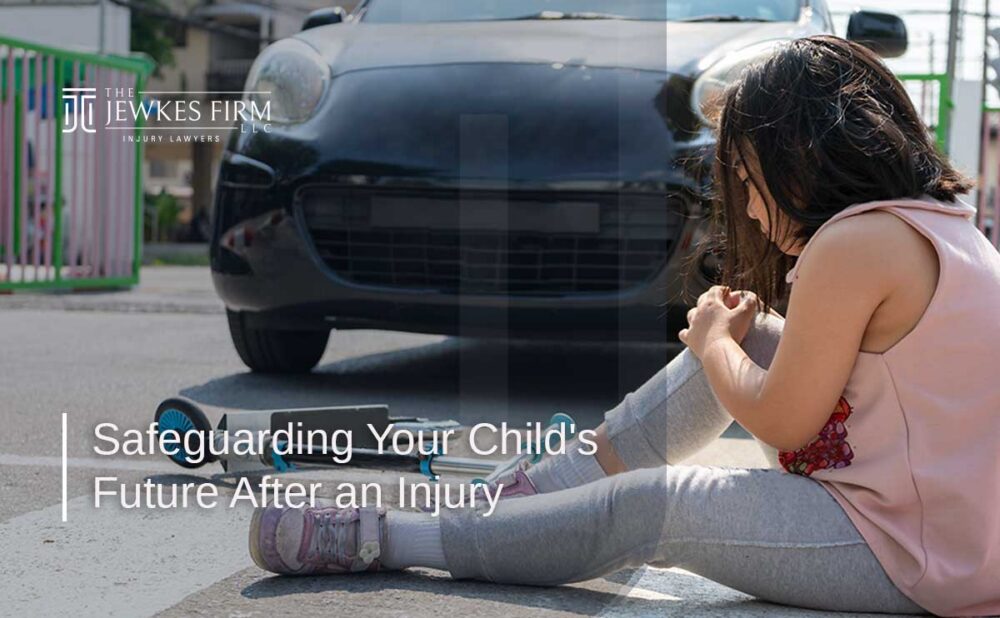
Safeguarding Your Child’s Future After an Injury — A Parent’s Guide to Child Injury Claims in Georgia
As a parent, nothing is more frightening than seeing your child hurt in an accident. Whether it’s a car crash, playground mishap, or any other injury caused by someone else’s negligence, the aftermath can feel overwhelming. When your child is hurt in an accident, everything else instantly drops away. Between emergency rooms, doctor visits, and reassuring a scared child, it can be hard to even think about “legal rights.” But what you do in the days and weeks after the accident can strongly affect your child’s future medical care and financial security.
This guide explains, in plain English, what Georgia parents need to know after a child suffers an injury – and how The Jewkes Firm can help protect your family. Every case is different, and deadlines can be tricky in child injury cases. If your child has been hurt, you should speak with an attorney as soon as possible. Attorney Jordan Jewkes explores child injury claims in greater detail on the Peachtree Injury Talk podcast episode Protecting Your Kids — What Parents Need to Know After a Child Is Injured in an Accident.
The podcast and this article complement each other: the episode offers a dialogue-based summary, whereas this guide serves as a written resource to which you can refer whenever inquiries arise.
Watch or listen to the Peachtree Injury Talk episode Protecting Your Kids — What Parents Need to Know After a Child Is Injured in an Accident for more on child injury claims.
Child Injured In An Accident? Contact Us For A Free Consultation
Child Injured In An Accident?
Understand the Importance of Legal Advocacy
Children are vulnerable, and the legal system recognizes this by offering special protections. However, navigating these protections can complicate matters without experienced legal help. Attorney Jordan Jewkes and The Jewkes Firm work tirelessly to ensure your child receives the compensation they deserve for medical bills, pain and suffering, and any long-term impacts.
Immediate Steps to Take After Your Child’s Accident
Get Immediate Medical Care
Your child’s health is the top priority. Even if your child “seems fine,” get them checked by a medical professional right away. Children often minimize pain or cannot describe what they feel. Some serious injuries – including concussions, internal bleeding, or fractures – may not show full symptoms immediately. Prompt medical evaluation not only safeguards your child but also establishes a critical record for any future legal claims. Prompt medical care:
- Protects your child’s health and safety.
- Establishes a medical record that connects the injury to the incident.
- Helps identify long-term issues early (for example, growth plate injuries, brain injuries, or psychological trauma).
Follow all treatment recommendations, attend follow-up appointments, and keep copies of:
- ER and urgent care records
- Specialist reports
- Imaging results (X-ray, CT, MRI)
- Therapy notes (physical therapy, occupational therapy, counseling)
These records are crucial if you later pursue a claim for your child.
Report the Accident
How you report the accident depends on where it happened:
- Car, truck, or pedestrian accident. Call law enforcement and make sure a crash report is created.
- School or daycare injury. Notify the school or facility immediately and request a written incident report. Daycare and childcare facilities have specific duties to keep children safe, and documented reports can be key evidence.
- Businesses and public places. Report the injury to the manager or property owner and ask them to document the incident.
If possible, ask for a copy of any report or at least write down the name and position of the person who took your report.
Document Everything and Preserve Evidence
Keep detailed notes about the accident, including how it happened, parties involved, and any witnesses. Take photographs of the injury, accident scene, and relevant conditions that may have contributed to the accident.
Save medical records, accident reports, and any correspondence with insurance companies or other parties. This information will be essential if you pursue a legal claim.
Evidence is easier to collect right after an accident than months later. Helpful evidence may include:
- Photos and video of the scene (hazards, damaged equipment, skid marks, broken playground structures, lack of supervision, etc.)
- Photos of your child’s injuries over time (bruising, casts, scars)
- Names and contact information for witnesses (other parents, teachers, bystanders, drivers)
- Copies of any communications from insurance companies, schools, daycares, or businesses
If your child was hurt by a product (such as a defective toy, car seat, or sports equipment), keep the item in a safe place and do not attempt to repair or throw it away. Experts may need to inspect it later.
Avoid Giving Statements Without Legal Advice
Insurance adjusters may reach out to you soon after the accident. Be cautious about what you say, as insurance companies can sometimes use early statements to minimize or deny your claim. It’s best to consult Attorney Jordan Jewkes before discussing the accident with insurers or other parties.
What You Should Avoid Doing After Your Child is Injured
Even well-meaning actions can unintentionally harm your child’s legal case. In general, parents should avoid:
- Giving recorded statements to the insurance company before speaking with a lawyer.
- Posting details, photos, or opinions about the accident on social media.
- Signing medical releases, settlement documents, or waivers without legal review.
- Assuming the school, daycare, or business will “take care of it” informally.
- Waiting to see if things “get better on their own” before finding out what deadlines apply.
A brief consultation with an attorney can clarify your options and help you avoid costly mistakes early on.


When to Contact a Georgia Child Injury Lawyer
You should consider calling a lawyer as soon as:
- Your child goes to the ER or doctor after an accident.
- The injury involves head trauma, broken bones, surgery, scarring, or lasting emotional effects.
- The accident occurred at school, daycare, a sports facility, a business, or on public property.
- An insurance adjuster contacts you and wants a statement or offers a quick settlement.
- You are unsure who is responsible or how medical bills will be paid.
The earlier an attorney gets involved, the better your family’s rights can be protected and the stronger the evidence in your case is likely to be.
Understanding Georgia’s Laws Regarding Injured Children
Georgia has specific statutes governing personal injury claims involving minors including:
- Statute of Limitations. Parents or guardians generally have two years from the date of the accident to file a lawsuit on behalf of their injured child. However, minors have up to two years after they turn 18 to bring a claim, giving them more time to decide when to pursue legal action.
- Liability and Negligence. To recover damages, you must prove that another party was negligent and caused your child’s injury. This could be a driver, property owner, school, or another responsible individual or entity.
- Damages Available. Families may recover compensation for medical expenses, therapy costs, pain and suffering, future care needs, and in tragic cases, wrongful death.
How Child Injury Claims Work in Georgia
Georgia law treats injured children differently than injured adults in several important ways. In his “Protecting Your Kids” Peachtree Injury Talk episode, attorney Jordan Jewkes explains that a child cannot simply file a lawsuit on their own; the law recognizes that minors need special protection when it comes to legal rights and time deadlines.
Here are the key concepts parents should understand.
A Parent (or Guardian) Must Act For the Child
Because minors cannot file lawsuits in their own name, Georgia allows a parent or legal guardian to bring a claim “on behalf of” the child. Typically, this involves:
- A claim for the child’s damages (pain and suffering, permanent injury, disability, loss of quality of life, future medical needs).
- A separate claim parents may have for certain financial losses, such as medical expenses they are legally responsible for.
In serious cases, the court may appoint a conservator or guardian of the child’s property to manage settlement funds for the child’s benefit.
Two Separate Claims
In many Georgia child injury cases, there are effectively two claims:
The Child’s Claim
- Pain and suffering
- Emotional distress and trauma
- Permanent impairment or disfigurement
- Loss of future earning capacity
- Future medical treatment and care needs
The Parent’s Claim
- Past medical bills they paid or are responsible to pay
- Certain other losses tied directly to the parents
Georgia law allows the child’s personal injury claim to be “tolled” (paused) because they are a minor, but the parent’s claim is usually not tolled. That means a parent can lose certain rights if they wait too long, even though the child’s own claim might technically still be alive.
Statutes of Limitations and Tolling For Minors
In Georgia, you must file most personal injury cases – including car crashes, premises liability, and many other negligence claims – within two years of the injury. This general two-year deadline is set out in O.C.G.A. § 9-3-33.
However, when the injured person is a minor, Georgia law typically “tolls” (pauses) the statute of limitations until the child turns 18. Then the child generally has two more years – until their 20th birthday – to file a lawsuit.
Important cautions:
- A parent’s own claims (for example, medical bills) may still be subject to the standard two-year deadline running from the date of the accident.
- Claims against government entities (e.g., a city-owned bus, public school, or municipal property) may require much shorter “ante litem” notice deadlines, sometimes as short as six or twelve months – and Georgia’s appellate courts have made clear that the minor-tolling statute does not extend some of these notice deadlines.
- Other tolling rules may apply if the harm stems from a crime, there is fraud or concealment, or the defendant leaves the state.
Because these complicated rules can change, you should never assume you “have plenty of time.” A quick consultation with a lawyer can help you avoid missing a hidden deadline.


SOUTH ATLANTA CHILD INJURY LAWYER NEAR ME
Common Types of Child Injury Cases
Almost every type of situation that harms adults can also injure children. However, the legal analysis is often different, because children are more vulnerable and courts hold them to different standards of care. Examples include:
Motor Vehicle And Pedestrian Accidents
- Children struck as pedestrians or bicyclists
- Passengers in car, truck, or rideshare crashes
- School bus or daycare transport accidents
Daycare And Childcare Injuries
- Lack of supervision leading to falls, choking, or wandering
- Unsafe playground equipment or dangerous premises
- Abuse or neglect by staff or other children
School, Sports, And Recreation Injuries
- Inadequate supervision on playgrounds or during school activities
- Failure to follow concussion protocols
- Unsafe conditions on school property
Dangerous Property (Premises Liability)
- Broken stairs or railings
- Unsecured swimming pools
- Dog bites
- Poor lighting or security on apartment or commercial property
Dangerous Or Defective Products
- Defective or unsafe child safety seats, cribs, strollers, toys, or sports gear
- Products with inadequate warnings for foreseeable child use
The Jewkes Firm Injury Lawyers focus exclusively on injury and wrongful death cases, including complex child injury claims throughout Georgia.
Understanding Fault When a Child Gets Hurt
Georgia uses a modified comparative negligence system with a “50 percent bar.” Under O.C.G.A. § 51-12-33, an injured person can recover damages if they are less than 50 percent at fault; if they are 50 percent or more at fault, they are barred from recovery. The court reduces any damages they receive in proportion to their percentage of fault.
When the injured person is a child, courts recognize that children cannot be held to the same standard as adults. Georgia case law treats very young children as incapable of exercising “ordinary care” in the same way an adult would, and the law examines what is reasonable for a child of similar age, intelligence, and experience under the circumstances. This can be critical in cases like:
- A child darting into the street
- A child attracted to a hazard (an “attractive nuisance” such as a pool or trampoline)
- A child trusting unsafe instructions from an adult
An experienced Georgia child injury lawyer can push back when insurance companies try to blame the child for not “being careful enough,” and instead focus the legal responsibility where it belongs: on the adults, businesses, and institutions that failed to keep kids reasonably safe.
Insurance Companies and Child Injury Cases
Because Jordan Jewkes formerly defended insurance companies, he knows the tactics they use to reduce or deny claims. In child injury cases, insurers may:
- Push parents to accept quick, low settlements before hey fully understand how serious their child’s injury is.
- Ask for broad medical authorizations to dig through years of records looking for other explanations for the child’s problems.
- Suggest that the child (or parent) shares significant blame, hoping families do not understand Georgia’s comparative negligence rules.
- Downplay long-term impacts like learning difficulties, emotional trauma, or future surgeries.
Once you settle and sign a release, you cannot go back for more – even if your child’s condition later worsens. That is why it is so important to fully understand your child’s prognosis and future needs before resolving the case.
Court Approval of Settlements For Children
Georgia courts take special care when it comes to settlements involving minors. In many situations, a judge must approve a settlement on behalf of a child to ensure it is fair and in the child’s best interests.
Depending on the amount involved and the child’s circumstances, this may include:
- Petitioning the court to approve the settlement.
- The court creates a conservatorship or blocked account so funds are protected until the child turns 18.
- Using structured settlements or annuities to provide periodic payments for college, medical care, or long-term support.
The Jewkes Firm helps families navigate this process. Thus, making sure that they structure settlement funds in a way that truly protects the child’s future, not just the short term.
Need a Free Consultation? Need a Skilled Attorney?
Free Consultation
Call (770) 771-5130
If you’ve been injured, you need to hire the best legal care to assist you with your claim. Get a FREE consultation today!
What The Jewkes Firm Does For Families After A Child Injury
When you contact The Jewkes Law Firm after your child has been hurt, the goal is to remove as much stress from your shoulders as possible so you can focus on your child. A typical representation may include:
Listening to Your Story
- Understanding what happened, how your child is doing, and what your family needs right now.
Investigating the Accident
- Obtaining police, school, daycare, or incident reports.
- Interviewing witnesses and preserving video or photo evidence.
- Working with experts (accident reconstructionists, pediatric specialists, life-care planners) where needed.
Evaluating All Legal Claims and Deadlines
- Identifying every potential at-fault party and insurance policy.
- Calculating applicable statutes of limitations and notice requirements, including any special rules because your child is a minor.
Documenting Your Child’s Full Damages
- Medical bills (past and future).
- Rehabilitation, counseling, and special education needs.
- Physical pain, psychological trauma, and diminished quality of life.
- Long-term impacts on earning capacity and independence.
Negotiating and Litigating
- Dealing directly with insurance companies so you do not have to.
- Preparing the case as if it will go to trial, even if it ultimately settles.
- Seeking a resolution that truly reflects what your child has lost and will need going forward.
Known as one of South Atlanta’s trusted injury firms, The Jewkes Law Firm has recovered significant compensation for Georgia families in serious injury cases and is known as one of South Atlanta’s trusted injury firms.
Moving Forward — Healing and Protection
Beyond legal action, protecting your child means addressing their ongoing medical and emotional needs.
Accidents can cause trauma with lasting effects, and patients often need comprehensive care—including counseling and rehabilitation.
The Jewkes Firm also helps connect families with support resources and experts who can guide you through recovery.
SOUTH ATLANTA CHILD INJURY LAWYER NEAR ME
Talk With The Jewkes Firm About Your Child’s Injury
If your child has been injured anywhere in Georgia – whether in a car crash, at daycare or school, on dangerous property, or in any preventable incident – you do not have to navigate this alone.
The Jewkes Law Firm offers free consultations for families. Call us today at (770) 771-5130. There is no obligation to hire the firm, and if the firm takes your case, it is generally on a contingency fee basis: you do not owe attorney’s fees unless there is a financial recovery.
The safety and well-being of your child are our top priorities. Trust The Jewkes Firm Injury Lawyers to provide the legal protection your family deserves.
Your child gets one chance to be fairly compensated for a preventable injury. Make sure someone who knows Georgia law, understands how insurers think, and is committed to your child’s future protects that chance.
Frequently Asked Questions
What should I do first if an accident injures my child in Georgia?
Your top priority is to get immediate medical care. Even injuries that seem minor can become serious if untreated. After that, document the accident, take photos, report the incident to the appropriate authorities, and contact a child injury attorney.
Can a child file a personal injury claim in Georgia?
No. Under Georgia law, minors cannot file claims on their own. A parent or legal guardian must file a claim on the child’s behalf, and the settlement may require court approval to ensure it protects the child’s best interests.
Do child injury settlements require court approval in Georgia?
Often yes. The court must approve settlements to ensure they are fair and that the money is safely protected, usually through a restricted account, conservatorship, or structured settlement.
How long do I have to file a child injury claim in Georgia?
Georgia typically tolls (pauses) the statute of limitations for minors until age 18, giving them until age 20 to file. However, parents usually must file claims for medical expenses within two years. Claims against government entities may have even shorter deadlines. Always speak with an attorney quickly.
What compensation can a child recover after an accident?
A child’s claim may include medical expenses, future medical care, pain and suffering, emotional trauma, disability, scarring, or long-term impacts on schooling and development. Parents may have separate claims for medical costs they paid.
Why should I hire The Jewkes Firm for a child injury case?
Attorney Jordan Jewkes is a former insurance defense lawyer who understands how insurers fight these cases. The Jewkes Firm handles investigations, negotiations, litigation, and court approvals while prioritizing your child’s long-term well-being.
What types of accidents lead to child injury claims?
Common cases include motor vehicle crashes, daycare negligence, school injuries, playground incidents, unsafe property conditions, dog bites, and defective products.