

Yes, Medicare has a federal right to be repaid for any medical treatment it covered related to your injury, straight out of your settlement. If Medicare paid your bills, expect a demand letter unless your case falls under the SMART Act’s small-settlement exception. Your first moves: file a proof of representation with Medicare’s contractor, report the case to the Benefits Coordination & Recovery Center, and have your attorney request a final demand before you sign anything.
TL;DR:
- Settlements at or below $750 related to injury cases typically do not need to be reported or involve repayment under the SMART Act, effective January 2026.
- The final Medicare demand must be paid within 60 days of receipt, or interest accrues every 30 days on unpaid amounts, increasing the total owed.
- Responding promptly to the conditional payment notice within 30 days and documenting attorney and litigation costs can significantly reduce the amount Medicare demands.
- Failing to file proof of representation or disputing charges on time often results in higher payments and missed opportunities to exclude unrelated charges.
- Hiring an experienced lawyer ensures correct procedural steps, timely responses, and potential reductions, especially for settlements exceeding the $750 threshold.
Table of Contents
- Who Has a Medicare Lien in a Personal Injury Case?
- How Does the Medicare Recovery Process Actually Work?
- What Are the Key Deadlines and Dollar Thresholds?
- How Do You Dispute or Reduce Medicare’s Demand Before Settlement?
- What If You Disagree With Medicare’s Demand or Miss a Payment?
- What Does a Personal Injury Lawyer Actually Do About the Lien?
- What Mistakes Do We See Most Often With Medicare Liens?
- Get a Free Case Review Before You Settle
- Sources
Who Has a Medicare Lien in a Personal Injury Case?
If you’re a Medicare beneficiary, meaning you’re enrolled in Medicare Part A or Part B, and you receive a settlement, judgment, or award tied to an injury Medicare already paid to treat, federal law gives Medicare a right to get that money back. This applies whether your case arises from a car crash, a slip and fall, a defective product, or a workplace injury.
Medicare classifies these as NGHP claims, short for “non-group health plan.” That category covers three main buckets: liability claims (a negligent driver or property owner), no-fault claims (auto insurance regardless of fault), and workers’ compensation. Each triggers the same recovery obligation, just through slightly different reporting channels.
The legal foundation isn’t ambiguous. Medicare’s recovery right comes from 42 U.S.C. §1395y(b), the Medicare Secondary Payer statute, backed by the implementing regulations at 42 CFR Part 411. Congress designed this so Medicare acts as a “secondary payer,” meaning it fronts the cost of your care but expects reimbursement once a settlement confirms someone else was legally responsible.
A few practical distinctions matter once you’re inside this framework:
- Liability settlements (the most common personal injury scenario) trigger recovery once fault is established or compensation is paid.
- No-fault insurance payments, like Georgia’s uninsured motorist coverage, can trigger recovery even without an admission of fault.
- Workers’ compensation settlements follow the same reimbursement logic but often involve separate set-aside considerations for future medical care.
- Survival and wrongful death claims can still carry Medicare’s interest if the deceased received Medicare-covered treatment before passing, since the estate or survivors may inherit that repayment obligation.
None of this depends on how you or your attorney label the settlement. Calling a payout “pain and suffering” doesn’t remove Medicare’s claim to it. That mislabeling is one of the most persistent myths in this area of law, and it has no basis in the statute.
How Does the Medicare Recovery Process Actually Work?
Medicare’s recovery machinery runs on a fairly predictable sequence, and knowing the order helps you avoid missing a deadline.
- Reporting starts the clock. Once your attorney reports the case, either through Section 111 mandatory insurer reporting or by notifying the Benefits Coordination & Recovery Center directly, Medicare opens a case file and mails a Rights & Responsibilities letter explaining the recovery process.
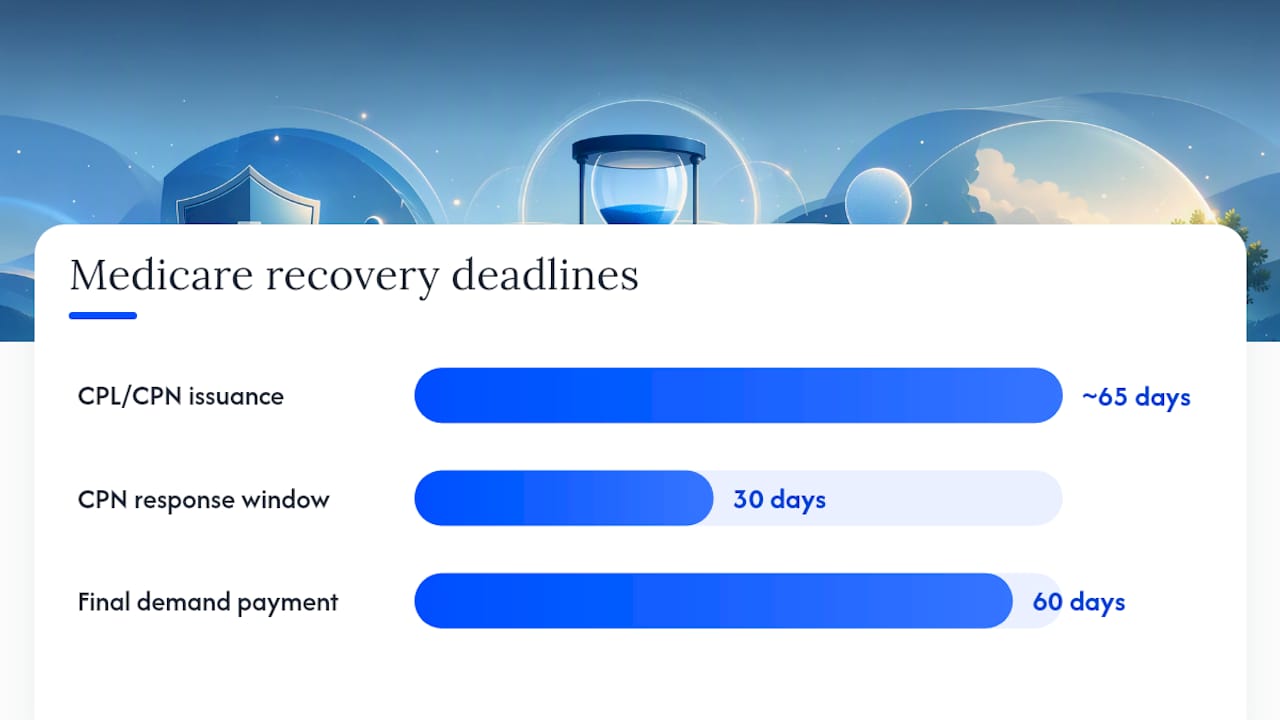
- Medicare issues a Conditional Payment Letter (CPL) or Conditional Payment Notice (CPN). According to CMS guidance, this typically happens within about 65 days of that initial letter. A CPL is informational and evolving; a CPN is more formal and starts a firm 30-day window to respond with corrections before it hardens into a demand.
- After settlement, Medicare generates the final demand letter. The recovery contractor searches Medicare’s paid claims database, tallies everything connected to your injury, and sends a letter stating the exact amount owed.
Statistic Callout: CMS states that once notified of a settlement, its contractor issues the final demand and expects payment within 60 days of that letter’s date, not the settlement date.
The CPL/CPN stage is where you have the most leverage. It’s your chance to strike unrelated charges (for example, a knee replacement that has nothing to do with your car accident) before the number becomes official. Miss that window, and you’re negotiating from a much weaker position.
What Are the Key Deadlines and Dollar Thresholds?
Three numbers govern almost every Medicare lien negotiation: $750, 60 days, and 30-day interest cycles. Get familiar with all three before you start settlement talks.
The SMART Act threshold. Effective January 1, 2026, CMS set the physical trauma-based settlement threshold at $750. Settlements at or under that amount don’t need to be reported to Medicare, and any conditional payments tied to them don’t need to be repaid. This exception applies specifically to liability, no-fault, and workers’ compensation settlements involving physical trauma, not every type of claim, so confirm your case actually qualifies before assuming you’re exempt.
The 60-day payment window. Once the final demand arrives, the clock starts. Full payment is generally due within 60 days.
Interest on late payments. Miss that window, and interest accrues for each full 30-day period the balance sits unpaid. Payments get applied to interest first, then to the principal debt, which means a partial payment doesn’t shrink the underlying lien as fast as you’d hope.
Procurement cost reductions. Here’s the part most people miss:
- Attorney fees and litigation costs you paid to obtain the settlement can reduce Medicare’s recovery amount on a pro-rata basis.
- CMS requires documentation of those procurement costs before applying any reduction.
- Without that paperwork, Medicare calculates its demand against the full settlement figure, not the amount you actually pocketed.
Documentation isn’t optional paperwork here. It’s the single biggest lever you have to shrink what you owe.
How Do You Dispute or Reduce Medicare’s Demand Before Settlement?
Reducing what you owe Medicare isn’t about finding a loophole. It’s about doing the administrative work correctly and on time.
- File Proof of Representation immediately. Without it, CPLs and CPNs go only to the beneficiary, leaving your attorney blind to deadlines they can’t act on if you forget to forward mail.
- Respond to the CPN within its 30-day window. Flag any charges unrelated to your injury with supporting medical records. A missed response often locks in a demand that ignores your dispute entirely.
- Request an updated conditional payment amount close to settlement. Medical bills keep accumulating during litigation, so the number from six months ago is rarely the final number.
- Submit procurement cost documentation as soon as it’s available, including itemized attorney fees and case expenses, so the pro-rata reduction applies automatically rather than requiring a second round of correspondence.
Pro Tip: Some liability settlements qualify for a fixed-percentage option under CMS rules, letting you resolve Medicare’s interest with a flat calculation instead of a full itemized review. Ask your attorney early whether your case meets the criteria, since it can shave weeks off the final demand timeline.
What If You Disagree With Medicare’s Demand or Miss a Payment?
You have real appeal rights, but they run on a strict clock. Under CMS’s reimbursement guidance, you must file an administrative appeal within 120 days of the demand letter’s date, with documentation showing why the amount is wrong.
Waivers are a separate path entirely. If repaying Medicare would cause genuine financial hardship, or if you weren’t at fault for the overpayment, you can request a waiver using Form SSA-632. This doesn’t dispute the amount; it asks Medicare to forgive some or all of it.
Ignoring the demand carries real consequences:
- Interest keeps accumulating for every 30-day period the debt goes unpaid.
- Medicare can refer unpaid balances to the U.S. Department of Treasury for collection.
- Nonpayment can jeopardize future Medicare benefits and trigger formal collection action against you.
What Does a Personal Injury Lawyer Actually Do About the Lien?
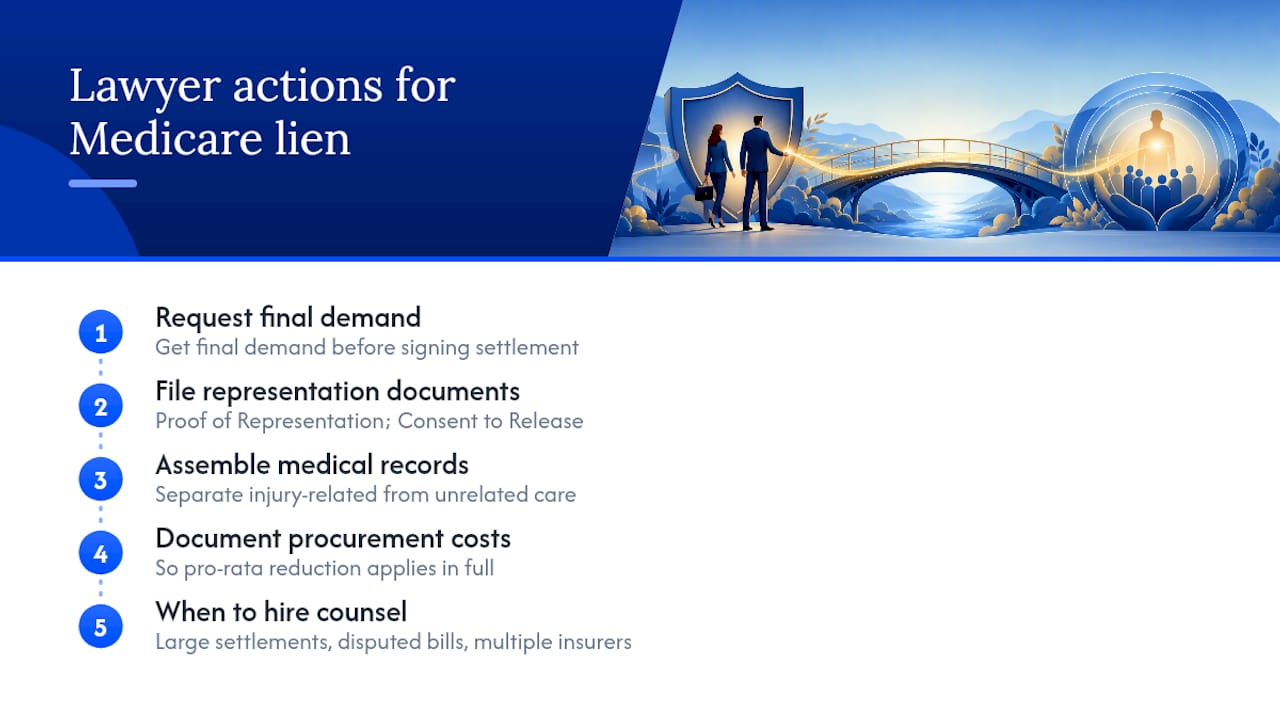
An attorney handling your Medicare lien isn’t just filing paperwork, they’re actively shaping how much of your settlement you keep. That work includes filing your Proof of Representation and Consent to Release, requesting the final demand before you sign a settlement agreement, assembling medical records that separate injury-related treatment from unrelated care, and documenting every procurement cost so the pro-rata reduction applies in full.
A personal injury law practice focuses on this kind of detail work for injury victims across Georgia counties. Such firms typically handle auto accidents, trucking crashes, medical malpractice, slip and fall claims, and wrongful death cases on a contingency fee basis, meaning you pay nothing unless the case succeeds. Every case usually starts with a free consultation.
Larger settlements, disputed billing, or cases involving multiple insurers are exactly where hiring counsel pays for itself. When the lien resolution touches five or six figures, the difference between a documented procurement cost claim and an undocumented one can be substantial.
What Mistakes Do We See Most Often With Medicare Liens?
The same three errors show up again and again in cases that come across our desks. Clients forget to file Proof of Representation, so Medicare’s letters go to an address the client barely checks. Clients miss the CPN’s 30-day response window and lose the chance to strip out unrelated charges. And clients fail to document attorney fees and litigation costs, so Medicare’s demand calculates against the full settlement instead of the reduced, pro-rata amount.
On intake, we take three steps immediately: file the Proof of Representation, request the current conditional payment amount, and start building the procurement cost file before settlement talks even begin. That sequencing protects your net recovery from day one.
If your settlement lands under the $750 SMART Act threshold, you may be able to manage it yourself without much hassle. Once a case grows beyond that, involving real medical bills and real negotiation, the math almost always favors having counsel handle the lien resolution alongside the settlement itself.
— Ali
Get a Free Case Review Before You Settle
Jewkesfirm is the direct alternative to trying to untangle a Medicare demand letter on your own, with attorneys who track CPL and CPN deadlines and negotiate procurement cost reductions as a routine part of settlement work. Cases involving disputed billing or a six-figure conditional payment amount get far better outcomes with someone watching the calendar for you.

Every consultation is free, and the firm works on a contingency fee, so you pay nothing unless your case results in a settlement or verdict. If you already have a settlement offer on the table, don’t sign until someone reviews the conditional payment amount. Call Jewkesfirm or fill out a short case form at Jewkesfirm to get started, and sign the Proof of Representation early so your attorney can start requesting Medicare’s records right away. For a broader look at how settlement steps unfold in Georgia, the firm’s guide on key steps in a Georgia personal injury settlement walks through the timeline in more detail.
This article is general information, not a substitute for advice from a qualified lawyer. Consult a qualified legal professional about your own circumstances before acting on anything here.