
Most people who slip on a wet floor, trip over a broken curb, or get hurt on someone else’s property never imagine their case reaching the Georgia Supreme Court. But that is exactly what happened after an 83-year-old woman went for an evening walk near a lagoon at The Landings, an exclusive golf and residential community on Skidaway Island near Savannah, Georgia — and never made it home.
A wild alligator killed Gwyneth Williams in October 2007. Her death, and the years-long legal battle her family waged against the community that managed the property, became one of the most closely watched premises liability cases in Georgia history. It shows both how catastrophic an unusual injury can be and how difficult it can be for victims and their families to hold a property owner accountable — which is exactly why experienced legal representation matters so much in these cases.
SUMMARY
This article examines the landmark Georgia Supreme Court premises liability case stemming from a fatal alligator attack at The Landings community. It explains how Georgia law governs property owner responsibility, the “equal knowledge” rule, and assumption of risk defenses in premises liability claims involving natural hazards. Highlighting challenges faced by injury victims and wrongful death families, the article underscores the critical role of experienced injury attorneys in securing compensation. Essential reading for Georgia property owners and victims seeking to understand premises liability and wrongful death legal protections.

Gwyneth Williams
In October 2007, Gwyneth Williams, then 83 and a resident of Ontario, Canada, was house-sitting for her daughter and son-in-law at their home in The Landings, a gated golf and residential resort community on Skidaway Island, about 10 miles south of Savannah, according to the Atlanta Journal-Constitution (AJC). Developers threaded The Landings with more than 150 interconnected lagoons during the community’s development in the 1970s to drain the low-lying coastal land — lagoons that, according to court filings described in news coverage, also created ideal alligator habitat.
On the evening of October 4, 2007, Williams reportedly went looking for her daughter’s dog near one of these lagoons, an area bordered by a park-like green space on one side and a golf course on the other, near the seventh hole, the AJC reported. Several boys in the area later told authorities they heard a woman crying for help that night. The next morning, someone found Williams’ body floating in the lagoon.
An autopsy determined that Williams died from massive blood loss caused by an alligator attack, according to Courthouse News Service. An alligator bit off her right foot and both forearms. A trapper subsequently caught an eight-foot alligator in the same lagoon. After the trapper killed the animal, investigators found parts of Williams’ body in its stomach, as both the AJC and Courthouse News reported.
Wildlife encounters were not new to the community. According to court testimony described in the AJC’s coverage, workers had previously seen alligators sunning themselves in a golf-course sand trap near the same lagoon where an alligator killed Williams. In the month following her death, licensed professionals trapped more than a dozen alligators in the lagoons — including one measuring over 10 feet long and weighing more than 300 pounds. The Landings had a standing policy of trapping and removing alligators seven feet or longer or that displayed aggressive behavior. Over one 4.5-year stretch, the trappers removed 91 alligators from the property under that policy, according to testimony from a lawyer for the community’s homeowners association.
Still, according to that same testimony, no alligator had reportedly attacked any other person at The Landings in the community’s history dating back to its founding in the early 1970s. This fact that would become central to the legal fight that followed.
The attack on Gwyneth Williams, being the first recorded alligator assault on a person in the history of The Landings community, raised difficult questions about wildlife management, community safety policies, and liability, setting the stage for subsequent legal proceedings and policy reviews.

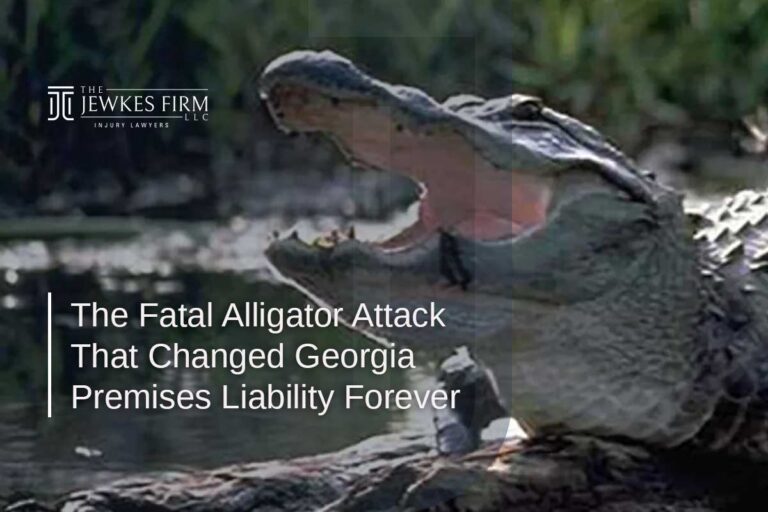
Alligator responsible for killing Gwyneth Williams at The Landings residential community near Savannah, Georgia.
Premises liability is a personal injury law holding property owners, businesses, and associations responsible for injuries caused by dangerous conditions on their property. In Georgia, owners must keep their premises reasonably safe for invitees and warn of hidden hazards they know or should know about.
In Georgia, property owners generally owe a duty to keep their premises reasonably safe for people they invite onto the property, and to warn of hazards that are not obvious and that the owner knows about (or should know about) but the visitor does not.
Premises liability claims often involve things like wet floors, broken stairs, inadequate lighting, defective handrails, or negligent security. But as the Williams case shows, they can also arise from natural or wildlife hazards — especially in a state like Georgia, where alligators, snakes, and other wild animals are common in and around residential developments, golf courses, retention ponds, and lagoons. To succeed on a premises liability claim in Georgia, an injured person (or their family, in a wrongful death claim) generally has to show:
The hardest element to overcome is often the second one, combined with what Georgia courts call the “equal knowledge” rule. If an injured visitor knew as much about a hazard as the property owner did, Georgia law generally treats the owner as not liable. This is because the visitor assumed the risk. As the Williams case shows, this doctrine can decide a case even when the property owner clearly knew a hazard existed.
In 2008, Williams’ family sued The Landings Association and The Landings Club, the entities that managed the community and its golf courses, arguing that they had failed to warn residents and guests and had failed to take reasonable steps to protect people from alligator attacks, according to Courthouse News. A trial court initially denied the defendants’ request for summary judgment in part, finding a genuine factual dispute over whether The Landings had failed to protect Williams under Georgia premises liability law. The Georgia Court of Appeals upheld that decision, allowing the family’s case to move forward.
The Landings then appealed to the Georgia Supreme Court, which heard oral arguments in February 2012 in what the AJC described as “a closely watched property rights case.” Lawyers for the community argued that a legal doctrine shields property owners from liability for attacks by unpredictable, indigenous wild animals like alligators. Lawyers for the Williams family countered that The Landings had effectively created the danger by carving out more than 150 lagoons that served as, in the words of the family’s attorney as quoted by the AJC, “the perfect habitat for alligators,” and should have done more to warn residents.
On June 18, 2012, the Georgia Supreme Court ruled 4-3 in favor of The Landings, reversing the Court of Appeals and ending the family’s case, according to Courthouse News and UPI. Writing for the majority, Justice Harold Melton found that Williams had “equal knowledge” of the danger, since she had previously told family members she had seen alligators at The Landings, and her son and son-in-law testified that she disliked alligators and knew they lived in the community’s lagoons. The majority reasoned that a reasonable, non-disabled adult understands that alligators can move between lagoons and assumes the risk of an attack by walking near a lagoon after dark in a community known to have wild alligators.
Three justices dissented. Writing for the dissent, Justice Robert Benham argued there was no clear evidence Williams knew alligators longer than seven feet lived in that specific lagoon. He noted that The Landings had advertised removing alligators seven feet or longer or displaying aggressive behavior. Therefore, the dissent suggested, could reasonably have led residents to believe that the property owners had already dealt with the larger, more dangerous animals. The dissent argued that disputed factual questions should go to a jury rather than decided by a judge on summary judgment.
Despite the severity of Williams’ injury and evidence of alligator presence, the Court’s decision barred the family from recovering compensation. The ruling underscored Georgia’s application of assumption of risk in cases involving injuries from indigenous wild animals on private property.
Because Williams did not survive the attack, her family’s case was a wrongful death claim. Under Georgia wrongful death law, a wrongful death claim allows certain surviving family members — typically a spouse, children, or parents, depending on the circumstances — to seek compensation for the “full value of the life” of the person who died, an idea that Georgia courts have interpreted to include both the economic value of the lost life and its intangible value. A related claim, called an estate or survival claim, can separately seek compensation for the deceased person’s own pain, suffering, and medical expenses before death.
The Williams case is a reminder that even a wrongful death claim with severe, well-documented injuries and a sympathetic victim can fail entirely if a court finds that a legal defense like assumption of risk applies. That is not a reason to give up on a claim — it is a reason to build the claim as strongly as possible from day one with an attorney who understands exactly what evidence will matter.
The Williams case highlights how difficult it is to win premises liability claims in Georgia, especially those involving wild animals, natural hazards, or “open and obvious” dangers. Legal doctrines like equal knowledge or assumption of risk can make or break a family’s chance of recovery, no matter how severe the injury. Hiring an experienced personal injury attorney right after a premises liability incident is crucial. Waiting or negotiating directly with an insurer can jeopardize your case. An experienced attorney can:
Our attorneys are well-versed in Georgia premises liability law and assumption-of-risk defenses. We focus on assembling the strongest case from the start to maximize your chances of recovery. If you or a loved one has suffered due to a property owner’s negligence—whether from structural hazards, inadequate security, or wildlife risks—call jewkesfirm today at (770) 771-5130 for a free evaluation of your legal options.

The case reached the Georgia Supreme Court and clarified how premises liability and assumption of risk apply to natural hazards like wild animals. It demonstrated the difficulty victims face in proving property owner liability when the visitor has 'equal knowledge' of the hazard.
Premises liability holds property owners responsible for injuries caused by dangerous conditions on their property. In Georgia, owners must warn or protect against hidden dangers they know or should know about, including wild animals, but liability depends on proving the owner breached this duty.
The court found that the victim, Gwyneth Williams, had “equal knowledge” of the alligator hazard and therefore assumed the risk, limiting the property owner’s liability despite the severity of the injury.
Property owners must understand that wildlife removal policies alone may not eliminate liability. Clear warnings, active hazard management, and documented safety efforts are essential to reduce legal risk.
Injured victims should contact an experienced personal injury attorney promptly to preserve evidence, investigate the property owner’s knowledge of the hazard, and build a strong case to counter defenses like assumption of risk.
It means if a visitor knows about a hazard and voluntarily exposes themselves to it, the property owner may not be liable for any resulting injuries because the visitor assumed the risk.
Yes, wrongful death claims allow surviving family members to seek compensation for the loss of their loved one’s life, including economic and intangible damages, but success depends on overcoming legal defenses like assumption of risk.
Sources:
GET A FREE CASE REVIEW
The death of Gwyneth Williams is a sobering reminder of how quickly an ordinary evening walk can turn fatal, and of how complex Georgia premises liability law can be when a case involves a natural hazard like a wild alligator. The Landings had removed dozens of alligators from its lagoons over the years. In fact, the association had a formal policy for doing so. The community was still not liable, however, in large part because Williams herself knew alligators were present.
For property owners, the case is a warning that maintaining a wildlife-removal policy is not the same as eliminating legal risk, and that clear, consistent, visible warnings matter. For injured victims and their families, it is a reminder that Georgia law can be unforgiving toward claims involving hazards a visitor might reasonably have known about. The strength of a premises liability claim often depends on the quality of the evidence gathered and how quickly they gather it.
Whether the hazard is a wild animal, a broken staircase, inadequate lighting in a parking lot, or negligent security, catastrophic injuries and wrongful deaths that happen on someone else’s property deserve a serious legal investigation — not an assumption that nothing can be done.








Advertising does not indicate a guarantee of results.
The information you obtain at this site is not, nor is it intended to be, legal advice. You should consult an attorney for advice regarding your individual situation. Contacting us does not create an attorney-client relationship.