
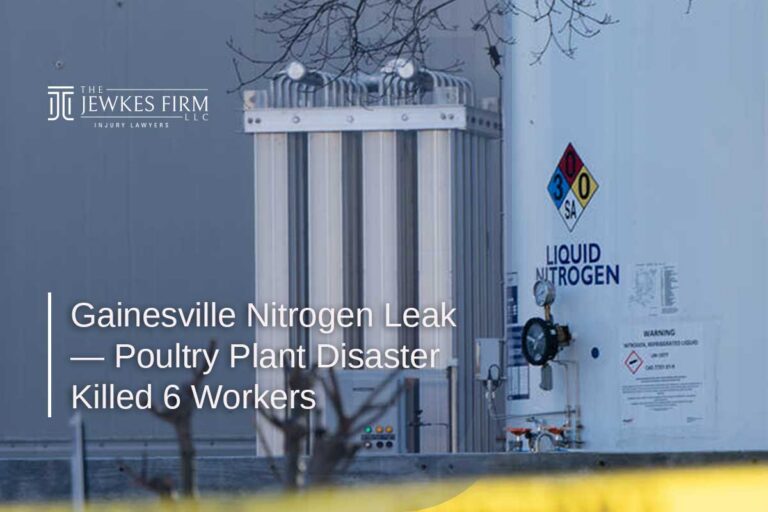
On a January morning in Gainesville, Georgia, a routine shift at a chicken processing plant turned into one of the deadliest industrial accidents in recent Georgia history. Within minutes, an invisible, odorless cloud of liquid nitrogen vapor spread across a freezer room. By the time it cleared, the leak killed six workers and hospitalized at least a dozen more. What followed was a sprawling federal investigation, allegations of destroyed evidence, and a legal battle over who — if anyone — could be held accountable for a tragedy investigators called “entirely avoidable.”
The Gainesville nitrogen leak is not a medical malpractice case or a car crash. It is something rarer and, in its own way, just as instructive: a workplace disaster caused by an unusual and severe mechanism of injury — asphyxiation by an industrial gas most people never think about — and a case study in how Georgia law treats injuries and deaths that happen on the job. This case offers important lessons for anyone hurt at work or who has lost a family member in a workplace incident.
SUMMARY
The 2008 Imperial Sugar refinery explosion in Port Wentworth, Georgia, stands as one of the state’s deadliest industrial disasters. The preventable accident claimed 14 worker fatalities and severe burn injuries to dozens. Accumulated combustible sugar dust ignited by faulty equipment caused this preventable tragedy. The incident highlights critical issues in workplace injury law. Survivors and families faced years of medical treatment, complex civil litigation, and settlement accountability challenges. Understanding this case underscores the importance of experienced legal representation for catastrophic industrial injury victims in Georgia to secure full compensation and corporate accountability.

A deadly chemical leak that killed six workers at Foundation Food Group’s Georgia poultry plant in 2021 resulted from a poorly designed freezer that spilled deadly liquid nitrogen as well as a failure by the plant’s owner to install safety equipment and properly train employees for emergencies.
On January 28, 2021, at the Foundation Food Group poultry processing facility in Gainesville, Georgia (Hall County), an industrial freezer malfunctioned and released a massive quantity of liquid nitrogen into an enclosed freezer room. The food industry uses liquid nitrogen throughout their operations to flash-freeze products. However, it is extraordinarily dangerous in high concentrations. As liquid nitrogen vaporizes, it displaces breathable oxygen in the air, creating an invisible, odorless hazard that can render a person unconscious within seconds and kill within minutes.
According to reporting on the federal investigation, a bent monitoring tube compromised the freezer’s control system, allowing nitrogen to overflow far beyond safe levels. The vaporized gas formed what investigators described as a four- to five-foot-high cloud that settled low across the floor of the freezer room — right in the breathing zone of anyone standing nearby. Messer LLC, a major industrial gas company, had reportedly installed the system only weeks earlier, in December 2020. Complaints about the equipment had surfaced in the days before the leak.
Three maintenance workers reportedly entered the contaminated freezer room without any warning that a dangerous concentration of nitrogen gas had accumulated. The gas quickly overcame them. In the chaos that followed, coworkers rushed in to help — not realizing that the same invisible hazard that struck down their colleagues would do the same to them. Federal investigators later found that at least fourteen employees entered the freezer room or the surrounding area attempting a rescue. Ultimately, six workers died of asphyxiation, and roughly a dozen others required hospital treatment, out of more than 130 employees who were in the building at the time.

The U.S. Chemical Safety and Hazard Investigation Board (CSB) and the U.S. Occupational Safety and Health Administration (OSHA) both investigated the Gainesville leak, and their findings paint a picture of systemic safety failures rather than an unforeseeable accident. OSHA ultimately cited Foundation Food Group and related contractors for 59 separate safety violations.
Among the failures investigators identified:
The U.S. Department of Labor proposed roughly $998,637 in civil penalties against Foundation Food Group and related entities — among the largest such fines in recent Georgia history. CBS News quoted U.S. Secretary of Labor Marty Walsh calling the deaths “entirely avoidable.” Walsh pointed to the company’s failure to implement even basic industrial safety measures.
The litigation that followed also surfaced a troubling evidence issue. According to reporting by The Atlanta Journal-Constitution, a Messer employee later discovered a similarly bent monitoring tube — without its protective bracket — at a different food-processing facility in Stillmore, Georgia. Rather than preserving it as potential evidence, the employee photographed it, reported it to a supervisor, and then discarded it, replacing it with a properly bracketed tube. A judge overseeing the wrongful-death litigation, according to the AJC, said the company’s failure to preserve that evidence made it appear “dishonest,” though as of that reporting no final sanctions had been ordered.
The aftermath of the Gainesville leak produced two distinct tracks of litigation, and the difference between them illustrates an important — and often surprising — feature of Georgia workplace injury law.
First, according to court filings reported by Courthouse News Service and NBC News, the families of at least four of the six workers who died — including Corey Murphy, a production superintendent, along with Saulo Suarez-Bernal, Jose de Jesus Elias Cabrera, and Victor Vellez — filed wrongful-death lawsuits. Notably, the victims did not file those suits against Foundation Food Group, the plant’s operator and their employer. Instead, they filed them against Messer LLC, the industrial gas company that had installed and serviced the nitrogen freezing system, and against an individual service technician. The complaints alleged that Messer had failed to properly inspect, test, repair, or shut down the system despite receiving complaints about it in the days before the leak.
Second, according to the Gainesville Times, three coworkers who survived the leak and had attempted to rescue their colleagues filed a separate lawsuit directly against Foundation Food Group. The parties settled that case — with the terms undisclosed — shortly before a scheduled hearing on allegations that the company had engaged in discovery abuses.
The AJC also reported that Foundation Food Group itself took its own legal action. The company sued its insurer over business-interruption losses tied to the disaster. This is a reminder that, in the aftermath of a mass-casualty workplace event, multiple companies often end up in court pursuing very different interests.
As of the most recent public reporting reviewed for this article, the wrongful-death litigation against Messer remained contested, with ongoing disputes over the destroyed evidence described above. This article does not assert a final verdict or resolution in that litigation, and any claims about the current status of these cases should be independently verified before publication.
Explore the harrowing reality of the Gainesville poultry plant nitrogen incident, where a routine workday spiraled into an unimaginable tragedy. Uncover how an invisible and odorless gas resulted in numerous fatalities and serious injuries at the Foundation Food Group facility on January 28, 2021.
This comprehensive investigation delves into the alarming consequences of a liquid nitrogen mishap that went disastrously awry. It reveals significant equipment malfunctions, startlingly ignored safety interlocks, and systemic lapses in workplace safety as highlighted by OSHA and CSB inquiries. Discover how a seemingly minor defect—a bent tube—combined with a critical lack of training created a deadly, suffocating environment for employees, managers, and even the emergency responders who arrived on scene.
For those intrigued by true crime narratives surrounding industrial disasters, the concealed hazards of contemporary industry, or the grim outcomes resulting from preventable incidents, this thoroughly researched account promises to captivate readers throughout. Grasp the profound impact of unseen dangers and recognize the invaluable worth of human life amid corporate irresponsibility. This narrative encompasses themes of bravery, neglect, and an urgent fight for survival against an invisible menace.
One of the most misunderstood aspects of workplace injury law is why the victims’ families in the Gainesville case sued an equipment company instead of their employer. The answer lies in Georgia’s workers’ compensation system.
In Georgia, when an employee suffers an injury — or death — on the job, workers’ compensation generally provides the exclusive remedy against the employer. That means an injured worker (or their surviving family) typically cannot sue their employer directly for negligence, even if the employer’s carelessness caused the harm. Instead, workers’ compensation provides a fixed set of benefits: medical treatment, a portion of lost wages, and, in fatal cases, limited death benefits. It does not compensate for pain and suffering, and the benefits are often far less than what a full negligence lawsuit could recover.
However, Georgia law recognizes an important exception: if someone other than the employer — a third party — contributed to the injury through negligence, the injured worker or their family may be able to bring a separate civil lawsuit against that third party, in addition to any workers’ compensation benefits. In the Gainesville case, that is precisely why the wrongful-death claims target Messer, the company that installed and serviced the nitrogen freezing system, rather than Foundation Food Group, the employer. A third-party claim like this can include damages that workers’ compensation does not cover, including pain and suffering, full lost earning capacity, and, in appropriate cases, punitive damages.
Identifying every potentially responsible third party — a contractor, a manufacturer, a maintenance company, a property owner — is one of the most valuable things an experienced Georgia workplace accident lawyer can do for an injured worker or grieving family. It is rarely obvious from the outset, and missing a viable defendant can mean leaving significant compensation on the table.
The Gainesville leak also illustrates how industrial equipment can give rise to product liability and negligent-maintenance claims when it causes a workplace injury. When machinery or equipment malfunctions and hurts someone, there are generally several legal theories that may apply, depending on the facts:
In the Gainesville case, the allegations against Messer center on this last category: that the company installed a system with a defective control mechanism and then failed to properly inspect, repair, or shut it down despite complaints in the days before the fatal leak. Cases like this often hinge on physical and documentary evidence — maintenance logs, complaint records, and the equipment itself — which is exactly why the reported destruction of a similar bent tube at another facility became such a significant issue in the litigation. When equipment evidence disappears, it can materially affect a victim’s ability to prove what went wrong and who is responsible.
Claims involving defective or negligently maintained industrial equipment fall under Georgia product liability law. These claims typically require early involvement of engineering experts and prompt legal action to preserve evidence before someone loses, alters, or discards it.
For workers who suffer life-altering injuries — from lung damage and brain injury due to oxygen deprivation to other severe, permanent harm — the case may also involve a catastrophic injury claim, which accounts for a lifetime of ongoing medical care and lost capacity to work.
Regulatory fines like the roughly $1 million OSHA proposed against Foundation Food Group and related entities serve an important purpose: they penalize the companies involved and deter future violations. But the government collects those fines, not the victims or their families. They do not cover funeral expenses, medical bills, lost future income, or the immeasurable loss of a spouse, parent, or child.
That is the role of a civil lawsuit. Depending on the facts, victims and families in a case like this may recover damages including past and future medical expenses, lost wages and diminished earning capacity, funeral and burial costs, pain and suffering, loss of consortium for surviving spouses and children, and — where a defendant’s conduct is shown to be willful, wanton, or grossly negligent — punitive damages, which the law intends not to compensate the victim but to punish the wrongdoer and deter similar conduct in the future.
Civil litigation also plays a public-accountability role that regulatory fines alone often cannot. Discovery in a lawsuit — depositions, document production, expert inspections — can uncover facts that never come out in a government report, and a public trial can put pressure on an entire industry, not just a single company, to change unsafe practices.
A leak of liquid nitrogen at a poultry processing facility in Gainesville resulted in the deaths of six individuals and left approximately twelve others injured.
The Georgia Today Podcast focuses on the unfortunate incident at the Gainesville poultry plant highlighting issues within an industry that is minimally regulated and predominantly employs undocumented workers. In a discussion on Georgia Today, Richard Fausset from The New York Times addresses the implications of this tragedy in what is known as the self-designated “Poultry Capital of the World.”
According to reporting by The Atlanta Journal-Constitution on the federal investigation, five of the six workers who died were members of Gainesville’s immigrant community — a detail that has drawn attention to the particular vulnerabilities faced by immigrant workers in industrial and food-processing jobs, where language barriers and inadequate training can compound already dangerous conditions.
The tragic Gainesville nitrogen leak reveals the complexities and challenges injured workers and families face when seeking justice after a workplace disaster. jewkesfirm brings decades of combined experience in handling catastrophic workplace injury and wrongful death claims throughout Georgia. We understand the unique legal hurdles posed by workers’ compensation exclusivity and the critical importance of pursuing third-party claims against negligent contractors, manufacturers, or equipment suppliers. An experienced Georgia workplace accident attorney can make a significant difference in outcomes like these by:
Georgia also imposes strict deadlines — generally a two-year statute of limitations for personal injury and wrongful death claims — so waiting to speak with an attorney can mean losing the right to recover at all.

If a workplace accident like the Gainesville nitrogen leak injured you or caused you to lose a loved one, you shouldn’t face the legal system alone. Georgia’s statute of limitations means time is of the essence to protect your rights.
Contact jewkesfirm Injury Lawyers now for a free, confidential consultation. We will evaluate your case, explain your legal options, and help you understand how to pursue maximum compensation — including workers’ compensation benefits and third-party claims.
Call us today at (770) 771-5130 or fill out our online contact form to schedule your free case review. Don’t wait until it’s too late — let Attorney Jordan Jewkes and our experienced legal team fight for you and help hold negligent companies accountable.
A malfunctioning freezer's liquid nitrogen system caused the disaster, where a bent monitoring tube led to a dangerous nitrogen gas leak that displaced oxygen, causing asphyxiation and killing six workers.
Under Georgia law, workers’ compensation is the exclusive remedy against employers for workplace injuries. However, families can sue third parties—like contractors or equipment companies—that may have contributed to the injury through negligence.
Investigations found that the poultry plant lacked air monitoring and alarm systems, failed to provide appropriate employee training and personal protective equipment, and left the safety manager position vacant for over a year.
Injured workers or families can claim workers’ compensation benefits from the employer and pursue third-party negligence lawsuits against other responsible parties to seek broader damages like pain and suffering and punitive damages.
An experienced attorney can identify all liable parties, preserve crucial evidence, collaborate with experts, navigate complex workers’ compensation laws, and fight for maximum compensation for victims and families.
Families may recover medical expenses, lost wages, funeral and burial costs, pain and suffering, loss of consortium, and sometimes punitive damages if they prove gross negligence.
Very important — Georgia has a two-year statute of limitations for personal injury and wrongful death claims, and early action is critical to preserve evidence and protect legal rights.
OSHA fines penalize companies and encourage safer practices but do not provide compensation to victims or their families. Civil lawsuits are often necessary to recover damages and ensure accountability.
Sources:
GET A FREE CASE REVIEW
The Gainesville nitrogen leak is a stark reminder that some of the most severe personal injury cases don’t originate from car crashes or hospital rooms. They come from ordinary workplaces where basic safety protocols lapsed. An odorless, invisible gas used every day in food processing plants across the country became lethal because, according to investigators, a company left a safety position vacant, skipped required training, and had no way to warn workers that the air around them had become unbreathable.
For the families of the workers who died — and for the survivors who tried to save them — no fine or settlement can undo what happened on January 28, 2021. But the legal proceedings that followed illustrate why civil accountability matters: it is often the only mechanism that forces a full accounting of what went wrong, compensates the people actually harmed, and creates real pressure for safer workplaces going forward.
If you or a loved one has been seriously injured — or worse — in a workplace incident in Georgia, you do not have to navigate the workers’ compensation system and potential third-party claims alone. jewkesfirm represents injured workers and grieving families across Georgia, with offices serving Tyrone, Griffin, and LaGrange.









Advertising does not indicate a guarantee of results.
The information you obtain at this site is not, nor is it intended to be, legal advice. You should consult an attorney for advice regarding your individual situation. Contacting us does not create an attorney-client relationship.