
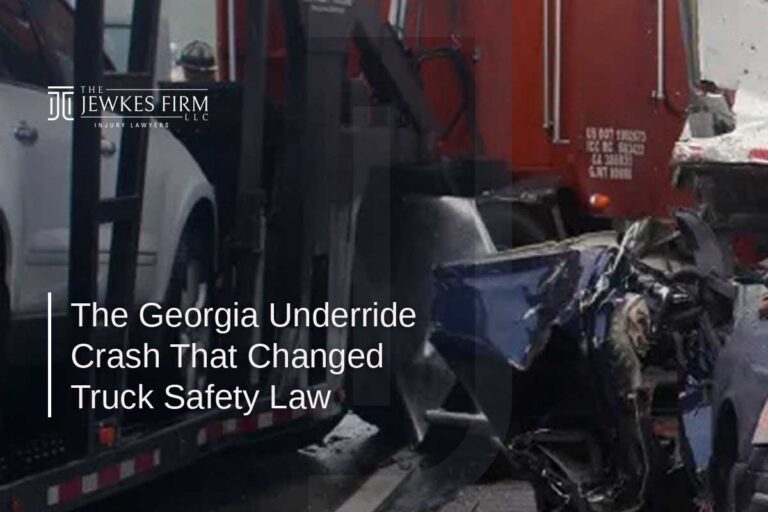
On May 4, 2013, Marianne Karth drove her family’s Ford Crown Victoria along Interstate 20 in Georgia, taking three of her children from North Carolina to Texas for a weekend of celebration — three college graduations and a wedding, all within the same few days. Traffic ahead had slowed for an earlier accident. Karth brought her car to a stop. A tractor-trailer behind her failed to stop in time. What happened in the next few seconds killed two of her daughters and eventually helped reshape the national conversation about truck safety.
The crash that killed 17-year-old AnnaLeah Karth and 13-year-old Mary Karth was what safety engineers call an “underride” collision — a crash in which a smaller passenger vehicle slides underneath the trailer of a tractor-trailer, often with catastrophic and sometimes fatal results for anyone riding in the back seat. Federal regulators and the insurance industry have documented this type of crash for decades, and engineers designed a stronger piece of equipment, properly engineered and installed, largely to prevent it. More than a decade later, the Karth family’s advocacy helped push Congress to consider new legislation aimed at closing that gap — legislation that, as of 2026, still works its way through the federal lawmaking process.
SUMMARY
Discover how the tragic 2013 underride crash involving AnnaLeah and Mary Karth on Georgia’s I-20 became a catalyst for stronger truck safety laws. Learn about underride collisions, the legal complexities in trucking accidents, and the ongoing fight for improved underride guards through federal legislation like the Stop Underrides Act 2.0. This article also highlights the importance of hiring experienced personal injury attorneys to protect victims’ rights and ensure accountability after trucking accidents in Georgia.
Jerry and Marianne Karth share their story of losing their two daughters in an underride truck crash on May 4, 2013.
The Insurance Institute for Highway Safety reports that hundreds of people die each year in rear underride accidents. This video by WUSA9 explains the causes and dangers of these crashes.
According to reporting by PBS Frontline, NPR, and the Truck Safety Coalition, Marianne Karth drove her son and two daughters from North Carolina toward Texas on May 4, 2013, for the family celebration. She sat behind the wheel of the family’s Crown Victoria; her son rode in the front passenger seat, while AnnaLeah, 17, and Mary, 13, rode in the back.
As traffic on I-20 slowed for a crash that had already occurred farther up the highway, Karth brought her car to a stop. A tractor-trailer hauling a car-carrier, traveling in an adjacent lane, failed to stop in time and struck the rear of the Karth vehicle. The impact spun the car around and sent it into the path of a second tractor-trailer. The rear of the Crown Victoria — the section of the car where AnnaLeah and Mary were riding — slid underneath that second trailer.
The collision killed AnnaLeah. Mary survived the initial impact but died several days later after the family decided to remove her from life support. Marianne Karth and her son, riding in the front of the vehicle, survived with injuries.
An “underride” crash happens when a passenger vehicle collides with the back or side of a tractor-trailer and slides partially or completely underneath the trailer itself, rather than stopping against the trailer’s bumper the way it typically would in a collision with another passenger car. Because a loaded trailer bed sits well above the height of most car hoods, it can shear open a passenger vehicle that goes underneath at windshield level, with catastrophic and often fatal consequences for anyone in the front seat — or, as in the Karth crash, the back seat.
Safety engineers generally describe three types of underride collisions. A rear underride happens when a car strikes the back of a stopped or slow-moving trailer, which investigators say happened to the Karth family’s car. A side underride happens when a vehicle strikes the long, largely unprotected side of a trailer, often at an intersection or when a truck turns across traffic. A front underride happens when a truck traveling at speed strikes the rear of a much smaller vehicle stopped ahead of it. Federal law currently requires trailers to have rear underride guards — sometimes called ICC bars or Mansfield bars (NHTSA Standard) — but side underride guards remain optional for most trailers on the road today.
Because an underride collision brings the leading edge of a trailer into direct contact with the passenger compartment of a much smaller vehicle, these crashes often cause injuries far more severe than those seen in an ordinary rear-end collision. Survivors and families of victims in underride crashes have reported traumatic brain injuries, spinal cord injuries and paralysis, severe facial and head trauma, and — in the most catastrophic cases, including some publicized elsewhere in the country — decapitation or near-decapitation injuries when a trailer strikes an occupant at head or neck height. Because these injuries are so severe and so closely tied to a known and long-documented equipment gap, safety regulators, journalists, and injury attorneys alike have sustained focused attention on underride crashes.
The National Highway Traffic Safety Administration (NHTSA) set federal rear underride guard standards in 1998. According to the Insurance Institute for Highway Safety (IIHS), crash testing conducted both before and after the Karth crash showed that guards meeting that 1998 standard often performed poorly in real-world collisions, particularly when a car struck a corner of the trailer rather than hitting it dead-center. The IIHS estimates that underride collisions between passenger vehicles and tractor-trailers cause roughly 500 to 600 deaths on U.S. roads every year — close to two deaths a day — a toll safety advocates argue we can largely prevent with stronger, more consistently engineered guards. Reporting on the Karth crash indicates the second trailer involved had a rear guard that met the 1998 federal standard, but the guard did not prevent the car from sliding underneath.
New IIHS tests reveal how side underride guards, like Airflow Deflector’s AngelWing, can prevent cars from sliding under semitrailers in crashes—saving lives by keeping airbags and seat belts effective.
After losing two daughters in a tragic underride crash, Marianne Karth fights to strengthen federal truck safety regulations. Excerpt from FRONTLINE and ProPublica’s “America’s Dangerous Trucks.”
Court records and news reports indicate that the authorities found the driver of the truck that first struck the Karth vehicle unconscious, slumped over the steering wheel, in the aftermath of the crash. They later charged him, and he pleaded guilty to second-degree homicide by vehicle and failure to maintain his lane; officials suspended his commercial driver’s license for two years. Public reporting reviewed for this draft does not identify a specific civil settlement between the Karth family and the trucking companies involved.
In the years following the crash, Marianne Karth became one of the country’s most visible advocates for stronger underride protections. She testified before federal regulators and lawmakers and helped found advocacy efforts memorializing her daughters. Advocates have credited her efforts, alongside the work of other families who lost loved ones in similar crashes, with helping push NHTSA to study side underride guard requirements and with keeping the issue in front of Congress.
As of early 2026, members of Congress reintroduced the Stop Underrides Act 2.0 (H.R. 7354, 119th Congress), legislation aimed at requiring stronger rear underride guards and, for the first time, mandatory side underride guards on new trailers. Congress had not yet enacted the bill into law as of this writing, and its ultimate fate remains uncertain — a reminder that, more than a decade after the Karth crash, legislators have still not fully closed the regulatory gap that contributed to it.
For families dealing with the aftermath of a similar crash today, that unfinished legislative history does not change the fact that Georgia law already allows injured parties to file injury and wrongful death claims against negligent drivers, trucking companies, and equipment manufacturers. An attorney who regularly handles trucking cases can help a family identify which parties may be responsible and preserve physical and electronic evidence — including the truck’s electronic logging device data, maintenance records, and the trailer itself — before parties repair or destroy it.
Underride crashes involving commercial trucks often raise more complicated legal questions than a typical two-car accident because more than one party can share responsibility for the crash and for the failure of the safety equipment involved.

Trucking cases move quickly, and evidence disappears fast — electronic logging devices may overwrite data, repair shops may repair or scrap damaged vehicles, and insurance adjusters representing large trucking companies typically begin building a defense within hours of a serious crash. Georgia families dealing with a catastrophic or fatal trucking accident benefit from experienced legal representation for several reasons:
The Jewkes Firm represents Georgia families in trucking accident, auto accident, and wrongful death claims from offices in Tyrone, Griffin, and LaGrange. Call (770) 771-5130 for a free consultation.
An underride crash happens when a smaller vehicle slides underneath the rear or side of a tractor-trailer, often causing catastrophic injuries or fatalities due to the height difference between the trailer bed and passenger vehicle.
Underride guards, such as rear ICC bars, prevent smaller vehicles from sliding beneath trailers during collisions, reducing severe injuries and fatalities. However, current federal standards are often insufficient, prompting calls for stronger guards.
Families can pursue civil injury and wrongful death claims against negligent truck drivers, trucking companies, trailer owners, and equipment manufacturers. Experienced attorneys can help preserve evidence and identify all liable parties.
The Stop Underrides Act 2.0, proposed in Congress, aims to mandate stronger rear and side underride guards on all new trailers to close longtime safety gaps and prevent tragedies like the Karth crash.
Attorneys assist with rapid evidence preservation, navigating complex federal trucking regulations, identifying all responsible parties, negotiating with insurance companies, and pursuing full compensation for victims’ medical and related expenses.
Sources:
GET A FREE CASE REVIEW
More than a decade after AnnaLeah and Mary Karth died on a Georgia interstate, their case remains a stark illustration of how a single, largely preventable equipment failure can turn an ordinary family road trip into tragedy — and of how long the legal and regulatory system can take to catch up. Authorities held the driver who caused the initial collision criminally accountable. The broader question of whether trailer underride guards on today’s roads protect the traveling public strongly enough remains, in significant part, unresolved at the federal level, even as Congress continues to debate new legislation introduced in the sisters’ memory.
For the families of underride crash victims, that unfinished business does not reduce the protections Georgia law offers them today. Georgia’s civil justice system allows injured victims and grieving families to pursue accountability against negligent drivers, trucking companies, and equipment manufacturers, regardless of whether Congress ultimately strengthens the federal safety standard. The Karth family’s story serves both as a warning about a hazard that still exists on Georgia’s highways and as a reminder that legal accountability — pursued case by case, family by family — has often driven safety improvements long before regulators or lawmakers act.
It also reminds us how far the consequences of a single highway crash can reach. A family that leaves on a routine road trip does not expect to come home having lost two children. The Karths turned their grief into more than a decade of public advocacy. While that does not erase what happened on I-20 in 2013, their work has kept the issue in front of regulators, lawmakers, and the traveling public in a way that has almost certainly made other Georgia families safer, even as the underlying legal fight over underride guard standards continues.









Advertising does not indicate a guarantee of results.
The information you obtain at this site is not, nor is it intended to be, legal advice. You should consult an attorney for advice regarding your individual situation. Contacting us does not create an attorney-client relationship.