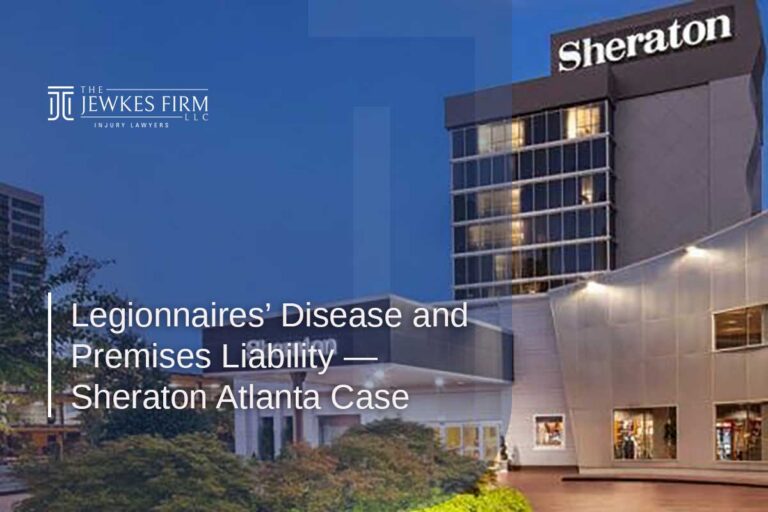
Legionnaires’ Disease and Premises Liability — Sheraton Atlanta Case
[[[ A view o ]]]
Premises Liability and Georgia’s Largest Legionnaires’ Disease Outbreak
How a Downtown Atlanta Hotel’s Neglected Water Systems Sickened Dozens and Claimed a Woman’s Life
In the summer of 2019, guests and visitors at one of downtown Atlanta’s largest convention hotels began falling ill with a severe, sometimes fatal form of pneumonia. Before health investigators identified the cause, a Decatur woman died, dozens of others became seriously ill or required hospitalization, and Georgia experienced what state health officials called the largest Legionnaires’ disease outbreak in state history. What began as a mysterious cluster of respiratory illness became a case study in an underappreciated corner of personal injury law: premises liability for defective or neglected building water systems.
The Sheraton Atlanta outbreak did not stem from a dramatic collision, a defective product recall, or a single visible act of carelessness. Instead, the hotel’s negligence allowed an air-conditioning cooling tower and a decorative lobby fountain to become breeding grounds for a bacterium most guests had never heard of before they got sick. This case shows how failures in maintenance can cause catastrophic harm to hotel guests, conference attendees, and workers, even when those failures remain invisible until people start struggling to breathe.
This article explains how the outbreak unfolded, what Legionnaires’ disease is and why it presents a serious premises liability hazard, the resulting legal claims, and what property negligence victims can learn about protecting their rights in hotels, apartment complexes, gyms, or workplaces.
Affected By A Premises Liability Injury?Contact Us For A Free Consultation
In 2019, neglected water system maintenance caused the Sheraton Atlanta hotel to become the center of Georgia’s largest Legionnaires’ disease outbreak. This serious public health incident sickened dozens and caused a wrongful death, highlighting critical premises liability issues for property owners under Georgia law. The outbreak showed how property owners’ failures to properly manage cooling towers and fountains can result in severe Legionella infections, triggering multiple personal injury and wrongful death lawsuits. This article examines the legal standards, outbreak investigation, and the importance of expert legal representation for victims seeking justice and compensation.
The Outbreak — How Georgia’s Largest Legionella Cluster Unfolded
The Sheraton Atlanta Hotel Becomes a Health Crisis Center
The Sheraton Atlanta Hotel, a large downtown property hosting conventions and conferences regularly, became the center of a public health emergency when guests who stayed or visited between June 12 and July 15, 2019, began reporting severe respiratory illness. By mid-July, health officials confirmed multiple Legionnaires’ disease cases among people connected to the hotel. Facing the escalating outbreak, Sheraton Atlanta voluntarily closed on July 15, 2019, and stayed closed for about a month while the Georgia Department of Public Health (DPH) and the Fulton County Board of Health, joined later by the U.S. Centers for Disease Control and Prevention, conducted their investigation.
Outbreak Scale — Growing Numbers and Historical Significance
As the investigation progressed, the scale of the outbreak grew. By late July, DPH confirmed 11 lab-confirmed cases and 55 probable cases. By early August, those numbers rose to approximately 12 to 14 confirmed cases and over 60 probable cases—people showing pneumonia symptoms consistent with Legionnaires’ disease but without laboratory confirmation. Health officials ultimately described the event as the largest Legionella outbreak ever recorded in Georgia and among the largest linked to a single hotel in the United States.
Human Impact — Personal Stories of Illness and Loss
Among the sickened was Cameo Garrett, a 49-year-old Decatur woman who attended a conference in late June. Garrett became severely ill and died; the DeKalb County Medical Examiner’s Office attributed her death to coronary artery disease with Legionella pneumonia as a contributing factor. Photographer Germany Greer, 67, who worked a multi-day convention at the hotel, later described in press interviews and court filings how the illness caused delirium, four days of intensive care hospitalization, and lasting leg weakness afterward.
Investigation Findings — Sources of Legionella Bacteria
Investigators identified the hotel’s cooling tower and an atrium decorative fountain as the likely Legionella bacteria sources. These common breeding grounds for the bacteria thrive in warm, stagnant water and spread when people inhale contaminated water droplets released into the air from cooling towers, fountains, hot tubs, or plumbing fixtures. Legionnaires’ disease is not contagious between people. All infected guests contracted the disease from the same environmental source (see CNN’s coverage).
Sheraton Atlanta among worst hotel Legionnaires’ outbreaks in U.S. history
What is Premises Liability?
Premises liability law holds property owners and occupiers responsible when they fail to keep their property reasonably safe for visitors. Most associate premises liability with slip-and-fall cases—wet floors, broken steps, icy sidewalks—but the property owner’s legal duty extends to other hazards equally dangerous and often harder to detect. These include defective wiring, mold, carbon monoxide, and—as in the Sheraton Atlanta case—unchecked bacteria growth in building water systems.
Why This Type of Case Differs From Typical Slip-and-Fall Claims
Outbreak cases pose unique legal and practical challenges. Legionnaires’ disease’s two-to-ten-day incubation and pneumonia-like symptoms mean victims and doctors often don’t immediately connect illness to a specific hotel stay. Plaintiffs must rely on epidemiological evidence—the survey data and case-clustering analyses public health agencies like DPH and CDC produce during outbreak investigations—combined with environmental testing that genetically links the bacteria in patients to a specific property’s water source.
Georgia’s Premises Liability Standard
Georgia law (O.C.G.A. § 51-3-1) requires landowners or occupiers to exercise reasonable care toward invitees, including hotel guests, conference attendees, and paying customers, by maintaining safe premises and approaches. To win a premises liability claim, injured persons generally must prove the property owner knew or should have known about the hazard, failed to correct or warn about it, and that this failure caused the injury.
Owners and operators of large commercial properties like hotels must implement systems to identify and control known risks. The hospitality industry has long recognized that cooling towers, decorative fountains, and other water features can harbor Legionella bacteria if not properly maintained, tested, and treated. Industry standards—such as ASHRAE Standard 188, which governs Legionella risk management—require a written water management plan identifying bacterial growth points and outlining routine monitoring and treatment protocols. When a hotel fails to adopt or implement such a plan, it commits precisely the “should have known” negligence premises liability law addresses.
Legal Accountability — The Lawsuits Against Sheraton Atlanta
Less than a month after closing, lawyers filed the first lawsuit. On August 12, 2019, attorneys representing Germany Greer sued the Arden Group and Arepii SA Hotel LLC, Sheraton Atlanta’s owners and managers, along with the hotel’s general manager, in the State Court of Gwinnett County. The lawsuit alleged the hotel’s “negligence in operating and maintaining the water systems” caused Greer and others to contract Legionnaires’ disease and accused the hotel of failing to adopt or follow a water management plan that could have prevented the outbreak (Atlanta Journal-Constitution).
Greer’s attorneys stated they represented over 40 additional people with confirmed or suspected Legionnaires’ cases linked to the hotel. By January 2020, plaintiffs filed more than 50 claims and five separate lawsuits alleging bodily injury, including a wrongful death claim on behalf of the estate of the person whose death the outbreak caused.
The scale of the exposure also triggered a separate insurance dispute. In January 2020, Sheraton Atlanta’s owning company sued its insurance carriers in Fulton County Superior Court, asking a judge to require insurers to cover the hotel’s legal defense and any judgments or settlements from guest injury claims (Georgia Public Broadcasting). Coverage litigation is common in large premises liability cases; even when property owners accept guest harm, insurers often dispute which policy pays and how much, delaying compensation to injured victims.
Public reports available upon this draft did not include confirmed settlement figures or trial verdicts for individual injury and wrongful death claims from the outbreak. Many large premises liability cases resolve confidentially. Anyone referencing this article should verify the litigation’s current status before citing outcomes.
The Importance of Hiring a Personal Injury Attorney
Mass exposure events—whether bacterial outbreaks, chemical releases, or contaminated products—rank among the most complex personal injury claims. Plaintiffs face large hotel chains, property managers, and insurers, requiring resources and experience most injured people lack. Hiring an experienced Georgia personal injury attorney can make the difference between fair recovery and an uphill, unsuccessful fight. Reasons include:
Expert Knowledge of Premises Liability and Public Health Regulations — understanding how building codes, ASHRAE standards, and state health department findings intersect with Georgia negligence law.
Ability to Investigate and Preserve Evidence — securing cooling tower maintenance logs, water testing records, and internal communications before loss or destruction.
Coordination With Medical and Scientific Experts — linking a client’s specific illness to a specific property through epidemiological and laboratory evidence.
Experience Litigating Against Corporate Defendants and Insurers — including navigating parallel insurance-coverage disputes that can delay payment to injured victims.
Effective Negotiation and, When Necessary, Trial Representation — pursuing full compensation for medical expenses, lost wages, pain and suffering, and, in fatal cases, wrongful death damages.
Advocacy for Long-Term Care Needs — severe Legionella pneumonia can cause lasting lung damage requiring lifelong support.
If a property owner’s failure to maintain safe conditions—be it a bacterial outbreak, a fall, or another premises liability hazard—caused you or a family member serious injury, jewkesfirm can help you understand your rights. The same applies to surviving families pursuing wrongful death claims under Georgia law. When injuries cause lasting harm, such as severe respiratory infections producing permanent lung damage, victims may face catastrophic injury claims requiring lifelong care.
If you or a loved one suffered due to a property owner’s negligence anywhere in Georgia, jewkesfirm offers free, no-obligation consultations from offices in Tyrone, Griffin, and LaGrange. Call (770) 771-5130 to speak with our team.
Frequently Asked Questions
What caused the Legionnaires’ disease outbreak at the Sheraton Atlanta?
Neglected maintenance of the hotel’s air-conditioning cooling tower and a decorative lobby fountain allowed Legionella bacteria to proliferate in the water systems.
What is premises liability in the context of Legionnaires’ disease?
Premises liability holds property owners responsible when they fail to maintain safe conditions, such as properly managing water systems to prevent Legionella bacteria growth causing illness.
How is Legionnaires’ disease contracted?
The disease spreads through inhalation of water droplets contaminated with Legionella bacteria, commonly from cooling towers, fountains, hot tubs, or plumbing systems.
What legal rights do victims have in Georgia after contracting Legionnaires’ disease on a property?
Victims can file premises liability claims showing the property owner’s negligence in maintaining safe conditions and seek compensation for medical costs, suffering, and wrongful death where applicable.
Why are Legionnaires’ disease cases legally complex to prove?
Because the disease has a delayed incubation period and mimics other pneumonias, victims must rely on epidemiological evidence and environmental testing to link illness to a specific property’s water source.
What role do personal injury attorneys play in Legionnaires’ disease premises liability cases?
Attorneys gather scientific and medical evidence, preserve critical records, manage litigation, negotiate settlements, and ensure victims receive fair compensation for injuries or wrongful death.
How can hotel and building owners prevent Legionella outbreaks?
Owners can implement water management plans involving routine monitoring, maintenance, and treatment following standards like ASHRAE Standard 188 to control Legionella risk.
Sources:
Georgia Department of Public Health, “Legionella Outbreak Investigation Update,” July 29, 2019
CNN, “Deadly Legionnaires’ outbreak at Atlanta hotel is the largest on record in Georgia,” Aug. 11, 2019
The Atlanta Journal-Constitution, “Lawsuit filed in Legionnaires’ outbreak linked to Atlanta hotel,” Helena Oliviero, Aug. 12, 2019
Georgia Public Broadcasting, “Sheraton Atlanta Files Lawsuit Against Insurance Companies After Legionella Outbreak,” Ellen Eldridge, Jan. 24, 2020
The Washington Post, “Legionnaires’ outbreak at Atlanta Sheraton hotel becomes largest recorded in state history,” Aug. 7, 2019
Insurance Journal, “55 ‘Probable’ Legionnaires’ Cases Tied to Atlanta Sheraton Hotel,” Aug. 2, 2019
CBS News, “Legionnaires’ disease: Atlanta hotel deadly outbreak that left one dead is a ‘nationwide problem’”
GET A FREE CASE REVIEW
A Cautionary Tale
The Sheraton Atlanta Legionnaires’ outbreak reminds us that the most dangerous hazards often hide out of sight. Conference attendees assume the water circulating through hotel pipes, cooling towers, and decorative fountains is safe. When property owners cut maintenance corners and neglect water management, they cause not a single accident but dozens of illnesses and, in this case, a life lost.
For Cameo Garrett’s family, Germany Greer, and dozens more who fell ill just by attending a conference or staying in a hotel room, the outbreak changed lives without warning. The lawsuits sought not only compensation but accountability—a clear message to the hospitality industry that routine maintenance exists precisely because failure can cause catastrophic harm.
The broader lesson for consumers in Georgia is simple: if you become seriously ill after staying at a hotel, attending a large event, or visiting a commercial property and suspect the property’s condition caused the illness, document your symptoms, seek prompt medical care, and consult an attorney quickly. Parties can alter or discard water testing records and maintenance logs once problems become public. The window to build a strong claim may close faster than victims expect.
As South Atlanta's most trusted personal injury firm, we understand that being injured can be a traumatic and life-changing event. We fight for our clients to ensure they receive the justice they deserve.
Follow us
Corporate Office
The Jewkes Firm, LLC
1155 Senoia Road
Suite 102
Tyrone, GA 30290
Advertising does not indicate a guarantee of results.
The information you obtain at this site is not, nor is it intended to be, legal advice. You should consult an attorney for advice regarding your individual situation. Contacting us does not create an attorney-client relationship.