
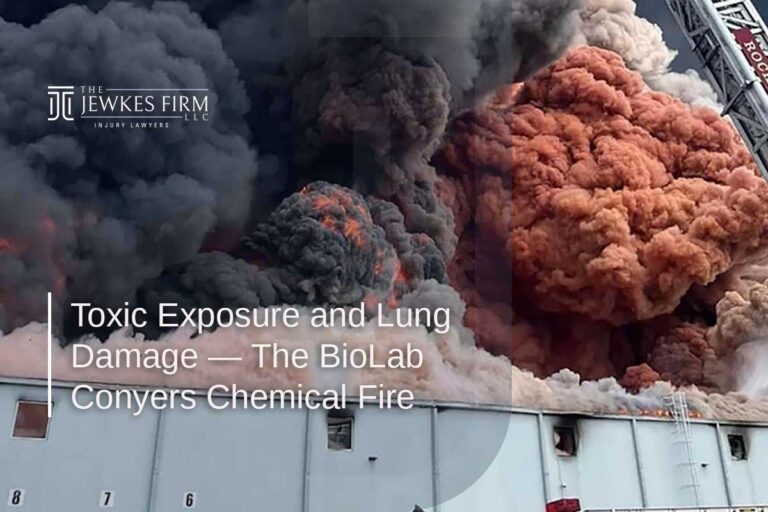
On the morning of September 29, 2024, a malfunctioning sprinkler head at a chemical plant in Conyers, Georgia triggered a chain reaction that displaced tens of thousands of residents, blanketed Rockdale County in a chlorine haze for weeks, and — according to a lawsuit filed nearly two years later — caused permanent, life-altering lung damage to at least three people. Two of them, sheriff’s deputies, entered the plume to direct traffic. The third, a Conyers resident, says she was simply out for a morning run.
The BioLab, Inc. chemical fire is not a story about a single dramatic moment of harm, the way a car crash or a fall might be. It is a story about what can happen when a company’s safety failures unfold slowly, invisibly, and at a scale that touches an entire community — and about how long it can take for injured people to get their case in front of a jury. As of this writing, the litigation remains active and unresolved. That ongoing process is itself part of the story and part of why this case matters to anyone in Georgia injured by a company’s negligence.
SUMMARY
The 2024 BioLab chemical fire in Conyers, Georgia, released a toxic chlorine gas plume that exposed thousands of residents and first responders to hazardous chemicals, resulting in permanent lung damage for several individuals. This ongoing incident has led to multiple active lawsuits alleging negligence in chemical storage, inadequate safety measures, and failure to protect the community and emergency personnel. Victims face complex legal battles involving premises liability, product liability, and toxic tort claims under Georgia law. Those affected by the BioLab fire should seek experienced personal injury attorneys to navigate the challenging process of pursuing compensation for lasting health impacts.
According to county officials and multiple news outlets, the incident began early on September 29, 2024, when a sprinkler system malfunctioned inside a storage warehouse at the BioLab plant on Old Covington Highway in Conyers, part of Rockdale County east of Atlanta. Water contacted stored trichloroisocyanuric acid (TCCA), a chemical compound BioLab used in pool and spa sanitizing products. That water-chemical reaction triggered a fire and released a large plume of chlorine gas and hydrochloric acid into the air, with the plant’s roof reportedly collapsing in part during the incident.
The plume was visible for miles and carried a strong chlorine odor across the region. Local officials ordered an evacuation covering roughly 17,000 residents near the plant, while a much broader shelter-in-place order affected tens of thousands more — CBS News reported the shelter-in-place order applied to as many as 90,000 residents, with parts of Rockdale County remaining under some form of advisory into mid-October 2024. Air monitoring during the incident reportedly detected chlorine concentrations many times higher than EPA acute-exposure guidelines on at least some nights.
Reporting on the incident, including a one-year retrospective from Georgia Public Broadcasting, noted that this was not BioLab’s first safety incident at the Conyers site — it was reportedly the fourth in roughly twenty years. Rockdale County’s own lawsuit against the company later alleged that the warehouse involved, known as Plant 12, held approximately 13.9 million pounds of chemicals at the time of the fire, more than double the roughly 6.2 million pounds the company had reported to county officials it would store there.
The walls of the BioLab warehouse, where chemicals were stored, collapsed due to the fire on September 29, 2024.

On June 10, 2026, three plaintiffs filed a personal injury lawsuit in Rockdale County Superior Court against BioLab, Inc. and its parent companies.
The most personal and, for purposes of a personal injury discussion, the most instructive part of this story emerged in a lawsuit filed June 10, 2026, in Rockdale County Superior Court. Three plaintiffs — Rockdale County Sheriff’s Deputy Edwin Gonzalez, Deputy Aaron Tate, and Conyers resident Cachia Rose — sued BioLab, Inc. and related corporate entities identified in reporting and court filings as KIK LLC, KIK Consumer Products, and KIK International LLC (BioLab’s parent company structure), according to WSB-TV and CBS News Atlanta, which independently reported on the filing.
According to the lawsuit as reported by both outlets, supervisors ordered Deputy Gonzalez to work roadblocks directly in the chemical plume without adequate protective equipment. He later received a diagnosis of severe obstructive pulmonary disease and alleges that he permanently lost approximately 40 percent of his total lung capacity.
The reporting describes that authorities assigned Deputy Tate even more prolonged exposure: they allegedly posted him just 75 yards from the burning facility for sixteen consecutive days, without providing what the suit characterizes as adequate hazard information or protective gear. The chemical residue coated his home, roughly 4.5 miles from the plant, during the incident. He alleges that his injuries include severe, lasting pulmonary damage requiring ongoing medical care.
Ms. Rose, the lawsuit alleges, was out running near her home the morning of the fire and inhaled the plume before she understood what was happening. She alleges she has lost approximately 50 percent of her baseline lung function as a result.
Plaintiffs accuse BioLab and related entities of negligence, specifically citing inappropriate facility siting near residential areas and emergency responders, failure to prevent sprinkler corrosion and water intrusion into chemical storage, and withholding timely, accurate information from emergency planners and first responders during the incident. The plaintiffs are seeking a jury trial and compensatory and punitive damages in an amount to be determined at trial.
The Georgia Supreme Court considers if toxic exposure alone supports medical monitoring relief — and what standard plaintiffs must meet.
It is important to be direct about where this case currently stands: as of this writing, no court has scheduled a trial date, reached a settlement, or delivered a verdict in the Gonzalez, Tate, and Rose lawsuit. The case remains active and pending. Anyone researching this story or relying on it for legal information should understand that the allegations described above come from a filed complaint — and no court has yet proven these claims. As of this draft, no court has found BioLab or its related entities liable.
Incidents like the BioLab fire usually touch on multiple parts of Georgia's injury laws, based on who got hurt and in what way. Understanding the basic categories helps explain why a case like this can involve multiple, simultaneous lawsuits.
EPA Southeast is monitoring the air quality in the community surrounding the BioLab facility. Discover how this technology supports the response efforts: https://www.epa.gov/ga/conyers-ga-biolab-fire
Georgia law (O.C.G.A. § 51-3-1) requires property owners and occupiers to exercise ordinary care to keep their premises safe for those who are lawfully on or near them, and that duty extends to how a business handles dangerous conditions it creates — including the storage of hazardous chemicals in quantities and configurations that create foreseeable risks to neighbors, employees, and emergency responders.
When a company manufactures, stores, or distributes a hazardous chemical product, Georgia product liability principles can come into play, particularly where a company’s own handling or storage practices — not just the chemical itself — create the danger. Allegations that a facility stored more than double the chemical volume it had reported to local officials, as alleged in Rockdale County’s lawsuit against BioLab, go to exactly this kind of corporate accountability.
When a single event exposes a large number of people to a harmful substance, plaintiffs often file toxic tort or mass exposure litigation. Individuals, such as Deputies Gonzalez and Tate and Ms. Rose, file personal injury lawsuits. Counties or governments assert claims for public harm and cleanup costs. Broader class actions represent residents who may not yet show symptoms but fear future health consequences.
Georgia sheriff’s deputies injured while on duty may have workers’ compensation coverage through their employer. However, workers’ compensation does not bar them from also pursuing a separate personal injury lawsuit against a third party — like BioLab — whose alleged negligence caused their injuries. This is why first responders hurt by another company’s conduct while on the job often need to understand both systems at once.
The Gonzalez, Tate, and Rose lawsuit is only one piece of a much larger legal picture that has developed in the nearly two years since the fire. According to reporting from Georgia Public Broadcasting, Atlanta News First, and other outlets:
Taken together, this case study shows how a single corporate safety failure can generate years of overlapping litigation — government claims, class actions, individual injury suits, and insurance disputes — long before any single piece of it resolves. For the people most directly harmed, like Deputies Gonzalez and Tate and Ms. Rose, that means a long road between the day they suffered injuries and the day a court may hold anyone accountable.


Cases arising from large-scale toxic exposure events are among the most complex in personal injury law. They illustrate why victims benefit from experienced legal representation rather than trying to navigate a claim on their own.
A case like this may involve a parent company, subsidiaries, and contractors, each with different insurance coverage and legal exposure — as reflected in the multiple corporate names (BioLab, Inc., KIK LLC, KIK Consumer Products, KIK International LLC) tied to the litigation.
Lung damage from chemical exposure doesn’t always show up immediately, and connecting a diagnosis months or years later back to a specific exposure event requires medical documentation and, often, expert testimony.
When a workers’ compensation claim, a third-party lawsuit, a class action, and a government enforcement action can all touch the same underlying event, an attorney can help a victim understand which options apply to their situation and how pursuing one may affect the others.
Georgia has strict statutes of limitation for personal injury claims, generally two years from the date of injury under O.C.G.A. § 9-3-33, and evidence like air-monitoring data and medical baselines can be time-sensitive.
If chemical exposure, an industrial accident, or a company’s failure to safely store hazardous materials harmed you or a family member, the attorneys at jewkesfirm can help you understand your options. Learn more about how we handle these cases on our product liability and workplace accident practice pages, or reach out directly for a free consultation.

The fire started when a malfunctioning sprinkler system sprayed water on stored trichloroisocyanuric acid (TCCA), triggering a chemical reaction that released chlorine gas and hydrochloric acid.
The chemical plume displaced or forced tens of thousands of Rockdale County residents to shelter in place. Three people—two sheriff's deputies and one local resident—have filed lawsuits alleging that toxic exposure caused them permanent lung damage.
The victims reportedly suffer severe obstructive pulmonary disease and have lost up to 50% of their lung capacity, requiring ongoing medical care.
Yes, multiple lawsuits are active, including individual injury claims, class actions by residents, and a county lawsuit for emergency response costs.
Yes. Sheriffs’ deputies may have workers’ compensation benefits but can still file separate personal injury lawsuits against third parties responsible for their injuries.
Claims often involve premises liability, product liability, toxic tort/mass exposure litigation, and workplace injury claims for first responders.
Toxic exposure claims are complex, often involving multiple parties, delayed symptoms, overlapping lawsuits, and strict filing deadlines that require experienced legal guidance.
The lawsuits remain unresolved and active as of mid-2026, with no trial dates or settlements reported.
Sources:
GET A FREE CASE REVIEW
The BioLab Conyers fire is a reminder that the most serious injuries don’t always come from a single reckless moment — sometimes they come from a slow accumulation of decisions: how much chemical to store, how accurately to report it, how quickly to warn the public, and how well to protect the first responders sent into harm’s way. Two sheriff’s deputies who were simply doing their jobs, and a resident who was out for a morning run, allege they will live with reduced lung capacity for the rest of their lives because of choices made inside a chemical plant they had no control over.
Nearly two years after the fire, the legal system is still working through what happened in Conyers. Pending litigation includes a county’s cost-recovery suit and class actions on behalf of residents. Additional unresolved issues include a pending question before the Georgia Supreme Court about medical monitoring and an individual injury lawsuit from three people who claim that the company left them to breathe toxic air without adequate protection. That, too, is part of the lesson: accountability for mass corporate harm can take years, and victims need advocates willing to stay with the case for the long haul.
If a chemical release, industrial accident, or another company’s negligence harmed you in Georgia, you do not have to figure out the legal system alone.
If you need expert legal assistance related to toxic chemical exposure or industrial accident injuries in Georgia, contact a qualified personal injury attorney to explore your rights and options.









Advertising does not indicate a guarantee of results.
The information you obtain at this site is not, nor is it intended to be, legal advice. You should consult an attorney for advice regarding your individual situation. Contacting us does not create an attorney-client relationship.