
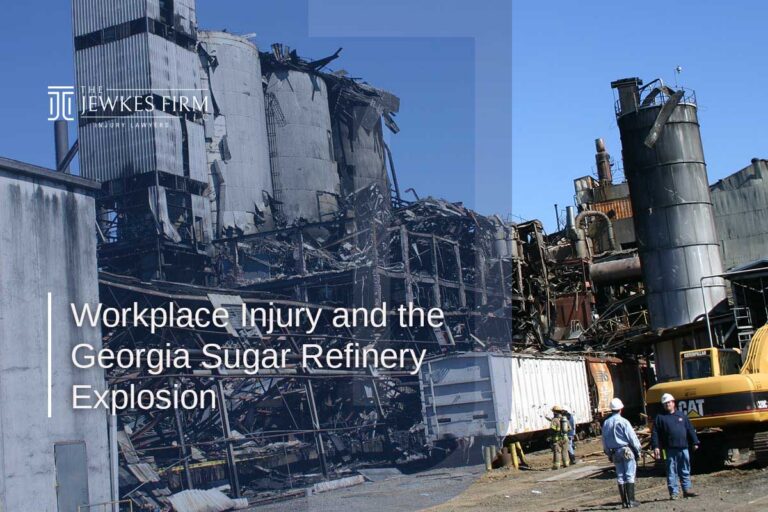
A view of the damage caused to the Imperial Sugar refinery at Port Wentworth in Georgia, United States by a sugar dust explosion on February 7, 2008. By U.S. Chemical Safety and Hazard Investigation Board – ftp://ftp.csb.gov/imperialsugar, linked at [1], Public Domain, Link
SUMMARY
When people think about personal injury cases, they usually picture car crashes or slip-and-falls in a grocery store aisle. But some of the most catastrophic injuries in Georgia’s history did not happen on a highway or in a parking lot — they happened inside a century-old factory on the banks of the Savannah River, where an invisible hazard had been quietly accumulating for years.
On the evening of February 7, 2008, a massive dust explosion and a chain of secondary blasts rocked the Imperial Sugar refinery in Port Wentworth, Georgia — just outside Savannah — and tore through the packing building and storage silos. By the time firefighters finally extinguished the fires, the explosion killed 14 workers and left dozens more with severe, life-altering burns. It remains one of the deadliest industrial disasters in modern Georgia history. It offers a sobering case study in workplace injury law, product and premises liability, and why injured workers and grieving families need experienced legal counsel standing between them and a corporation’s lawyers. And, as this case ultimately showed, even between them and the court system meant to protect their money.
The Port Wentworth refinery had operated since 1916, originally known as the Dixie Crystals plant. By 2008, the Imperial Sugar Company, headquartered in Sugar Land, Texas, owned it. Refining raw sugar cane into the granulated sugar found on grocery shelves generates an enormous amount of fine sugar dust. Left unchecked, that dust can settle into enclosed spaces — conveyor housings, basements beneath storage silos, the crevices of old wooden and steel construction — the way sawdust collects in a workshop no one has swept in years.
Investigators with the U.S. Chemical Safety Board (CSB) later determined that the facility had allowed sugar dust to build up throughout, in some areas reportedly knee-deep. That evening, a spark — traced by investigators to failed equipment — ignited an initial pocket of airborne dust in an enclosed area beneath the silos. The blast itself did the real damage indirectly: it threw still more accumulated dust into the air. That suspended dust ignited in a rapid series of secondary explosions that ripped through the packing building and surrounding structures. The CSB’s conclusion was blunt — the disaster was entirely preventable.
According to reporting at the time, roughly 121 workers were on site when the explosions began. The blast killed some instantly. Collapsing structures trapped others, or flames engulfed them. Fires continued to burn in parts of the facility for days afterward. Rescue crews worked through the wreckage of a plant that, until that moment, most Georgians had probably never thought twice about. This is a stark reminder that some of the gravest personal injury cases arise not from a single moment of driver inattention, but from years of overlooked hazard in an ordinary workplace.
Fourteen workers ultimately lost their lives — some that night, others over the following days and weeks from burn injuries too severe to survive. News coverage at the time and in later retrospectives named several of the victims, including Eric Barnes, Truitt Byers, Michael Kelly Fields, Shelathia “Shon” Harvey, and Michael “Big Mike” Williams, among others who died as a result of the explosion and fire. Roughly three dozen more workers survived with injuries, many of them severe burns covering anywhere from a small percentage of their bodies to, in the worst cases, as much as 85 to 95 percent of total body surface area. The Joseph M. Still Burn Center in Augusta, one of the region’s leading burn-trauma facilities, treated a number of survivors for months.
One survivor, Lawrence Manker Jr., became emblematic of just how devastating a catastrophic burn injury can be. Manker suffered burns over 85 percent of his body and underwent more than 70 surgeries in the years that followed, with medical expenses reported to exceed $17 million. His case — like most of the civil claims to come out of the disaster — was ultimately resolved through a settlement rather than a jury verdict, reached just days before a scheduled three-week trial in Chatham County State Court in December 2011.
For the families who lost loved ones and the workers who survived with permanent scarring, disfigurement, and years of reconstructive surgery, the explosion did not end on February 7, 2008. It marked the beginning of a long road through medical treatment, workers’ compensation systems, and civil litigation against the companies responsible for the conditions that caused the blast.


A view of the damage caused to the Imperial Sugar refinery at Port Wentworth in Georgia, United States. By U.S. Chemical Safety and Hazard Investigation Board – ftp://ftp.csb.gov/imperialsugar, Public Domain, Link
The Occupational Safety and Health Administration (OSHA) investigated the explosion and issued 124 safety citations at the Port Wentworth facility, the majority classified as “willful” — OSHA’s most serious violation category, reserved for situations where an employer knew of a hazard and made no reasonable effort to fix it. Investigators also cited Imperial Sugar’s sister facility in Gramercy, Louisiana, for 97 additional violations. OSHA initially proposed fines of roughly $8.8 million.
In July 2010, Imperial Sugar settled with federal regulators for a combined $6.05 million — about $4.05 million tied to the Georgia plant and $2 million tied to the Louisiana facility — without admitting fault. As part of the settlement, the company agreed to implement combustible-dust safety programs, hire independent safety experts, and submit to several years of continued OSHA oversight. In February 2013, the U.S. Attorney’s Office announced its decision not to pursue criminal charges, stating that insufficient evidence existed under the criminal laws available at the time. This decision sparked a broader national conversation about whether those responsible for workplace-safety failures that lead to worker deaths face adequate punishment.
Separately from the regulatory process, injured workers and victims’ families filed at least 44 civil damages lawsuits in Chatham County State Court, naming Imperial Sugar and a contractor involved in the facility’s operations. The parties resolved nearly all of these cases — including Lawrence Manker Jr.’s — through confidential out-of-court settlements rather than public jury verdicts. This is common in large industrial injury litigation where both sides have strong incentives to avoid the uncertainty, expense, and publicity of trial.
Years later, the case took an unusual and cautionary turn. According to a U.S. Department of Justice press release, Kim Birge, a former chief clerk of the Chatham County Probate Court, embezzled more than $750,000 from court accounts between 2011 and 2014 — including, according to WTOC’s reporting, settlement funds held in trust for five child survivors of Imperial Sugar victims. Attorney Brent Savage, who represented some of the families, uncovered the shortfall and pursued claims against the county to recover the missing money. Birge was later convicted of mail fraud and sentenced to six years in federal prison. It is a stark illustration of a lesson every injury victim should take seriously: winning a settlement is not the end of the story. Someone must ensure that the money rightfully belongs to individuals reaches them — often years or even decades after the case concludes.

The Imperial Sugar explosion touches on several distinct — and often misunderstood — areas of Georgia personal injury law. Understanding how they fit together helps explain why cases like this one require experienced legal representation from the very beginning.
In Georgia, the workers’ compensation system covers most employees injured on the job. This generally provides medical treatment and partial wage replacement regardless of who was at fault. However, it does not allow injured workers to recover pain-and-suffering damages, and it typically bars injured workers from suing their own employer directly. That is not, however, the end of the story. When a third party outside the direct employment relationship contributes to an injury — a contractor, an equipment manufacturer, a property owner, or another company working at the same site — an injured worker may be able to bring a separate personal injury lawsuit against that third party in addition to a workers’ compensation claim. In the Imperial Sugar litigation, lawsuits reportedly named both the refinery operator and a contracting firm involved at the facility. Thus, illustrating how a single workplace disaster can give rise to multiple, overlapping legal claims.
Severe burn injuries are among the most painful and expensive injuries a person can suffer. Third- and fourth-degree burns destroy skin, muscle, and sometimes bone, often requiring repeated skin grafts and reconstructive surgeries over the course of years. Survivors frequently face permanent scarring and disfigurement, chronic pain, loss of mobility, and significant psychological trauma, including post-traumatic stress. Lawrence Manker Jr.’s reported 70-plus surgeries and $17 million in medical bills are an extreme example. However, they underscore a broader truth. Catastrophic burn cases require damages calculations that account not just for past medical bills, but for a lifetime of future care, lost earning capacity, and diminished quality of life.
Following the tragedy on February 7, 2008 that fatally burned fourteen workers in a series of sugar dust explosions, CSB released a nine-minute safety video, “Inferno: Dust Explosion at Imperial Sugar” on how the combustible dust accident at the Imperial Sugar refinery in Port Wentworth, Georgia occurred. The video illustrates the extremely serious nature of combustible dust hazards.
Sugar dust is not the only substance capable of causing this kind of disaster. Grain, flour, sawdust, coal, and various metal and plastic powders can all become combustible when suspended in the air in sufficient concentration and ignited by a spark, friction, or static electricity. The Imperial Sugar explosion became a landmark case study for industrial safety regulators. The tragedy contributed to renewed federal attention on combustible dust hazards. This includes OSHA’s National Emphasis Program aimed at inspecting facilities for dust accumulation, inadequate housekeeping, and poor ventilation. Personal injury attorneys often hire fire investigators and safety engineers in cases like this one to reconstruct exactly how and why an explosion occurred — and whether it should have been foreseen and prevented.
A finding of ‘willful’ OSHA violations does not, by itself, compensate an injured worker. Instead, the government receives OSHA fines, not victims. But those findings can become powerful evidence in a civil case. They support arguments of negligence or, in especially egregious circumstances, provide a basis for punitive damages under Georgia law. Punitive damages punish and deter conduct showing willful misconduct or a conscious disregard for the safety of others.
Beyond workers’ compensation and general negligence claims, some workplace disasters implicate product liability and premises liability principles as well. For instance, when defective equipment, faulty conveyor systems, or inadequate facility design contributes to an accident. Georgia law allows injured parties to pursue claims against equipment manufacturers, maintenance contractors, and property owners whose products or premises were unreasonably dangerous, separate and apart from any claim against an employer.
Cases like the Imperial Sugar explosion demonstrate why injured workers and grieving families need to hire experienced legal representation from the outset — and why that representation matters long after they resolve a case. A workplace disaster of this scale typically involves overlapping workers’ compensation claims, third-party civil lawsuits, complex expert testimony from fire investigators and engineers, and negotiations with well-resourced corporate defendants and their insurers. Georgia also imposes strict statutes of limitations — generally two years from the date of injury for personal injury claims — making early legal guidance essential to preserving a family’s rights.
Perhaps the most striking lesson from this case, though, came years after the victims signed the settlements. Beware that even funds a court is holding in trust for injured children are not automatically secure. It took a diligent attorney to notice the shortfall, investigate, and pursue accountability against the county responsible for safeguarding that money. An experienced personal injury attorney does not simply negotiate a settlement and walk away. They continue to look out for their client’s best interests, making sure that the settlement money is handled correctly and kept safe. In cases involving children or incapacitated adults, the lawyer also ensures that the money is managed responsibly for many years. If you or a loved one has been seriously injured in a workplace accident, industrial explosion, or any incident involving a catastrophic injury, jewkesfirm can help you understand your rights under both Georgia workers’ compensation law and any applicable third-party liability or product liability claims.
The Imperial Sugar refinery explosion stands as one of Georgia’s deadliest industrial disasters. Ultimately, the disaster was a tragedy born not from a single reckless act, but from years of an overlooked hazard hiding in plain sight. It cost 14 workers their lives and left dozens of survivors to rebuild bodies and futures after unimaginable burns. It also revealed, through the later probate-court theft uncovered by the victims’ own attorney, that accountability does not end when a settlement check is signed.
For any worker or family facing the aftermath of a serious workplace accident, the case is a reminder to move carefully, document everything, and secure experienced legal counsel who will fight for full accountability — from the responsible companies, and for the money owed long after the case closes. If you have questions about a workplace injury, catastrophic burn, or any serious personal injury case in Georgia, call jewkesfirm at (770) 771-5130 for a free consultation. Our offices in Tyrone, Griffin, and LaGrange, Georgia are ready to help you understand your rights and pursue the accountability your family deserves.
A spark from faulty equipment ignited accumulated combustible sugar dust, which triggered the blast and led to a series of devastating secondary explosions.
Fourteen workers tragically died, and about three dozen others suffered severe, often life-altering burn injuries.
Injured workers can file workers’ compensation claims for medical care and lost wages and may pursue third-party personal injury lawsuits against contractors, equipment manufacturers, or property owners responsible for hazards.
Complex industrial injury cases often involve overlapping claims, expert testimony, and negotiations with large corporations. Skilled attorneys protect victims’ rights and ensure proper settlement administration long after cases conclude.
OSHA investigated, issued numerous willful safety violation citations, and imposed fines, leading to mandated safety reforms and ongoing oversight at the refinery facilities.
Combustible dust explosions occur when fine dust particles suspended in the air ignite. Prevention requires strict housekeeping, proper ventilation, and safety programs to control dust accumulation and eliminate ignition sources.
Yes, families may pursue wrongful death and product liability claims against third parties responsible for hazardous conditions contributing to the accident.
Legal safeguards exist, but cases like the discovery of embezzled settlement funds in this disaster show the importance of vigilant attorneys ensuring funds reach rightful recipients, especially minors or incapacitated persons.
Sources:
jewkesfirm is well-versed in effectively challenging major insurance companies on your behalf to secure the highest settlement permissible by law. Our primary objective is to ensure your optimal recovery. It is only after this point that we assess the worth of your case.
The timeframe for filing an injury case, also known as the statute of limitations, can vary significantly. As per OCGA §9-3-33, you are granted a two-year period from the date of your injuries or the passing of a family member to initiate your personal injury claim.
There is no upfront cost associated with hiring a personal injury lawyer. Our fees are based on a percentage of your settlement, meaning you only pay if we successfully recover compensation. Our top priority is ensuring your well-being and helping you return to your normal life.
A personal injury lawyer aims to establish negligence and seek restitution for the harm caused by the liable party. Additionally, you may be entitled to compensation for funeral costs, medical expenses, and income lost if you are a family member of someone who died as a result of an injury.










Advertising does not indicate a guarantee of results.
The information you obtain at this site is not, nor is it intended to be, legal advice. You should consult an attorney for advice regarding your individual situation. Contacting us does not create an attorney-client relationship.