
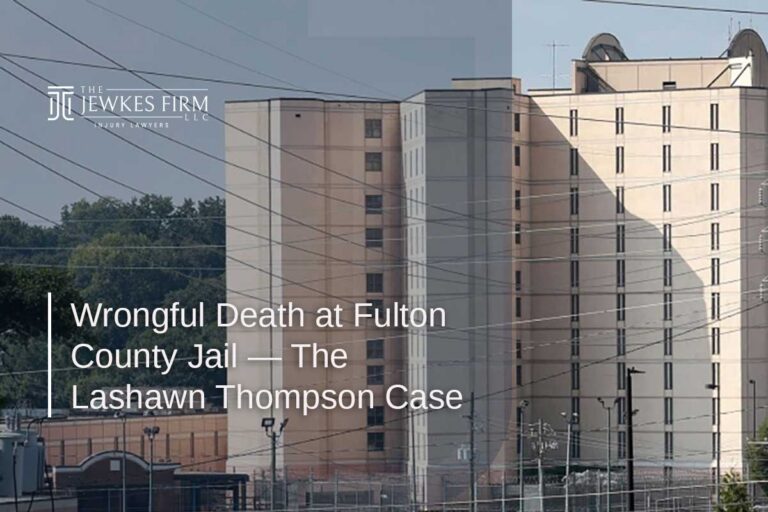
[[[ A view o ]]]
Some personal injury cases begin with a single, sudden moment of catastrophe — a car crash, a fall, a surgical error. Others reveal something slower and, in some ways, more disturbing: weeks of neglect that quietly accumulate into a wrongful death. The death of Lashawn Thompson inside the Fulton County Jail in Atlanta is one of the most disturbing examples of the latter to come out of a Georgia detention facility in recent years, and it has become a case study in why wrongful death and government-negligence law exists in the first place.
In September 2022, authorities found Thompson, a 35-year-old man held on a misdemeanor charge, dead in his cell after he had spent weeks in a unit infested with bed bugs and lice, according to reporting by ABC News, NBC News, CNN, and Atlanta’s WSB-TV. His death — and the graphic photographs that later surfaced — drew national outrage, triggered a Georgia Bureau of Investigation (GBI) review and a separate U.S. Department of Justice civil rights investigation, and ultimately led Fulton County to approve a $4 million settlement with his family in 2023, according to reporting from CNN, WSB-TV, and 11Alive.
SUMMARY
The Lashawn Thompson wrongful death case exposes severe government negligence and systemic failures at Fulton County Jail in Georgia. Thompson died from complications of neglect while in custody, prompting a $4 million settlement and federal investigations into jail conditions. The Thompson case highlights the complexities of wrongful death and government negligence claims, including sovereign immunity, duty of care, and the necessity of independent autopsies. Families seeking justice for custody deaths need experienced legal counsel to navigate strict notice deadlines and legal defenses. Learn how wrongful death claims work and the critical steps families must take to protect their rights.

Lashawn Thompson
The tragic death of Lashawn Thompson inside Fulton County Jail in Atlanta is a heartbreaking example of government negligence and the devastating consequences of institutional failure. Authorities held Thompson on a minor misdemeanor charge. Tragically, he endured conditions so deplorable—his psychiatric wing cell infested with bed bugs and lice—that his health deteriorated until he died from complications of severe neglect. The official medical examiner initially ruled his death as “undetermined,” but an independent autopsy commissioned by his family concluded his death was a homicide caused by dehydration, malnutrition, untreated schizophrenia, and severe insect infestation.
This case sheds light on the critical importance of wrongful death and government negligence claims in Georgia, especially for those who die or suffer harm while in custody. It also highlights systemic problems inside Fulton County Jail, which the U.S. Department of Justice later found to subject detainees to unconstitutional, violent, and inhumane conditions.
This article walks through what is publicly known about the case based on reporting from multiple independent news organizations. We use this information to explain how wrongful death, government-negligence, and sovereign immunity law work in Georgia. It is educational, not a comment on any pending legal proceeding. We attribute every fact below to the news organization or official record that reported it.

According to ABC News and NBC News, police arrested Lashawn Thompson on June 12, 2022 on a simple battery charge — a low-level misdemeanor. Because Thompson had a documented history of schizophrenia, he was ultimately held in the psychiatric wing of the Fulton County Jail on Rice Street in Atlanta, a facility that has since become the subject of a formal federal civil rights investigation.
Family attorneys have said Thompson was “physically healthy when booked,” according to WSB-TV. Over the following three months, however, his family’s legal team and an independent autopsy later alleged that his cell became infested with bed bugs and lice, and that his health deteriorated due to dehydration and malnutrition while he was in the county’s custody.
ABC News reported that guards found Thompson dead in his cell on September 13, 2022. Photographs of his body and cell that later became public showed what multiple news outlets described as severe insect infestation. The Fulton County Medical Examiner’s office initially listed his cause of death as “undetermined,” noting the infestation but no obvious signs of trauma, as reported by WSB-TV.
That ruling did not sit well with Thompson’s family. In 2023, they commissioned an independent autopsy — funded by Colin Kaepernick’s Know Your Rights Camp organization, according to ABC News — which reached a starkly different conclusion. The independent examiner listed the manner of death as “homicide” and the cause as “complications of severe neglect,” citing dehydration, malnutrition, a severe body insect infestation, and untreated, decompensated schizophrenia.
“It’s enough that the bed bugs and lice sat there and ate my brother to death, but it’s the neglect that hurts me the most.” – Thompson’s brother, Brad McCray
Why this matters for other families: officials do not necessarily make the final determination when they list the cause of death as ‘undetermined’ after a death in custody, in a hospital, or in a long-term care facility. An independent, family-commissioned autopsy can uncover evidence of neglect that an institution’s own examiner may miss or may have no incentive to find. A personal injury attorney can help a grieving family arrange this step quickly, before evidence is lost.
Lawyers representing the Thompson family, including nationally recognized civil rights attorney Ben Crump and Michael Harper, have been relentless in demanding justice and systemic change. Two separate public news conferences led by Mr. Crump and Mr. Harper called for a federal Department of Justice investigation into Fulton County Jail and urged Fulton County officials to close and replace the jail altogether to prevent future tragedies. The family’s wrongful death lawsuit against Fulton County resulted in a $4 million settlement in 2023, an important step toward accountability, though the fight for lasting reform continues.
LaShawn Thompson died of ‘severe neglect,’ independent autopsy findsThompson died in a Fulton County, Georgia, jail on Sept. 13, 2022.
Thompson’s death did not occur in isolation. The U.S. Department of Justice’s Civil Rights Division separately opened a broader investigation into conditions at the Fulton County Jail. In November 2024, the DOJ released a report — summarized by CNN, NBC News, and Axios, and published in full at justice.gov — concluding that the jail subjected detainees to “inhumane, violent” conditions that violate constitutional rights, citing widespread violence between detainees, inadequate medical and mental health care, and unsafe living conditions.
Thompson’s death was not simply a tragic, isolated failure by a few individuals. According to the DOJ’s own report, it reflected systemic conditions inside one of Georgia’s largest jails. That distinction — between an isolated act of negligence and a pattern of institutional failure — often shapes how investigators and litigators approach wrongful death and civil rights cases.


Ben Crump calls for federal investigation into Fulton County jail. The family of LaShawn Thompson demands justice after they claim he was “eaten alive by insects and bedbugs” in an Atlanta jail.
In August 2023, the Fulton County Board of Commissioners voted 6-0 to approve a $4 million settlement with the family.
According to NBC News, public attention to Thompson’s case intensified around April 2023, when images from his cell and autopsy became widely circulated. Fulton County Sheriff Pat Labat publicly acknowledged “failures that led to Mr. Thompson’s tragic death,” and stated that he had already “held the executive staff responsible for jail operations accountable,” accepting the resignations of the jail’s Chief Jailer, an Assistant Chief Jailer of Housing, and an Assistant Chief Jailer of the Criminal Investigative Division, as reported by WSB-TV. The GBI also received the matter for further review.
Thompson’s family, represented by attorneys Ben Crump and Michael Harper, filed a wrongful death claim against Fulton County. The Fulton County Board of Commissioners approved a $4 million settlement with the family in August 2023, according to reporting from CNN, WSB-TV, Atlanta News First, 11Alive, and Fox 5 Atlanta. Some outlets noted that the parties did not fully disclose certain financial and settlement terms publicly. A settlement of this kind resolves the civil claim. It does not constitute a criminal conviction or a formal legal finding of guilt against any individual. The GBI’s review should independently confirm any further accountability findings before republication.
Under Georgia law (O.C.G.A. § 51-4-1, et seq.), certain surviving family members can recover damages through a wrongful death claim when another party’s negligence, recklessness, or wrongful act — including that of a government entity or its employees — causes a person’s death. Georgia law describes the damages available as the “full value of the life” of the person who died, which can include both economic factors (such as lost income and lost services) and the intangible value of the life itself, as determined by a jury. Generally, in order of priority, the following parties may bring a Georgia wrongful death claim:
Separately, the decedent’s estate may bring its own claim — sometimes called a survival action — to recover the decedent’s own damages, such as pre-death pain and suffering, and medical and funeral expenses (O.C.G.A. § 51-4-5). In a case like Thompson’s, both types of claims can potentially apply: one for the value of the life lost, and one for what he personally endured before his death.
A question we hear often is whether it’s even possible to sue a county, city, or state agency in Georgia. The general rule is sovereign immunity: state and local governments are presumptively immune from lawsuits unless that immunity has been specifically waived by law.
Georgia has several waiver mechanisms. The Georgia Tort Claims Act waives immunity for the state itself in certain negligence cases, subject to damage caps and exceptions. Separate rules govern counties and municipalities. In many cases, a local government waives its immunity only to the extent it has purchased liability insurance covering the claim.
When a jail, prison, hospital, or nursing home takes physical custody of a person — particularly someone who cannot leave, feed themselves, or seek their own medical care — the law recognizes a heightened duty to meet that person's basic needs: food, water, sanitation, and necessary medical and mental health treatment.
Most personal injury cases involve a duty owed by one private party to another — a driver’s duty to other motorists, a store’s duty to its customers. Custodial cases are different. In these situations, families often can pursue two distinct legal paths simultaneously: a state-law negligence or wrongful death claim, and a federal civil rights claim under 42 U.S.C. § 1983 alleging “deliberate indifference” to a serious medical need, in violation of the Eighth or Fourteenth Amendment. Public reporting indicates the Thompson case implicated both frameworks — a state-law settlement with the county, and a broader federal civil rights investigation into the jail itself.
On top of that, anyone pursuing a claim against a Georgia state or local government generally must first satisfy strict ante litem notice requirements. This includes a formal written notice delivered within a short deadline—sometimes as little as six months to one year—well before they can even file a lawsuit.
That the Thompson family’s claim resulted in a negotiated settlement, rather than an automatic dismissal on immunity grounds, illustrates why these cases require experienced counsel — a missed notice deadline or an incorrectly named defendant can bar an otherwise valid claim entirely. For more on how this doctrine works in Georgia, see our related article on Georgia’s sovereign immunity law.
When a loved one dies or is seriously injured in the custody of a jail, hospital, or care facility, there are concrete steps a family can take to protect their legal rights and preserve evidence before it disappears.
Family says inmate Lashawn Thompson died after being covered, bitten by bed bugs in the Fulton County Jail.
For wrongful death and government negligence claims, securing legal accountability is crucial for grieving families. It not only helps uncover the truth surrounding the circumstances of their loved one’s passing but also ensures that responsible parties are held liable. Thus, providing a sense of justice, closure, and financial support during an incredibly difficult time.
It’s also worth understanding what damages may — and may not — be available. Georgia law generally limits or bars punitive damages against government entities themselves, though claims against individual employees, in their personal capacity, or against private contractors (such as a jail’s outside medical or mental health provider) may proceed under different rules. An attorney experienced in these cases can help identify every potentially liable party.
Cases like this one are significantly more complex than a typical car accident or slip-and-fall claim. Wrongful death claims involving government agencies in Georgia are especially complex due to sovereign immunity laws and strict procedural prerequisites like short notice deadlines. The Thompson case illustrates how necessary it is to have skilled legal representation that can:
At The Jewkes Firm, LLC, we understand how overwhelming it is to lose a loved one to neglect — especially when that neglect happened inside an institution meant to keep them safe. Our attorneys handle wrongful death and negligence claims throughout Georgia from our offices in Tyrone, Griffin, and LaGrange, and we work on a contingency-fee basis, meaning our clients pay nothing unless we recover compensation for them.

If your loved one has suffered injury or wrongful death while in custody at a jail, hospital, nursing home, or other government-run institution, do not wait. Time is critical to protect your family’s legal rights and preserve essential evidence.
Contact The Jewkes Firm Injury Lawyers today at (770) 771-5130 for a free, confidential consultation. Let us help you understand your options and fight for the justice your family deserves.
Together, we can hold negligent institutions accountable and work toward preventing future tragedies like Lashawn Thompson’s. Your family’s fight for justice starts here.
In Georgia, a wrongful death claim allows family members to seek damages when a loved one dies due to the negligence or wrongful acts of another, including government entities. It covers both economic losses and intangible damages related to the death.
Yes, but sovereign immunity laws in Georgia protect state and local governments from lawsuits unless they waive immunity. This means you must navigate these protections when suing a government entity. Strict notice requirements and damage caps may apply, so legal expertise is essential.
Jails have a heightened duty to meet inmates’ basic needs—such as food, water, sanitation, and necessary medical and mental health care—especially when detainees cannot care for themselves.
Families should preserve all records and evidence immediately, consider an independent autopsy, document communications, comply with strict legal notice deadlines, and consult an experienced wrongful death attorney promptly.
Fulton County settled the wrongful death claim with Thompson’s family for $4 million in 2023, following public outrage, a DOJ investigation, and findings of severe neglect and unconstitutional jail conditions.
An independent autopsy, commissioned by the family, can uncover evidence of neglect or wrongdoing missed by official examiners, potentially changing the cause and manner of death and strengthening legal claims.
Because of complex sovereign immunity defenses, strict procedural rules, multiple defendants, and parallel investigations, experienced attorneys are crucial to protect families' rights and obtain fair compensation.
Sources:
GET A FREE CASE REVIEW
Lashawn Thompson’s case is, by any measure, an extreme one — but it is also a cautionary tale about how quickly a minor legal problem can turn fatal when the people responsible for someone’s basic care fail to act.
Lashawn’s case is a reminder that incarcerated people, nursing home residents, hospital patients, and others in institutional custody remain entitled to basic dignity and care, and that the law provides real, if procedurally demanding, avenues for their families to hold negligent institutions accountable.
If you believe a jail, hospital, nursing home, or other institution harmed or caused the death of a loved one by failing to provide basic care, you do not have to face the government or a large institution’s legal team alone. And, you may be working against a deadline you don’t yet know about. The Jewkes Law Firm offers free, confidential consultations to help Georgia families understand their rights and options.









Advertising does not indicate a guarantee of results.
The information you obtain at this site is not, nor is it intended to be, legal advice. You should consult an attorney for advice regarding your individual situation. Contacting us does not create an attorney-client relationship.