

Most pedestrian injury claims in Atlanta settle in a range for moderate injuries, while catastrophic cases involving brain or spinal injury can reach very high amounts. Preserve every photo, witness contact, and medical record now, get treated immediately, and talk to a lawyer before you talk to the insurance adjuster.
TL;DR:
- Settlement amounts within each injury severity band in Atlanta can vary widely, with severe injuries like traumatic brain injury often reaching hundreds of thousands to millions of dollars.
- Commercial vehicle and MARTA bus accidents tend to result in higher settlements due to deeper insurance limits and more severe injury outcomes.
- Non-economic damages in Georgia are unlimited and calculated with no statutory cap, which can lead to much higher settlements for catastrophic injuries compared to states with caps.
- The two-year statute of limitations and strict deadlines for government claims require prompt action and careful evidence preservation to maximize settlement potential.
- Early scene documentation, witness contacts, and immediate medical treatment are critical in building a strong case, as much evidence can be lost within days or weeks.
Table of Contents
- Pedestrian Accident Settlement Amounts in Atlanta by Injury Severity
- What Damages Can You Claim After a Pedestrian Accident in Georgia?
- How Georgia’s Fault Rules and Deadlines Affect Your Claim
- Evidence That Determines Your Settlement Value
- How to Maximize a Pedestrian Injury Settlement in Atlanta
- Hiring a Pedestrian Accident Lawyer in Atlanta
- Local Experience That Strengthens Your Atlanta Claim
- What Insurers Don’t Want You to Know
- Get a Free Case Review From the Jewkes Firm
- Sources
- FAQ
Pedestrian Accident Settlement Amounts in Atlanta by Injury Severity
Settlement value in a pedestrian accident settlement in Atlanta tracks almost directly with injury severity, but the range within each tier is wider than most victims expect. A broken ankle and a shattered pelvis both count as “moderate to severe,” yet the dollar gap between them can be six figures.
Georgia pedestrian cases tend to cluster into four rough bands. Minor injuries, soft tissue damage, minor fractures, cuts requiring stitches, typically settle between $10,000 and $75,000. Moderate injuries, think displaced fractures or a mild traumatic brain injury with full recovery, land between $75,000 and $200,000. Severe injuries with permanent impairment run $200,000 to $750,000. Catastrophic injuries, including spinal cord damage, severe TBI, amputation, or wrongful death, can settle anywhere from $500,000 to $25 million or more depending on the defendant’s coverage and the victim’s lifetime care needs, according to settlement data compiled for Georgia pedestrian cases.
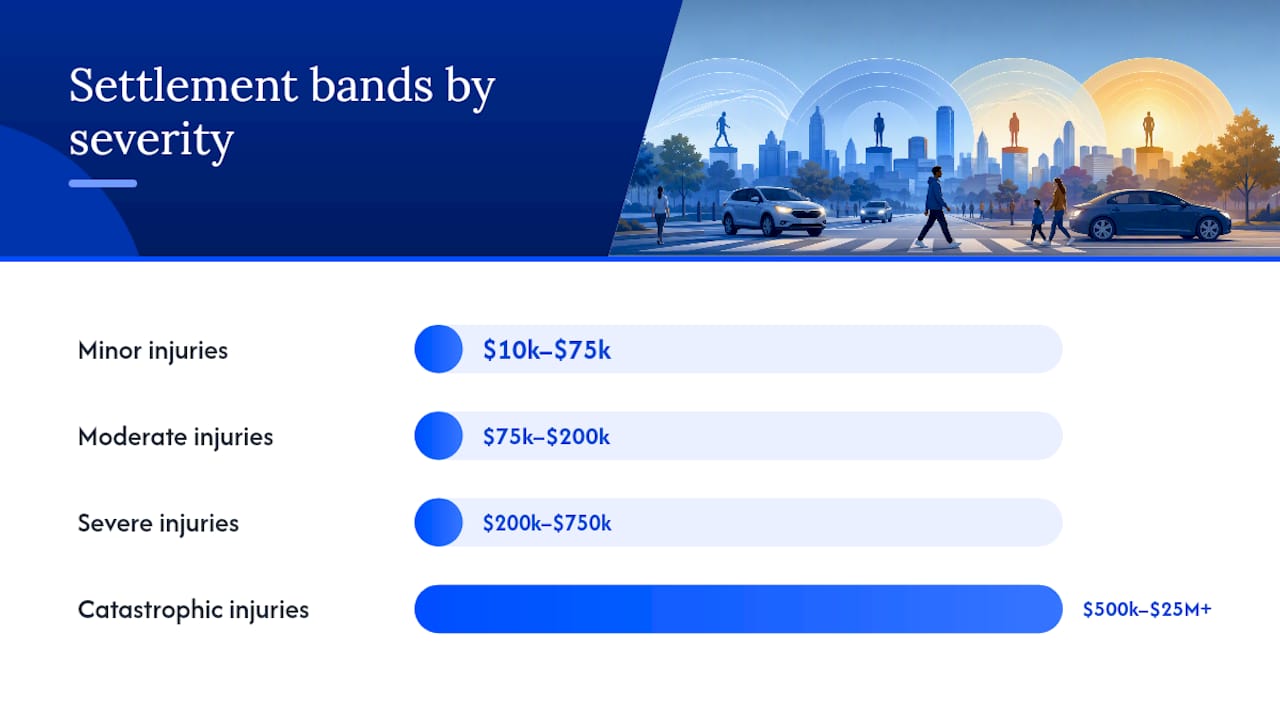
That same data indicates the “typical” Georgia pedestrian settlement is lower than the national average, which is raised by a few catastrophic verdicts. If you’re valuing your own claim, the median matters more than the headline number you see in a Google search.
Several case-specific factors can influence settlement value within these bands, including the insured driver’s policy limits, fault allocation under Georgia law, future medical needs, vehicle type involved, driver’s conduct, and whether the driver violated crosswalk laws.
Atlanta cases involving commercial vehicles or MARTA buses often see higher reported settlements than private-vehicle cases with similar injuries, largely because commercial policies carry deeper limits and because national fatality data shows these crash types frequently produce more severe outcomes to begin with.
What Damages Can You Claim After a Pedestrian Accident in Georgia?
Georgia law recognizes three broad categories of damages in a pedestrian injury claim, and understanding how each is calculated changes how you negotiate.
Economic damages cover the costs you can put a receipt to: emergency room bills, surgery, physical therapy, prescriptions, lost wages, and reduced future earning capacity if your injury limits your ability to work. Keep every bill, every pay stub showing missed shifts, and a written note from your treating physician connecting your time off work to the crash.

Non-economic damages compensate for pain, suffering, emotional distress, and loss of enjoyment of life. Insurance adjusters frequently start with a multiplier method, taking your total economic damages and multiplying by a factor between 1.5 and 5 depending on injury severity, as a negotiation anchor. That formula is a starting point, not a rule. Georgia sets no statutory cap on non-economic damages in pedestrian cases, so a catastrophic or permanently disabling injury can justify a settlement far outside any multiplier math.
Punitive damages apply when the driver’s conduct was willful, reckless, or intoxicated, and uninsured/underinsured motorist (UM/UIM) coverage becomes critical when the at-fault driver carries minimal or no insurance, which happens more often in pedestrian cases than most victims expect.
Georgia places no dollar ceiling on pain and suffering awards in personal injury cases, which is a meaningful difference from states that cap non-economic damages, and it’s one reason severe pedestrian injuries in Atlanta can settle well above what a simple multiplier calculation would suggest.
Our pain and suffering compensation guide breaks down how Georgia victims should document non-economic losses in more detail.
How Georgia’s Fault Rules and Deadlines Affect Your Claim
The single biggest legal threat to a pedestrian accident compensation Atlanta claim isn’t the driver’s insurance company. It’s Georgia’s own comparative fault statute.
Under O.C.G.A. § 51-12-33, Georgia follows modified comparative negligence with a 50% bar. That single rule is why insurance companies push so hard, early, to get you to say something that shifts even a sliver of blame onto you.
Georgia’s crosswalk law works in the pedestrian’s favor when it applies. O.C.G.A. § 40-6-91 requires drivers to stop and remain stopped for pedestrians who are lawfully in a marked crosswalk. A confirmed crosswalk violation by the driver makes it much harder for an insurer to argue you share fault, and it often becomes the single strongest fact in your case.
Deadlines matter just as much as fault percentages:
- Two-year statute of limitations. Georgia’s personal injury filing deadline under O.C.G.A. § 9-3-33 gives you two years from the crash date to file a lawsuit. Miss it, and your claim is almost certainly barred forever.
- Ante-litem notice for government defendants. If a city vehicle, county vehicle, or MARTA bus struck you, you must file a formal notice, often within six months to a year, before you can sue the government entity at all. These windows are dramatically shorter than the two-year rule and trip up more victims than any other procedural issue in Atlanta pedestrian cases.
Evidence That Determines Your Settlement Value
Every dollar of your pedestrian accident settlement in Atlanta rests on evidence you either preserved or lost in the first days after the crash. Here’s the priority order.
- Photograph everything at the scene. Capture the crosswalk markings, skid marks, your injuries, the vehicle’s position, and the surrounding intersection before conditions change.
- Get the police report. The responding officer’s narrative and any citations issued often become the anchor document adjusters reference first.
- Secure video footage fast. Traffic cameras, nearby business security systems, and bystander phone video frequently get overwritten or deleted within days to weeks. Ask, request, or have your attorney subpoena it immediately.
- Collect witness contact information. Memories fade and people move. A name and phone number gathered at the scene is worth more than a witness you try to track down six months later.
- Build a consistent medical record. Treat immediately, follow every recommended appointment, and make sure your providers document that your injuries stem from the crash, not a preexisting condition.
- Bring in reconstruction or life-care experts when injuries are severe. For catastrophic cases, an accident reconstructionist can establish exact vehicle speed and driver reaction time, while a life-care planner projects decades of future medical costs into a defensible dollar figure.
Pro Tip: Exact measurements, the distance from the crosswalk line, lane position, signal timing, often decide these cases. A few feet of difference can be the line between a driver clearly at fault and a disputed liability fight, so document distances with a tape measure or phone app, not just a general description.
How to Maximize a Pedestrian Injury Settlement in Atlanta
Timing and discipline drive settlement value as much as the injury itself. Here’s how the process should unfold.
- Get treated immediately and follow through. Gaps in treatment give insurers an argument that your injuries were minor or unrelated to the crash.
- Decline recorded statements early. Adjusters often call within days asking for a “quick recorded statement.” That statement gets used to lock in details before you know the full extent of your injuries.
- Stay off social media about the crash. A single photo of you smiling at a barbecue can be twisted into an argument that you weren’t really hurt.
- Build a full demand package before negotiating. A strong demand letter includes medical records, wage-loss documentation, photos, and a specific dollar figure, and it should go out only once your treatment has stabilized enough to know your full damages.
- Recognize common insurer tactics. Lowball initial offers, delayed responses, and requests for unnecessary medical authorizations are standard pressure plays, not genuine assessments of your claim’s worth.
Pro Tip: If an adjuster’s first offer arrives within two weeks of the crash, treat it as a red flag, not good news. Fast, low offers are designed to close the file before you understand your total medical costs.
Simple claims with clear liability and modest injuries can resolve in three to six months. Cases requiring litigation, expert testimony, or extended treatment often take twelve to twenty-four months. Delays usually stem from disputed liability, ongoing medical treatment, or insurer resistance rather than anything you did wrong. Our Georgia settlement guide walks through each stage of that timeline in more depth.
Hiring a Pedestrian Accident Lawyer in Atlanta
Case expenses, expert witness fees, court costs, and record retrieval are usually advanced by the firm and repaid from the settlement.
A capable firm does more than send a demand letter. Expect investigation of the scene, subpoenaing of video before it’s deleted, coordination with medical providers, negotiation with the insurer, and, when necessary, filing suit and preparing for trial.
At your free consultation, ask direct questions:
- How many pedestrian cases has the firm handled in Georgia specifically?
- Who actually handles my case day to day, an attorney or a paralegal?
- What’s the firm’s approach to insurers who lowball early?
- How does the fee work if the case settles versus goes to trial?
Vague answers to any of these are a red flag worth taking seriously.
Local Experience That Strengthens Your Atlanta Claim
Some law firms focus on personal injury law in the Atlanta area and surrounding Georgia counties, bringing experience with local courts, claims adjusters, and procedural requirements, including ante-litem deadlines.
Every case starts with a free consultation, and representation runs on a contingency fee basis, so there’s no cost to find out where you stand. The firm handles complex injury cases and publishes educational resources, including step-by-step filing guidance, because informed clients make better decisions about their own claims. That local familiarity with courts, expert witnesses, and evidence procedures is often what preserves a strong liability picture long enough to convert it into a fair settlement.
What Insurers Don’t Want You to Know
The lowball early offer isn’t an insult, it’s a business strategy. Insurers know that most injured pedestrians are worried about medical bills and lost paychecks within weeks of a crash, and a quick check, even a small one, can look tempting before you understand your total damages. The tactic works often enough that it stays standard practice across the industry.
If there’s one thing claimants consistently underestimate, it’s how fast the evidence that actually proves fault disappears. Traffic camera footage gets overwritten. Witnesses move. Skid marks fade with the next hard rain. The strongest cases I see are built in the first 72 hours, not the first court filing.
Preserve what you can, get medical care immediately, and talk to a lawyer before you talk to the adjuster. That single sequence of decisions does more to protect your recovery than any negotiating tactic that comes later. Schedule a free consultation while the evidence is still there to collect.
— Ali
Get a Free Case Review From the Jewkes Firm
An experienced personal injury lawyer can help evaluate your case’s value and explain how Georgia’s fault rules apply. Many firms offer free consultations and work on a contingency fee basis, so you may pay nothing unless you recover money.

A pedestrian case typically starts the same way regardless of severity: the firm investigates the scene, works to preserve video and witness evidence before it disappears, and consults medical or reconstruction experts when the injury calls for it. From there, the team builds your demand package and negotiates from a position backed by real evidence, not guesswork about what a jury might award. If litigation becomes necessary because the insurer won’t offer a fair number, the firm is prepared to file suit and take the case to trial.
If you were hurt as a pedestrian anywhere in South Atlanta or the surrounding Georgia counties, schedule your free case review today. The sooner your case is in an attorney’s hands, the more evidence there is left to protect.
Sources
This guide draws on Georgia’s statute of limitations, City of Atlanta crosswalk guidance, NHTSA pedestrian safety data, and Georgia settlement value data. Confirm ante-litem notice deadlines directly with the relevant government entity.
This article is general information, not a substitute for advice from a qualified lawyer. Consult a qualified legal professional about your own circumstances before acting on anything here.
- City of Atlanta document on pedestrian safety / crosswalk rules
- Georgia pedestrian accident settlement calculator: values by injury (SetCalc)
FAQ
How much is a pedestrian injury lawsuit typically worth in Atlanta?
Minor injuries typically settle between $10,000 and $75,000, moderate injuries between $75,000 and $200,000, and severe or catastrophic injuries can reach $750,000 to several million dollars depending on long-term care needs and available insurance coverage.
How long does a pedestrian accident settlement take in Georgia?
Straightforward cases with clear liability often resolve in three to six months, while cases requiring litigation or extensive medical treatment can take twelve to twenty-four months.
How long does an insurance company have to settle a claim in Georgia?
Georgia law doesn’t set a strict deadline for insurers to settle, but they must respond to claims and demands in good faith; unreasonable delay or refusal can itself become grounds for a bad-faith claim against the insurer.