

TL;DR:
- Informed consent requires all five core elements — disclosure, capacity, understanding, voluntariness, and authorization — to be legally valid.
- When properly obtained, it empowers patients to make autonomous medical decisions, fostering trust and better outcomes.
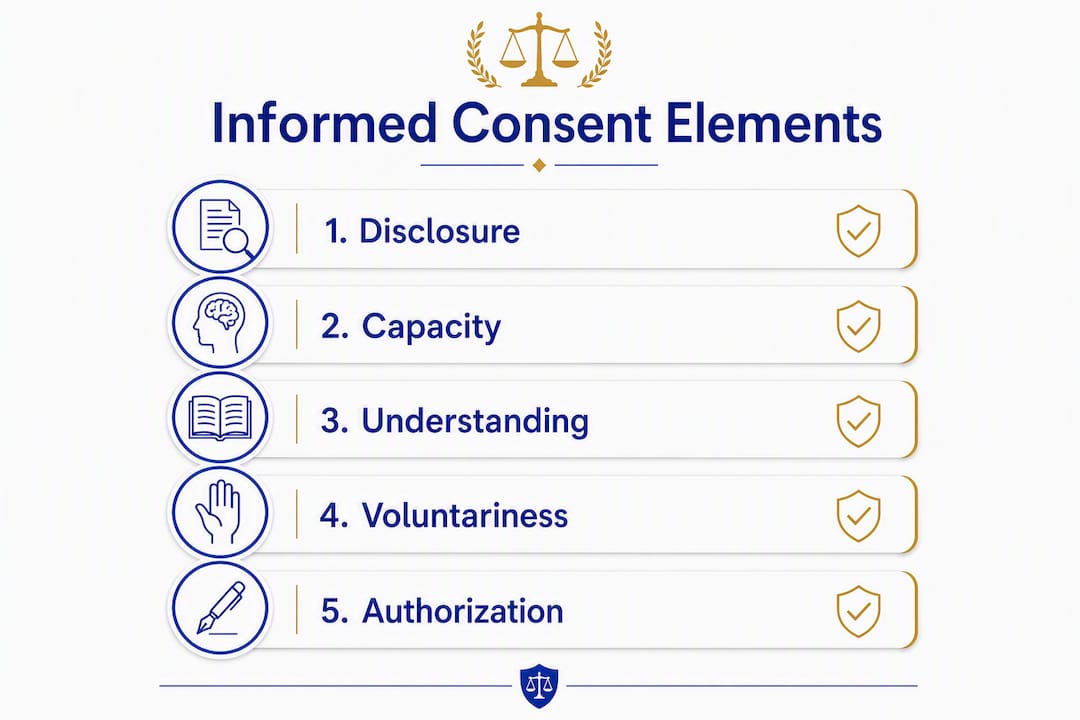
Informed consent is a patient’s voluntary, knowing agreement to a medical procedure or treatment after a clinician has fully disclosed the diagnosis, the nature of the proposed intervention, its risks and benefits, reasonable alternatives, and the consequences of declining. Under U.S. medical and legal standards, it rests on five core elements: disclosure, capacity, understanding, voluntariness, and authorization. Without all five, consent is legally and ethically incomplete, regardless of whether a form was signed.
Why does this matter to you? Because informed consent is the legal and ethical mechanism that puts you in charge of your own body and medical decisions. When it fails, patients can suffer harm they never agreed to accept, and clinicians can face serious legal consequences.
The five core elements at a glance:
- Disclosure: The clinician shares all material information about the procedure, risks, benefits, and alternatives.
- Capacity: The patient has the mental and legal ability to make the decision at that moment.
- Understanding: The patient genuinely comprehends the information, not just hears it.
- Voluntariness: The decision is free from coercion, pressure, or undue influence.
- Authorization: The patient actively agrees, either verbally or in writing, to proceed.
If you believe your consent was inadequate: Ask your provider for a full explanation, request copies of your medical records and any signed consent forms, and consider speaking with a personal injury attorney who handles medical malpractice claims.
Table of Contents
- Why informed consent matters: ethics, trust, and patient rights
- The five elements of informed consent explained step by step
- What clinicians must disclose under U.S. standards
- Assessing capacity, minors, and who may legally decide
- When informed consent can be waived or is implied
- How consent is obtained and documented: forms, verbal consent, and best practices
- Legal implications: malpractice, battery, and remedies for inadequate consent
- If you believe your consent was inadequate: concrete next steps
- Key Takeaways
- Strong consent practices protect everyone at the table
- If you were harmed without proper consent, Jewkesfirm is ready to help
- Authoritative sources and further reading
Why informed consent matters: ethics, trust, and patient rights
Informed consent is not a bureaucratic formality. It is the practical expression of one of medicine’s most fundamental ethical principles: autonomy, the right of every competent adult to decide what happens to their own body.
The American Medical Association’s Code of Medical Ethics frames consent as a shift from physician-centered authority toward a shared decision-making model, where the conversation itself is the ethical act, not the signature at the end. When clinicians honor that model, patients are more likely to follow through with treatment, report higher satisfaction, and trust their care team. When they don’t, the consequences range from damaged relationships to civil liability.
Clinical benefits go beyond ethics. Shared decision-making produces better adherence because patients who understand their treatment are more likely to follow it. It also reduces the risk of post-procedure regret, which is one of the most common drivers of malpractice complaints. The American Cancer Society reinforces this from the patient’s perspective, noting that informed consent is a conversation, not just a document, and that patients have every right to ask questions until they feel confident in their decision.
Clinicians benefit too. Thorough, documented consent conversations protect providers by demonstrating transparency and reducing later claims of negligence, as ethics experts consistently note.
The five elements of informed consent explained step by step
Each element carries specific obligations for clinicians and specific rights for patients. Understanding how each one works in practice is what separates genuine consent from a signature on a form.
1. Disclosure
Disclosure means the clinician shares everything a reasonable patient would need to make a meaningful decision: the diagnosis, the nature and purpose of the proposed treatment, its risks and benefits, available alternatives, and what happens if the patient declines. Plain language is not optional here. A clinician who explains a procedure using medical jargon the patient cannot follow has not met the disclosure standard, even if the words were technically accurate.
Clinician checklist for disclosure:
- State the diagnosis clearly and confirm the patient understands it.
- Describe the procedure and its purpose in plain terms.
- Name the material risks, including rare but serious ones.
- Explain the expected benefits and realistic outcomes.
- Present at least one or two reasonable alternatives.
- Describe the risks of doing nothing.
2. Capacity
Capacity is the patient’s ability, at that specific moment, to understand information, appreciate how it applies to their situation, reason through the options, and communicate a choice. Critically, capacity is decision-specific: a patient with mild cognitive impairment may have full capacity to consent to a routine blood draw but lack capacity to consent to a complex surgery with life-altering consequences. The higher the stakes, the higher the threshold.
The four functional abilities assessed:
- Choice: Can the patient state a clear preference?
- Understanding: Can they repeat back the key facts in their own words?
- Appreciation: Do they grasp how the information applies to their own situation?
- Reasoning: Can they weigh the options and explain their thinking?
3. Understanding
A patient who hears information is not the same as a patient who understands it. Clinicians are responsible for verifying comprehension, not just delivering a speech. Teach-back is the most reliable method: ask the patient to summarize the plan in their own words, then correct any gaps immediately. Studies consistently show that patients retain far less than clinicians assume after a single explanation.

Pro Tip: If your provider has not asked you to repeat back the key points of your procedure in your own words, ask them to walk through it again. That simple request can reveal misunderstandings before they become problems.
4. Voluntariness
Consent obtained through pressure, fear, or manipulation is not valid consent. Voluntariness means the patient’s decision is genuinely free, made without coercion from providers, family members, or institutional pressures. A patient who feels they have no real choice, or who agrees only because they fear being abandoned by their care team, has not consented voluntarily.
5. Authorization
Authorization is the patient’s explicit agreement to proceed. It can be verbal for minor procedures, but written authorization is standard for surgeries, invasive diagnostics, experimental treatments, and any procedure carrying significant risk. The signed form documents the authorization; it does not replace the conversation that must precede it.
What clinicians must disclose under U.S. standards
U.S. disclosure obligations are grounded in two competing legal standards, and which one applies depends on the state.
The reasonable physician standard asks what a competent physician in the same specialty would typically disclose. The reasonable person standard asks what a reasonable patient in the same situation would want to know. Most states have moved toward the patient-centered standard, which tends to require broader disclosure because it focuses on what matters to the patient, not what is customary among physicians.
Regardless of which standard governs, U.S. clinical guidance consistently requires disclosure of:
- The diagnosis or suspected diagnosis
- The nature and purpose of the proposed intervention
- Material risks, including both common and rare but serious ones
- Expected benefits and realistic outcomes
- Reasonable alternatives, including watchful waiting
- The risks of declining or delaying treatment
Plain-language communication is not a courtesy. For patients with limited English proficiency, clinicians must use qualified medical interpreters, not family members who may soften or distort information. For patients with low health literacy, written materials should be at a sixth-grade reading level or lower. Teach-back confirms that the communication actually worked.
Assessing capacity, minors, and who may legally decide
When a patient cannot consent
Adults are presumed to have capacity unless there is a specific reason to question it. When capacity is in doubt, a formal assessment using the four functional abilities described above is the appropriate next step. Psychiatrists and neuropsychologists often conduct these assessments for complex cases, but any attending physician can perform a bedside capacity evaluation for routine decisions.
Factors that may affect capacity:
- Acute illness, pain, or sedation
- Psychiatric conditions (though diagnosis alone does not equal incapacity)
- Intellectual disability
- Dementia or delirium
- Substance intoxication
Minors and consent
In most U.S. states, patients under 18 cannot legally consent to medical treatment without a parent or legal guardian, with important exceptions. Mature minor doctrines, recognized in several states, allow adolescents who demonstrate sufficient understanding to consent to certain treatments. Federal and state law also permit minors to consent independently to reproductive health care, substance use treatment, and mental health services in many jurisdictions.
Surrogate decision-makers
When an adult lacks capacity and has not executed an advance directive, a surrogate decision-maker steps in. The surrogate’s job is to apply the patient’s known wishes, not their own preferences. Most states follow a statutory hierarchy:

| Priority | Surrogate Decision-Maker |
|---|---|
| 1 | Health care agent named in advance directive or durable power of attorney |
| 2 | Spouse or domestic partner |
| 3 | Adult children (majority agreement often required) |
| 4 | Parents |
| 5 | Adult siblings |
| 6 | Close friend or other relative |
| 7 | Court-appointed guardian |
State law governs this hierarchy, and it varies. Georgia, for example, has its own Health Care Decisions Act that specifies the order and the standards surrogates must apply. Always verify the applicable state statute.
When informed consent can be waived or is implied
Exceptions to the consent requirement are narrow and legally defined. They are not a general license to skip the conversation.
Emergency/presumed consent
When a patient arrives unconscious, incapacitated, and without a surrogate available, and delay would cause serious harm or death, clinicians may proceed under the doctrine of presumed consent. The legal assumption is that a reasonable person would want life-saving treatment. Once the patient regains capacity or a surrogate becomes available, the AMA Code of Medical Ethics requires that providers inform them of what was done and why, and obtain consent for any ongoing treatment.
Emergency waiver checklist:
- The situation is genuinely life-threatening or will cause serious irreversible harm.
- The patient lacks capacity at that moment.
- No surrogate is available and reachable in time.
- Delay to obtain consent would itself cause harm.
- The intervention is limited to what is necessary to stabilize the patient.
Research consent exceptions
Research settings operate under stricter rules. The HHS regulations at 45 CFR Part 46 require legally effective informed consent for all human subjects research, with limited exceptions that must be reviewed and approved by an Institutional Review Board (IRB). An IRB may waive or alter consent requirements only when:
- The research involves no more than minimal risk to participants.
- The waiver will not adversely affect participants’ rights or welfare.
- The research could not practicably be carried out without the waiver.
- Participants will be debriefed when appropriate.
IRBs also require additional disclosures for experimental procedures, including the fact that the treatment is investigational, what alternatives exist outside the study, and how participant data will be protected.
Other recognized exceptions
- Therapeutic privilege: — A clinician may withhold information if disclosure would cause direct and immediate harm to the patient. This exception is narrow, controversial, and shrinking in U.S. law.
How consent is obtained and documented: forms, verbal consent, and best practices
The signed consent form is evidence of a conversation, not a substitute for one. This distinction matters enormously in clinical practice and in court.
Research published in PMC confirms that consent is ethically intended as an ongoing process, beginning before the first signature and continuing as long as the decision remains relevant. A patient who signs a form three days before surgery and then asks new questions the morning of the procedure deserves a fresh conversation, not a reference to what they already signed.
The documentation problem is real. StatPearls data from NCBI shows that required elements such as procedure nature, risks, benefits, and alternatives were documented on generic preprinted consent forms only 26.4% of the time in one systematic review. That gap is where legal and ethical exposure lives.
Documentation best practices
| Element to Document | What to Record |
|---|---|
| Disclosure | Specific risks, benefits, and alternatives discussed |
| Capacity | Brief note confirming patient was alert, oriented, and able to communicate a choice |
| Understanding | Teach-back result or patient’s summary of the plan |
| Voluntariness | Note that patient had time to ask questions and was not pressured |
| Authorization | Verbal or written agreement, date, and time |
| Interpreter use | Name of interpreter and language used |
Sample progress note language: “Discussed proposed laparoscopic cholecystectomy with patient, including risks of bleeding, infection, bile duct injury, and conversion to open surgery. Alternatives including conservative management and ERCP were reviewed. Patient verbalized understanding using teach-back and agreed to proceed. No interpreter required. Patient signed written consent form at 10:15 AM.”
Pro Tip: Document the consent conversation in your clinical notes the same day it happens. A form signed weeks before a procedure, with no supporting note, is weak evidence that a real conversation occurred.
Legal implications: malpractice, battery, and remedies for inadequate consent
Failure to obtain proper informed consent creates two distinct legal pathways for patients seeking accountability.
Medical malpractice
The more common claim is medical malpractice based on inadequate disclosure. To succeed, a patient generally must prove: (1) the clinician had a duty to disclose; (2) the clinician failed to disclose material information; (3) a reasonable patient, had they known, would have made a different decision; and (4) that decision would have avoided the harm suffered. Documentation of the consent conversation, or the lack of it, is often the central evidence in these cases.
Understanding how common malpractice claims arise from consent failures can help patients recognize when their rights were violated.
Battery
Battery claims arise when a clinician performs a procedure the patient never authorized at all, not just one where disclosure was incomplete. If a surgeon operates on the wrong body part, or performs an additional procedure the patient explicitly refused, that is battery, not merely negligent disclosure. Battery claims do not require proof of harm in the same way malpractice claims do, but they are less common because most consent failures involve inadequate disclosure rather than total absence of authorization.
Remedies available to patients
- Compensatory damages: Medical expenses, lost income, pain and suffering caused by the undisclosed risk that materialized.
- Nominal damages: In battery cases where no physical harm resulted but the patient’s autonomy was violated.
- Injunctive relief: Rare in individual cases but available in systemic institutional failures.
Statutes of limitations for medical malpractice vary by state. In Georgia, the general limitation period is two years from the date of injury, with specific rules for cases involving minors or fraudulent concealment. Waiting too long can permanently bar a valid claim, which is why preserving records and seeking legal advice early is critical.
If you believe your consent was inadequate: concrete next steps
If you think a provider failed to obtain proper informed consent before a procedure, act methodically. Here is a prioritized sequence:
- Ask your provider for a full explanation. Request a meeting to discuss what information was shared before the procedure, what risks were disclosed, and what alternatives were presented. Document the date and content of that conversation.
- Request your complete medical records. Under HIPAA, you have the right to copies of all your records, including any signed consent forms, progress notes from the consent conversation, and operative reports. Request them in writing and keep the request.
- Review the consent documentation carefully. Look for: the date and time of signing relative to the procedure, whether specific risks and alternatives are named, whether an interpreter was used, and whether the clinician’s notes reflect a real conversation.
- Get a second medical opinion. Another clinician can help you understand whether the disclosed risks were complete and whether the procedure was appropriate given your situation.
- Preserve all evidence. Save every document, photograph consent forms before returning originals, keep records of all communications with the provider or facility, and note dates and times.
- Consult a personal injury attorney. A lawyer experienced in medical negligence claims can evaluate whether the consent failure contributed to your harm and whether you have a viable claim. Most medical malpractice attorneys offer free consultations and work on contingency, meaning you pay nothing unless they recover compensation for you.
- Act before the statute of limitations expires. In Georgia, you generally have two years. Other states vary. Do not wait.
Pro Tip: Keep a dedicated folder, physical or digital, for every document related to your medical care. Include appointment summaries, discharge instructions, consent forms, and any written communications. Date every item you add. This habit can make or break a legal claim.
Key Takeaways
Informed consent is only valid when all five elements are present: disclosure, capacity, understanding, voluntariness, and authorization. A signed form without a documented conversation is legally and ethically insufficient.
| Point | Details |
|---|---|
| Five required elements | Disclosure, capacity, understanding, voluntariness, and authorization must all be present for consent to be valid. |
| Forms vs. process | The signed form documents consent; the conversation is the actual consent. Forms documented required elements only 26.4% of the time in one review. |
| Emergencies are narrow exceptions | Presumed consent applies only when the patient lacks capacity, no surrogate is available, and delay would cause serious harm. |
| Legal exposure is real | Inadequate consent can support malpractice or battery claims; statutes of limitations mean early action is critical. |
| Jewkesfirm can help | If you were harmed after a procedure without proper consent in Georgia, Jewkesfirm offers free consultations and contingency-fee representation. |
Strong consent practices protect everyone at the table
Most discussions of informed consent frame it as a protection for patients, and it is. But the clinicians who take it most seriously tend to see it differently: not as a liability shield, but as the foundation of a genuine therapeutic relationship.
The consent conversation, done well, is where a patient stops being a chart and becomes a person with specific fears, values, and priorities. A surgeon who learns that a patient’s greatest fear is not death but losing the use of their dominant hand will approach the risk discussion differently. A primary care physician who discovers that a patient’s cultural background makes certain treatment options unacceptable can adjust the plan before harm is done. That kind of conversation cannot happen on a preprinted form.
What concerns me most about current practice is the gap between what the law requires and what actually gets documented. The 26.4% documentation rate for required elements on generic forms is not a minor administrative shortfall. It represents thousands of patients who may have agreed to procedures without fully understanding what they were agreeing to, and thousands of clinicians who have no written record of a conversation they may have had in good faith.
The fix is not more paperwork. It is a genuine commitment to the conversation itself: plain language, teach-back, time for questions, and a clinical note that reflects what was actually said. Patients who push for that conversation are not being difficult. They are exercising a right that took most of the 20th century to establish.
If you were harmed without proper consent, Jewkesfirm is ready to help
When a medical procedure goes wrong and you were never fully informed of the risks, you deserve to know whether your legal rights were violated. Jewkesfirm represents injury victims in South Atlanta and throughout Georgia’s surrounding counties in medical malpractice and inadequate informed consent cases, with no upfront cost to you.
The firm works on a contingency fee basis: you pay nothing unless Jewkesfirm recovers compensation on your behalf. The intake process starts with a free consultation where an attorney reviews your records, explains your options, and gives you an honest assessment of your case. There are no obligations and no pressure.
If you believe a provider failed to disclose material risks before a procedure, or performed a treatment you never authorized, contact Jewkesfirm for a free case review. Preserve your records now, because statutes of limitations in Georgia are strict, and waiting can cost you your right to recover.
This article provides general legal and medical information, not professional legal or medical advice. Laws vary by state and individual circumstances differ. Consult a qualified attorney and your healthcare provider for guidance specific to your situation.
Authoritative sources and further reading
The following sources were used throughout this article and represent the most reliable U.S.-focused guidance on informed consent:
- Informed Consent — NCBI Bookshelf (Holland-Frei Cancer Medicine): Core clinical and ethical framework, including the five-element model and historical case law.
- Informed Consent — StatPearls / NCBI Bookshelf: Empirical data on documentation rates and clinical practice standards.
- Informed Consent for Clinical Treatment — PMC / NCBI: Peer-reviewed analysis of consent as a process rather than a form.
- AMA Code of Medical Ethics — Informed Consent: The authoritative professional ethics standard for U.S. physicians.
- Informed Consent FAQs — HHS.gov: Federal guidance on research consent under 45 CFR Part 46 and IRB requirements.
- Informed Consent — American Cancer Society: Patient-facing guidance on what to expect and what to ask.
- Informed Consent — MedlinePlus / National Library of Medicine: Plain-language patient instructions on disclosure requirements and communication strategies.
State law governs many aspects of informed consent, including surrogate hierarchies, statutes of limitations, and disclosure standards. For Georgia-specific rules, the Georgia Health Care Decisions Act and the Georgia Code are the primary references. If you are in another state, consult your state’s department of health or a licensed attorney in your jurisdiction.