

In Georgia, most birth-injury malpractice claims must be filed within two years of the injury under OCGA § 9-3-71. A child injured before age five generally gets until two years after their fifth birthday, which commonly extends the outside deadline for the child’s own claim until two years after their fifth birthday. Parents pursuing their own individual claims often face the plain two-year rule instead. Preserve every medical record now and talk to a Georgia birth-injury attorney before any deadline quietly closes.
TL;DR:
- Birth injury claims for children injured before age five may be filed up to two years after their fifth birthday, but parents’ claims generally follow the standard two-year rule from injury date.
- The two-year malpractice statute of limitations starts at the injury date, not the discovery of the injury, which is crucial for delayed diagnoses like cerebral palsy.
- Deadlines are also limited by a five-year repose period, meaning most claims are barred five years after the negligent act, regardless of injury discovery.
- Parents risk losing their own damages if they wait too long, as their claims do not benefit from the child’s extended filing window under the minors’ tolling rule.
- Early collection of medical records, expert evaluations, and legal consultation are vital to preserve the ability to file within Georgia’s strict statutory timeframes.
Table of Contents
- Understanding the Georgia birth injury statute of limitations
- How the minors’ exception in OCGA § 9-3-73 actually works
- Do parents get the same extended deadline as their child?
- What to do right now to protect your child’s claim
- What damages can a Georgia birth injury claim recover?
- What Georgia families can expect when they call a birth-injury attorney
- Talk to Jewkesfirm before your filing window closes
- Sources
- FAQ
Understanding the Georgia birth injury statute of limitations
Georgia’s core deadline for medical malpractice sits in OCGA § 9-3-71, which gives injured patients two years from the date the injury occurred to file suit. Courts generally read “date of injury” as the date the malpractice happened, not the date it was noticed, which catches families off guard when a birth injury surfaces gradually as a child misses developmental milestones months or years later.
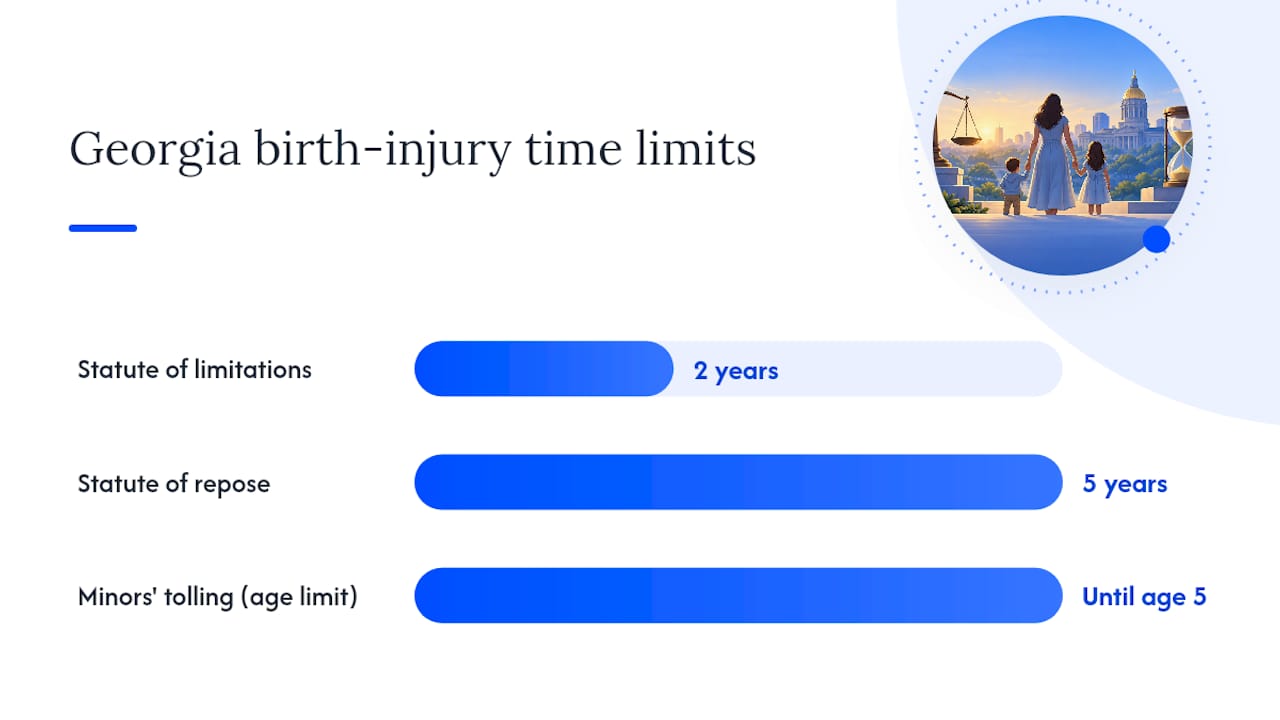
Layered on top of that two-year rule is a statute of repose. Even when an injury goes undiscovered, Georgia law bars most malpractice claims once five years have passed since the negligent act, regardless of when a parent finally learns something went wrong. The Court of Appeals walked through exactly this interplay in Ray v. Scottish Rite Children’s Medical Center, explaining how the two-year limitation and five-year repose period operate as separate but overlapping constraints, with special carve-outs for minors that soften the repose bar somewhat.
Three statutes anchor almost every birth-injury case in Georgia:
- OCGA § 9-3-71: the general two-year statute of limitations for medical malpractice actions.
- OCGA § 9-3-73: the minors’ tolling provision that extends filing deadlines for children injured before age five.
- OCGA § 51-13-1: the statute governing caps on noneconomic damages in malpractice actions.
Knowing these three code sections by number matters. Any Georgia birth injury laws discussion between you and an attorney will circle back to these statutes, and a filing built on the wrong one can be dismissed before a judge ever hears the medical facts.
How the minors’ exception in OCGA § 9-3-73 actually works
Georgia treats children differently than adult malpractice victims, and the difference is significant. Under OCGA § 9-3-73(b), a child injured before turning five years old has until two years after their fifth birthday to file a malpractice claim, which is where the commonly cited “age seven” deadline comes from. A baby injured during delivery, for instance, is not held to the ordinary two-year clock that starts at birth; the child’s own claim effectively runs far longer.
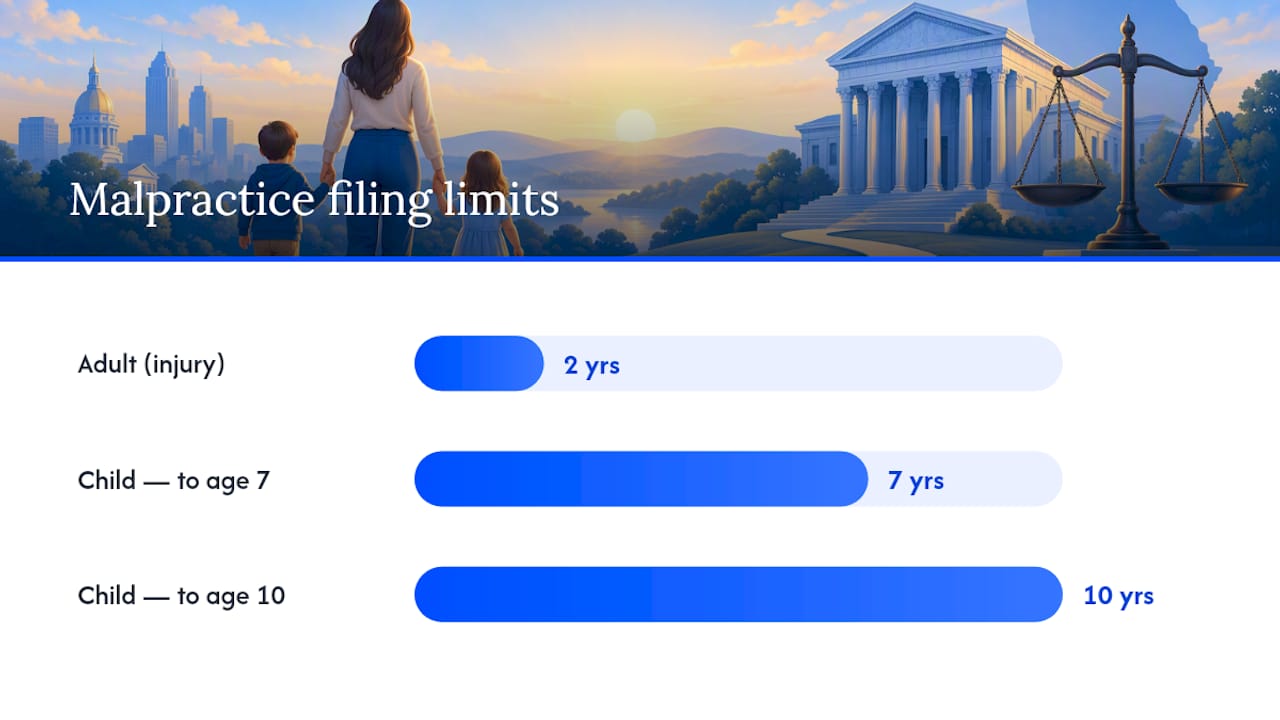
That said, the statute is not unlimited. Georgia law also imposes an outer boundary tied to a child’s tenth birthday in certain circumstances, meaning the minors’ exception has real edges, not an open-ended extension. The Syfert Injury Law Firm’s summary of § 9-3-73 lays out these timing permutations in plain language, which is worth reading alongside the statute itself.
Courts have also clarified how this accrual works in practice:
- Swallows v. Adams-Pickett confirms the minor tolling rule attaches to the child’s claim specifically, not automatically to every related claim in the case.
- Accrual under Georgia law generally turns on when the cause of action legally “arose,” not when a parent first suspected or discovered the injury.
- Delayed diagnosis (a cerebral palsy diagnosis made at eighteen months, for example) does not necessarily restart the clock; the original date of the negligent act typically still controls.
This distinction between accrual and discovery trips up more families than any other part of Georgia birth trauma regulations, which is exactly why early legal review matters.
Do parents get the same extended deadline as their child?
Not usually, and this is the single most misunderstood piece of birth injury legal claims in Georgia. The minors’ tolling rule under § 9-3-73 protects the child’s cause of action. It does not automatically extend a parent’s individual claims, which include things like reimbursement for medical expenses already paid, loss of consortium, or emotional distress tied to witnessing the injury.
- The child’s claim runs on the extended minors’ timeline, commonly up to two years after the child’s fifth birthday under § 9-3-73(b).
- The parents’ individual claims typically fall under the standard two-year rule in § 9-3-71, counted from the date of the injury itself.
- Wrongful-death claims, when a birth injury tragically results in a child’s death, carry their own two-year clock that starts running from the date of death rather than the date of the underlying malpractice.
Swallows v. Adams-Pickett is the controlling case on this point, and it is blunt about the outcome: parents who wait, assuming their own claims share the child’s longer runway, can lose the right to recover their own damages even while the child’s claim remains viable. Filing sooner protects the whole family’s interests, not just the child’s.
What to do right now to protect your child’s claim
The gap between “something felt wrong at delivery” and “we have a lawyer reviewing the case” is where evidence disappears and deadlines quietly tick forward. A few concrete steps now can preserve options later.
- Request complete copies of the labor and delivery records, fetal heart monitoring (CTG) strips, and any NICU records before hospital retention policies or system migrations make them harder to obtain.
- Get an independent pediatric or neonatal specialist evaluation of your child’s condition, and keep that written assessment on file.
- Contact a Georgia attorney experienced in pediatric malpractice claims for an early expert medical review; identifying whether the standard of care was breached almost always requires a specialist, not just a lawyer’s read of the chart.
- Build a simple timeline calendar marking the date of the alleged injury, your child’s fifth birthday, and the outer repose boundary discussed above.
Pro Tip: Ask the hospital’s medical records department for a complete certified copy, not a summary. Summaries frequently omit the CTG strip data and nursing notes that malpractice experts rely on most heavily to establish what happened during labor.
Waiting to “see how the child develops” before consulting a lawyer is one of the most common and costly mistakes parents make. A consultation costs you nothing and starts no clock; missing a filing deadline can end a valid claim permanently.
What damages can a Georgia birth injury claim recover?
Georgia families in a successful birth-injury lawsuit typically recover two broad categories of damages. Economic damages cover measurable costs: past and future medical bills, therapy, specialized equipment, and lost future earning capacity if the injury affects the child’s ability to work as an adult. Noneconomic damages cover pain, suffering, and loss of enjoyment of life, and in wrongful-death cases, the full value of the child’s life.
Noneconomic damages in Georgia have a complicated legal history. OCGA § 51-13-1 originally imposed caps on noneconomic damages in malpractice cases, but the Georgia Supreme Court’s 2025 decision in Medical Center of Central Georgia v. Turner addressed how those caps apply in wrongful-death cases and sent the underlying constitutional questions back for further proceedings.
- Economic damages: medical costs, future care, lost earning capacity.
- Noneconomic damages: pain, suffering, loss of enjoyment of life.
- Wrongful-death damages: the full value of the child’s life, a distinct Georgia legal measure.
What this means for your case: Damages caps remain an active, evolving area of Georgia pediatric malpractice law. No general article can tell you what your family’s case is actually worth; that number depends on medical severity, life-care projections, and how the caps question ultimately resolves in your jurisdiction.
What Georgia families can expect when they call a birth-injury attorney
A serious initial consultation starts with gathering your medical records and timeline, then moves to an independent expert review before anyone discusses filing. That review is what determines whether a deviation from the standard of care actually occurred. Legal firms often handle these cases on a contingency-fee basis, meaning families pay nothing upfront, and bring local experience to birth-injury and pediatric malpractice matters.
— Ali
Talk to Jewkesfirm before your filing window closes
A law firm that handles birth-injury claims on a contingency-fee basis can be a helpful option for Georgia families racing statutory deadlines; typically, such firms collect fees only if they recover compensation. That contingency-fee structure matters most right when families need it, in the weeks after a diagnosis, when medical bills are already piling up and legal fees feel like one more expense you cannot absorb.

Bring what you have to the first consultation: delivery and NICU records if you already obtained them, a rough timeline of when symptoms or diagnoses appeared, and contact information for any specialists currently treating your child. You do not need a complete file to start; the firm’s review process is built to identify what is still missing and request it directly. Visit the Jewkes Firm practice areas page to schedule a free consultation and get a straight answer about where your family’s timeline stands before another day passes.
This article is general information, not a substitute for advice from a qualified lawyer. Consult a qualified legal professional about your own circumstances before acting on anything here.
Sources
- Ray v. Scottish Rite Children’s Medical Center, Inc., Court of Appeals of Georgia (2001)
- Syfert Injury Law Firm: Georgia code 9-3-73 summary
FAQ
Can you sue for birth trauma in Georgia?
Yes. If a doctor, nurse, or hospital deviated from the accepted standard of care during pregnancy, labor, or delivery and that deviation caused injury, Georgia law allows a malpractice claim. Whether a case is viable depends on medical evidence establishing that breach and a causal link to the harm, which is why an early expert review matters so much.
What is the statute of limitations on a birth injury claim in Georgia?
The general rule under OCGA § 9-3-71 is two years from the date of injury. For a child injured before age five, OCGA § 9-3-73(b) extends that to two years after the child’s fifth birthday, commonly making age seven the outside deadline for the child’s own claim.
How much is a birth injury settlement worth in Georgia?
There is no fixed number; settlement value depends on the severity of the injury, projected lifetime care costs, lost future earning capacity, and how noneconomic damages caps under OCGA § 51-13-1 apply to the specific case. An attorney typically needs medical records and an expert life-care evaluation before offering any realistic range.
Can you recommend a birth injury lawyer in Atlanta?
Jewkesfirm represents families across South Atlanta and the surrounding Georgia counties in birth-injury and pediatric malpractice matters, offering free consultations and contingency-fee representation. You can reach the firm directly through its practice areas page to review your child’s timeline with an attorney at no upfront cost.
Does fraud or concealment change the filing deadline?
Georgia courts have recognized that fraud or active concealment by a healthcare provider can toll, or pause, the running of the statute of limitations in some circumstances. This is a fact-specific legal question, so any suspicion that records were altered or information withheld should be raised with an attorney immediately rather than assumed to automatically extend your deadline.