Liability for a Georgia railroad crossing accident usually falls on the railroad company, and sometimes on the local governing authority, when the crossing’s surface, signals, or warning devices failed to meet the standard set by O.C.G.A. §32-6-190 and O.C.G.A. §46-8-290. If you or someone you love was hurt at a crossing, get medical care first, photograph the scene and the crossing’s USDOT identification number if you can find it, and talk to a Georgia personal injury attorney before you speak with any insurance adjuster.
TL;DR:
- Most liability in Georgia crossing accidents falls on the railroad company, especially when maintenance failures of signals or the crossing surface caused the incident.
- Local authorities can also be liable if traffic signs, pavement markings, or drainage issues contribute to the accident.
- Fault may also lie with negligent drivers, pedestrians, or contractors if they ignore warnings or create hazards near the crossing.
- Enforcement and funding for safety upgrades depend on documented accident history, hazard rankings, and compliance with federal standards.
- Early legal action involves collecting scene evidence, official records, and consulting an attorney before dealing with insurance representatives.
Table of Contents
- Who Can Be Held Liable for Railroad Crossing Accidents in Georgia
- Key Georgia Statutes and Standards That Control Railroad Crossing Liability
- How Maintenance Disputes Get Escalated Through GDOT
- Common Crossing Accident Scenarios and How Fault Typically Plays Out
- What to Do Right After a Railroad Crossing Accident
- Damages and Legal Pathways Available in Georgia Railroad Cases
- The Jewkes Firm Perspective: Evaluating a Railroad Crossing Claim in Georgia
- How Jewkesfirm Can Help After a Georgia Railroad Crossing Accident
- Sources
- FAQ
Who Can Be Held Liable for Railroad Crossing Accidents in Georgia
Railroad crossing liability in Georgia rarely lands on a single party. The facts of the collision, the specific defect involved, and who controlled which piece of infrastructure all shape who ends up named in a claim.
Railroads carry the heaviest burden in most cases. They own the tracks, they operate the trains, and Georgia law makes them responsible for keeping crossing surfaces safe and warning systems functional. When a gate arm fails to lower, a signal light burns out and nobody replaces it, or the crossing surface degrades into a hazard that catches a tire or a bicycle wheel, the railroad’s maintenance failure becomes the center of the case.
Local governing authorities, meaning cities, counties, or the state, can also carry liability. Roadway approach signage, pavement markings near the crossing, and certain shared maintenance duties on the roadway side of the crossing often fall to the public entity that controls that road. When a stop sign is missing or a crossing’s advance warning signs have faded past legibility, the responsible government body can be pulled into a claim alongside the railroad.
Drivers, pedestrians, and even contractors doing nearby roadwork can bear fault too. A driver who goes around a lowered gate, a pedestrian who ignores an active warning signal, or a construction crew that leaves debris near the tracks all introduce their own negligence into the equation.
Trespasser status changes the calculation substantially. Someone injured while walking along tracks outside a designated crossing generally faces a much higher legal bar to recover damages than someone injured at a marked public crossing, since railroads owe a lower duty of care to trespassers than to the traveling public.
Typical defendants in a Georgia crossing case include:
- The railroad company that owns and operates the track and signals
- The city, county, or state agency responsible for the roadway approach
- A negligent driver who violated traffic signals or gate arms
- A contractor whose work created a hazard near the crossing
- In rare cases, a property owner whose land obstructs sightlines to an active crossing
Key Georgia Statutes and Standards That Control Railroad Crossing Liability
Two Georgia Code sections anchor nearly every railroad crossing claim in the state, and understanding what each one actually requires makes the difference between a vague accusation and a provable case.
O.C.G.A. §46-8-290 is the statute that establishes liability for railroad companies and their officers, agents, and employees when their negligence causes injury to a person or damage to property. This is the provision a personal injury claim typically cites when arguing the railroad itself acted carelessly, whether through equipment failure, inadequate warning devices, or operational negligence by train crews.
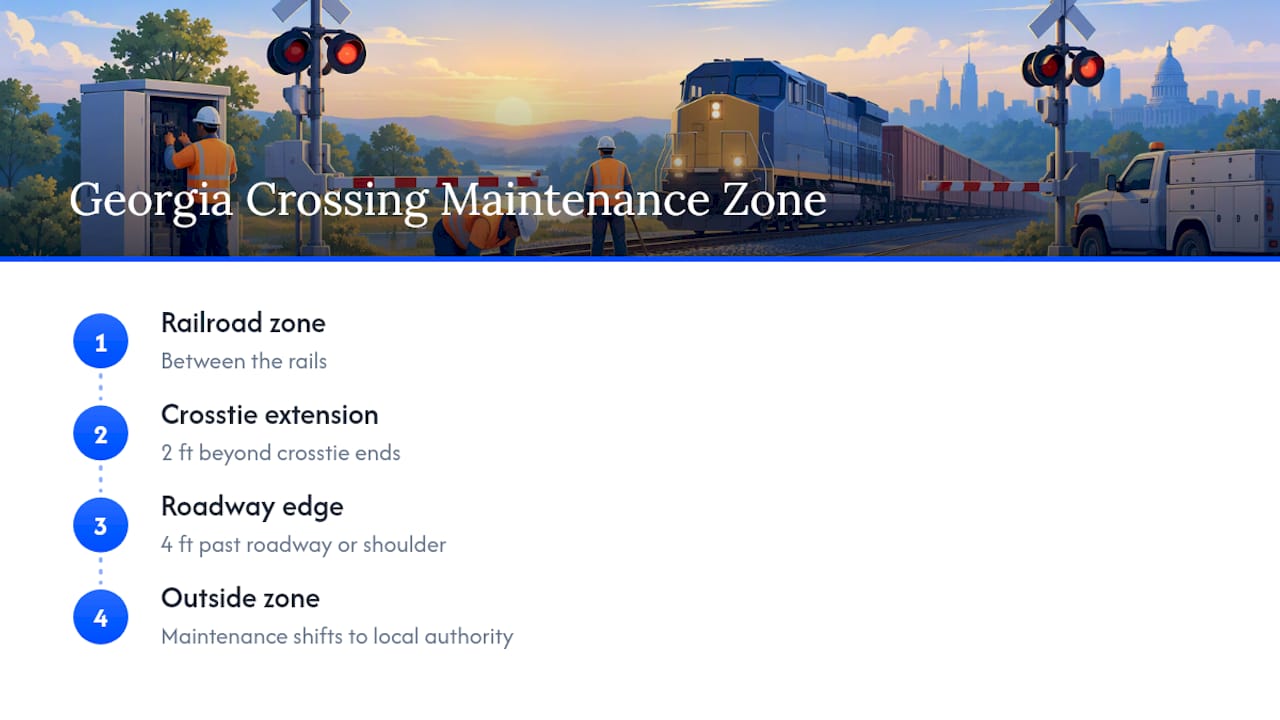
O.C.G.A. §32-6-190 sets the railroad’s maintenance duty at grade crossings. The statute defines a specific maintenance zone: the area between the rails, extending to two feet beyond the ends of the crossties, and reaching four feet beyond the traveled roadway or flush with the paved shoulder. Outside that zone, maintenance responsibility usually shifts to the local governing authority. That boundary line matters enormously in litigation, because a defect one foot outside the railroad’s zone can point liability squarely at a city or county instead.
Georgia’s Department of Transportation layers additional structure on top of these statutes. GDOT Policy documents, including the guidance found in Policy 6865-10, spell out inspection and enforcement procedures. The Section 130 program funds safety upgrades at public crossings statewide, ranking crossings by hazard index, accident history, and traffic volume to decide where gates, lights, and pavement improvements go first.
Georgia crossings compete for safety funding based on measurable risk factors, not complaints alone. A crossing with a documented history of near-misses or prior incidents typically ranks higher on GDOT’s improvement list under the Section 130 program, which is one reason attorneys push hard to obtain a crossing’s accident history early in a case.
Federal standards fill remaining gaps. The Federal Railroad Administration and the Manual on Uniform Traffic Control Devices govern signage design, signal timing, and warning device placement nationwide, and Georgia crossings must conform to those specifications even where state law is silent.
How Maintenance Disputes Get Escalated Through GDOT
Maintenance responsibility at a Georgia crossing typically falls into one of three patterns, and figuring out which one applies is often the first real step in building a liability case.
- Railroad-only maintenance. The defect sits entirely within the zone defined by O.C.G.A. §32-6-190, meaning the crossing surface, the immediate approach panels, or the signal equipment itself. The railroad bears full responsibility here.
- Governing-authority-only maintenance. The defect involves roadway elements outside the railroad’s zone, such as advance warning signage, pavement markings on the public road, or drainage that affects the roadway approach but not the track structure.
- Shared maintenance. Some crossings involve overlapping responsibility, particularly where a road authority upgraded a crossing years ago and left ambiguous documentation about who maintains what.
When a local government cannot resolve a maintenance dispute directly with a railroad, it can escalate the issue to GDOT under O.C.G.A. §32-6-202. That process requires a written request, the crossing’s identification number, prior correspondence with the railroad documenting the attempted resolution, and a description of the specific defect. GDOT then conducts an on-site inspection and typically issues an initial order within 30 days of receiving the completed request and filing fee.
If a railroad ignores that initial order, GDOT can assess civil penalties on a per-day basis until the railroad complies, and the department can also charge investigation costs back to the noncompliant party.
Pro Tip: If you’re a local official or an advocate pushing for a crossing repair, document every email and phone call with the railroad before you ever file a GDOT request. GDOT’s process moves faster, and holds up better if the railroad later disputes the order, when the paper trail shows a genuine attempt at direct resolution first.
Crossings that go through this process sometimes qualify for Section 130 funding afterward, meaning a maintenance dispute today can translate into gates, lights, or resurfacing tomorrow, which matters for future safety even if it comes too late for the person already injured.
Common Crossing Accident Scenarios and How Fault Typically Plays Out
Every railroad crossing case looks different on paper, but most fall into a handful of recognizable patterns that shape how liability gets argued.
- Vehicles stuck on the tracks. Sometimes the driver misjudged clearance or ignored a warning signal, which points toward driver fault. Other times a malfunctioning gate trapped the vehicle, or a poorly maintained crossing surface caused the car to bottom out and stall, which shifts the analysis toward the railroad or the road authority.
- Bicycle and pedestrian injuries on uneven surfaces. Flangeways, the gaps alongside the rail that let train wheels pass, can catch a bicycle tire or a pedestrian’s foot when they’re too wide or poorly maintained. These cases often hinge on engineering evidence and prior complaint records showing the railroad knew about the defect.
- Blocked crossings. A train sitting motionless across a crossing for an extended period creates its own hazard, from emergency vehicle delays to pedestrians attempting to climb between cars. Georgia currently has no state law capping how long a train may block a crossing, so remedies run through local reporting and emerging legislative proposals rather than a hard legal limit.
- Warning device failures. When gates don’t lower, lights don’t flash, or horns don’t sound, the railroad’s own maintenance logs and signal inspection records become the central evidence, often requiring a subpoena to obtain.
What to Do Right After a Railroad Crossing Accident
The steps you take in the hours and days after a crossing accident often determine how strong your claim becomes later, so treat this checklist as a priority list, not a suggestion.
- Get medical attention immediately, even if injuries seem minor. Train collisions generate enormous force, and contemporaneous medical records create the clearest link between the accident and your injuries, which insurers and courts both weigh heavily.
- Document the scene with photos and video before anything gets cleared away, including the crossing surface, signal equipment, gate position, and any skid marks or debris.
- Locate the crossing’s USDOT identification number, usually posted on a blue sign near the crossing itself. This number unlocks the crossing’s full history in the FRA’s public safety data query tool, including prior accidents and inspection records.
- Get contact information from every witness on scene, including other drivers, pedestrians, and anyone who works nearby and may have seen the crossing malfunction before.
- Report the incident to local police and request a copy of the official accident report once it’s filed.
- Contact a Georgia personal injury attorney early, ideally before you give a recorded statement to any insurance company.
Pro Tip: Insurance adjusters often call within 24 to 48 hours of a crossing accident, sometimes before you’ve even seen a doctor. You are not required to give a recorded statement right away, and speaking with an attorney first protects you from language that gets used against you later.
Early attorney involvement matters here in a way it doesn’t in a typical fender bender. Railroad companies maintain their own investigation teams and often dispatch them to the scene within hours, which means victims who wait weeks to get legal help are frequently negotiating against a defendant that has already built its defense.
Damages and Legal Pathways Available in Georgia Railroad Cases
Victims of railroad crossing accidents in Georgia can pursue several categories of damages, and the specific mix depends heavily on the severity of the injury and whether the case involves a death.
- Medical expenses, both past bills and projected future care for serious injuries like spinal damage or traumatic brain injury
- Lost income, including diminished future earning capacity for permanent injuries
- Pain and suffering, covering the physical and emotional toll of the accident
- Wrongful death damages, including funeral and burial expenses, loss of the deceased’s future earnings, and the full value of the life lost under Georgia law
Contractual indemnity arrangements sometimes complicate who actually pays a settlement. Georgia state authority policies show that public entities occasionally carry insurance or indemnity agreements that shift financial responsibility for incidents on or near facilities they operate, which means the party that seems obviously liable isn’t always the one writing the check.
Railroad employees injured on the job generally cannot pursue a standard personal injury claim against their employer railroad. Instead, they typically proceed under the Federal Employers Liability Act, a federal framework with its own procedural rules and venue considerations, separate from the claims available to a driver or pedestrian injured at the same crossing.
Case value in these claims rises and falls on documentation. Maintenance records, prior citizen complaints about the same crossing, GDOT inspection findings, and expert engineering reports carry more weight than eyewitness testimony alone, because they establish what the railroad or governing authority knew and when they knew it.
The Jewkes Firm Perspective: Evaluating a Railroad Crossing Claim in Georgia
The strongest railroad crossing claims share a common thread: they’re built on paper, not just pain. During intake, we request the crossing’s USDOT identification number, any available maintenance and inspection logs, the official crash report, and complete medical records from the outset, because those documents tell us whether we’re looking at a straightforward maintenance failure or a case that needs deeper investigation.
Some cases call for an engineering or accident reconstruction expert early, particularly when signal timing or sightline obstruction is disputed. We screen every potential claim against the statutory framework in O.C.G.A. §46-8-290 before deciding how hard to push, because a well-documented maintenance failure settles very differently than a case with thin evidence.
We work on a contingency-fee basis, meaning you pay nothing unless we recover for you. A free consultation is the fastest way to find out where your case stands.
— Ali
How Jewkesfirm Can Help After a Georgia Railroad Crossing Accident
It is important not to guess your way through a claim against a railroad company that has its own investigators, adjusters, and legal team working the case from hour one. Georgia families dealing with a crossing injury or a wrongful death don’t need to interpret GDOT policy documents or track down a USDOT crossing number alone. Experienced attorneys can handle that groundwork while you focus on recovery.
A free consultation walks through the specific facts of your accident, identifies the likely defendants based on where the failure occurred, whether the railroad’s maintenance zone, the local road authority’s signage, or another driver’s negligence, and lays out realistic next steps. There’s no upfront cost and no fee unless the firm recovers compensation for you, consistent with the contingency arrangement standard across serious personal injury claims in Georgia.
Jewkesfirm represents clients across auto accidents, wrongful death, and a full range of injury claims through its practice areas, including cases involving trains, trucks, and pedestrians. If you or a family member was hurt at a Georgia railroad crossing, consider seeking a case review before you speak with an insurance adjuster.
This article is general information, not a substitute for advice from a qualified lawyer. Consult a qualified legal professional about your own circumstances before acting on anything here.
Sources
- GDOT policy: Duty of Railroads to Maintain Grade Crossings on all Public Roads (Policy 6865-10)
- Georgia DOT – Railroad Safety & Risk Reduction / Section 130 program
- Georgia Code § 46-8-290 (Justia)
- FRA public safety data query (crossing inventory and accident/incident reports)
FAQ
How long can a train legally block a crossing in Georgia?
Georgia has no state law setting a maximum blocking time, and GDOT guidance confirms there’s currently no federal cap either. Report a prolonged blockage to local police and your city or county, since those are the primary channels for pushing enforcement or future legislative change.
What is the penalty for driving around a lowered railroad crossing gate?
Driving around a lowered gate is a traffic violation in Georgia that can result in fines and points against your license, and it also significantly undermines any injury claim you might later bring, since it shifts fault heavily toward the driver. If a crash results, this conduct typically becomes the central issue in any comparative negligence analysis.
What makes a railroad crossing exempt from standard safety requirements?
Certain private crossings, crossings with extremely low traffic volume, or those slated for closure can qualify for exemptions from full gate and signal requirements under state and federal guidelines. These determinations are made case by case through GDOT and FRA review, so a specific crossing’s exempt status should be confirmed through those agencies rather than assumed.
How many railroad crossing accidents happen in the United States each year?
Exact yearly totals shift and are best checked directly through the FRA’s public accident and incident database, which tracks crossing-specific crash history nationwide. That same database lets you pull the accident history for a specific Georgia crossing using its USDOT identification number.
Who is usually liable when a train hits a car at a Georgia crossing?
Liability depends on the specific failure involved: the railroad if warning devices malfunctioned or the crossing surface was defective, the local governing authority if roadway signage or markings failed, or the driver if they ignored a functioning warning system. Jewkesfirm reviews the maintenance history and crash facts to identify which party, or combination of parties, bears responsibility in your specific case.