

Mild traumatic brain injuries in Georgia typically settle in the low six figures, moderate TBIs often land in the mid-six-figure range, and catastrophic cases frequently exceed $1 million, though outcomes vary widely by liability and insurance limits. The single most important step you can take right now is getting medical care documented and speaking with a Georgia personal injury lawyer, because Georgia’s two-year filing deadline starts running the day you’re hurt.
TL;DR:
- Settlement amounts for Georgia traumatic brain injuries range from tens of thousands for mild cases to over a million dollars for catastrophic injuries, depending heavily on liability proof and insurance coverage.
- Strong objective medical evidence, clear liability, and sufficient insurance coverage are critical factors that influence the settlement value of a brain injury claim.
- Filing deadlines are strict, with most cases requiring action within two years of the injury, and shared fault rules can significantly reduce the recovery amount.
- Documenting symptoms daily and consulting an attorney early can help maximize settlement prospects and avoid evidence gaps that insurers exploit.
- Hiring a local Georgia lawyer familiar with court procedures and insurers can significantly improve case outcomes and ensure proper value for future medical and lost earnings.
Table of Contents
- What Are Typical Brain Injury Settlement Amounts in Georgia?
- What Factors Most Affect a TBI Settlement in Georgia?
- What Damages Can You Recover for a Brain Injury Claim?
- What Georgia Laws Affect Your Settlement Timeline and Odds?
- How Does a Georgia Lawyer Increase Your TBI Settlement Value?
- What Should You Do in the First Days and Months After a TBI?
- Why Local Legal Experience Changes TBI Case Outcomes
- Get a Free Case Review From Jewkesfirm
- Sources
- FAQ
What Are Typical Brain Injury Settlement Amounts in Georgia?
Settlement figures for a brain injury settlement in Georgia move within fairly predictable bands, but the spread inside each band can be enormous. A mild concussion with a full recovery in eight weeks settles very differently than a mild TBI that leaves someone with six months of persistent headaches and memory lapses, even though both start in the same diagnostic category.
Three factors drive most of the variation: total medical costs, the strength of liability evidence, and how much insurance coverage sits behind the at-fault party. A driver with a $25,000 minimum policy limits what you can collect from that source alone, no matter how catastrophic the injury, unless umbrella coverage or underinsured motorist coverage applies.
Here’s how the tiers generally break down for a Georgia brain injury claim:
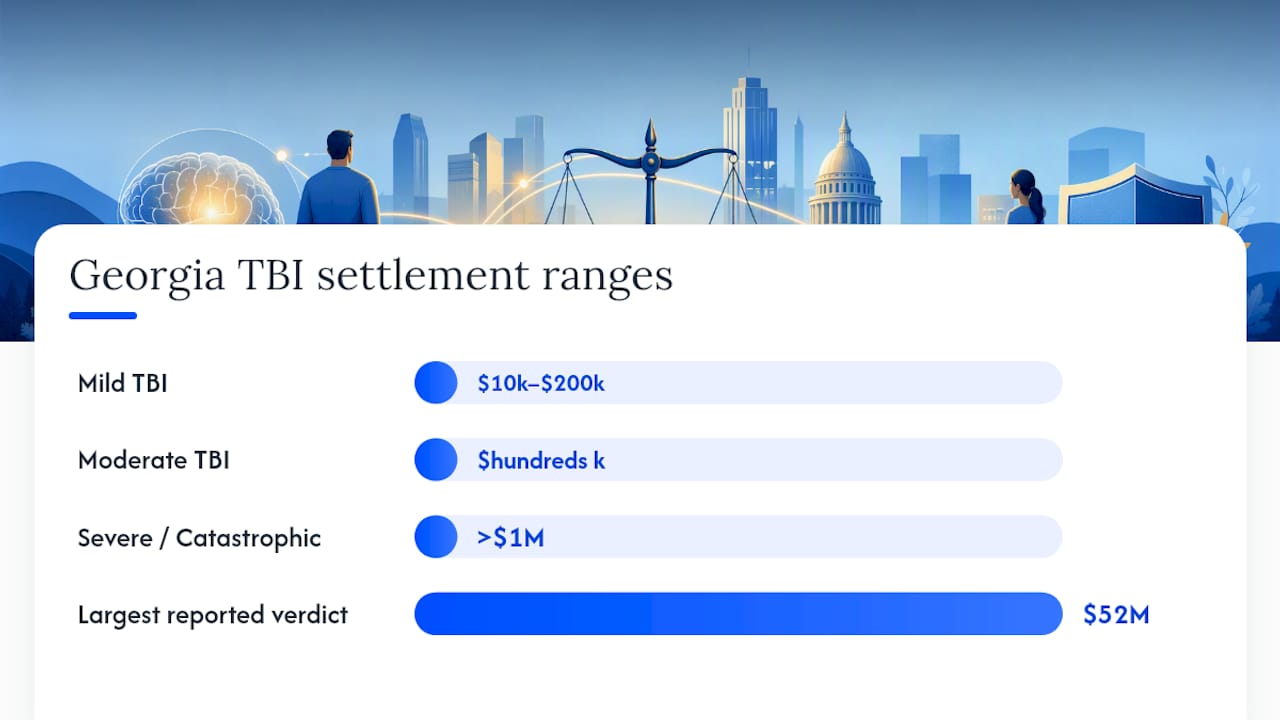
- Mild TBI (concussion, brief loss of consciousness): Often resolves with settlements typically in the range of tens of thousands to a couple hundred thousand dollars, depending on lingering symptoms and lost income.
- Moderate TBI (extended cognitive impairment, ongoing therapy): Frequently settles with amounts typically in the several hundred-thousand-dollar range once future treatment needs are factored in.
- Severe or catastrophic TBI (permanent disability, need for lifetime care): Settlements often exceed a million dollars, and in cases involving commercial vehicles or corporate defendants, can reach very high amounts.
Georgia has seen verdicts and settlements at the upper end of that range that illustrate how far catastrophic cases can go. A tractor-trailer crash case resulted in a $52 million verdict tied to severe brain trauma and long-term disability. A Rockdale County case reached a $37.5 million settlement involving catastrophic injury and clear evidence of corporate negligence. Neither of those numbers is typical, but both show what happens when severe injury, strong liability proof, and substantial insurance or corporate assets line up.
To judge whether a headline settlement is comparable to your situation, look past the dollar figure to three details: the injury’s medical classification, whether liability was contested or admitted, and the type of defendant involved. A settlement against a trucking company with a $5 million policy tells you almost nothing about what a claim against an individual driver with state minimum coverage might yield. Georgia’s Rockdale County TBI case analysis breaks down how comparative fault and coverage limits shaped that specific outcome.
What Factors Most Affect a TBI Settlement in Georgia?
Insurance adjusters and defense attorneys evaluate five things when they decide how much to offer. Knowing these levers helps you understand why two seemingly similar injuries can settle for very different amounts.
- Medical evidence and diagnostic clarity. CT and MRI results establish that a brain injury exists, but neuropsychological testing is what proves functional impairment, memory loss, or personality changes that don’t show up on a scan. Insurers discount claims lacking this kind of objective documentation, according to clinical guidance from NINDS on how TBI severity and outcomes are assessed.
- Liability proof. Police reports, eyewitness statements, and evidence of a traffic or safety violation (running a red light, a trucking company skipping required rest breaks) all strengthen your position. Weak liability evidence invites lowball offers regardless of how serious the injury is.
- Insurance exposure. Settlements are capped by available coverage. That includes the at-fault party’s liability policy, your own underinsured motorist coverage, an employer’s policy if the crash happened on the job, and product liability coverage if defective equipment caused the injury.
- Comparative negligence. Georgia reduces your recovery by your percentage of fault, and bars recovery entirely once you hit 50% or more. A $500,000 claim where you’re found 20% at fault settles for $400,000 on paper.
- Age, occupation, and future earning capacity. A 32-year-old electrician who can no longer climb ladders after a TBI has a dramatically different lost-earnings calculation than a 68-year-old retiree with the same diagnosis.
Pro Tip: Keep a daily symptom journal starting the day of your injury. Adjusters and defense experts routinely argue that gaps in symptom reporting mean the injury wasn’t as serious as claimed. A dated log closes that argument before it starts.
Georgia’s shared-fault rule deserves special attention because it applies even in cases with clear-cut injuries. If you were partially at fault, say you were a pedestrian crossing outside a marked crosswalk when a distracted driver hit you, your own attorney needs to build a record showing the driver’s violation outweighs your jaywalking. That framing can be the difference between a six-figure recovery and nothing at all. Solid medical record documentation also plays directly into this calculus, since detailed provider notes support both the severity argument and the liability narrative.
What Damages Can You Recover for a Brain Injury Claim?
Georgia law separates damages into two broad categories, and understanding both is essential to any brain injury compensation Georgia case.
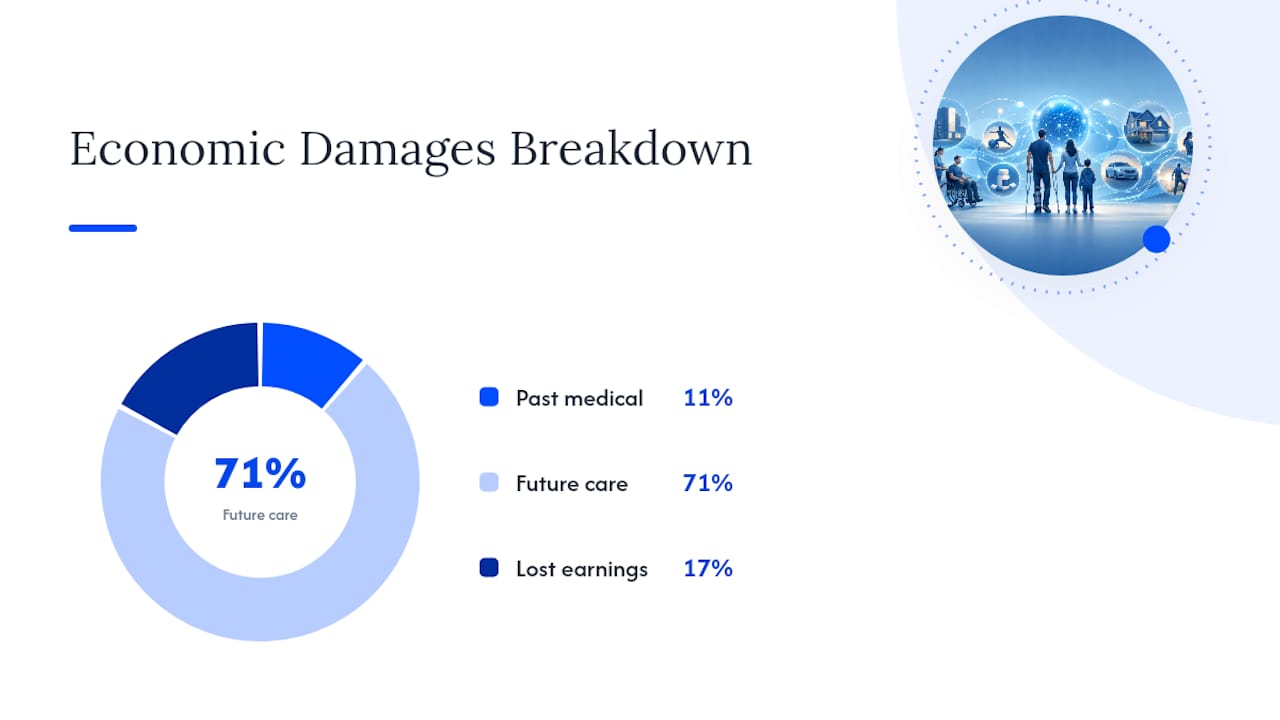
Economic damages cover the bills and losses you can put a number on: emergency room and hospital charges, neurologist and neuropsychologist fees, cognitive rehabilitation therapy, home health aides, wheelchair ramps or other home modifications, and lost wages during recovery. For catastrophic cases, this category also includes future medical costs projected over a person’s remaining lifespan.
Noneconomic damages cover harder-to-quantify losses: pain and suffering, emotional distress, loss of enjoyment of life, and loss of consortium for a spouse who’s lost companionship or partnership as a result of the injury. Georgia places no statutory cap on noneconomic damages in most personal injury cases, unlike some states.
Attorneys typically use a few established methods to translate these losses into a settlement figure:
- The multiplier approach, where noneconomic damages are calculated as a multiple (often 1.5 to 5, depending on severity) of total economic damages.
- The per diem method, which assigns a daily dollar value to pain and suffering and multiplies it by the expected recovery or lifetime period.
- Life-care plans, developed by certified life-care planners, that itemize every future medical and support need year by year.
- Vocational and life-expectancy expert testimony, used to project lost future earnings and the cost of replacement services like household labor a person can no longer perform.
Consider a rough sketch: a 40-year-old with a severe TBI facing $400,000 in past medical bills, a life-care plan projecting $2.5 million in future treatment and support over a normal life expectancy, and $600,000 in lost future earnings. Even before applying any multiplier for pain and suffering, the economic damages alone push the case well past $3 million. That’s how catastrophic TBI settlements in Georgia climb into seven figures, not through inflated pain-and-suffering claims but through documented future need. A closer look at how compensation categories break down in Georgia injury cases shows how these pieces fit together for different injury types.
What Georgia Laws Affect Your Settlement Timeline and Odds?
Georgia’s legal framework sets hard boundaries on your Georgia brain injury claim, and missing one of them can end a valid case before it starts.
The statute of limitations under O.C.G.A. § 9-3-33 gives you two years from the date of injury to file a lawsuit. There are exceptions: the clock can pause, or “toll,” for minors and individuals deemed legally incapacitated at the time of injury, but you shouldn’t count on an exception applying to your case without a lawyer confirming it. Once two years pass without a filed lawsuit, most Georgia courts will dismiss the claim outright, regardless of how strong the evidence is.
Two years. That’s the entire window Georgia gives most injury victims to file suit, and it starts the day of the crash, not the day you finally get a diagnosis.
Georgia’s modified comparative negligence rule reduces your recovery by your percentage of fault and eliminates it entirely at 50% or above. This rule shapes settlement negotiations from day one, since insurers will always look for ways to shift blame onto you to reduce their exposure.
Claims against government entities, a county road crew, a city bus, a state agency, follow a different and much stricter timeline:
- Notice of claim is often required within 12 months of the injury, far shorter than the standard two-year statute.
- Damage caps typically apply, commonly $1 million per person and $3 million per occurrence under Georgia law.
- Filing procedures differ from standard civil suits and require strict compliance with statutory notice language.
Punitive damages, meant to punish especially reckless conduct, are capped in most Georgia personal injury cases, though product liability claims involving defective products carry different rules and can allow for higher punitive awards. If a defective helmet, faulty airbag, or unsafe machine caused your TBI, that distinction matters for how your case gets valued.
How Does a Georgia Lawyer Increase Your TBI Settlement Value?
Insurance companies negotiate against unrepresented victims very differently than they negotiate against attorneys who are prepared to file suit and take a case to trial. A lawyer’s job in a brain injury lawsuit process isn’t just paperwork, it’s building a record that makes a lowball offer indefensible.
That work typically includes:
- Preserving evidence early: obtaining police reports, securing surveillance or dashcam footage before it’s overwritten, and locking down witness statements while memories are fresh.
- Coordinating with neurologists, neuropsychologists, and life-care planners to document both the injury and its projected lifetime cost.
- Building a demand package that ties medical evidence directly to a dollar figure, rather than leaving the adjuster to guess.
- Preparing the case for trial from the start, since insurers pay closer attention to attorneys who are genuinely ready to go to court rather than settle for whatever’s offered.
Nearly every personal injury lawyer in Georgia, including Jewkesfirm, works on a contingency fee basis: you pay nothing upfront, and the fee comes out of the settlement or verdict only if the case succeeds. That arrangement exists specifically so injury victims aren’t forced to pay legal fees out of pocket while they’re also facing medical bills and lost income.
Pro Tip: Bring every piece of medical documentation you have to your first consultation, even records that seem minor. A lawyer evaluating your case needs the full picture to give you an honest read on what it’s worth.
The firm offers free consultations and emphasizes familiarity with local court procedures, claims adjusters, and medical providers who regularly handle TBI cases in the area. Learn why hiring local injury counsel tends to change outcomes for Georgia claimants specifically.
What Should You Do in the First Days and Months After a TBI?
The choices you make in the days right after a head injury often determine how strong your claim looks months later.
- Immediately: Get medical care even if symptoms seem mild, document every symptom as it appears, photograph the accident scene and any visible injuries, collect witness contact information, and preserve damaged clothing or property exactly as it was.
- First 30 to 90 days: Request complete medical records from every provider you’ve seen, keep a running log of expenses and missed work, notify your own insurer as your policy requires, and schedule a consultation with a Georgia personal injury lawyer.
- 3 to 24 months: Work with your attorney to bring in medical and vocational experts if needed, gather employment records to support lost-wage and reduced-capacity claims, and track the statute of limitations closely, especially if a government entity might be a defendant.
- Decision point: Settlement talks usually begin once your treatment has plateaued and long-term prognosis is clear. If the insurer won’t negotiate in good faith or the statute of limitations is approaching, filing suit becomes the next necessary step.
Georgia’s step-by-step lawsuit filing guide walks through what happens procedurally once settlement talks stall.
Why Local Legal Experience Changes TBI Case Outcomes
The biggest mistakes I see in Georgia TBI cases happen in the first two weeks, not the last two months. People skip follow-up care because they feel “fine,” accept a quick settlement offer before they know their full prognosis, or stop documenting symptoms once the initial pain fades. Every one of those choices hands the insurance company ammunition to argue the injury wasn’t serious.
Local knowledge matters more than people expect. Knowing which Georgia superior court judges move cases quickly, which local neurologists give testimony that holds up under cross-examination, and how a specific county’s juries have historically valued brain injury claims all shape strategy in ways a generic national playbook can’t replicate.
If you’re unsure whether your case is strong enough to pursue, a free consultation costs you nothing and gives you a clear, honest read on where you stand.
— Ali
Get a Free Case Review From Jewkesfirm
This firm presents itself as a local option for Georgia families needing legal representation familiar with how local courts and insurers handle brain injury claims. The lead attorney has prior experience negotiating insurance cases, which may benefit clients during settlement discussions.

The firm handles traumatic brain injuries alongside auto accidents, trucking crashes, medical malpractice, and other serious injury claims under a contingency fee arrangement, meaning clients pay nothing unless compensation is recovered. Consultations are free and carry no obligation. If you’re weighing whether your TBI claim is worth pursuing or worried about a deadline approaching, visit the Jewkesfirm practice areas page to see the full scope of cases handled, or call the firm directly to schedule your free case review before evidence disappears or your filing window closes.
Sources
These resources back the legal and medical facts covered above, and they’re worth reading directly if you want to verify anything before making a decision:
- Casetext — Georgia Code § 9-3-33
- National Institute of Neurological Disorders and Stroke — Traumatic brain injury (TBI)
This article is general information, not a substitute for advice from a qualified lawyer. Consult a qualified legal professional about your own circumstances before acting on anything here.
FAQ
What Is the Average Settlement for a Brain Injury in Georgia?
Mild TBI settlements in Georgia typically fall in the low six figures, moderate cases often settle in the mid-six figures, and severe or catastrophic cases frequently exceed $1 million. The exact figure depends heavily on liability strength, available insurance coverage, and documented future care needs.
What Percentage Does a Lawyer Get in a Georgia Settlement?
Most Georgia personal injury lawyers work on a contingency fee basis, meaning the fee is a percentage of your settlement or verdict and you pay nothing if the case doesn’t succeed. Exact contingency percentages vary by firm and case complexity; clients should inquire directly for fee details.
How Hard Is It to Get Disability for a TBI?
Qualifying for disability benefits after a TBI depends on medical documentation showing functional impairment, which is why neuropsychological testing and consistent treatment records matter so much, as outlined in NINDS clinical guidance. This process is separate from a personal injury settlement, though the same medical evidence often supports both.
How Long Do TBI Cases Take to Settle in Georgia?
Timelines vary widely, but straightforward mild TBI claims can resolve in a few months, while moderate to severe cases often take a year or longer, especially when future care costs require expert life-care planning. Cases that don’t settle before the two-year statute of limitations deadline typically require filing suit to preserve the claim.
Do I Need a Lawyer to File a Georgia Brain Injury Claim?
You’re not legally required to hire a lawyer, but insurance companies routinely offer far less to unrepresented claimants, particularly in TBI cases where future care costs are hard to calculate without expert input. A free consultation with a firm like Jewkesfirm can clarify whether your case is strong enough to justify legal representation before you accept any offer.