

Yes, Georgia personal injury plaintiffs have a constitutional right to a jury trial, but that right vanishes if you miss the deadline. Under O.C.G.A. § 9-11-38, you must file a timely written demand or the case defaults to a bench trial. Civil verdicts in Georgia must be unanimous, though jury size varies by court. Check your demand is on file, confirm your statute of limitations, and talk to trial-capable counsel now.
TL;DR:
- Missing the written jury demand deadline under O.C.G.A. § 9-11-38 converts a case into a bench trial, regardless of case strength or evidence.
- Verifying your demand is filed, on record, and not waived by scheduling stipulations is critical to preserve the right to a jury trial.
- Jury panels in Georgia start with 24 members in superior court, reduced to 12 through voir dire challenges that can influence case outcomes.
- Georgia civil trials require proof by a preponderance of evidence, with jurors weighing documentation and testimony on damages and liability.
- Post-trial motions, including motions for new trial or JNOV, must be filed within strict deadlines, or the opportunity to appeal may be lost.
Table of Contents
- Georgia’s Legal Basis for a Personal Injury Jury Trial
- How to Preserve Your Right to a Jury Trial
- Jury Selection in Georgia: Voir Dire and Why It Shapes Your Case
- What Happens During a Georgia Personal Injury Jury Trial
- How Long It Takes to Get a Georgia Injury Case to Trial
- Post-Trial Motions and the Georgia Appeal Process
- How Georgia Juries Evaluate Damages
- Pre-Trial Procedures Before a Georgia Injury Jury Trial
- The Attorney’s Role and Strategy in a Georgia Jury Trial
- Common Defenses in Georgia Personal Injury Jury Trials
- Types of Damages Available in Georgia Injury Verdicts
- Preparing for Testimony in a Georgia Jury Trial
- The Role of Expert Witnesses in Georgia Injury Trials
- A Trial Lawyer’s View on What “Trial-Ready” Really Means
- How Jewkesfirm Prepares Georgia Injury Cases for Jury Trial
- Sources
- FAQ
Georgia’s Legal Basis for a Personal Injury Jury Trial
The right to a jury trial in a Georgia civil case comes from Article I, Paragraph XI of the Georgia Constitution, which preserves jury trials “as heretofore used” while allowing judgment without a jury when no issuable defense is filed or no jury is demanded in writing. That single exception is why so many valid injury claims never reach a jury box.
Georgia’s statutes fill in the mechanics:
- O.C.G.A. § 9-11-38 governs how and when a jury demand must be filed.
- O.C.G.A. § 15-12-122 sets jury size and selection rules.
- Superior Court hears most serious injury cases and typically seats larger panels; state court handles many claims too, sometimes with smaller juries depending on the damages at stake.
Which court you land in shapes how your jury gets picked, so this isn’t a minor procedural detail.
How to Preserve Your Right to a Jury Trial
Filing a personal injury claim lawsuit in Georgia doesn’t automatically guarantee a jury will hear it. You have to ask, in writing, and on time. Failing to file that demand under O.C.G.A. § 9-11-38 is one of the most common, irreversible mistakes in Georgia litigation. It quietly converts a strong case into a bench trial, even when the facts clearly favor the injured plaintiff.
Follow this checklist:
- Confirm your attorney filed a written jury demand with the initial pleading or shortly after.
- Check the court docket directly, don’t just take someone’s word for it, to verify the demand appears on record.
- Watch for consent stipulations in scheduling orders that might inadvertently waive the jury right.
- If you suspect a demand was missed, act immediately; late motions rarely revive a waived right.
- Keep a copy of the filed demand in your own case file, not just your lawyer’s.
Pro Tip: Don’t assume your jury demand was filed just because your attorney mentioned it. Ask for the stamped, docketed copy. A verbal confirmation means nothing if opposing counsel later argues waiver.
Jury Selection in Georgia: Voir Dire and Why It Shapes Your Case
Superior Court trials typically start voir dire with a 24-person panel struck down to a 12-person jury, following O.C.G.A. § 15-12-122. State court can seat fewer jurors, though a party may demand a 12-person jury once damages cross certain statutory thresholds.
Two tools shape the final panel:
- Challenges for cause remove jurors who show clear bias or a conflict.
- Peremptory strikes let each side remove a limited number of jurors without stating a reason.
Many experienced Georgia trial lawyers treat voir dire as the most decisive early phase of the case. Jurors are ordinary citizens who arrive with preexisting assumptions about lawsuits, injuries, and credibility. Practitioner commentary consistently points to voir dire as where case themes take hold, long before opening statements begin. That’s also when your own demeanor starts mattering. Jurors watch how you sit, how you answer, and whether you seem to be exaggerating.
What Happens During a Georgia Personal Injury Jury Trial
Trial stages follow a set order, and each one carries weight with the jury:
- Opening statements frame the story each side wants the jury to believe before a single piece of evidence appears.
- Presentation of evidence includes medical records, photos, demonstratives, and testimony, with direct examination building your case and cross-examination testing it.
- Closing arguments let each side make a final appeal, followed by jury instructions from the judge explaining the legal standard.
- Deliberation and verdict require unanimous agreement in Georgia civil cases, and the jury decides both liability and the dollar figure for damages.
The evidentiary standard in Georgia civil trials is preponderance of the evidence, meaning your side only needs to show it’s more likely than not that the defendant caused your injury. That’s a lower bar than criminal court, but jurors still expect a coherent, well-documented story.
How Long It Takes to Get a Georgia Injury Case to Trial
Timelines swing widely. Some Georgia injury claims reach trial within a year; others stretch past two, depending on the court’s backlog, the judge’s calendar, and how complex the medical or liability issues are.
- Docket practices vary by county, and Georgia Courts publishes local calendars and rules that affect scheduling.
- Cases get called from a trial calendar, sometimes with little notice, which is why being trial-ready matters even when trial feels distant.
- Judges and court staff manage docketing differently, so a case in one county may move faster than an identical one filed in another.
Stay ready by finalizing exhibits early, locking in witness availability, preserving depositions, and checking in with your attorney regularly rather than waiting for a call that trial is imminent.
Post-Trial Motions and the Georgia Appeal Process
A verdict doesn’t always end the case. Georgia law allows several post-trial motions, each on a tight clock:
- Motion for new trial under O.C.G.A. § 9-11-59.
- Judgment notwithstanding the verdict (JNOV) under O.C.G.A. § 9-11-50(b).
- Many of these post-trial motions and appeals carry strict deadlines, often around 30 days, so missing the window can forfeit your options entirely.
An injury verdict appeal in Georgia typically heads to the Court of Appeals, with the Supreme Court of Georgia reserved for narrower categories of cases. Preserving the trial record, objections, and rulings matters here, since appellate courts generally review only what was raised at trial. This is usually where appellate-focused counsel gets involved, since post-trial strategy differs sharply from trial advocacy.
How Georgia Juries Evaluate Damages
Juries weigh two categories of loss. Economic damages cover medical bills, lost wages, and future treatment costs, backed by records and testimony. Noneconomic damages cover pain and suffering, loss of enjoyment of life, and similar harms that resist a receipt-based calculation.
Jurors decide under the preponderance standard, and they tend to respond best to concrete documentation:
- Medical records and billing statements tied directly to the injury.
- Testimony from treating physicians, not just retained experts.
- Demonstratives like timelines, anatomical models, or day-in-the-life videos.
- Consistent testimony from the plaintiff about how the injury changed daily function.
Jurors grow skeptical fast when documentation is thin or when the plaintiff’s account shifts between deposition and trial. Understanding how compensation types work in Georgia injury cases before trial helps set realistic expectations for what a jury is likely to award.
Pre-Trial Procedures Before a Georgia Injury Jury Trial
Long before a jury is seated, the case goes through discovery, motions, and often settlement talks that shape what the jury eventually sees.
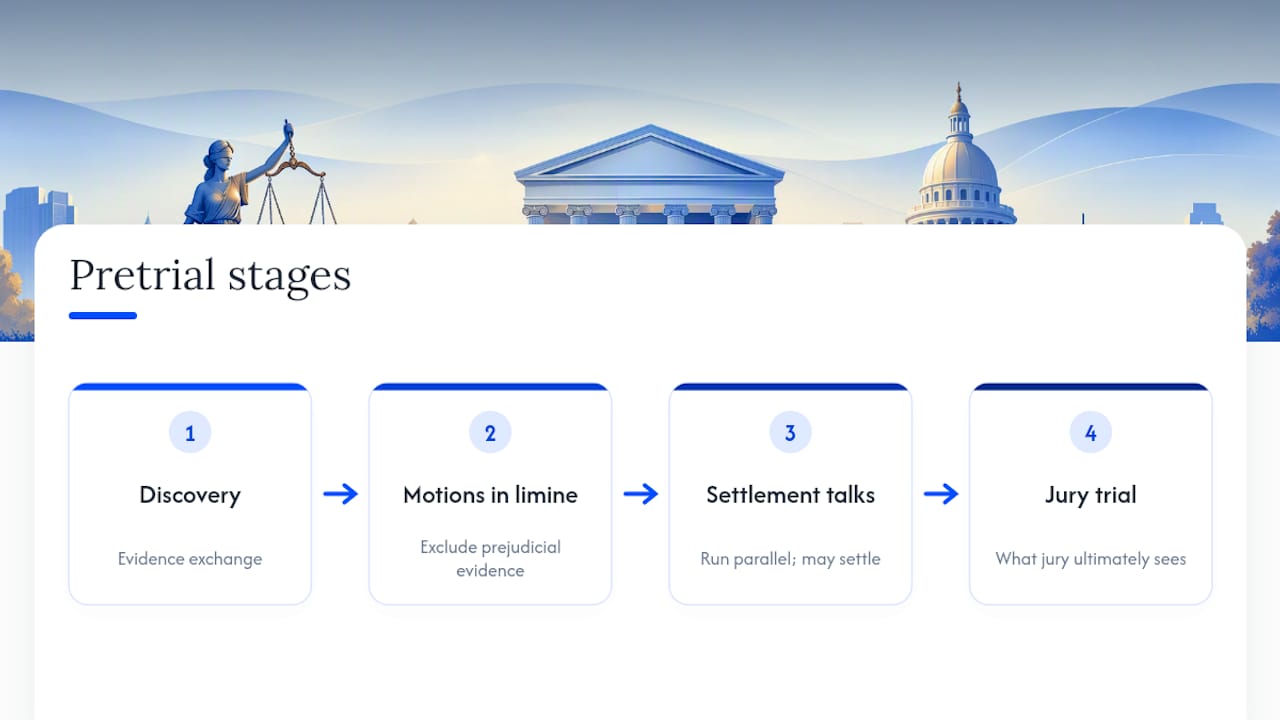
Discovery is where both sides exchange evidence: medical records, accident reports, deposition testimony, and expert reports. This phase often runs longer than anyone expects, and it’s where the strongest evidence for trial actually gets built. Skipping depth here weakens everything that follows.
Motions in limine come next, filed before trial to exclude evidence one side considers irrelevant, unfairly prejudicial, or legally improper. A successful motion in limine can keep damaging testimony or documents away from the jury entirely, which is why these filings often get contested hard.
Settlement negotiations run parallel to all of this. Many injury claim lawsuits in Georgia settle in the weeks before trial, sometimes because a strong motion in limine ruling shifts leverage, sometimes because a firm trial date forces both sides to get realistic about risk. Insurance carriers frequently make their best offers only once they see a plaintiff genuinely prepared to go the distance.
Reviewing the full Georgia litigation process helps clarify how discovery, motions, and settlement talks interact before a case ever reaches a jury. None of these steps happen in isolation. A weak discovery effort makes settlement leverage weaker, and a poorly argued motion in limine can leave damaging evidence in front of the jury that otherwise could have been excluded.
The Attorney’s Role and Strategy in a Georgia Jury Trial
A trial attorney’s job shifts dramatically once a case moves from negotiation to courtroom. Pretrial, the focus is building a paper record. At trial, it becomes real-time persuasion in front of twelve strangers who’ve never seen the case file.
Strategy starts with case theory: a clear, simple explanation of what happened and why the defendant is responsible. Every witness, exhibit, and cross-examination question should reinforce that theory rather than introduce confusing side plots. Jurors remember narratives, not legal technicalities.
During voir dire, attorneys try to identify jurors likely to hold biases against injury claims, sometimes shaped by tort reform messaging or personal experience with insurance disputes. Skilled counsel use both challenges for cause and peremptory strikes to shape a panel more receptive to the plaintiff’s story.
At trial, direct examination builds credibility slowly, letting the plaintiff and witnesses tell their story in their own words. Cross-examination of defense witnesses, especially the defendant and any hired experts, focuses on exposing inconsistencies or bias without appearing aggressive to the jury.
Closing argument is where strategy peaks. That’s the moment counsel connects every piece of evidence back to the damages number the jury is asked to award, translating months of discovery and depositions into a single, coherent request. Weak closings leave jurors unsure what number to write down, and uncertain jurors tend to award less.
Common Defenses in Georgia Personal Injury Jury Trials
Defense strategy shapes almost everything about how a jury trial unfolds. Understanding the likely defense early lets your side prepare targeted rebuttal evidence instead of reacting at trial.
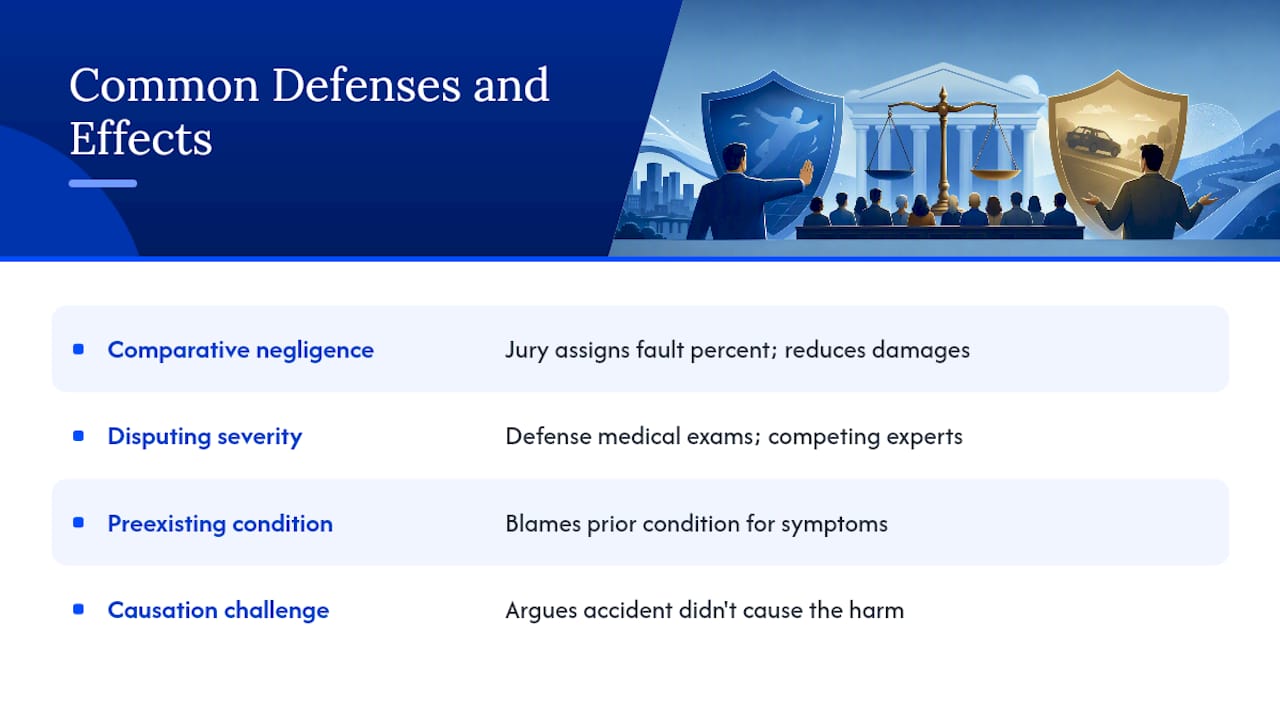
Comparative negligence is the most common defense in Georgia injury cases. Defense counsel argues the plaintiff bears some percentage of fault, which can reduce or eliminate recovery depending on how the jury allocates blame. Because Georgia juries assign a specific fault percentage, this defense directly shapes the final damages number, not just liability.
Other frequent defenses include disputing the severity of injuries, often through defense medical examinations or competing expert testimony, and arguing that a preexisting condition, not the accident, caused the plaintiff’s symptoms. Some defenses challenge causation outright, claiming the accident simply didn’t produce the harm alleged.
Each defense changes trial strategy. A comparative negligence defense means the plaintiff’s own conduct, speed, attention, choices in the moments before the accident, becomes fair game for cross-examination. A causation defense means medical experts and treatment timelines take center stage. Attorneys who anticipate the defense theory early can build counter-evidence into the case from the start rather than scrambling once trial begins.
Types of Damages Available in Georgia Injury Verdicts
Georgia recognizes several categories of damages, and understanding each helps set realistic expectations for a jury verdict.
Economic damages cover quantifiable losses: medical expenses, lost wages, future earning capacity, and property damage. These are typically the easiest for a jury to calculate because they’re backed by bills, pay stubs, and expert projections.
Noneconomic damages cover pain and suffering, emotional distress, disfigurement, and loss of enjoyment of life. These carry no fixed formula. Juries weigh testimony, demonstratives, and the plaintiff’s own account of how the injury changed daily life. Reviewing what Georgia victims should know about pain and suffering compensation can help set expectations before trial.
Punitive damages are different entirely. Georgia allows them only when the plaintiff proves the defendant acted with willful misconduct, malice, fraud, wantonness, or that entire want of care raising a presumption of conscious indifference to consequences. Ordinary negligence, even serious negligence, generally doesn’t qualify. Punitive damages exist to punish and deter, not to compensate the plaintiff, and Georgia caps them at $250,000 in most cases outside of specific exceptions like product liability or DUI-related injuries.
Preparing for Testimony in a Georgia Jury Trial
How you testify often matters as much as what you say. Jurors form impressions within seconds, long before they’ve absorbed the substance of an answer.
Start by reviewing your deposition transcript closely. Any inconsistency between deposition testimony and trial testimony gives defense counsel an easy opening on cross-examination. Your attorney should walk through likely questions well before trial, not the night before.
Keep answers short and direct. Long, rambling answers invite more cross-examination and give opposing counsel more material to pick apart. Answer only the question asked, then stop.
Avoid guessing. If you don’t remember a detail, say so plainly rather than filling in gaps with assumptions that later prove wrong. Jurors forgive “I don’t recall” far more readily than they forgive a memory that shifts under pressure.
Dress and demeanor matter more than most plaintiffs expect. Calm, respectful, consistent answers read as credible. Defensive or evasive answers, even on minor points, can undercut an otherwise strong case. Practice sessions with your attorney, ideally including a mock cross-examination, make a real difference in how composed you appear on the stand.
The Role of Expert Witnesses in Georgia Injury Trials
Expert witnesses often decide close cases. Jurors rarely have the medical or technical background to evaluate causation or the extent of an injury on their own, so they lean heavily on how credible and clear an expert sounds.
Treating physicians carry particular weight because jurors see them as neutral, focused on care rather than litigation. Retained experts, brought in specifically for trial, face more scrutiny and often get challenged on cross-examination about fees and how often they testify for plaintiffs or defendants.
Accident reconstruction experts, life care planners, and vocational experts round out the picture in more serious injury cases, translating complex technical findings into numbers a jury can use. A vocational expert explaining reduced earning capacity, backed by clear data, often does more to move a damages number than emotional testimony alone.
The clearest experts win more often than the most credentialed ones. Jurors respond to plain language, confident answers, and experts who avoid jargon rather than the ones with the longest résumé.
A Trial Lawyer’s View on What “Trial-Ready” Really Means
Being trial-ready isn’t a slogan. It means courtroom hours logged, an expert network built before trial dates loom, and demonstratives prepared well ahead of the docket call that First Counsel’s litigation overview notes often arrives with little warning. Contingency fee representation only works for clients when the firm is genuinely prepared to try the case, not just settle it. Local courtroom knowledge, how a specific judge runs voir dire, what a given county’s jury pool tends to expect, shapes strategy in ways no generic playbook can.
— Ali
How Jewkesfirm Prepares Georgia Injury Cases for Jury Trial
Jewkesfirm is the alternative to firms that treat every case as a settlement negotiation from day one. We prepare cases as though they’re going in front of a jury, because insurance companies pay closer attention to a demand backed by trial-ready counsel than one backed by a phone call.

Our practice covers the situations most likely to end up in a Georgia courtroom: auto accidents, trucking crashes, medical malpractice, slip and falls, and wrongful death claims, among the full range of personal injury matters we handle. When you come in for a consultation, bring your accident timeline, medical records, any pleadings or demand letters already filed, and contact information for potential witnesses. That lets us evaluate not just whether you have a claim, but whether your jury demand is properly preserved under O.C.G.A. § 9-11-38.
Consultations are free, and you pay nothing unless we win. If you’re weighing whether to move forward with a personal injury jury trial in Georgia, get a free case review and find out where your case actually stands.
This article is general information, not a substitute for advice from a qualified lawyer. Consult a qualified legal professional about your own circumstances before acting on anything here.
Sources
- Georgia Constitution (Article I, Paragraph XI)
- O.C.G.A. § 9-11-38 — Demand for jury trial (Justia)
- Georgia Judicial Branch — Official site
- Georgia civil procedure basics (Georgia Legal Services Authority)
FAQ
What Are the Odds of Winning a Jury Trial in Georgia?
Outcomes depend heavily on liability clarity, evidence quality, and how well the plaintiff’s testimony holds up under cross-examination. There’s no reliable universal statistic, since results vary by county, judge, and case type, but strong documentation and trial-ready counsel measurably improve the odds of a favorable verdict.
How Much Is a Good Settlement for Pain and Suffering in Georgia?
There’s no fixed formula, since Georgia juries weigh pain and suffering based on testimony, medical records, and how the injury changed daily life rather than a set multiplier. A detailed look at pain and suffering compensation explains the factors that tend to drive higher or lower valuations.
Is a Waiver of Jury Trial Enforceable in Georgia?
Yes. Under O.C.G.A. § 9-11-38, failing to file a timely written jury demand results in an enforceable waiver, and the case proceeds as a bench trial instead. Courts generally will not revive the jury right once the waiver has taken effect, so confirming the demand was filed matters immediately after your case begins.
What Is the Longest a Personal Injury Case Can Take in Georgia?
Some Georgia injury cases stretch past two years before reaching trial, particularly in counties with heavy dockets or in cases involving complex medical evidence. Factors like court backlog, judge scheduling, and case complexity all affect the timeline, which is why staying trial-ready throughout the process matters even when trial feels far off.
Does Jewkesfirm Handle Personal Injury Jury Trials in Georgia?
Yes. Jewkesfirm represents clients across auto accidents, trucking crashes, medical malpractice, slip and falls, and wrongful death claims, among other personal injury practice areas, preparing every case as though it may go before a jury. Consultations are free, and fees are contingency based, meaning you pay nothing unless the case results in a settlement or verdict.