

Georgia’s $350,000 cap on noneconomic damages in medical malpractice cases is no longer being applied by courts to reduce most jury verdicts that include pain-and-suffering awards. The Georgia Supreme Court’s 2026 rulings blocked the cap from operating whenever a verdict includes jury-protected pre-death pain-and-suffering damages, and multiple multimillion-dollar awards have already survived intact as a result.
That said, the underlying statute, OCGA § 51-13-1, still sits on the books, including a rule requiring periodic payments funded by an annuity when future damages reach $350,000 or more. One narrow question remains open: whether a pure wrongful-death claim with no pre-death pain-and-suffering component could still face the statutory limit.
- The cap cannot be applied when protected pain-and-suffering damages are part of the award.
- The annuity/periodic-payment rule under the statute still applies to large future-damages awards.
- Pure wrongful-death-only claims remain a legally unsettled category.
Quick fact: Georgia’s statutory cap for a single provider is $350,000, but the Georgia Supreme Court’s 2026 decisions have made that number largely unenforceable in cases involving pain-and-suffering claims.
Key Takeaways
Georgia’s statutory noneconomic damages cap no longer limits most malpractice verdicts that include jury-protected pain-and-suffering awards, though pure wrongful-death-only claims remain legally unresolved.
| Point | Details |
|---|---|
| Cap is largely unenforceable | The 2026 Georgia Supreme Court rulings block the $350,000 cap when pain-and-suffering damages are part of the verdict. |
| Statute still exists | OCGA § 51-13-1 remains law, including its rule requiring annuity-funded periodic payments for future damages of $350,000 or more. |
| Proof burden hasn’t changed | Plaintiffs must still establish breach of care, causation, and damages regardless of potential award size. |
| Wrongful-death-only cases are unsettled | Claims without pre-death pain-and-suffering may still face the statutory cap, pending future litigation. |
| Jewkesfirm offers a clear next step | Free consultations and contingency-fee representation help injured Georgians evaluate claims under current law at no upfront cost. |
Table of Contents
- How the 2026 Georgia Supreme Court Rulings Changed the Malpractice Limits in Georgia
- What Does the Georgia Malpractice Cap Statute Actually Say?
- What These Rulings Mean If You’re Pursuing a Malpractice Claim
- What Should You Do Right Now If You Suspect Malpractice?
- Where Did Georgia’s Malpractice Cap Come From?
- How Does Georgia’s Cap Compare to Other States?
- What This Means for Doctors, Hospitals, and Insurance Costs
- What the Data Shows About Malpractice Claims and Damages
- The Ongoing Debate Over Malpractice Caps in Georgia
- Economic Damages vs. Noneconomic Damages Under Georgia Law
- How Jewkesfirm Approaches Cases After the 2026 Rulings
- Get a Free Case Review From a Georgia Malpractice Attorney
- Key Documents on the Georgia Malpractice Cap
- Sources
How the 2026 Georgia Supreme Court Rulings Changed the Malpractice Limits in Georgia
Two decisions issued together in June 2026, Clark v. Leigh and a companion case out of Rockdale County, reshaped how Georgia medical negligence cap law actually functions in practice. In Clark, the Court vacated a trial court’s remittitur order that had slashed a jury’s noneconomic damages award down to the statutory ceiling, and sent the case back for further proceedings. The justices found the cap could not be applied as written because part of the verdict reflected constitutionally protected pain-and-suffering findings.
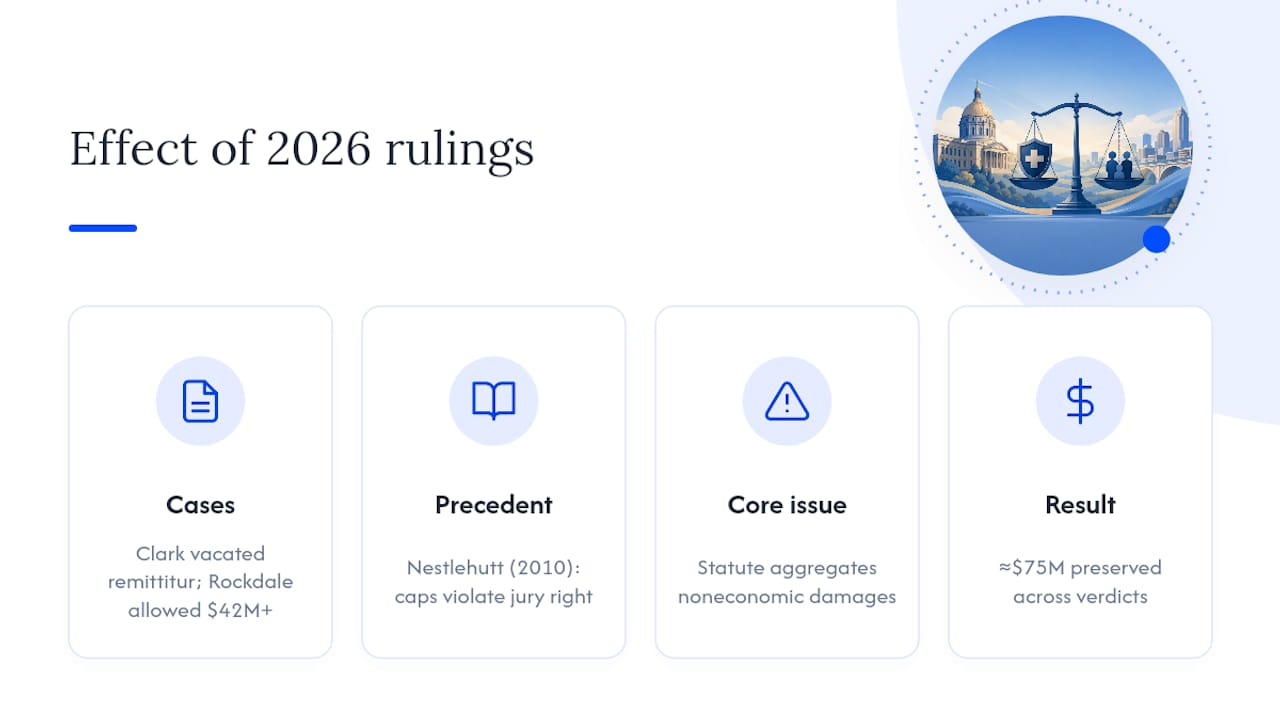
The companion Rockdale case involved a jury verdict exceeding $42 million. Rather than trimming it to conform with the aggregate caps in the statute, the Court let the award stand, reasoning that any attempt to apply the statute would improperly overwrite a jury’s factual findings on a portion of damages the Georgia Constitution protects.
Both rulings lean heavily on Atlanta Oculoplastic Surgery v. Nestlehutt, the 2010 decision that first struck down Georgia’s malpractice cap as a violation of the state constitution’s right to a jury trial. Nestlehutt held that a legislature cannot cap what a jury has already decided a plaintiff’s pain and suffering is worth. The 2026 Court didn’t just reaffirm that holding, it applied it to a much thornier problem: what happens when a single verdict blends protected and unprotected damages together.
The majority opinion lays out the core issue plainly: the statute lumps every category of noneconomic loss into one aggregated figure, with no built-in mechanism for separating a jury’s protected pain-and-suffering finding from any other component of the award. Courts cannot rewrite the statute to create that carve-out themselves.
That aggregation problem is the crux of it. Because OCGA § 51-13-1 treats noneconomic damages as one lump figure rather than itemized categories, a court applying the cap would necessarily be cutting into the protected portion too, something Nestlehutt already forbids. The result, as Law noted, preserved roughly $75 million combined across the affected verdicts.
What Does the Georgia Malpractice Cap Statute Actually Say?
Before the 2026 rulings, most people encountered Georgia’s malpractice damages limit as a single number. The statute itself is more layered than that, and understanding its structure helps explain why the courts had to intervene.
OCGA § 51-13-1(a)(4) defines “noneconomic damages” broadly, covering pain and suffering, loss of consortium, loss of enjoyment of life, and similar nonpecuniary harms that don’t come with a receipt or a paycheck stub attached.
On paper, the numeric structure looks like this:
- $350,000 against a single healthcare provider or facility.
- $700,000 total when multiple healthcare facilities share liability.
- $1,050,000 as the aggregate ceiling regardless of how many defendants are involved.
Statutory detail worth knowing: subsection (f) of the statute requires that when a future-damages award reaches $350,000 or more, the court can order periodic payments funded through an annuity rather than a single lump-sum check. That provision wasn’t touched by the 2026 rulings and still governs how large future-damages awards get paid out over time, even as the noneconomic cap itself sits unenforceable in most pain-and-suffering cases.
What These Rulings Mean If You’re Pursuing a Malpractice Claim
If you’re weighing whether to pursue a claim, the practical takeaway is straightforward: a jury that finds real, provable pain and suffering is now far more likely to have that number actually stand. But a bigger potential recovery doesn’t lower the bar for proving your case.
- You still have to prove the underlying negligence. Breach of the standard of care, causation linking that breach to your injury, and demonstrable damages remain the three pillars of any Georgia malpractice claim, cap or no cap.
- Expect different behavior from insurers and defense counsel. With less certainty that a large verdict will get trimmed on appeal, insurers and providers may push harder for early settlement in strong cases, while defending harder on liability itself in weaker ones.
- Wrongful-death-only claims sit in a gray zone. If a loved one died without any period of conscious pain and suffering beforehand, it’s not yet settled whether the statutory cap could still apply to that claim. Legal commentary from Phelps flags this as the next major battleground in Georgia malpractice litigation.
Pro Tip: If your case involves a loved one’s death, ask your attorney early whether your claim includes a pre-death pain-and-suffering component. That distinction alone can determine whether your damages face any statutory ceiling at all.
For families navigating a fatal malpractice case, our guide on damages in Georgia wrongful death claims breaks down how these categories are calculated and argued.
What Should You Do Right Now If You Suspect Malpractice?
Legal doctrine only helps you if you act while your evidence is still fresh and your claim is still timely. Here’s where to start.
- Preserve every medical record. Request complete charts, imaging, and provider notes before facilities purge or lose them.
- Document your daily life. Keep a journal of pain levels, missed work, and activities you can no longer do; this record becomes central to proving noneconomic damages now that juries can award them without an artificial ceiling.
- Track every bill. Medical costs, future care estimates, and lost income all fall under economic damages and require their own proof separate from pain and suffering.
- Know your deadline. Georgia generally gives injured parties a limited window to file, and wrongful-death claims carry their own countdown, detailed in our Georgia wrongful death guide.
- Talk to an attorney early, even if you’re not sure you have a case.
- Bring all medical records, bills, and correspondence with providers to your first consultation.
- Ask about contingency-fee arrangements, most malpractice firms, including ours, only get paid if you recover compensation.
- Expect an investigation phase involving medical experts before any trial date gets set.
Pro Tip: If your case involves a large future-damages award, ask your attorney how a court-ordered annuity payment might affect your long-term financial planning, since periodic payments spread out compensation rather than delivering it all at once.
Our overview of how malpractice claims get proven in Georgia covers what evidence carries the most weight during an investigation.
Where Did Georgia’s Malpractice Cap Come From?
Georgia lawmakers passed the original noneconomic damages cap in 2005 as part of a broader tort reform push, driven by arguments that rising malpractice insurance premiums were pushing physicians, particularly obstetricians and surgeons, out of the state or out of high-risk specialties altogether. The legislature’s stated goal was to stabilize the malpractice insurance market and keep more doctors practicing in Georgia, especially in rural areas already short on specialists.
The bill capped noneconomic damages at $350,000 per provider, with higher aggregate limits when multiple facilities were involved, mirroring similar reforms passed in other states around the same period. Supporters framed it as a way to curb unpredictable jury verdicts that they argued were driving up the cost of practicing medicine. Critics countered that the cap punished the most severely injured patients, since noneconomic damages tend to matter most in catastrophic cases involving permanent disability, disfigurement, or death.
That tension came to a head just five years later. In 2010, the Georgia Supreme Court’s Nestlehutt decision struck the cap down as applied to jury verdicts, ruling that it violated the state constitution’s guarantee of a jury trial by letting a legislature override a jury’s own factual findings. The statute itself was never repealed, it simply became unenforceable against the very type of award it was designed to limit, a legal contradiction that set the stage for the 2026 rulings.
How Does Georgia’s Cap Compare to Other States?
Georgia isn’t alone in trying to cap noneconomic damages, but its constitutional collision with Nestlehutt and the 2026 rulings puts it in a distinct category. States generally fall into a few buckets on this issue.
Some states, like California, cap noneconomic damages by statute and have had those caps upheld by their own courts, though California’s legislature has since raised its cap on a phased schedule. Other states, including Florida and Illinois, saw their own malpractice caps struck down by state supreme courts on similar jury-trial or equal-protection grounds, closely paralleling Georgia’s path. A third group of states never adopted noneconomic caps for malpractice at all, leaving jury awards fully intact by design.
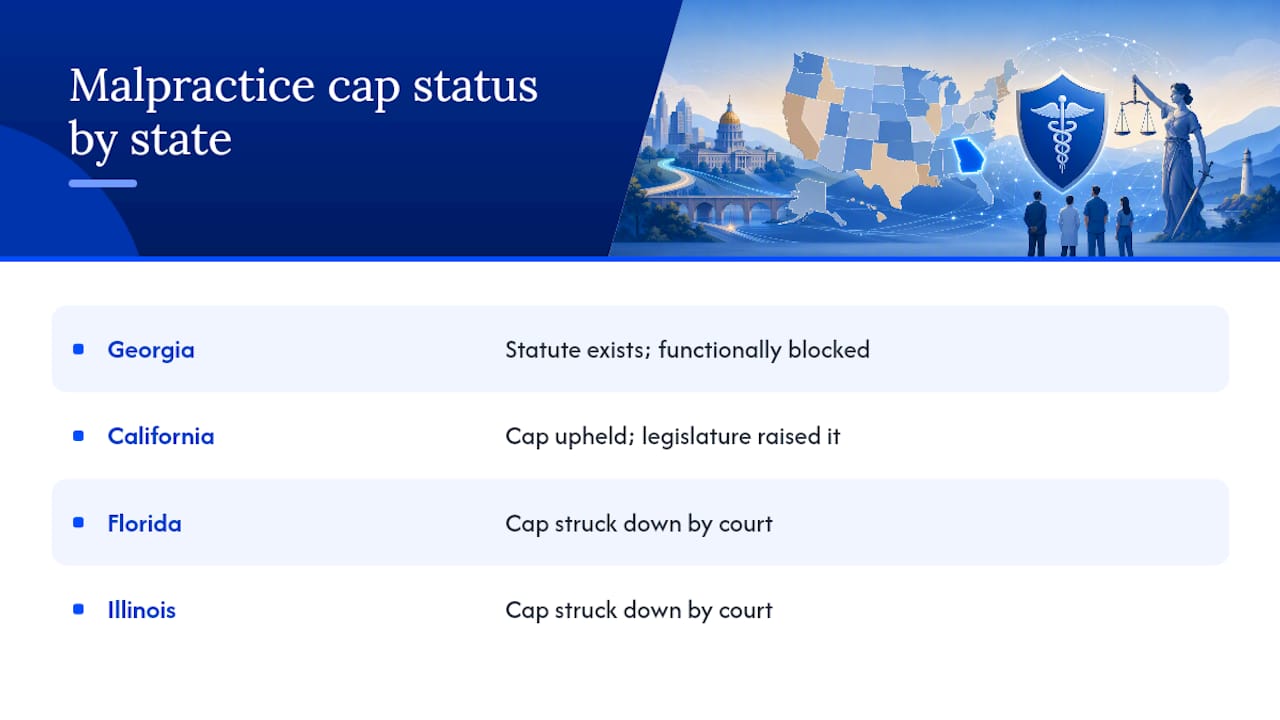
Georgia now sits in an unusual middle position: the cap statute remains written into law, but Georgia Supreme Court precedent has made it functionally inapplicable in cases involving protected pain-and-suffering findings. That’s different from a state that repealed its cap outright, and different from one where the cap simply never existed. For Georgians, the practical effect looks similar to living in a state with no cap at all, provided the claim includes a pain-and-suffering component that a jury can independently weigh.
What This Means for Doctors, Hospitals, and Insurance Costs
Every conversation about malpractice caps eventually turns to insurance premiums, and for good reason. The original 2005 cap was sold as a way to hold down what doctors pay for malpractice coverage, and insurers priced their policies for years around the assumption that noneconomic exposure was capped at $350,000 per provider.
The 2026 rulings change that math. With the cap unenforceable in most pain-and-suffering cases, insurers now face genuine uncertainty about how high a single verdict could climb. That uncertainty typically shows up in one of two ways: insurers raise premiums to build in a larger buffer for catastrophic verdicts, or they get more aggressive about settling strong claims early to avoid the risk of an uncapped jury award at trial.
Hospitals and physician groups, particularly those in high-risk specialties like obstetrics, neurosurgery, and emergency medicine, are likely to feel this first. These are the specialties where catastrophic injury claims, and the pain-and-suffering damages that come with them, tend to be highest. Whether this translates into materially higher premiums across Georgia’s healthcare system will depend partly on how insurers price risk going forward and partly on how many future verdicts follow the pattern set by Clark and its companion case. For now, providers and their carriers are operating with far less certainty than they had a year ago.
What the Data Shows About Malpractice Claims and Damages
Precise, current claims data broken out by Georgia county or verdict size isn’t something insurers or courts publish in real time, which makes it hard to say exactly how many pending Georgia cases will be affected by the 2026 rulings. What’s clear from the cases already decided is the scale involved: the two June 2026 rulings alone preserved roughly $75 million in combined jury awards that would otherwise have been reduced to a fraction of that amount under the statutory cap.
That $75 million figure matters because it illustrates the gap between what a capped system produces and what a jury actually finds when asked to value a person’s suffering. Under the old capped framework, those same verdicts would have been reduced to somewhere between $350,000 and $1,050,000 depending on how many defendants were involved, regardless of what the jury concluded the harm was actually worth.
Malpractice cases involving catastrophic injury, permanent brain damage, paralysis, wrongful death with documented pre-death suffering, are the ones most likely to see this dynamic play out, since they’re where noneconomic damages historically dwarfed economic damages like medical bills and lost wages. Georgia’s rising verdict trends in personal injury litigation generally reflect a broader pattern of juries awarding higher noneconomic figures across case types, not just malpractice.
The Ongoing Debate Over Malpractice Caps in Georgia
The argument over whether Georgia should cap malpractice damages hasn’t gone away just because the courts effectively neutered the statute. If anything, the 2026 rulings have sharpened both sides of the debate.
Advocates for caps, largely medical associations and insurance industry groups, argue that unpredictable, uncapped verdicts drive up malpractice premiums, which in turn drive doctors away from high-risk specialties or out of the state entirely. They point to rural Georgia’s ongoing shortage of obstetricians and surgeons as evidence that cost pressures on providers have real consequences for patient access to care.
Opponents, including patient-advocacy groups and much of the plaintiffs’ bar, argue that caps disproportionately punish the most severely injured patients: children with permanent disabilities, people left paralyzed, families who lost a loved one. They argue a jury, having heard the full evidence of a person’s suffering, is better positioned to value that harm than a number set by legislators two decades ago and never adjusted for inflation.
Georgia’s constitutional structure has effectively sided with the second view for cases involving jury-protected pain-and-suffering findings. Whether the legislature attempts to rewrite the statute to survive constitutional scrutiny, perhaps by itemizing damage categories rather than aggregating them, remains an open question worth watching in future sessions.
Economic Damages vs. Noneconomic Damages Under Georgia Law
Georgia law draws a sharp line between two categories of harm, and that line is exactly what the 2026 rulings turn on. Economic damages cover the losses you can put a dollar figure on with a receipt: medical bills, future medical care, lost wages, lost earning capacity, and out-of-pocket costs tied directly to the injury. These have never been subject to any statutory cap in Georgia, regardless of how large they get.
Noneconomic damages, by contrast, cover harm that doesn’t come with an invoice: pain and suffering, loss of enjoyment of life, disfigurement, and loss of consortium. These are the damages OCGA § 51-13-1 attempted to cap, and they’re the category the Georgia Supreme Court has now shielded from that cap whenever a jury’s protected findings are part of the verdict.
The practical distinction matters enormously for how a malpractice case gets built. Economic damages require documentation: bills, wage records, expert projections of future care costs. Noneconomic damages require a different kind of proof entirely, testimony, medical records describing ongoing impairment, and often expert witnesses who can speak to the long-term quality-of-life impact of an injury. Since uncapped noneconomic damages now flow more directly from what a jury believes, building a compelling record of pain, suffering, and lost quality of life has become one of the more consequential parts of case preparation.
How Jewkesfirm Approaches Cases After the 2026 Rulings
These rulings change how we build a case from day one. When protected pain-and-suffering damages are on the table, documenting the real, lived impact of an injury, not just the medical bills, becomes central to case strategy, and that means working closely with medical experts who can speak credibly to long-term impairment.
Jewkesfirm has built its practice around free consultations and contingency fees: you pay nothing unless we recover compensation for you. We serve clients across South Atlanta and the surrounding Georgia counties, and every case starts with the same commitment, a thorough evaluation of what your claim is actually worth under the law as it stands today, not as it stood before these decisions came down.
— Ali
Get a Free Case Review From a Georgia Malpractice Attorney
If a doctor, hospital, or healthcare provider’s negligence caused you or a loved one serious harm, the legal landscape just shifted in your favor, and waiting to find out how it applies to your case only makes it harder to gather evidence while it’s fresh. Jewkesfirm gives injured Georgians a real path forward: a free consultation, no upfront cost, and a contingency-fee structure that means you pay nothing unless we win your case.

Bring what you have, medical records, bills, provider correspondence, and any notes on how the injury has changed your daily life, and we’ll walk you through what your claim could realistically be worth given the current state of Georgia law. We serve clients throughout South Atlanta and the surrounding counties, and our team handles everything from initial investigation through trial if your case requires it. Visit Jewkesfirm to schedule your free case review and find out where you stand.
Key Documents on the Georgia Malpractice Cap
- OCGA § 51-13-1 statutory text
- Georgia Supreme Court opinion, June 2026
- Law and Phelps rulings summaries
This article is general information, not a substitute for advice from a qualified lawyer. Consult a qualified legal professional about your own circumstances before acting on anything here.
Sources
- 2024 CODE OF GEORGIA Title 51 – TORTS (§§ 51-1-1 — 51-16-5) Chapter 13 – LIMIT ON NONECONOMIC DAMAGES IN MEDICAL MALPRACTICE ACTIONS (§ 51-13-1) Section 51-13-1
- Law
- Supreme Court of Georgia opinion (June 2026)
- Georgia Supreme Court keeps non-economic damages uncapped in medical malpractice cases | Phelps