

Key Takeaways
- Georgia’s modified comparative negligence law bars recovery if fault is 50% or higher.
- Proving negligence requires establishing duty, breach, causation, and damages with solid evidence.
- Timely documentation and early legal advice are crucial to protect your injury claim.
If you were hurt in an accident in Georgia, you might assume that as long as the other party was mostly at fault, you will be compensated. That assumption can cost you everything. Georgia follows a modified comparative negligence rule, meaning that if you are found 50% or more at fault, you recover nothing at all. Not a reduced amount. Zero. Most accident victims never see this coming. This guide walks you through what negligence means under Georgia law, how fault is calculated, what defenses you will face, and the steps you can take right now to protect your right to compensation.
Table of Contents
- What negligence means in Georgia personal injury cases
- How Georgia’s comparative negligence rule affects your claim
- Proving negligence and handling defenses in your case
- Special situations: Premises liability and medical malpractice claims
- Our perspective: The biggest mistake Georgia claimants make about negligence
- Get personalized legal help for your Georgia injury claim
- Frequently asked questions
Key Takeaways
| Point | Details |
|---|---|
| Georgia’s 50% fault rule | If you are judged 50% or more responsible in an accident, you cannot collect damages. |
| Proving negligence | You must show duty, breach, causation, and damages to win a personal injury claim. |
| Prompt evidence matters | Gathering quality evidence early on greatly increases your chance for a successful outcome. |
| Special case proof | Medical malpractice and slip-and-fall incidents have unique requirements, including expert affidavits and specific evidence of property conditions. |
| Legal guidance helps | Personal injury laws in Georgia are complex, so consulting an attorney can protect your rights and maximize compensation. |
What negligence means in Georgia personal injury cases
To start, let’s get clear on what “negligence” actually means in the context of Georgia personal injury law. Negligence is not just carelessness in a general sense. It is a specific legal standard with four distinct elements that every plaintiff must prove to win a claim. Understanding personal injury law basics is the first step toward protecting yourself after an accident.
Here are the four elements you must establish:
- Duty: The defendant had a legal obligation to act with reasonable care toward you.
- Breach: The defendant failed to meet that standard of care.
- Causation: That failure directly caused your injury.
- Damages: You suffered real, measurable harm as a result.
Plaintiffs bear the burden to prove all four negligence elements. Miss even one, and your claim fails regardless of how badly you were hurt. That is not a technicality. It is the foundation of every personal injury case in Georgia.
Georgia law also recognizes different types of negligence, each carrying different weight:
| Type | Definition | Example |
|---|---|---|
| Basic negligence | Failure to use ordinary care | Running a red light |
| Gross negligence | Extreme disregard for safety | Drunk driving at high speed |
| Negligence per se | Violating a safety statute | Speeding in a school zone |
Negligence per se is particularly powerful. If a defendant violated a law designed to protect people like you, that violation can be treated as automatic proof of breach. You still need to prove causation and damages, but the breach element is essentially established for you.
Knowing the injury lawsuit steps in Georgia early gives you a real advantage. Evidence fades, witnesses forget details, and surveillance footage gets deleted. The stronger your documentation from day one, the harder it becomes for the other side to challenge your account.
Pro Tip: Start a dedicated folder, physical or digital, the moment after your accident. Save every medical bill, photo, police report, and communication with insurance companies. This habit alone can significantly strengthen your negligence claim.
How Georgia’s comparative negligence rule affects your claim
Now that you understand what negligence is, let’s examine how Georgia’s comparative negligence rule decides your right to compensation. This is where many Georgia accident victims get blindsided.
Georgia uses a modified comparative negligence system. Here is how it works in plain terms:
- The court assigns a percentage of fault to each party involved.
- If your fault percentage is below 50%, your damages are reduced by that percentage.
- If your fault percentage reaches 50% or more, you receive nothing.
Plaintiffs less than 50% at fault can recover reduced damages proportional to the defendant’s fault, but 50% or more bars recovery entirely.
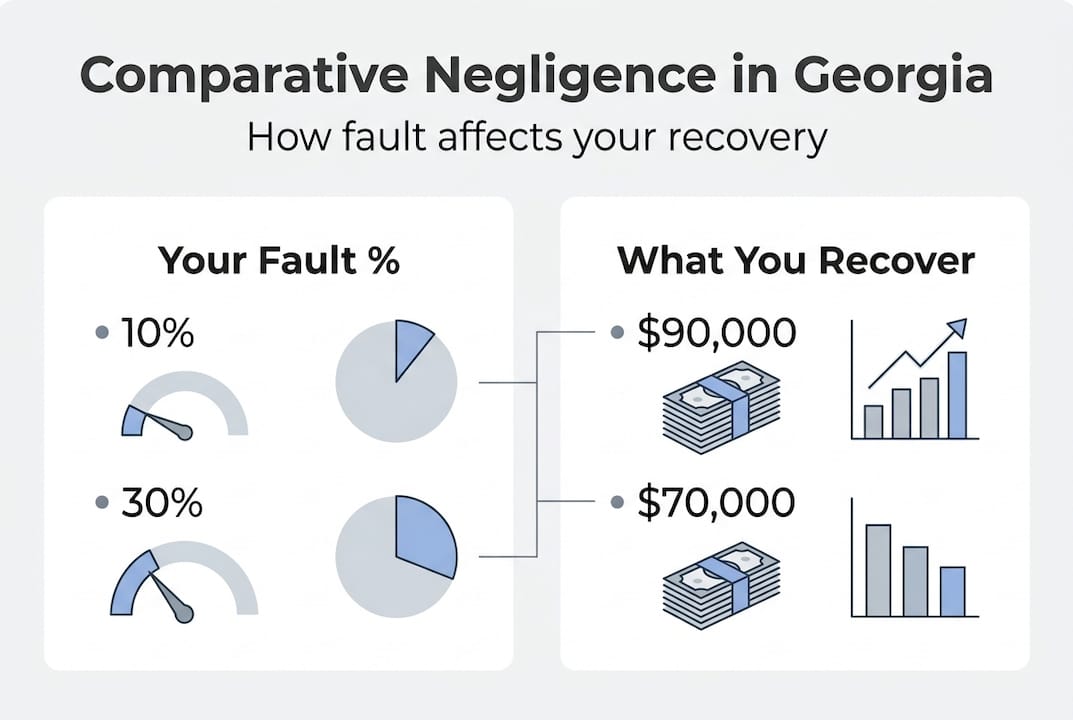
Let’s make this concrete with numbers:
| Your fault % | Total damages | What you actually recover |
|---|---|---|
| 10% | $100,000 | $90,000 |
| 30% | $100,000 | $70,000 |
| 49% | $100,000 | $51,000 |
| 50% | $100,000 | $0 |
That single percentage point between 49% and 50% is the difference between recovering over $51,000 and walking away with nothing. Insurance companies know this. They use it strategically.
Insurers often work to push your assigned fault percentage as high as possible. They may point to your speed, your distraction, your failure to avoid the hazard, or even your clothing in a pedestrian case. Every detail you shared in a recorded statement can be used to nudge that number upward.
When multiple parties are involved, things get more complicated. Each defendant’s share of fault is calculated separately. You can still recover from a defendant who is even 1% at fault, but only for their proportional share. Understanding the Georgia 50% fault rule in detail is critical before you accept any settlement offer.
Important: Never admit partial fault to an insurance adjuster, even casually. Phrases like “I was also distracted” or “maybe I could have stopped sooner” can be used to increase your fault percentage and reduce or eliminate your recovery.
Proving negligence and handling defenses in your case
Understanding the rules is important, but knowing how to prove negligence and defending against the arguments you will face is where many claims are won or lost.
Plaintiffs must prove all four elements, and defendants often argue comparative fault or plaintiff knowledge to undermine those elements. Here is what strong evidence looks like for each:
- Duty: Establish the relationship. A driver owes a duty to other road users. A store owner owes a duty to customers.
- Breach: Use police reports, traffic camera footage, witness statements, and expert testimony to show what the defendant did wrong.
- Causation: Medical records linking your injuries directly to the accident are essential. Gaps in treatment can be used against you.
- Damages: Document every expense, lost wage, and medical procedure. Pain and suffering claims need consistent, detailed records.
Two defenses come up repeatedly. First, comparative fault, where the defendant argues you contributed to your own injury. Second, the “knew or should have known” defense, where they claim you were aware of the hazard and chose to proceed anyway. Both can reduce or eliminate your recovery.

Timing matters enormously. Act within the 2-year statute of limitations under O.C.G.A. § 9-3-33. Miss that deadline and your case is gone, regardless of how strong it is. Two years sounds like plenty of time, but evidence disappears fast.
Reviewing accident claim examples from similar Georgia cases can help you understand what documentation courts find most persuasive. You can also learn more about handling accident claims to avoid common mistakes that weaken cases before they even reach an attorney.
Pro Tip: Photograph the scene from multiple angles immediately after the accident, including skid marks, signage, lighting conditions, and any visible hazards. These details are nearly impossible to recreate later and can directly counter a comparative fault argument.
Special situations: Premises liability and medical malpractice claims
Some types of injury cases in Georgia have unique twists on the negligence rules. Here is what to watch for in two of the most common scenarios.
Premises liability (slip and fall)
When you are injured on someone else’s property, the case hinges on what the owner knew or should have known about the hazard. Georgia courts distinguish between two types of knowledge:
| Knowledge type | Definition | Example |
|---|---|---|
| Actual knowledge | Owner was directly aware of the hazard | Employee reported a wet floor |
| Constructive knowledge | Owner should have discovered it through reasonable inspection | Spill present for hours with no check |
In premises liability, owners owe ordinary care to invitees, and actual versus constructive knowledge of hazards is central to the case. If you knew about the danger and proceeded anyway, your recovery may be barred entirely.
Key factors that affect premises liability claims:
- How long the hazard existed before your fall
- Whether the owner had a regular inspection routine
- Whether warning signs were posted
- Your own familiarity with the area
For a detailed breakdown of your rights, the slip and fall law in Georgia guide covers current 2026 standards. Also note that slip and fall time limits apply here too, so prompt action matters.
Medical malpractice
Medical malpractice is a different animal entirely. Medical malpractice requires an expert affidavit by law, a higher standard than general negligence cases. Before you can even file, you need a qualified medical expert to review your case and sign an affidavit confirming that the provider deviated from the accepted standard of care.
This requirement exists because courts recognize that medical decisions are complex. Without expert backing, your case will be dismissed at the outset. Many Georgia malpractice claims are lost not because the negligence did not happen, but because the evidentiary bar was not cleared from the start.
Our perspective: The biggest mistake Georgia claimants make about negligence
Having seen dozens of Georgia negligence cases up close, there is a recurring pattern we think anyone with a claim needs to understand. Most people walk into the process believing that if the other party was clearly more at fault, the outcome will reflect that. It often does not.
Insurance companies are not neutral fact finders. They are businesses protecting their bottom line. Their adjusters are trained to find anything that shifts blame toward you, even partially. A casual comment, a delayed doctor visit, or a prior injury can all be used to push your fault percentage higher.
The uncomfortable truth is that proving negligence is not just about what happened. It is about surviving a sustained effort to reframe what happened. Strong early documentation is your best shield against that. Getting legal advice before you speak with any insurer is not paranoia. It is strategy.
We have seen clients with legitimate, serious injuries lose significant portions of their recovery simply because they assumed fault was obvious and did not protect their position early. Learning about hiring a Georgia injury lawyer before you need one is the kind of preparation that pays off when it counts most.
Get personalized legal help for your Georgia injury claim
Georgia’s negligence laws are detailed, and the stakes are high. A single percentage point in fault can mean the difference between full compensation and nothing at all.

If you found this overview helpful but still have questions about your case, jewkesfirm is here to help. Our attorneys understand Georgia’s comparative negligence rules inside and out, and we fight to make sure your fault percentage stays where it belongs. You can speak with a Georgia personal injury attorney at no cost through our free consultation. We work on contingency, meaning you pay nothing unless we win. If you want guidance on choosing the right advocate, our guide to finding the right lawyer is a strong starting point. Your recovery matters. Let’s protect it.
Frequently asked questions
What are the four elements of negligence in a Georgia personal injury case?
All four elements, duty, breach, causation, and damages, must be proven for a successful claim. Failing to establish even one element means your case does not move forward.
Can I receive compensation if I was partly at fault for my injury in Georgia?
Yes, as long as your share of fault is below 50%. At 50% or more at fault, Georgia law bars you from recovering any damages at all.
What is the statute of limitations to file a personal injury lawsuit in Georgia?
Under O.C.G.A. § 9-3-33, you generally have 2 years from the date of your injury to file a lawsuit. Missing this deadline ends your right to pursue compensation.
What makes medical malpractice different from other negligence cases in Georgia?
Medical malpractice claims require a signed expert affidavit before filing, confirming the provider deviated from the standard of care. This requirement does not apply to standard negligence cases.
How does property owner knowledge affect a slip-and-fall personal injury claim?
Premises liability cases depend on whether the owner had actual or constructive knowledge of the hazard. If you knew more about the danger than the owner did, your ability to recover may be significantly reduced or eliminated.
Recommended
- How to file injury lawsuit in Georgia: step-by-step 2026
- Georgia Auto Accident Liability: 50% Fault Rule Explained
- Personal injury law guide for South Atlanta victims 2026
- Why hire an injury lawyer in South Atlanta: maximize claim