

After a car accident in Georgia, many victims assume fault is obvious. The reality is far more complex. Georgia operates under a modified comparative negligence system that can dramatically affect your compensation. If you’re found 50% or more at fault, you recover nothing. Understanding how liability works isn’t just helpful, it’s essential to protecting your rights and maximizing your claim.
Table of Contents
- What is auto accident liability?
- Georgia’s modified comparative negligence rule
- How liability is determined after an accident
- Common misunderstandings about Georgia liability
- What victims can do to protect themselves
- Get expert legal support for your auto accident claim
- Frequently asked questions
Key Takeaways
| Point | Details |
|---|---|
| Georgia uses modified comparative negligence | You can recover damages if you’re less than 50% at fault, but your compensation is reduced by your fault percentage. |
| Liability determination is complex | Insurers, police, and courts all play roles in deciding responsibility — evidence and expert advice are crucial. |
| Prompt legal action maximizes compensation | Documenting everything and seeking expert guidance quickly may significantly improve your recovery. |
| Common pitfalls can harm your claim | Avoid recorded statements and mistakes after an accident to protect your interests. |
What is auto accident liability?
Liability means legal responsibility for damages after an accident. In Georgia, this determines who pays for medical bills, lost wages, vehicle repairs, and pain and suffering. Unlike no-fault states where your own insurance covers you regardless of blame, Georgia follows a fault-based system. The at-fault driver’s insurance typically pays for the victim’s losses.
Who decides liability? Initially, police officers document the scene and may note violations or contributing factors in their report. Insurance adjusters then investigate, reviewing evidence like photos, witness statements, and traffic laws. If disputes arise, courts make the final determination. Each party’s degree of fault directly impacts compensation under Georgia law.
Key liability factors include:
- Traffic violations (speeding, running red lights, failure to yield)
- Distracted or impaired driving
- Road conditions and weather
- Vehicle maintenance issues
- Witness testimony and physical evidence
Georgia is a fault-based state with modified comparative negligence under O.C.G.A. § 51-12-33. This statute governs how fault percentages affect your ability to recover damages. Understanding this framework is critical before filing any accident claim.
“In Georgia, your percentage of fault directly reduces your compensation, but cross the 50% threshold and you lose everything. This makes accurate liability determination absolutely critical for accident victims.”
Georgia’s modified comparative negligence rule
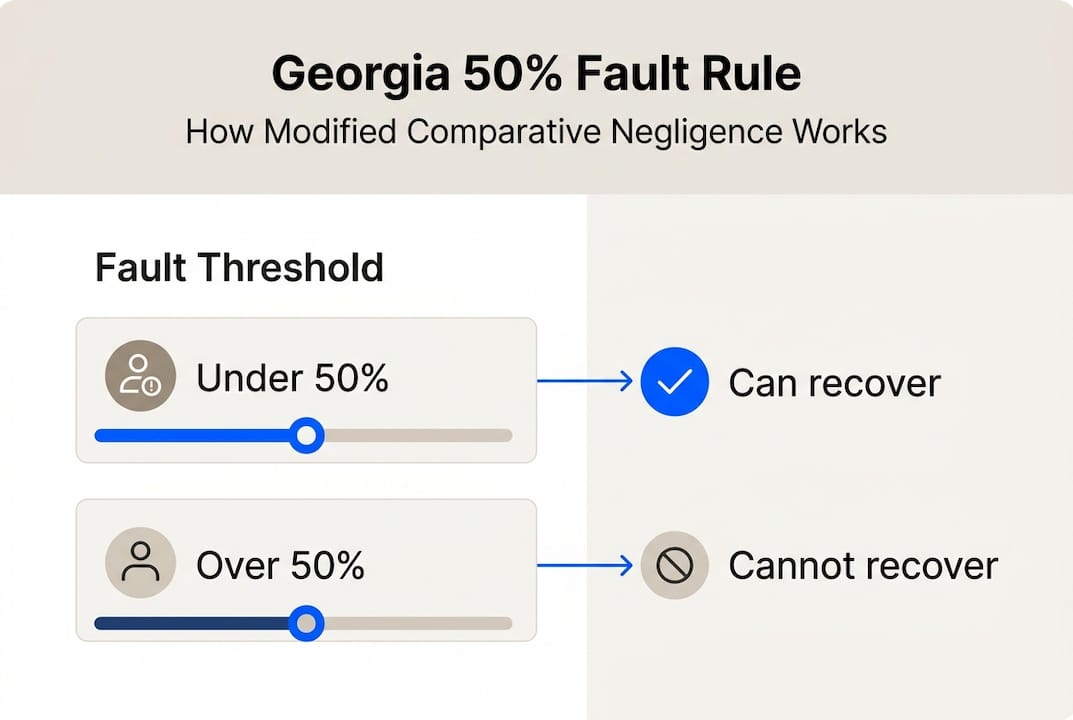
Georgia uses a modified comparative negligence system, which differs significantly from pure comparative negligence states. Under the modified rule, victims less than 50% at fault recover damages reduced by their fault percentage. However, if you’re 50% or more at fault, you cannot recover any damages.
Here’s how it works in practice. Suppose you suffer $100,000 in damages. If you’re found 20% at fault, you recover $80,000. If you’re 49% at fault, you still recover $51,000. But at 50% fault or higher, you get nothing, regardless of your injuries or losses.
Comparison of negligence systems:
| System Type | Georgia’s Rule | Pure Comparative | Contributory Negligence |
|---|---|---|---|
| Recovery if 30% at fault | Yes, reduced by 30% | Yes, reduced by 30% | No recovery |
| Recovery if 50% at fault | No recovery | Yes, reduced by 50% | No recovery |
| Recovery if 51% at fault | No recovery | Yes, reduced by 51% | No recovery |
| States using system | Georgia, 32 others | 13 states | 4 states + DC |
This 50% bar creates high stakes in liability disputes. Insurance companies know this and often fight aggressively to push your fault percentage above the threshold. Even a few percentage points can mean the difference between substantial compensation and walking away with nothing.
Critical statistic: In modified comparative negligence states, settlement values drop an average of 67% when victim fault reaches 40-49%, as insurers leverage the proximity to the 50% bar.
Understanding how to handle accident claims under this system requires careful evidence management and strategic negotiation. The burden falls on you to prove the other driver’s greater fault.
How liability is determined after an accident
Liability determination follows a specific process, and understanding each step helps you protect your interests. Here’s the typical sequence:
-
Police investigation: Officers arrive, document the scene, interview parties and witnesses, note visible damage, and check for violations. Their report, while not conclusive, carries significant weight.
-
Evidence collection: Photos of vehicle damage, skid marks, traffic signals, and injuries form the foundation. Witness contact information and statements preserve crucial testimony.
-
Insurance claim filing: You notify your insurer and file a claim against the at-fault driver’s policy. Both insurers assign adjusters to investigate.
-
Adjuster investigation: Insurers use adjusters and experts to shift blame. They review evidence, take statements, and calculate damages. Their goal is minimizing payout.
-
Negotiation: Adjusters present settlement offers based on their liability assessment. This is where fault percentages get debated and compensation amounts determined.
-
Legal action (if needed): When negotiations fail, filing a lawsuit allows courts to make binding liability determinations through evidence presentation and expert testimony.
Insurers employ specific tactics to shift liability onto victims. They request recorded statements hoping you’ll say something damaging. They downplay their insured’s violations while magnifying any mistake you made. They delay investigations, hoping evidence disappears or memories fade.
Pro Tip: Never give a recorded statement to the other driver’s insurance company without legal advice. Adjusters are trained to ask questions that elicit responses they can use against you. Politely decline and consult an attorney first.
Prompt action matters enormously. Skid marks fade, witnesses forget details, and surveillance footage gets deleted. Gathering evidence immediately after an accident preserves the facts before they disappear. Seeking legal advice after an accident early in the process helps you avoid costly mistakes and strengthens your position.

Documentation should include photos from multiple angles, contact information for all witnesses, medical records linking injuries to the accident, repair estimates, and copies of all correspondence with insurers. This evidence forms the foundation of your liability argument.
Common misunderstandings about Georgia liability
Many accident victims hold misconceptions that hurt their claims. Understanding the truth helps you navigate the process effectively.
Misconception 1: Fault is all or nothing. Many people assume one driver is 100% at fault while the other bears no responsibility. In reality, pure vs. modified comparative systems recognize that multiple parties often share fault. Georgia law allows for split liability, with percentages assigned to each driver.
Misconception 2: The police report determines fault. While police reports carry weight, they’re not legally binding. Insurers and courts conduct independent investigations. Officers sometimes get facts wrong or lack complete information when writing reports.
Misconception 3: You can recover all damages regardless of fault. This might be true in pure comparative negligence states, but Georgia’s modified system bars recovery at 50% fault. Your compensation gets reduced proportionally even below that threshold.
Misconception 4: Minor violations don’t affect liability. Even small infractions like failing to signal or slightly exceeding the speed limit can increase your fault percentage. Insurers scrutinize every detail to shift blame.
“The difference between 49% and 50% fault isn’t just one percentage point. It’s the difference between reduced compensation and zero compensation. That’s why accurate liability determination is worth fighting for.”
Key differences from neighboring states:
- Florida uses pure comparative negligence, allowing recovery even at 99% fault
- Alabama and North Carolina follow contributory negligence, barring recovery at any fault
- Tennessee uses modified comparative with a 50% bar like Georgia
- South Carolina uses modified comparative with a 51% bar, slightly more favorable to victims
These variations matter if your accident occurred near state lines or involved out-of-state drivers. Jurisdiction can affect which state’s laws apply. Understanding personal injury law in Georgia specifically helps you set realistic expectations and build stronger claims.
What victims can do to protect themselves
Taking the right steps immediately after an accident dramatically improves your chances of favorable liability determination and maximum compensation.
Essential actions after an accident:
-
Ensure safety first: Move to a safe location if possible, check for injuries, and call 911. Your health takes priority over everything else.
-
Document everything: Take photos of all vehicles, damage, license plates, the surrounding area, traffic signals, skid marks, and visible injuries. Capture multiple angles and distances.
-
Gather information: Collect names, contact details, insurance information, and license numbers from all drivers. Get contact information from witnesses before they leave.
-
Avoid admitting fault: Don’t apologize or say anything that could be interpreted as accepting blame. Stick to factual descriptions of what happened.
-
Seek medical attention: See a doctor within 24 hours even if you feel fine. Some injuries manifest later, and gaps in treatment hurt your claim.
-
Report promptly: Notify your insurance company quickly, but provide only basic facts. Save detailed discussions for after consulting an attorney.
-
Preserve evidence: Keep damaged clothing, save all medical records and bills, maintain a pain journal, and store all accident-related documents together.
-
Decline recorded statements: Victims should avoid recorded statements to the other driver’s insurer. These recordings are used to minimize your compensation.
Pro Tip: Set up a dedicated folder (physical or digital) for all accident-related documents immediately after the crash. Include a timeline of events while details are fresh. This organization proves invaluable during negotiations or litigation.
Common mistakes that hurt claims:
- Delaying medical treatment, which insurers interpret as proof injuries aren’t serious
- Posting about the accident on social media, providing ammunition for the defense
- Accepting the first settlement offer without understanding full damages
- Missing statute of limitations deadlines (two years in Georgia for most injury claims)
- Trying to handle complex claims without legal guidance
Timeline considerations:
| Action | Recommended Timeframe | Consequence of Delay |
|---|---|---|
| Seek medical care | Within 24 hours | Gaps used to dispute injury causation |
| Report to your insurer | Within 24-48 hours | May violate policy requirements |
| Consult an attorney | Within 1-2 weeks | Evidence degrades, memories fade |
| File injury claim | Before 2-year statute | Lose right to compensation entirely |
| Gather witness statements | Within 1 week | Witnesses become unreachable |
Knowing when to seek legal help makes a significant difference. If you suffered serious injuries, face disputed liability, deal with multiple parties, or encounter an uncooperative insurer, professional guidance becomes essential. Attorneys understand how to counter insurer tactics, properly value claims, and navigate Georgia’s legal system.
Filing a personal injury claim involves specific procedures and deadlines. Missing steps or filing incorrectly can jeopardize your entire claim. Similarly, understanding how to file an injury lawsuit prepares you if settlement negotiations fail.
Your actions in the days and weeks following an accident set the foundation for everything that follows. Protecting yourself means being proactive, thorough, and strategic from the very beginning.
Get expert legal support for your auto accident claim
Navigating Georgia’s modified comparative negligence system requires more than just understanding the rules. It demands strategic evidence presentation, skilled negotiation, and the ability to counter insurer tactics designed to minimize your compensation.
The Jewkes Firm brings dedicated experience to auto accident claims throughout South Atlanta and surrounding Georgia counties. We understand how insurers manipulate fault percentages and fight to keep your liability below the critical 50% threshold. Our approach focuses on thorough evidence gathering, expert witness coordination, and aggressive advocacy that levels the playing field.
Every percentage point of fault matters when it can reduce your compensation or eliminate it entirely. Professional legal support means having someone who knows how to build compelling liability arguments, counter adjuster tactics, and maximize your recovery. We’ve helped countless accident victims secure the compensation they deserve under Georgia’s complex fault system.
Don’t let insurance companies take advantage of your unfamiliarity with liability laws. Expert legal support can mean the difference between a reduced settlement and full compensation. Studies consistently show that seeking legal advice after an accident results in significantly higher settlements, even after attorney fees.
Your path to fair compensation starts with understanding your rights and having experienced advocates in your corner. Contact us for a free consultation to discuss your accident and learn how we can help protect your interests.
Frequently asked questions
What does modified comparative negligence mean for Georgia auto accident victims?
Victims less than 50% at fault can recover damages reduced by their own fault percentage; those 50% or more at fault cannot recover any damages.
How do insurers determine fault after a car accident?
Insurers use adjusters and experts to shift blame by reviewing evidence, taking statements, and investigating the scene. Victims should protect themselves by documenting facts and avoiding recorded statements.
Can you still recover compensation if partially at fault in Georgia?
Yes, but your compensation is reduced by your percentage of fault, and you cannot recover at all if you’re 50% or more at fault under Georgia’s modified comparative negligence rule.
What steps should victims take right after an auto accident in Georgia?
Document everything with photos and witness information, avoid recorded statements to other insurers, gather evidence quickly before it disappears, and consider seeking legal advice to protect your rights.
How long do I have to file an auto accident claim in Georgia?
Georgia’s statute of limitations gives you two years from the accident date to file a personal injury lawsuit. However, you should report to insurers within days and begin the claims process immediately to preserve evidence and protect your rights.