

Many Georgia residents believe you must prove intentional harm to win a slip and fall case. That’s completely wrong. Georgia law requires property owners to maintain safe premises for all visitors, and liability stems from negligence, not intent. If you’ve suffered injuries from a slip and fall accident on someone else’s property, understanding your legal rights under Georgia law is essential for securing fair compensation.
Table of Contents
- Understanding Slip And Fall Liability In Georgia
- Key Elements To Prove Negligence In Slip And Fall Cases
- Types Of Visitors And Liability Differences Under Georgia Law
- Impact Of Comparative Negligence On Slip And Fall Claims In Georgia
Key takeaways
| Point | Details |
|---|---|
| Property owner duty | Georgia law requires owners to maintain safe premises and warn visitors of known hazards. |
| Proving negligence | You must demonstrate the owner knew or should have known about the hazard and failed to address it. |
| Visitor classification matters | Your status as invitee, licensee, or trespasser directly affects the owner’s legal duty and your compensation rights. |
| Comparative negligence rule | Georgia reduces your damages by your percentage of fault if you’re less than 50% responsible. |
| Two year deadline | You have exactly two years from your injury date to file a claim or lose your legal rights permanently. |
Understanding slip and fall liability in Georgia
Slip and fall liability exists when a property owner’s negligence causes someone to trip, slip, or fall and suffer injuries. Georgia law mandates property owners maintain safe conditions and warn visitors about dangers they know exist. This duty isn’t about intentional harm. It’s about failing to fix or warn about hazardous conditions.
The level of care owed depends on your visitor classification. Invitees receive the highest protection because property owners invite them for mutual benefit, like customers in stores. Licensees enter with permission but for their own purposes, such as social guests at homes. Trespassers enter without permission and receive minimal protection except in cases involving children or willful harm.
Common hazards causing slip and fall accidents throughout Georgia include:
- Wet or freshly waxed floors without warning signs
- Uneven sidewalks, cracked pavement, or potholes in parking lots
- Poor lighting in stairwells, hallways, or exterior walkways
- Torn carpeting, loose floorboards, or debris in walkways
- Ice or snow accumulation on steps and entryways
- Broken handrails or missing safety barriers
Understanding these categories helps you evaluate whether you have a valid claim. A customer injured by a spill in a grocery store has stronger legal standing than someone hurt while trespassing on private property. Learning about slip and fall settlements provides insight into how Georgia courts evaluate these cases. The visitor classification framework creates different legal expectations that directly impact your ability to recover damages.
Key elements to prove negligence in slip and fall cases
Winning your slip and fall case requires proving four essential elements. You must show the property owner owed you a duty of care, breached that duty, caused your injuries through that breach, and that you suffered actual damages. Missing even one element can derail your entire claim.
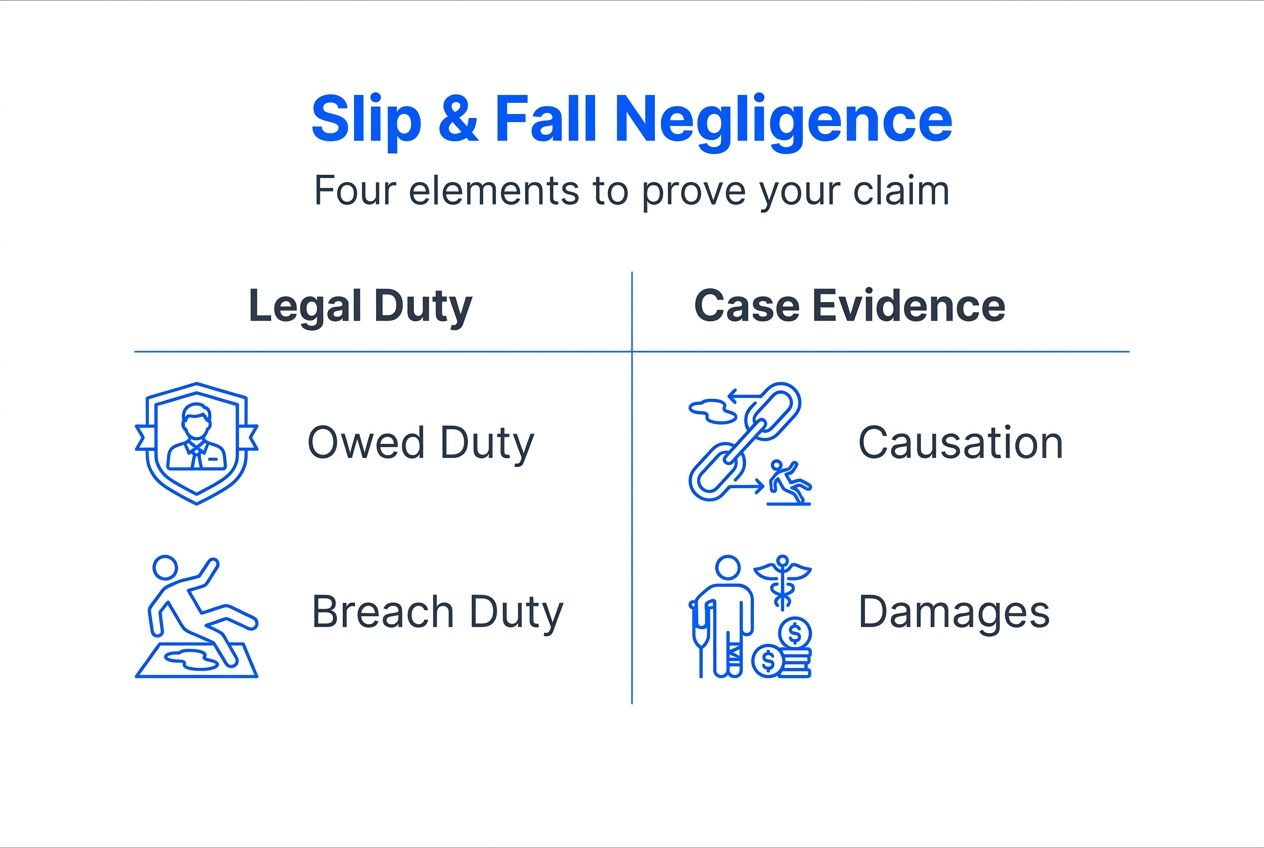
The most critical element is establishing the owner’s knowledge. Proving the property owner either caused or knew about the dangerous condition and failed to address it requires solid evidence. Georgia courts recognize two types of knowledge: actual knowledge, where the owner directly knew about the hazard, and constructive knowledge, where the hazard existed long enough that a reasonable owner should have discovered it.
Collecting strong evidence immediately strengthens your case:
- Photograph the exact hazard location from multiple angles with visible timestamps
- Document your injuries with dated photos showing bruises, swelling, or wounds
- Obtain contact information and written statements from any witnesses present
- Request incident reports from the property owner or manager
- Preserve clothing or shoes worn during the fall as physical evidence
- Keep receipts, medical records, and bills documenting all injury related expenses
Pro Tip: Take photos of the hazard within hours of your fall if physically possible. Conditions change quickly, and property owners may fix hazards or claim they never existed without immediate photographic proof.
Evidence gaps create serious problems for your claim. Without proof the owner knew about the hazard, establishing negligence becomes nearly impossible. Delayed documentation allows defense attorneys to question whether conditions changed or your memory faded. Understanding filing injury claims in Georgia helps you avoid these common pitfalls that weaken otherwise valid cases.
Types of visitors and liability differences under Georgia law
Your legal status when entering property dramatically affects what the owner owes you and what compensation you can pursue. Georgia premises liability law creates three distinct visitor categories with vastly different protection levels.
Invitees receive the strongest legal protection. Property owners must actively inspect for hazards, fix dangerous conditions, and warn invitees about risks they cannot immediately address. Store customers, restaurant patrons, and hotel guests all qualify as invitees. Owners owe them the highest duty of care because the relationship involves mutual benefit.

Licensees enter property with permission but primarily for their own purposes. Social guests visiting friends qualify as licensees. Owners must warn licensees about known hazards but don’t have to inspect actively for unknown dangers. This creates a lower protection standard that can significantly reduce compensation.
Trespassers receive minimal protection. Owners generally owe no duty to trespassers except to avoid willfully harming them. However, special rules apply for child trespassers under the attractive nuisance doctrine, particularly around swimming pools or construction sites.
| Visitor Type | Property Owner’s Duty | Compensation Potential | Common Examples |
|---|---|---|---|
| Invitee | Inspect, fix hazards, provide warnings | Highest recovery for all damages | Store customers, restaurant diners, hotel guests |
| Licensee | Warn of known hazards only | Moderate recovery, limited by knowledge | Social guests, door-to-door salespeople |
| Trespasser | Avoid willful harm | Minimal to none unless attractive nuisance applies | Unauthorized property entrants |
Your classification determines how courts evaluate your case and calculate potential damages. Reporting slip and fall claims in Georgia requires understanding which category applies to your situation. Misidentifying your visitor status can lead to unrealistic expectations about your claim’s value and success probability.
Impact of comparative negligence on slip and fall claims in Georgia
Georgia uses modified comparative negligence rules that directly reduce your compensation based on your share of fault. Understanding this framework prevents surprise when settlement negotiations begin or court verdicts arrive.
Under Georgia’s 50% bar rule, you can only recover damages if you’re less than 50% responsible for your injuries. Your compensation decreases by your exact fault percentage. If you’re 30% at fault, you receive only 70% of total damages. Reach 50% or more fault, and you recover nothing.
Common scenarios where victims share fault include:
- Texting while walking and failing to notice obvious hazards
- Ignoring clearly posted warning signs about wet floors or construction
- Wearing inappropriate footwear like high heels on icy surfaces
- Running or horseplay in areas where walking carefully was expected
- Entering restricted areas marked as off limits to visitors
Many people wrongly believe any fault bars recovery completely. Georgia law actually allows substantial compensation even when you bear partial responsibility. A 20% fault finding still delivers 80% of your damages, which can mean tens of thousands of dollars in serious injury cases.
Pro Tip: Never admit fault at the accident scene or to insurance adjusters. Statements like