
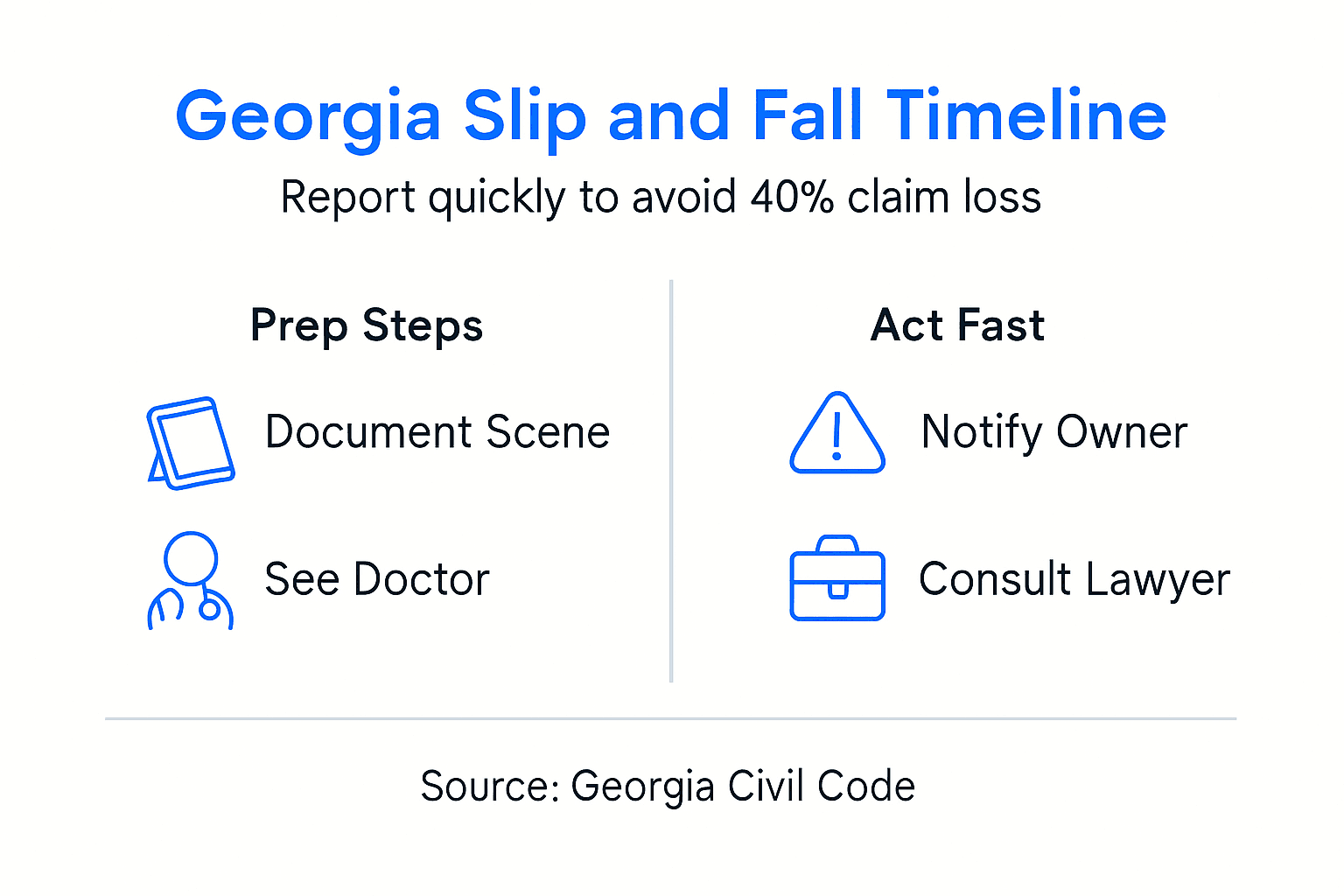
Improper reporting of slip and fall incidents destroys your chances of fair compensation in Georgia. Failure to report quickly leads to 40% reduction in successful claims, yet many victims unknowingly sabotage their cases by missing critical documentation steps. This guide provides specific reporting procedures aligned with Georgia law to protect your legal rights and maximize your settlement potential.
Table of Contents
- Prerequisites: What You Need Before Reporting
- Step 1: Document The Incident Immediately
- Step 2: Notify The Property Owner Or Manager
- Step 3: Consult A Georgia Personal Injury Lawyer
- Common Mistakes And How To Avoid Them
- Expected Timelines And Outcomes
- Get Expert Legal Help With Your Slip And Fall Case
- Frequently Asked Questions
Key Takeaways
| Point | Details |
|---|---|
| Immediate Documentation | Take photos and seek medical evaluation within 24 hours to preserve evidence and establish injury causation. |
| Written Notification | Send detailed written notice to property owners within 48 hours to create a legal record and protect claim validity. |
| Legal Consultation | Contact a Georgia personal injury attorney within 30 days to improve settlement outcomes by 30%. |
| Common Pitfalls | Avoid delayed reporting, missing evidence collection, and skipping medical evaluation that reduce claim success by 25%. |
| Expected Timeline | Most cases resolve in 6 to 12 months when proper reporting procedures are followed from the start. |
Prerequisites: What You Need Before Reporting
Successful slip and fall claims in Georgia require specific preparation and awareness of legal deadlines before you begin the reporting process. Understanding what to gather and when to act ensures you build the strongest possible case from day one.
Your smartphone or camera becomes your most critical tool immediately after the incident. Have it ready to capture detailed images of the hazard that caused your fall, surrounding conditions, and visible injuries. Clear photographic evidence collected within the first 24 hours carries significantly more weight than delayed documentation that allows property owners time to repair hazards or claim they never existed.
Medical records form the foundation of injury claims. Schedule an evaluation with a doctor or emergency room within 24 hours of your accident, even if you feel your injuries are minor. Many slip and fall injuries like soft tissue damage or concussions show delayed symptoms, and gaps in medical treatment create opportunities for insurance companies to argue your injuries weren’t serious or weren’t caused by the fall.
Witness information strengthens your version of events. If anyone saw your accident, collect their full names, phone numbers, and email addresses at the scene. Independent witnesses provide crucial corroboration that counters property owner defenses claiming you were careless or the hazard didn’t exist.
Georgia law imposes strict time limits on personal injury claims. Georgia has a 2-year statute of limitations for personal injury claims, meaning you must file your lawsuit within two years of the accident date or lose your right to compensation permanently. This deadline makes prompt action essential, not optional.
Understand typical slip and fall settlements in Georgia before beginning your claim. Research average compensation ranges for injuries similar to yours to set realistic expectations and recognize when settlement offers fall short of fair value.
Pro Tip: Create a dedicated folder on your phone labeled with the accident date to store all photos, videos, and notes in one organized location that’s easy to share with your attorney later.
Step 1: Document the Incident Immediately
The moments following your slip and fall determine whether you build a winning case or struggle to prove what happened. Immediate, thorough documentation creates an evidence trail that insurance companies cannot dispute or minimize.
Start by photographing the exact location where you fell from multiple angles. Capture close-up images showing the specific hazard like wet floors, uneven surfaces, torn carpeting, or inadequate lighting. Take wide shots that show the surrounding area, nearby warning signs or their absence, and overall conditions. Taking photos within 24 hours preserves evidence crucial for compensation claims before property owners clean, repair, or alter the scene.
Record video footage if possible. Walk through the area slowly, narrating what you’re seeing and explaining how the hazard caused your fall. Video provides context that static photos miss and demonstrates the genuine danger the condition posed to visitors.
Write detailed notes while events remain fresh in your memory. Document the exact date, time, and location of your accident. Describe weather conditions, lighting levels, what you were doing immediately before the fall, and how the incident occurred. Note whether you saw any warning signs, caution tape, or employees in the area. Include every detail you can recall about your immediate injuries and pain levels.
Photograph your injuries as they develop. Take pictures of bruises, cuts, swelling, or other visible damage immediately after the fall and again over the following days as injuries evolve. This visual timeline proves the severity and progression of your harm.

Collect witness statements on the spot if anyone saw your accident. Ask witnesses to write down what they observed in their own words, including their contact information and signature. If they’re unwilling to write statements, record their verbal accounts on your phone with their permission.
Seek medical attention at an emergency room, urgent care clinic, or your primary doctor within 24 hours. Tell healthcare providers exactly how the fall happened and describe all areas of pain or discomfort, even if symptoms seem minor. Medical records created immediately after your accident establish the critical link between the slip and fall and your injuries.
Understanding insurance coverage for slip and fall injuries helps you identify which policies may apply to your claim and ensures you pursue all available compensation sources.
Pro Tip: Enable location services on your phone before taking photos so each image automatically embeds GPS coordinates and timestamps that verify when and where you captured the evidence.
Step 2: Notify the Property Owner or Manager
Formal written notification to property owners creates the official record of your accident and triggers their legal obligation to investigate and respond. This step protects your right to file a claim and prevents owners from later denying knowledge of the incident.
Send written notice to the property owner or manager within 48 hours of your fall. Identify yourself, provide the exact date, time, and location of the accident, describe the hazardous condition that caused your fall, and list your injuries. Keep your description factual and avoid speculation about fault or negligence.
Deliver your notice through certified mail with return receipt requested. This method provides proof the owner received your notification and creates a paper trail courts recognize. Delayed notification beyond 48 hours reduces claim success by 40% because it gives property owners time to claim the hazard never existed or you caused your own injuries.
Retain copies of every document you send. Store your original notice, the certified mail receipt, and the return signature card in your claim file. These documents prove you met notification requirements if disputes arise later about whether or when the owner learned of your accident.
If the property is a business, check whether posted notices or employee handbooks describe specific incident reporting procedures. Some commercial properties require you to complete their standardized accident report forms in addition to your written notice. Follow their procedures while also sending your own detailed written notification.
Document all responses you receive from property owners or their insurance companies. Save emails, letters, and notes from phone conversations. If representatives contact you, politely decline to give recorded statements or sign documents without consulting an attorney first.
Understanding proper methods for communicating with property owners ensures you meet legal requirements without accidentally compromising your claim through premature statements.
Step 3: Consult a Georgia Personal Injury Lawyer
Professional legal representation transforms slip and fall cases from uphill battles into negotiated settlements that reflect your true damages. Attorneys who specialize in Georgia premises liability law understand the tactics insurance companies use to minimize payouts and know how to counter them effectively.
Contact a personal injury attorney within 30 days of your accident. Legal consultation within 30 days improves settlements by 30% because early attorney involvement prevents costly mistakes like accepting lowball settlement offers or missing evidence preservation deadlines. Lawyers can immediately send spoliation letters demanding property owners preserve surveillance video, maintenance records, and other critical evidence before it’s destroyed.
Most personal injury attorneys work on contingency fee arrangements. You pay nothing upfront and owe legal fees only if your lawyer recovers compensation through settlement or trial verdict. This structure aligns your attorney’s interests with yours and makes quality legal help accessible regardless of your financial situation.
Your attorney handles all communications with insurance adjusters. Insurance companies employ trained negotiators whose job is minimizing claim payouts. They’ll use your own words against you, twisting casual statements into admissions of fault. Let your lawyer do the talking to avoid these traps.
Legal counsel guides you through Georgia’s complex premises liability laws. Property owners owe different duties to different types of visitors, and proving negligence requires showing they knew or should have known about the hazard but failed to fix it or warn you. Attorneys understand these legal standards and build cases that meet them.
Experienced lawyers accurately value your claim. They calculate not just your current medical bills and lost wages but also future treatment costs, permanent disability impacts, and pain and suffering compensation. This comprehensive approach prevents you from settling for amounts that leave you undercompensated.
Learn more about benefits of hiring a personal injury lawyer and review our guide to choosing a personal injury attorney who fits your needs.
Early legal representation gives you peace of mind while ensuring every aspect of your claim receives professional attention from someone who understands Georgia premises liability law inside and out.
Common Mistakes and How to Avoid Them
Even well-intentioned slip and fall victims make critical errors that destroy their chances of fair compensation. Recognizing these pitfalls helps you avoid them and preserve the full value of your claim.
Delaying property owner notification beyond 48 hours ranks as the most damaging mistake. Property owners use reporting delays to argue you weren’t really injured or the accident didn’t happen as you described. Some even claim you’re fabricating the incident for financial gain. Immediate written notification eliminates these defenses.
Failing to collect photographic evidence at the scene allows hazardous conditions to disappear. Property owners quickly repair dangerous conditions once they learn someone was injured, destroying the proof you need to establish negligence. Without photos showing the hazard as it existed when you fell, you’ll struggle to prove your case.
Skipping timely medical evaluation within 24 hours creates gaps insurance companies exploit. Adjusters argue delayed treatment means your injuries weren’t serious or were caused by something other than the fall. Even if you feel fine initially, see a doctor immediately because many injuries show delayed symptoms.
Ignoring Georgia’s statute of limitations leads to automatic case dismissal. You have exactly two years from your accident date to file a lawsuit. Missing this deadline by even one day means you lose your right to compensation forever, regardless of how strong your case might be.
Giving recorded statements to insurance adjusters without attorney guidance hands them ammunition to deny your claim. Adjusters ask leading questions designed to get you to downplay injuries, admit partial fault, or contradict your previous statements. Politely refuse and direct them to contact your lawyer.
25% of slip and fall claims fail due to common reporting mistakes that victims could easily avoid with proper guidance. Learning about common slip and fall mistakes helps you sidestep these traps.
| Mistake | Consequence | Solution |
|---|---|---|
| Delayed notification | 40% lower claim success | Written notice within 48 hours |
| Missing photos | Unable to prove hazard existed | Immediate scene documentation |
| Delayed medical care | Injury causation disputes | Doctor visit within 24 hours |
| No legal counsel | 30% lower settlements | Attorney consultation within 30 days |
Expected Timelines and Outcomes
Understanding realistic timeframes and factors affecting compensation helps you maintain appropriate expectations throughout your slip and fall claim. While every case is unique, certain patterns emerge from Georgia premises liability cases.
Cases typically resolve within 6 to 12 months with prompt reporting, though complex claims involving severe injuries or disputed liability may take longer. The process moves through investigation, medical treatment completion, demand letter submission, negotiation, and potentially litigation if settlement talks fail.
Prompt and thorough reporting correlates with higher settlement amounts. Cases with immediate photographic evidence, timely medical documentation, and written property owner notification settle for significantly more than claims lacking these elements. Insurance companies recognize strong cases and offer fair settlements to avoid trial costs.
Compensation amounts depend heavily on injury severity and quality of documentation. Broken bones, traumatic brain injuries, and permanent disabilities generate larger settlements than minor bruises or sprains. Complete medical records, consistent treatment, and clear evidence linking injuries to the fall maximize your recovery.
Legal representation significantly improves outcome chances. Attorneys negotiate settlements averaging 30% higher than amounts victims obtain on their own. Lawyers understand claim valuation, know negotiation tactics, and aren’t afraid to file lawsuits when insurance companies refuse reasonable offers.
Several factors influence your final settlement. Your percentage of fault under Georgia’s modified comparative negligence rule reduces your recovery proportionally. Property owner insurance policy limits cap maximum payouts. Your own patience and willingness to reject lowball offers affect outcomes.
Review slip and fall claim timelines to understand each phase of the process and when to expect key milestones in your case.
Get Expert Legal Help with Your Slip and Fall Case
You’ve learned the essential steps for reporting slip and fall injuries in Georgia, but navigating the actual claims process requires experienced legal guidance. Property owners and their insurance companies employ teams of lawyers and adjusters working to minimize what they pay you.
The Jewkes Firm specializes in South Atlanta and Georgia premises liability cases. We’ve recovered millions for slip and fall victims by building comprehensive claims backed by thorough evidence and aggressive negotiation. Our contingency fee structure means you owe nothing unless we win your case.

Our attorneys understand the specific challenges Georgia slip and fall victims face. We know which property owners try to deny responsibility, which insurance companies refuse fair settlements, and how to counter their tactics effectively. When you hire a personal injury lawyer in Georgia from our firm, you gain an advocate who fights for maximum compensation while you focus on recovery.
We offer free consultations to evaluate your case and explain your legal options. Learn how to choose a personal injury attorney who prioritizes your interests, then contact Georgia personal injury lawyers at The Jewkes Firm today. Don’t let reporting mistakes or insurance company tactics cheat you out of the compensation you deserve.
Frequently Asked Questions
How soon should I report a slip and fall injury in Georgia?
Report the injury to the property owner or manager in writing within 48 hours to preserve your claim and create an official record of the incident. Seek medical evaluation within 24 hours to document injuries properly and establish the critical link between the fall and your harm.
What happens if I delay reporting my slip and fall accident?
Delaying notification reduces chances of successful claims by up to 40% because it allows property owners time to repair hazards, destroy evidence, and claim your injuries weren’t serious. Always notify promptly to protect your legal rights and maintain claim credibility.
Do I need a lawyer to report a slip and fall injury in Georgia?
While not mandatory, legal consultation within 30 days improves settlements by 30% because attorneys prevent costly mistakes and negotiate more effectively with insurance companies. Early consultation helps preserve rights and navigate complex procedures that determine your compensation.