

After an accident in Georgia, most people immediately think about their medical bills, lost wages, and property damage. These are real losses, and they matter. But there’s a category of compensation that many accident victims overlook entirely: pain and suffering. Georgia law allows injured people to recover for the physical anguish, emotional distress, and reduced quality of life that follows a serious accident. These non-economic damages can be substantial, sometimes exceeding the economic losses themselves. This guide breaks down exactly what pain and suffering compensation means, how it’s calculated, what evidence supports your claim, and how to take action to protect your recovery.
Table of Contents
- What does pain and suffering compensation mean in Georgia?
- Types of pain and suffering losses covered
- How is pain and suffering compensation calculated in Georgia?
- What evidence supports a pain and suffering claim?
- How to take action and maximize your recovery
- Why most accident victims undervalue pain and suffering—and how to avoid this costly mistake
- Get help with your pain and suffering claim
- Frequently asked questions
Key Takeaways
| Point | Details |
|---|---|
| Understanding your rights | Pain and suffering compensation includes more than just medical bills and covers real emotional and physical impacts. |
| Types of eligible losses | Both physical pain and emotional distress may be compensated under Georgia law. |
| Documentation is crucial | Detailed medical records and personal journals can greatly strengthen your claim for pain and suffering. |
| Calculation methods | Georgia uses approaches like multipliers and per diem to put a value on pain and suffering damages. |
| Legal support matters | Experienced lawyers can often increase the compensation you recover for pain and suffering. |
What does pain and suffering compensation mean in Georgia?
Now that we’ve set the stage, let’s clarify what pain and suffering compensation actually means and why it’s so important in Georgia cases.
When most people hear “compensation,” they think about money for doctor visits, surgeries, or missed paychecks. These are called economic damages because they have a clear dollar figure attached to them. Pain and suffering fall into a different category entirely: non-economic damages. These compensate you for losses that can’t be itemized on a medical bill but are very real in your daily life.
Pain and suffering are non-economic damages that compensate for intangible losses. This includes the physical pain you experience during treatment and recovery, the anxiety or depression that follows a traumatic accident, and the ways your injury limits activities you once enjoyed. Georgia law recognizes all of these as legitimate, compensable harms.
Here are some common examples of what qualifies:
- Physical pain and discomfort during and after treatment
- Emotional distress, including fear, anxiety, PTSD, and depression
- Loss of enjoyment of life, such as no longer being able to hike, play with your children, or pursue hobbies
- Disfigurement from scarring or permanent physical changes
- Mental anguish from reliving the accident or fearing future injury
“Many accident victims don’t realize they can be compensated for suffering that doesn’t show up on a receipt. Georgia law treats your emotional and physical anguish as real losses deserving real compensation.”
One of the biggest misconceptions we see is that only economic damages are truly recoverable, or that pain and suffering are “too subjective” to matter in court. Neither is true. While valuing non-economic damages requires more work than adding up medical bills, Georgia courts and juries do it every day. In serious injury cases, pain and suffering awards can be larger than all economic losses combined. Understanding your full claim is the first step toward protecting it.
Types of pain and suffering losses covered
With a clear definition in mind, understanding the different forms pain and suffering can take helps you recognize the full scope of your eligible losses.
Georgia law covers a wide range of non-economic losses. Pain and suffering include physical pain, mental anguish, and decreased quality of life, which means your eligible losses are broader than most people initially expect. There are many examples of personal injury claims where pain and suffering damages played a decisive role in the final settlement or verdict.
Here’s a closer look at the main categories:
- Physical pain (immediate and long-term): This covers the pain you felt at the accident scene, through surgeries, during physical therapy, and any chronic pain that persists long after treatment ends. Chronic back pain, nerve damage, and persistent headaches all qualify.
- Emotional suffering: Fear, anxiety, PTSD, depression, and sleep disturbances directly linked to your accident are compensable. If the trauma of the crash affects your ability to drive again, that matters legally.
- Loss of enjoyment of life: If you used to coach your child’s soccer team and can no longer do so, or you enjoyed weekend runs that are now impossible, these lifestyle changes have real legal value.
- Disfigurement: Visible scars, amputations, or physical deformities resulting from the accident can result in significant additional compensation.
- Loss of consortium: Your spouse or close family members may also suffer compensable losses if your injuries affect your relationship and daily family life.
Pro Tip: Start a daily journal immediately after your accident. Write down your pain levels, what activities you could not do, your emotional state, and any medical appointments. This creates a powerful, dated record that directly supports your non-economic damage claim. Courts and juries find personal journals compelling because they offer an honest, real-time account of suffering.
How is pain and suffering compensation calculated in Georgia?
Once you know what counts as pain and suffering, the next challenge is understanding how these damages are actually calculated in Georgia.

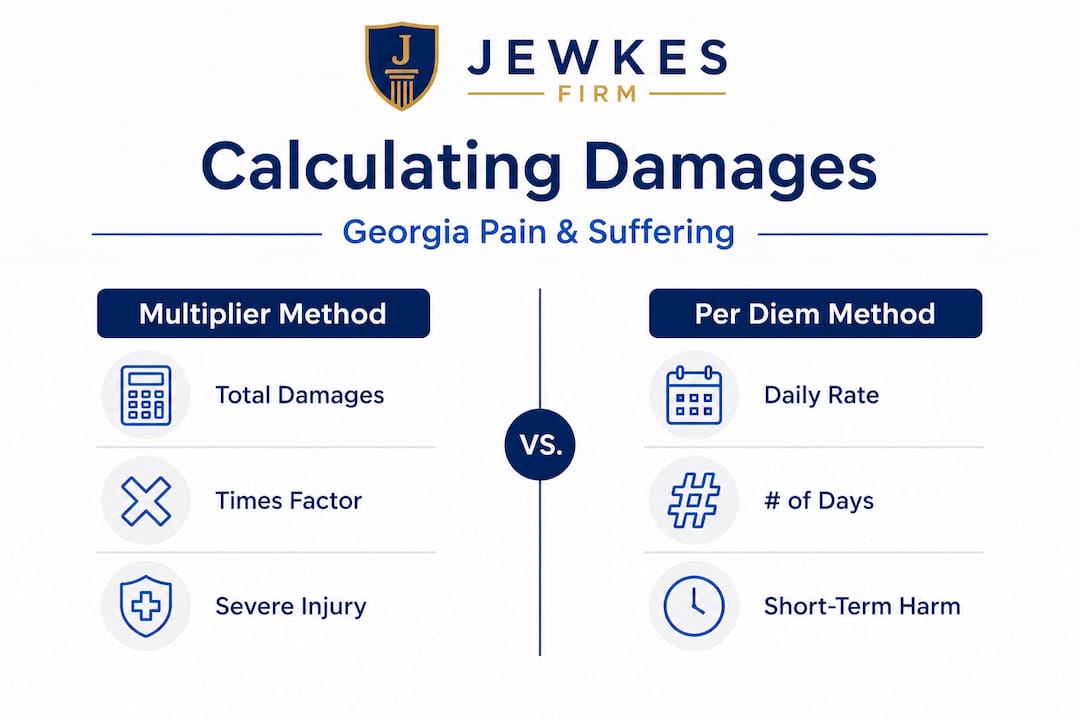
There’s no fixed formula written into Georgia law for pain and suffering. Instead, Georgia uses multiple approaches, including multiplier and per diem methods, with results varying depending on case specifics. Understanding both helps you think realistically about your potential recovery.
The multiplier method
This is the most widely used approach. An attorney or insurer takes your total economic damages (medical bills, lost wages, rehabilitation costs) and multiplies them by a number, typically between 1.5 and 5. The more severe, permanent, or life-altering your injuries, the higher the multiplier.
For example, if your economic damages total $50,000 and your injury caused long-term disability, a multiplier of 3 would produce $150,000 in pain and suffering alone. Catastrophic injuries often justify multipliers at the higher end of the range.
The per diem method
This method assigns a specific dollar value to each day you experience pain and suffering. For example, if your daily suffering is valued at $200 and you suffered for 365 days, your non-economic damages would total $73,000. This method works well for injuries with a clear endpoint but is less effective for permanent or ongoing conditions.
| Calculation method | How it works | Best used when |
|---|---|---|
| Multiplier method | Economic damages x factor (1.5 to 5) | Serious, long-term, or permanent injuries |
| Per diem method | Daily value x number of days suffering | Short-term or finite recovery periods |
| Hybrid approach | Combines elements of both | Complex cases with mixed injury timelines |
Factors that influence your final number
Several key factors shape how high or low your pain and suffering award may be:
- Severity of the injury: Broken bones, traumatic brain injuries, and spinal cord damage carry far more weight than minor sprains.
- Duration of recovery: A six-month recovery is valued differently from a lifelong disability.
- Medical evidence: Strong, consistent documentation of treatment and diagnoses makes your claim credible.
- Impact on daily life: The more your injury disrupts your personal, professional, and family life, the stronger the case for higher damages.
- Pre-existing conditions: Insurers will try to argue that prior conditions reduce your claim. An experienced attorney helps counter this.
To maximize your injury claim, you need both strong evidence and skilled advocacy when the numbers are being set.
Pro Tip: Keep thorough records of every medical treatment, every therapy session, every prescription, and every limitation your injury places on your life. A single missed appointment or undocumented gap can give insurers a reason to undervalue your claim significantly.
What evidence supports a pain and suffering claim?
Knowing how compensation is calculated, it’s crucial to focus on the kinds of evidence that make a pain and suffering claim credible and compelling.
Courts consider medical records, psychological evaluations, and testimony from the injured and their family when assessing non-economic damages. Without strong evidence, even a clearly valid claim can be undervalued by insurers or dismissed more easily in court.
Here are the most persuasive types of evidence for pain and suffering:
- Medical documentation: Detailed records from every provider who treated you, including emergency room notes, specialist evaluations, imaging results, physical therapy progress reports, and prescription records.
- Mental health evaluations: Reports from psychologists, psychiatrists, or licensed counselors that diagnose and describe your emotional suffering directly linked to the accident.
- Personal pain diary: A daily written record of your pain levels, emotional state, missed activities, and how the injury affects your life. Dated entries carry real weight.
- Testimony from family and friends: People who know you well can describe firsthand the changes they’ve observed in your mood, mobility, personality, and daily routine.
- Photographic and video evidence: Photos of visible injuries over time, or videos showing your limited mobility, add powerful visual proof.
- Expert witness testimony: Medical experts can explain to a jury the long-term impact of your injuries on your physical and emotional health.
| Type of evidence | What it proves |
|---|---|
| Medical records | Nature, severity, and treatment of physical injuries |
| Mental health evaluations | Emotional suffering and psychological impact |
| Pain diary | Day-to-day impact and duration of suffering |
| Family and friend testimony | Observable life changes and disruption to relationships |
| Expert witness reports | Long-term prognosis and medical causation |
| Photographs and video | Visible injury progression and physical limitations |
For guidance on filing a personal injury claim in Georgia, understanding what evidence you need from day one can make the difference between a fair settlement and a lowball offer.
How to take action and maximize your recovery
With evidence in hand, here’s how you can proactively protect your rights and position your case for maximum compensation.
Many accident victims lose significant compensation not because their claim lacks merit, but because they didn’t take the right steps soon enough. Hiring an experienced lawyer can increase your likelihood of maximum recovery, but the actions you take on your own in the early days after an accident also matter enormously.
Here is a step-by-step action plan:
- Seek immediate medical attention. See a doctor the same day or within 24 hours of your accident, even if you feel okay. Delayed treatment gives insurers an opening to argue your injuries weren’t serious or weren’t caused by the accident.
- Follow through with all recommended treatment. Stopping treatment early, missing appointments, or skipping prescribed therapy gives the defense ammunition to claim your injuries weren’t that bad.
- Start a daily pain and limitation journal. Beginning the day of the accident, write down your pain levels, emotional state, what you could not do, and any conversations with your medical team.
- Preserve all evidence. Photograph your injuries, save all medical bills and records, and gather contact information for any witnesses. Store everything in a safe, organized place.
- Avoid social media. Posts about your activities, photos of outings, or casual comments about feeling better can be used by insurers to minimize your pain and suffering claim.
- Consult a Georgia personal injury attorney. An attorney will evaluate your claim, identify the full scope of your losses, and guide you through negotiations or litigation.
- File your claim and negotiate or litigate. Your attorney will handle communications with the insurer, push back on undervalued offers, and take your case to court if the insurer refuses to offer fair compensation.
Acting quickly matters because Georgia’s statute of limitations gives you a limited window to file. Taking these steps now protects your future.
Why most accident victims undervalue pain and suffering—and how to avoid this costly mistake
Having laid out the essential steps, it’s important to reflect on why so many victims miss out on fair pain and suffering compensation, and what you can do differently.
Here’s the uncomfortable truth we see regularly: most accident victims leave money on the table. Not because their injuries aren’t real. Not because Georgia law doesn’t support their claim. But because they’ve been conditioned to think of their accident losses in purely economic terms. Medical bills feel concrete. Pain feels private.
Insurance companies count on this. When an adjuster calls a few days after your accident and asks how you’re feeling, they’re gathering information designed to minimize your non-economic damages. The quicker they can settle your claim for medical costs alone, the less they pay. And if you don’t understand the full value of your pain and suffering damages in Georgia, you may accept a settlement that barely scratches the surface of what you’re owed.
We’ve seen clients come to us after accepting settlements that covered only their hospital bills. They didn’t know they could recover for the months of anxiety that followed a frightening crash, or for the years of chronic pain that changed how they sleep, work, and parent. The gap between what they were paid and what they were actually owed was often staggering.
Strategic documentation changes everything. A well-kept pain diary, consistent mental health treatment, and family member testimony create a record that insurers and juries cannot easily dismiss. An experienced attorney knows how to frame these losses in terms that resonate, both at the negotiating table and in a courtroom. You don’t have to be your own advocate. You just have to act before it’s too late.
Get help with your pain and suffering claim
If this guide helped clarify the process, you may want practical, experienced assistance to ensure your claim reaches its full potential.
Recovering from an accident is hard enough without fighting an insurance company alone. Pain and suffering compensation is often the most contested part of any Georgia injury claim, and insurers are skilled at minimizing these damages when victims aren’t represented.

The Jewkes Firm serves accident victims across South Atlanta and the surrounding Georgia counties, offering FREE consultations with no obligation. Our team works on a contingency fee basis, meaning you pay nothing unless we win your case. We fight to ensure your full pain and suffering losses are documented, valued, and pursued aggressively. If your claim has been undervalued or you’re just getting started, contact us today for a personalized case review. GET A FREE CASE REVIEW and let us help you understand what your case is truly worth.
Frequently asked questions
Can I recover pain and suffering if my injury was minor?
Yes, even minor injuries can cause pain and emotional distress that are compensable, but the amount will depend on how significantly your life was affected and for how long.
Is there a cap on pain and suffering compensation in Georgia?
Georgia generally does not cap non-economic damages in personal injury cases, though certain medical malpractice claims may be subject to specific limitations under state law.
How long do I have to file a pain and suffering claim?
Georgia’s statute of limitations is generally two years from the date of the accident for personal injury claims, so acting promptly is essential.
What if the insurance company offers less than I believe my pain and suffering is worth?
You have the right to negotiate or pursue legal action, and legal counsel can help maximize your settlement by building a stronger case and pushing back against inadequate offers.