

TL;DR:
- Strong evidence is crucial for accident claims, often outweighing fault in settlement outcomes.
- Documentation should include photos, witness details, police reports, medical records, and digital evidence promptly.
- Avoid common mistakes like delays, social media posts, and incomplete records to protect claim strength.
Most accident settlements do not hinge primarily on who was at fault. They hinge on the quality and detail of the evidence the victim presents. That counterintuitive reality surprises many people, but insurance adjusters and defense attorneys know it well. They look for gaps in your story. Thin documentation gives them the ammunition to minimize or deny your claim entirely. If you were injured in South Atlanta or anywhere in the surrounding Georgia counties, understanding why filing an injury claim matters for your compensation starts with knowing how to build a rock-solid evidence record from the moment the accident occurs.
Table of Contents
- The crucial role of accident evidence in your claim
- What counts as accident evidence and what’s often missed
- How to document accident evidence: a step-by-step Georgia guide
- Mistakes to avoid when documenting accident evidence
- Our experience: what really moves the needle for Georgia accident victims
- Get personalized help documenting your accident evidence
- Frequently asked questions
Key Takeaways
| Point | Details |
|---|---|
| Evidence drives compensation | Detailed accident evidence is often the difference between a denied claim and a fair settlement. |
| Document everything early | Start collecting and securing evidence immediately after an accident for best results. |
| Know what matters | Photos, records, and timelines are crucial—missing them can weaken your case. |
| Avoid documentation mistakes | Small oversights or delays can significantly hurt your injury claim. |
The crucial role of accident evidence in your claim
Insurance companies are not on your side. Their adjusters are trained to identify weaknesses in claims and use those weaknesses to pay you less. Strong accident evidence is your most powerful tool to push back. It establishes exactly what happened, who caused it, and how severely you were harmed.
Georgia courts require clear, credible evidence to assign fault and calculate damages. Without it, even a legitimate claim can collapse. Evidence can make or break your injury case in Georgia, and the difference between thorough documentation and poor documentation is often the difference between a fair settlement and a denied claim.
Here is a direct comparison that shows why this matters:
| Factor | Documented claim | Undocumented claim |
|---|---|---|
| Fault determination | Clear, supported by photos and reports | Disputed, relies on memory |
| Medical damages | Verified through records and bills | Questioned, may be reduced |
| Pain and suffering | Supported by documented injury timeline | Difficult to prove |
| Settlement likelihood | High | Lower, often contested |
| Negotiation position | Strong | Weak |
| Insurer response | Must take seriously | May deny outright |
“Claims with organized, time-stamped documentation are significantly more likely to reach fair settlements faster. Insurers settle quickly when the evidence leaves them no room to dispute the facts.”
The data tells the same story. Studies show that personal injury victims who document thoroughly are far more likely to why evidence matters for the final outcome of their case. In Georgia especially, where comparative negligence laws apply, even a 10 to 20 percent reduction in your assigned fault can translate into thousands of additional dollars in your settlement.
What counts as accident evidence and what’s often missed
Having explained the importance of evidence, it is time to break down exactly what forms of documentation matter and which are commonly overlooked. Many victims assume a police report and a few phone photos are enough. They are not.
Strong accident evidence includes a wide range of materials, and documenting the right evidence to support potential legal action means thinking beyond the obvious.
Here is what you should be gathering:
- Photographs of the scene. Capture every angle, every vehicle position, all skid marks, traffic signs, road conditions, and debris. Take wide shots and close-ups.
- Witness information. Get full names, phone numbers, and email addresses. Ask bystanders if they saw what happened before they leave the scene.
- Police reports. Always call law enforcement. Request a copy of the report as soon as it is filed. The officer’s observations carry significant weight.
- Medical records and bills. Every treatment, diagnosis, prescription, and follow-up appointment should be documented and saved.
- Dashcam footage. If you or another vehicle had a dashcam running, that footage is among the most powerful evidence available. Secure it immediately.
- Texts, emails, and app data. In distracted driving cases, digital communication records can confirm whether the other driver was on their phone at the time of the crash.
- Weather and road conditions. Note the time, visibility, whether it was raining, if there were potholes or faded lane markings. These details matter more than most victims realize.
- Vehicle damage specifics. Document the exact location and nature of damage on all involved vehicles. This can confirm impact direction and speed.
What do most victims miss? Timelines. The sequence of events in the minutes before a crash can be just as important as the crash itself. Many people also forget to photograph their injuries not just at the scene, but in the days and weeks following the accident. Bruising, swelling, and scarring often become more visible over time. Following the car accident steps after a crash and reviewing an auto accident victim checklist can help ensure you capture everything.

Pro Tip: Take a photo of your injuries every two to three days for the first three weeks after the accident. This creates a visual timeline that powerfully illustrates your suffering and recovery, making it far harder for insurers to downplay your pain.
How to document accident evidence: a step-by-step Georgia guide
After identifying key evidence, you need to know how to efficiently capture and organize it, especially with Georgia’s legal specifics in mind. The Georgia personal injury guide offers guidelines for both attorneys and clients on how to document accidents to strengthen a legal case, and the framework below draws on those same principles.
Here is a proven, step-by-step system:
-
Secure the scene first. Before anything else, make sure you are safe. Move to a safe location if you can do so without worsening injuries. Turn on hazard lights and call 911 immediately.
-
Call law enforcement. Always get a police officer to the scene, even in minor crashes. A formal police report creates an official record that is very difficult for the opposing party to challenge.
-
Begin photographing immediately. Start at the widest view of the scene and work your way in. Document all vehicle positions before they are moved. Capture license plates, insurance information, and any visible injuries.
-
Collect witness contact information. Do this before people leave. Even a single credible eyewitness can shift a disputed case decisively in your favor.
-
Seek medical attention the same day. Even if you feel fine, see a doctor. Delayed injury discovery is common, particularly with spinal trauma and concussions. A same-day medical record establishes a direct connection between the accident and your injuries.
-
Begin a personal injury journal. Starting that evening, write down everything you remember about the accident. Include how your body feels, what pain you experience, what activities you cannot perform. Continue this daily during recovery.
-
Request and preserve all records. Collect your police report, medical bills, repair estimates, and any correspondence with insurance companies. File them systematically, organized by date.
-
Report to your insurer but be careful. Notify your insurance company of the accident, but do not give recorded statements to the other party’s insurer without legal advice first.
Here is a quick-reference documentation table to keep handy:
| Evidence type | When to gather | Why it matters |
|---|---|---|
| Scene photos | Immediately at the scene | Establishes conditions and positions |
| Witness statements | Before witnesses leave | Provides independent account of fault |
| Police report | Within 24 hours of filing | Official record insurers must consider |
| Medical records | Every visit | Documents injury extent and progression |
| Repair estimates | Within days of the crash | Quantifies property damage |
| Personal injury journal | Starting day of accident | Tracks pain, limitations, and recovery |
| Digital evidence | As soon as possible | Can confirm distracted driving or other fault |
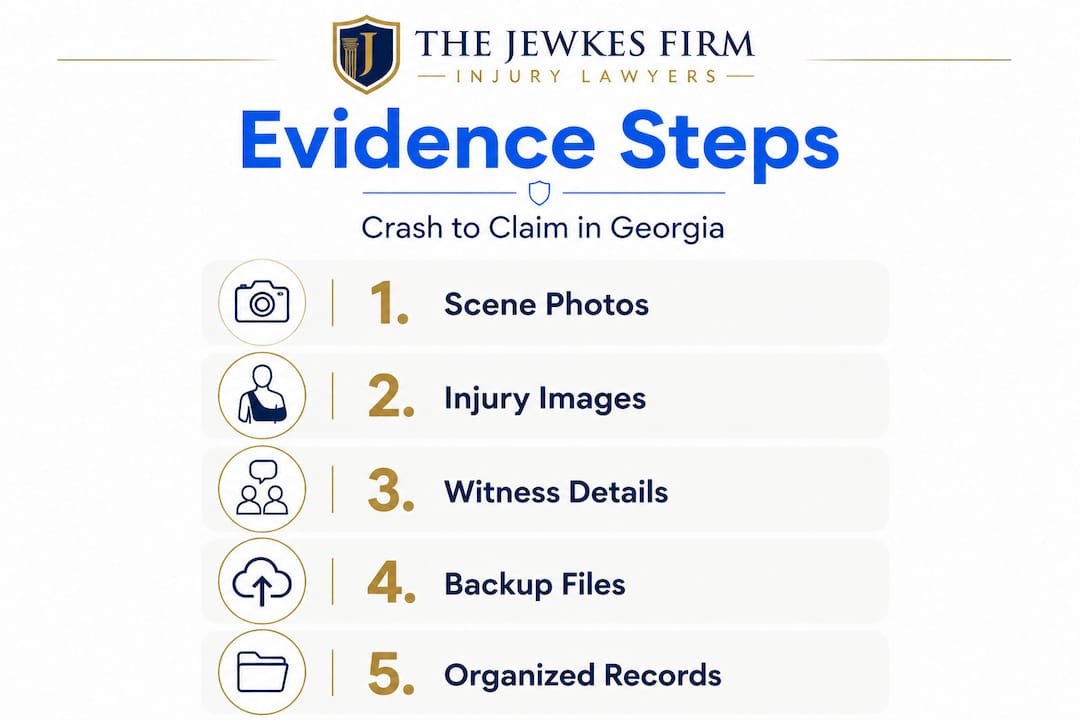
Pro Tip: Back up all digital evidence to a cloud storage account immediately. Phones get lost, damaged, or stolen after accidents. If your photos and dashcam footage are only on your device, one bad moment can erase critical proof.
Mistakes to avoid when documenting accident evidence
Knowing what to do is only half the battle. The next challenge is avoiding missteps that sabotage your accident evidence and give insurers an easy way to minimize your claim.
These are the most damaging mistakes Georgia accident victims make:
- Waiting too long to document. Skid marks fade. Witnesses forget details. Weather changes road conditions. Every hour that passes after an accident weakens the evidence available to you.
- Posting about the accident on social media. Insurance companies routinely monitor claimants’ social media profiles. A single casual photo of you smiling at a barbecue can be used to argue you were not seriously injured.
- Giving recorded statements without an attorney. Adjusters are trained interviewers. Anything you say can be used to minimize your claim. Politely decline until you have legal counsel.
- Accepting an early settlement offer. Initial offers from insurers are almost always lower than what you deserve. Once you accept, you typically cannot seek additional compensation if your injuries worsen.
- Failing to follow your treatment plan. Gaps in medical treatment signal to insurers that your injuries were not serious. Attend every appointment and follow every recommendation your doctor makes.
- Omitting details from your injury journal. Incomplete records hurt your credibility. Document everything, even the days when you feel a little better.
“Even small inconsistencies in your documentation give insurers grounds to question your entire claim. A detail you consider minor could be the one they use to deny or reduce your payout.”
The path to maximizing compensation in Georgia requires avoiding these pitfalls as much as it requires gathering strong evidence. If you were involved in a slip and fall incident, following the slip and fall steps outlined specifically for those cases is equally important, since property injury claims carry their own unique evidentiary requirements.
Our experience: what really moves the needle for Georgia accident victims
After reviewing common mistakes, let us look at what we have seen succeed for real clients in Georgia.
Here is an uncomfortable truth most articles will not tell you: memory is not a substitute for documentation. Clients often tell us they remember everything clearly. They are confident in their recollection. But human memory is unreliable, especially after a traumatic event when adrenaline distorts perception and stress scrambles sequence. What feels vivid in the moment fades, shifts, and becomes inconsistent under questioning. Organization beats memory every single time.
The clients who come to us with thorough, well-organized records consistently have stronger claims and experience far less stress during negotiations. They have photo timelines, dated journals, clearly filed medical records, and all digital evidence preserved. When the opposing insurer tries to dispute a detail, they have an immediate, credible answer backed by documentation. That is an enormous advantage.
We have also seen cases where seemingly irrelevant details became decisive. A photo taken 40 minutes after a crash showed a traffic sign that had been knocked sideways, proving the intersection was a known hazard. A weather app screenshot taken shortly after an accident confirmed icy conditions the opposing driver denied. These were not details the clients thought would matter. They documented them anyway, and it made a real difference.
The personal injury case workflow in Georgia rewards preparation. Following a step-by-step case guide from the very beginning keeps everything organized and positions your attorney to negotiate from a position of strength rather than playing catch-up. Clients who overprepare consistently recover more. That is not an opinion. It is a pattern we see case after case.
The counterintuitive advice we give every new client is this: document more than you think is necessary. You will never regret having too much evidence. You may deeply regret having too little.
Get personalized help documenting your accident evidence
If you are facing the aftermath of an accident and want to ensure nothing is missed, here is how to get help. Gathering evidence on your own is a strong start, but knowing which evidence carries the most weight in a Georgia courtroom is a different skill entirely.

At The Jewkes Firm, we work with accident victims across South Atlanta and the surrounding Georgia counties to ensure that every piece of critical evidence is identified, preserved, and presented effectively. Our team handles complex cases involving auto accidents, trucking crashes, slip and falls, and more, all on a contingency fee basis. That means you pay nothing unless we win. We review your documentation, identify any gaps, and build the strongest possible case on your behalf. Call today for a FREE CONSULTATION and let us help you protect your rights and pursue the maximum compensation you deserve.
Frequently asked questions
What should I do immediately after an accident in Georgia?
Secure the scene, check for injuries, call police, and begin documenting everything with photos and written notes right away before conditions change or witnesses leave.
Can missing evidence hurt my injury claim?
Yes, missing evidence makes it significantly harder to prove fault or the extent of damages, and gaps in documentation often give insurers justification to reduce or deny your compensation entirely.
What types of accident evidence are most important?
Photos of the scene, medical records, police reports, and witness contact details are the most essential pieces of evidence, and gathering all four types immediately after an accident gives your claim the strongest possible foundation.
How can I organize my accident evidence for a Georgia claim?
Keep everything in a single physical folder or digital file, labeled clearly by date and evidence type, and follow the personal injury guide for Georgia recommendations by making backup copies of all digital files immediately.