

Imagine this: a Jonesboro resident gets rear-ended on I-285, walks away thinking the damage looks minor, and waits three weeks before contacting anyone. By then, surveillance footage is gone, the at-fault driver’s insurer has already built its defense, and a recorded statement made in the parking lot that day is being used to minimize the payout. That one sequence of events cost that victim tens of thousands of dollars. You don’t have to let that happen to you. This guide gives you a clear, Georgia-specific roadmap so you know exactly what to do, in what order, and why each step protects your right to fair compensation.
Table of Contents
- What you need before starting your accident claim
- Step-by-step process to file an accident claim in Georgia
- Common mistakes and how to avoid them
- What to expect after filing your claim
- Why most accident victims struggle and what actually works in Georgia
- Get expert help with your Georgia accident claim
- Frequently asked questions
Key Takeaways
| Point | Details |
|---|---|
| Start with strong evidence | Gather thorough documentation and records before you file to avoid delays. |
| Follow every step | Sticking to the claim process maximizes your success and protects your rights. |
| Avoid common mistakes | Never speak with insurance companies before consulting a lawyer. |
| Post-claim stages matter | Expect negotiation, possible litigation, and always track your communications. |
| Expert help improves results | A local attorney can increase compensation and simplify your claim process. |
What you need before starting your accident claim
Before you begin the claim process, knowing what you need ensures you’re prepared for every step ahead.
Think of your accident claim like building a house. You wouldn’t pour concrete without a blueprint. The same logic applies here. The strength of your claim depends almost entirely on what you can prove, and accident claim evidence is what drives every negotiation and courtroom argument.
Core documents every victim needs
- Police report: Request this from the responding law enforcement agency as soon as possible. It contains the officer’s observations, fault notations, and witness contact information.
- Photographs and video: Capture vehicle damage, road conditions, skid marks, traffic signals, and any visible injuries immediately at the scene.
- Medical records and bills: Every emergency room visit, specialist appointment, prescription, and physical therapy session must be documented.
- Witness information: Full names, phone numbers, and email addresses of anyone who saw the collision.
- Your own insurance policy: Know your coverage limits, including uninsured motorist and medical payments provisions.
- Employment records: Pay stubs or employer statements that support a lost wage claim.
| Document | Where to get it | Why it matters |
|---|---|---|
| Police report | Local police or sheriff’s office | Establishes facts of the crash |
| Medical records | Your healthcare provider | Connects injuries to the accident |
| Photos/video | Your phone, nearby cameras | Visual proof of damage and conditions |
| Witness statements | Gathered at the scene | Independent confirmation of events |
| Insurance policy | Your insurer | Defines your coverage options |
| Employment records | Employer or HR department | Supports lost income calculation |
“The quality of your evidence can make or break your case.” This is especially true in Georgia, where comparative fault rules mean insurers look for any reason to reduce what they owe you.
Pro Tip: Act fast on surveillance footage. Gas stations, traffic cameras, and nearby businesses typically overwrite footage within 24 to 72 hours. Sending a formal preservation letter immediately can save critical visual evidence. A lawyer can handle gathering forensic evidence that most victims don’t even know exists, including trucking electronic logs, black box data, and cell phone records.
Missing even one key document can stall your claim for months. Insurers routinely use documentation gaps as leverage to deny or lowball settlements. Starting organized and staying organized removes that leverage from their hands.
Step-by-step process to file an accident claim in Georgia
Once you’ve assembled all the necessary documents, here’s your roadmap for moving forward.
Following the proper accident claim steps can significantly increase your case’s likelihood of success. Georgia has specific procedural rules, and understanding them before you act is the difference between a strong claim and a dismissed one.
Your numbered action plan
- Seek immediate medical attention. Even if you feel fine, get evaluated. Delayed injury symptoms are common after adrenaline wears off, and a medical record dated close to the accident date is critical for connecting injuries to the crash.
- Report the accident. Notify your own insurance company promptly. Georgia law and most policies require timely notice. Failing to report can void your coverage.
- Preserve all evidence. Do not repair your vehicle yet. Photograph everything, save all digital communications, and store all receipts related to your injuries and treatment.
- Request the police report. Obtain your copy and review it carefully for errors. If facts are wrong, contact the reporting officer to file a supplement or correction.
- Consult a personal injury attorney. Do this before speaking with the other driver’s insurer. An attorney can protect your rights before you say something that damages your claim.
- File a personal injury claim Georgia. Your attorney will submit a formal demand package to the at-fault party’s insurer, including all evidence, medical records, and a calculated damages figure.
- Respond to the investigation. The insurer will assign an adjuster. Your attorney manages all communication during this phase.
- Negotiate the settlement. This back-and-forth process can take weeks or months. Your attorney fights for maximum compensation on your behalf.
- Accept or proceed to litigation. If the insurer refuses a fair offer, your attorney files a lawsuit in the appropriate Georgia court.
| Step | Estimated time frame | Who handles it |
|---|---|---|
| Seek medical care | Same day as accident | Victim and healthcare provider |
| Report the accident | Within 24 to 48 hours | Victim and insurer |
| Consult an attorney | Within first week | Victim and law firm |
| Submit claim and demand | Within 30 to 60 days | Attorney |
| Insurer investigation | 30 to 90 days | Insurance company |
| Negotiation | 1 to 6 months | Attorney and insurer |
| Litigation (if needed) | 6 months to 2 years | Attorney and courts |
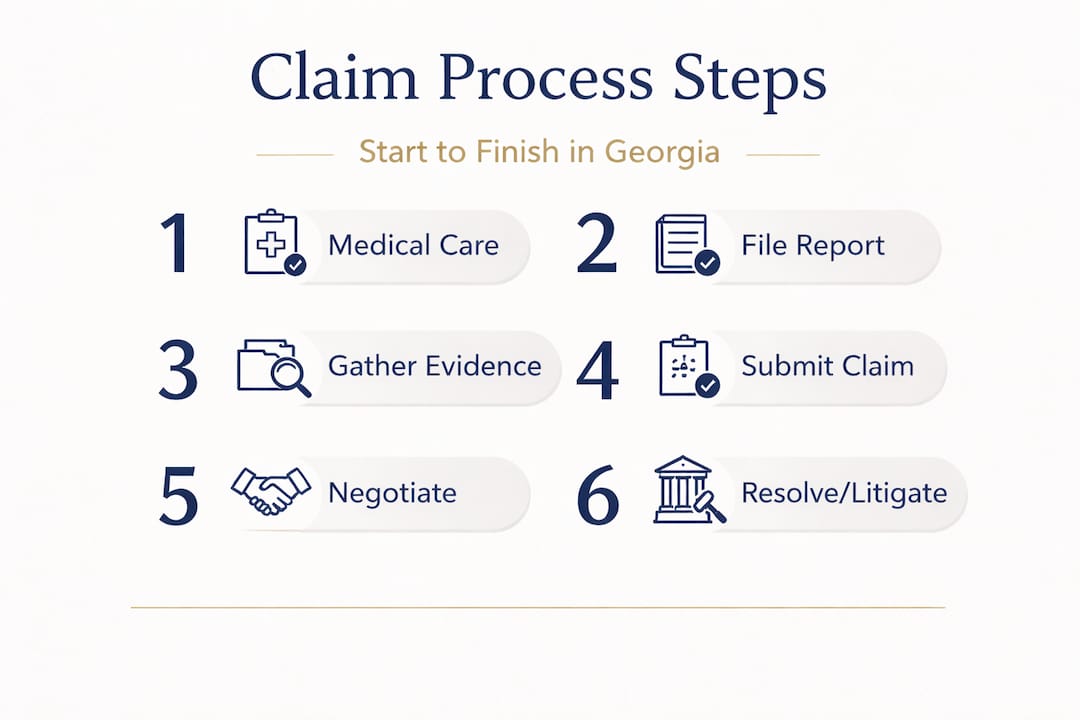
Personal injury claims in Georgia are more successful when claimants follow a clear procedure from day one. Skipping steps or reordering them can significantly weaken your position.
Pro Tip: Georgia has a two-year statute of limitations for most personal injury claims. That sounds like plenty of time, but building a strong case takes months. Starting your claim process within the first two to four weeks gives your attorney the most tools to work with.
Common mistakes and how to avoid them
Carefully following the process is crucial, but being aware of the traps many victims fall into can save your claim.
The sad reality is that many accident victims harm their cases by giving recorded statements to insurers or missing deadlines. These aren’t rare edge cases. They happen every day to ordinary people who simply didn’t know better.
The biggest pitfalls and how to avoid them
- Admitting fault at the scene. Never say “I’m sorry” or speculate about what happened. Even a casual apology can be used as an admission of liability.
- Giving a recorded statement to the other driver’s insurer. Adjusters are trained to ask questions that lead you into weakening your own claim. You are not legally required to give a statement to an opposing insurer.
- Delaying medical care. Every day without treatment is ammunition for the insurer to argue your injuries aren’t serious or weren’t caused by the accident.
- Posting on social media. Photos, check-ins, or status updates that suggest you’re active and feeling well can be used to dispute injury severity.
- Missing the filing deadline. Georgia’s two-year statute of limitations is firm. Miss it and your claim is gone, no matter how strong it was.
- Accepting the first settlement offer. Initial offers are almost always low. They’re designed to close the claim before you fully understand your damages.
- Handling the claim alone. This is especially risky in trucking accidents, where federal regulations, multiple liable parties, and complex evidence make self-representation extremely difficult.
Warning: Never admit fault or speculate about the cause of an accident at the scene, in writing, or over the phone. Even well-meaning statements can be twisted by insurers to shift blame onto you and reduce your compensation.
Getting legal advice after an accident is not a sign of being litigious. It’s simply the smartest protective step you can take. Studies consistently show that represented accident victims recover significantly more compensation than those who handle claims alone.
Pro Tip: Before you speak with any insurance adjuster, even your own, consult a personal injury attorney first. Most offer free consultations with no obligation. That one call can prevent costly mistakes that are impossible to undo.
What to expect after filing your claim
Submitting your claim is just the beginning. Understanding what comes next gives you control and peace of mind.

Personal injury workflows in Georgia typically involve insurance investigation, negotiation, and, if necessary, litigation. Knowing what each phase looks like helps you stay patient and engaged without feeling lost.
The post-claim timeline
Insurance company investigation. After your claim is filed, the insurer assigns an adjuster who reviews police reports, medical records, photos, and witness statements. They may also have you examined by a doctor of their choosing. This phase commonly takes 30 to 90 days.
Negotiation. Your attorney submits a formal demand letter with a specific dollar figure. The insurer responds with a counteroffer. This exchange can involve multiple rounds of back-and-forth. Your attorney’s job is to protect your position and push for the maximum.
Mediation. If direct negotiation stalls, both sides may agree to mediation, where a neutral third party helps facilitate a resolution. This avoids the time and expense of a full trial while keeping both parties at the table.
Litigation. If no agreement is reached, your attorney can file an injury lawsuit in Georgia. This triggers the formal court process, including discovery, depositions, and potentially a jury trial. Most cases settle before reaching trial, but being willing to go to court often produces better offers.
| Post-claim stage | Estimated duration | What’s happening |
|---|---|---|
| Investigation | 30 to 90 days | Insurer reviews all evidence |
| Negotiation | 1 to 6 months | Demand and counteroffer exchange |
| Mediation | 1 to 2 days of sessions | Neutral facilitation of resolution |
| Litigation | 6 months to 2 years | Court proceedings if no settlement |
Expected timelines at a glance:
- Minor injury cases with clear liability: 3 to 6 months
- Moderate injury cases: 6 to 12 months
- Severe injury or disputed liability cases: 1 to 2 years or more
- Cases involving trucking companies or multiple defendants: often 18 months or longer
Pro Tip: Keep a written log of every call, email, and letter related to your claim. Note the date, the person’s name, and what was discussed. This documentation protects you if the insurer later misrepresents what was agreed upon or disputes the timing of communications.
Why most accident victims struggle and what actually works in Georgia
Now that you know the process, let’s look at why so many victims struggle and what the most effective claims have in common.
Here’s an uncomfortable truth: the vast majority of people who handle their own accident claims leave money on the table. Not because they’re unintelligent. Because the insurance industry employs teams of trained professionals whose job is to minimize every payout. When an unrepresented victim sits across from that machine, the outcome is predictable.
The most successful claims we see share a consistent pattern. The victim sought medical attention quickly. They preserved evidence within hours, not days. And they called an attorney before speaking with anyone from the opposing insurer. That sequence matters enormously.
Trucking accident claims are an entirely different level of complexity. Commercial carriers are required to maintain extensive records, including driver logs, maintenance histories, and GPS data. Federal regulations from the Federal Motor Carrier Safety Administration also apply. Missing or ignoring any of these elements during a self-managed claim often results in a settlement far below what the case is actually worth.
Hiring a South Atlanta injury lawyer levels the playing field immediately. A local attorney knows the judges, the local court processes, and the specific tactics used by insurers operating in Georgia. That localized knowledge has real dollar value in your case.
The other thing effective claims have in common is patience combined with persistence. Rushing to accept a settlement before you’ve completed treatment means you might not know the full extent of your damages. A good attorney won’t let you close your case until you have a clear picture of your total losses, both current and future.
Get expert help with your Georgia accident claim
If you’ve been injured in a car or truck accident in South Atlanta or the surrounding Georgia counties, you don’t have to figure this out alone.

jewkesfirm supports accident victims through every phase of the claims process, from evidence gathering and insurer negotiations to full courtroom representation when needed. With a proven track record of millions recovered for injured clients, the firm brings local expertise, dedicated advocacy, and a client-first approach to every case. There are no upfront fees. You pay nothing unless we win your case. Take the next step with a FREE CONSULTATION and let us fight to protect your rights and your recovery. Call jewkesfirm today or visit jewkesfirm.com to GET A FREE CASE REVIEW and speak directly with an attorney who knows Georgia law and your community.
Frequently asked questions
How long do I have to file an accident claim in Georgia?
Georgia law generally allows two years from the accident date to file a personal injury claim, so acting quickly is still important because building a strong case takes time and early evidence is often the most valuable.
What if the other driver doesn’t have insurance?
You can file an uninsured motorist claim with your own insurer if you carry that coverage, which is why reviewing your own policy immediately after an accident is a critical early step.
Should I talk to the insurance company before hiring a lawyer?
It’s best to consult a lawyer first, as giving statements to insurers without legal guidance is one of the most common ways victims unintentionally damage their own claims.
What compensation can I claim after an accident?
Georgia law allows victims to pursue medical bills, lost wages, property damage, and pain and suffering, and in cases of extreme negligence, punitive damages may also be available.
How does a trucking accident claim differ from a car accident?
Trucking cases involve more complex evidence requirements in Georgia, federal safety regulations, and often multiple potentially liable parties including the driver, the carrier, and equipment manufacturers.