

After an accident in South Atlanta, confusion about what to do next can derail your recovery and delay the compensation you deserve. Insurance companies move fast, and every mistake you make in the early days can cost you thousands. This guide walks you through the complete personal injury case workflow in Georgia, from the moments right after the crash to final settlement or trial. Whether you were hurt in a car accident, a slip and fall, or a trucking collision, understanding each step puts you in control and gives you the best shot at maximum compensation.
Table of Contents
- What to do immediately after an accident
- The essential phases of a personal injury case workflow
- How insurance negotiations and settlements work
- Common obstacles and defense tactics in Georgia personal injury cases
- How to maximize your outcome with the right legal support
- Our perspective: Why most people misunderstand the personal injury workflow
- Get expert guidance for your personal injury case
- Frequently asked questions
Key Takeaways
| Point | Details |
|---|---|
| Take immediate action | Getting medical help and documenting everything right away is essential for your claim. |
| Know the workflow | Understand each phase of a personal injury case to avoid mistakes and surprises. |
| Most cases settle | About two-thirds of Georgia cases settle before trial, with amounts varying widely. |
| Beware defense tactics | Insurers use comparative fault and policy limits to challenge your claim—be prepared. |
| Get legal support | An experienced Georgia attorney can boost your chance of a higher, faster settlement. |
What to do immediately after an accident
The actions you take in the first 24 to 72 hours after an accident shape the entire trajectory of your case. Most people focus on the immediate chaos and forget that everything they do right now becomes evidence later. The Georgia injury case steps are clear: a standard personal injury case workflow begins with seeking medical attention, reporting the accident, and consulting an attorney.
Here is what you need to do right away:
- Seek medical attention immediately, even if you feel fine. Symptoms like whiplash, concussions, and internal injuries often appear hours or days later. A gap in medical care gives insurers ammunition to argue your injuries were not serious.
- Document the scene with photos and video. Capture vehicle damage, road conditions, traffic signals, and any visible injuries.
- Gather witness information, including names and phone numbers. Witnesses become harder to locate as time passes.
- File a police report and request a copy. This creates an official record of the incident.
- Preserve physical evidence such as damaged clothing, broken equipment, or defective products involved in the accident.
- Contact an attorney before speaking with the insurance company. Adjusters are trained to minimize payouts. Getting guidance on dealing with accident claims before you say anything protects your position.
Pro Tip: Start a dedicated folder, physical or digital, on the day of the accident. Save every receipt, medical bill, prescription, and correspondence. This habit alone can significantly strengthen your claim when it comes time to negotiate.
The essential phases of a personal injury case workflow
Once immediate needs are handled, it is vital to understand the full case process ahead. Knowing what comes next reduces anxiety and helps you make smarter decisions at each stage. The step-by-step Georgia lawsuit guide confirms that a personal injury case workflow involves evidence gathering, demand letters, negotiation, and possible litigation.
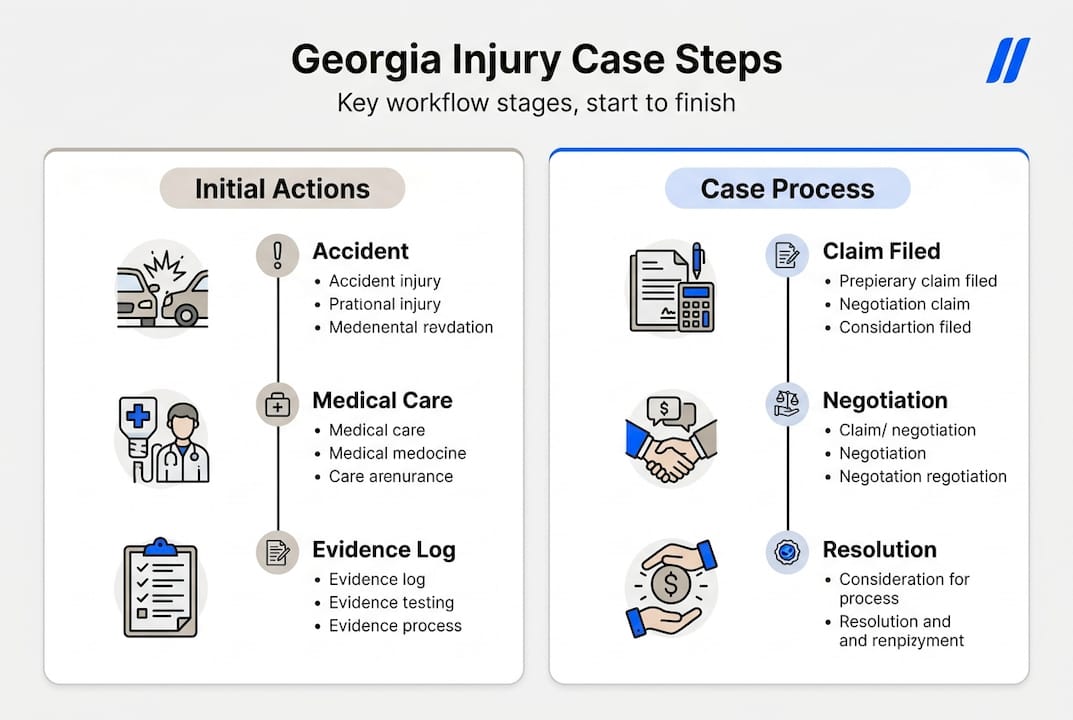
Here is a breakdown of the major phases:
| Phase | Key actions | Typical duration |
|---|---|---|
| Accident and medical care | Seek treatment, document injuries | Days 1 to 30 |
| Evidence gathering | Photos, records, witness statements | Weeks 1 to 8 |
| Attorney consultation | Case evaluation, strategy planning | Week 1 to 4 |
| Demand letter | Attorney submits claim to insurer | Months 2 to 6 |
| Negotiation | Back-and-forth settlement talks | Months 3 to 12 |
| Lawsuit filing | If no agreement is reached | Months 6 to 18 |
| Discovery | Depositions, document exchange | Months 9 to 24 |
| Mediation | Neutral third-party negotiation | Months 12 to 30 |
| Trial | Rare, reserved for unresolved cases | Months 18 to 36+ |
Walking through each phase in order:
- Medical care and documentation set the foundation. Your treatment records are the backbone of your claim.
- Evidence collection happens simultaneously. Your attorney will send preservation letters to prevent destruction of key records.
- Attorney consultation is where strategy begins. This is when filing a personal injury claim becomes a formal process.
- The demand letter is your attorney’s formal request to the insurer, outlining damages and a settlement figure.
- Negotiation is where most cases resolve. The South Atlanta injury law guide shows that local cases often settle here with strong representation.
- Lawsuit, discovery, mediation, and trial are escalating steps if the insurer refuses a fair offer. Most clients never reach a courtroom.
How insurance negotiations and settlements work
Having seen the phases, let us break down how insurance companies typically approach negotiations and settlements. The reality is that most PI cases settle before trial, with empirical data suggesting roughly 60 to 70 percent of federal tort cases settle, though real aggregate rates hover closer to 66 percent rather than the 90 percent figure often cited.

Settlement values depend heavily on the severity of your injuries. Here is a general range based on Georgia injury settlements:
| Injury severity | Typical settlement range |
|---|---|
| Minor injuries | $10,000 to $50,000 |
| Moderate injuries | $50,000 to $200,000 |
| Severe or catastrophic | $250,000 to millions |
| Wrongful death | Varies widely, often $500,000+ |
Several factors directly affect where your case lands in that range:
- Fault percentage. Georgia’s 50% fault rule means your recovery is reduced by your share of blame. If you are 30% at fault, you recover 70% of your damages.
- Policy limits. The at-fault party’s insurance coverage caps what you can collect without pursuing additional assets.
- Strength of evidence. Clear photos, consistent medical records, and credible witnesses push settlement values higher.
- Medical expenses and lost wages. Documented economic losses anchor the negotiation.
- Pain and suffering. Non-economic damages are harder to quantify but can significantly increase your total.
Pro Tip: Never accept the first offer from an insurance adjuster. Initial offers are almost always below the true value of your claim. Your attorney can calculate the full picture, including future medical costs and long-term income loss, before any agreement is signed.
Common obstacles and defense tactics in Georgia personal injury cases
With the settlement process in mind, it is wise to prepare for typical obstacles or pushback you will encounter, especially in Georgia. Insurers and defense attorneys use predictable tactics to reduce or deny claims. Knowing them in advance keeps you from being caught off guard.
Common challenges you may face:
- Shared fault arguments. Defense teams frequently argue that you contributed to the accident to reduce their liability under Georgia’s comparative fault rules.
- Delayed claim processing. Insurers sometimes drag out investigations hoping you will accept a low offer out of financial pressure.
- Policy limit defenses. Adjusters may claim the policy does not cover certain damages or that limits have been reached.
- Medical causation disputes. Defense experts may argue your injuries existed before the accident or were caused by something else.
- Tort reform impacts. Recent legislation like SB68 has introduced changes that affect how damages are calculated and presented in Georgia courts.
Empirical data shows settlement rates are real but not as high as many believe. Plan for negotiations to take time, and do not let financial pressure push you into accepting less than your case is worth.
Georgia’s 50% comparative fault rule is particularly important. If a jury finds you 50% or more responsible for the accident, you recover nothing. Defense attorneys know this and will work hard to push your fault percentage above that threshold. Reviewing South Atlanta accident claim examples shows how this plays out in real local cases. The settlement statistics study reinforces why preparation matters at every stage.
How to maximize your outcome with the right legal support
To make the workflow work for you rather than the insurance company, leverage expert help at each step. Attorney support correlates with higher success in personal injury cases, and the difference between going it alone and having experienced counsel is often measured in tens of thousands of dollars.
Here is how a skilled Georgia attorney adds value at each phase:
- Evidence preservation. Your attorney sends legal holds immediately, preventing the destruction of surveillance footage, vehicle data, or employer records.
- Accurate case valuation. Attorneys calculate future medical costs, lost earning capacity, and non-economic damages that most victims underestimate on their own.
- Demand letter strategy. A well-crafted demand letter sets the tone for the entire negotiation and anchors the insurer to a higher starting figure.
- Defense strategy anticipation. Experienced attorneys know how Georgia insurers argue fault and prepare counter-evidence in advance.
- Deadline management. Georgia’s statute of limitations for personal injury is generally two years. Missing it ends your case entirely, regardless of merit.
Pro Tip: When interviewing attorneys, ask specifically about their experience with Georgia comparative fault cases and their track record in negotiations versus trial. A lawyer who only settles fast may not fight hard enough for full value.
Choosing the right attorney is one of the most consequential decisions you will make. Resources like how to maximize your claim and choosing a Georgia injury lawyer walk you through what to look for. The attorney advantages are well-documented and go far beyond just courtroom representation.
Our perspective: Why most people misunderstand the personal injury workflow
Here is what decades of legal experience in Georgia personal injury law has taught us: most people walk into the process with two dangerous assumptions. First, they believe their case will settle quickly. Second, they assume a fair offer will come without a fight. Both assumptions cost clients money.
The truth is that insurers are businesses. Their goal is to close claims for as little as possible. Without proactive documentation and early legal involvement, low offers become the default. We have seen South Atlanta clients who waited weeks to hire an attorney lose critical evidence and accept settlements worth a fraction of their actual damages.
One client came to us after a rear-end collision on I-285. They had already spoken to the adjuster twice and received a $12,000 offer. After reviewing their medical records and future treatment needs, we identified over $85,000 in legitimate damages. Strategic documentation and firm negotiation changed everything.
Georgia cases carry unique challenges, from the 50% fault threshold to recent tort reforms. The comprehensive law guide we have developed reflects what we see on the ground every day. Local knowledge is not a bonus. It is a necessity.
Get expert guidance for your personal injury case
If you have been injured in South Atlanta or anywhere in the surrounding Georgia counties, you do not have to navigate this process alone. jewkesfirm guides clients through every phase of the personal injury workflow, from the first phone call to final resolution.

Our team handles evidence gathering, insurance negotiations, and litigation strategy so you can focus on healing. We work on a contingency fee basis, meaning you pay nothing unless we win. Whether you are just starting out or stuck in a stalled negotiation, Georgia personal injury lawyers at jewkesfirm are ready to help. Start with a FREE CONSULTATION and let us show you what your case is truly worth. Visit our guide on choosing your attorney to learn what questions to ask before you commit.
Frequently asked questions
How long does a typical personal injury case take in Georgia?
Most cases settle within 3 to 18 months, but severe or contested cases can extend to 1 to 3 years depending on complexity and insurer cooperation.
What evidence is most important for my personal injury claim?
Photos, medical records, police reports, and documented expenses are the most critical. Strong evidence gathered early in the process directly increases your settlement value.
Do most personal injury cases in Georgia go to trial?
No. About two-thirds of cases settle before trial, and only a small minority ever reach a courtroom in Georgia.
How much is a typical settlement for a Georgia personal injury case?
Settlements average around $55,000 but range from $10,000 for minor injuries to well over $250,000 for severe or catastrophic cases.
What is the 50% fault rule in Georgia?
Under Georgia law, if you are found 50% or more at fault for the accident, you cannot recover any damages from the other party.