

Cases with complete evidence are 3.5x more likely to succeed, yet most accident victims in South Atlanta and surrounding Georgia counties never think about evidence until it’s too late. Your claim can be won or lost before you ever speak to an insurance adjuster. The decisions you make in the hours and days following an accident directly shape what you can recover. This guide breaks down what evidence matters most in Georgia, how to collect it, and why the rules around it can catch victims off guard. Whether you were hurt in a car crash, a slip and fall, or a trucking collision, understanding evidence is your first real step toward fair compensation.
Table of Contents
- Why evidence matters in Georgia injury claims
- Types of evidence that influence your claim
- How Georgia rules affect what evidence can be used
- Practical steps for gathering and preserving evidence
- What most guides miss: The strategy behind evidence
- How to get help with your injury evidence
- Frequently asked questions
Key Takeaways
| Point | Details |
|---|---|
| Thorough evidence is essential | Complete and relevant evidence drastically increases your chances of a successful claim in Georgia. |
| Act quickly after an accident | Gather medical records, photos, and witness contacts as soon as possible to prevent insurer challenges. |
| Georgia law has strict standards | Only evidence that meets Georgia’s relevance and reliability rules will be allowed to support your case. |
| Know the insurer’s tactics | Insurers search for gaps and inconsistencies, so anticipate pushback and document everything. |
| Professional help pays off | Consulting an attorney can make it easier to collect, organize, and present the strongest evidence. |
Why evidence matters in Georgia injury claims
Personal injury claims live and die by what you can prove. Feelings, memories, and verbal accounts alone won’t move an insurance company or a court. You need documented, organized, and credible evidence that tells your story clearly.
Here’s a fact that surprises most people: 90-95% of injury claims settle before they ever reach a courtroom, but only when the evidence strongly supports the injured party. When your case is backed by solid proof, the insurer has little room to fight. When it isn’t, they’ll drag things out, minimize your injuries, or deny your claim entirely.
“Evidence isn’t just what you present in court. It’s the foundation of every negotiation, every settlement offer, and every decision an adjuster makes about your case.”
Insurance companies are not on your side. Their job is to protect their bottom line. They look for weak points: gaps in medical treatment, missing police reports, unclear photos. Every gap in your evidence is an open door for them to dispute your story. That’s why knowing the steps after a car accident matters so much from day one.
Here are the types of evidence that carry the most weight in Georgia courts and negotiations:
- Medical records showing the nature and extent of your injuries
- Official police or incident reports establishing what happened
- Photos and videos of the scene, your vehicle, and your injuries
- Witness statements from independent third parties
- Employment and wage records proving financial losses
- Expert testimony from doctors, accident reconstructionists, or economists
Evidence does more than prove fault. It quantifies your damages. That’s why victims who file injury claims with complete documentation consistently recover more than those who don’t. With the stakes set, let’s break down the forms of evidence that matter most.
Types of evidence that influence your claim
Not all evidence carries equal weight. Knowing which forms to prioritize and how to use them puts you in a far stronger position.
Medical records, police reports, photos, witness statements, employment records, and expert testimony are the six pillars of a strong Georgia personal injury claim. Each one serves a distinct purpose, and together they build a case that is difficult to challenge.
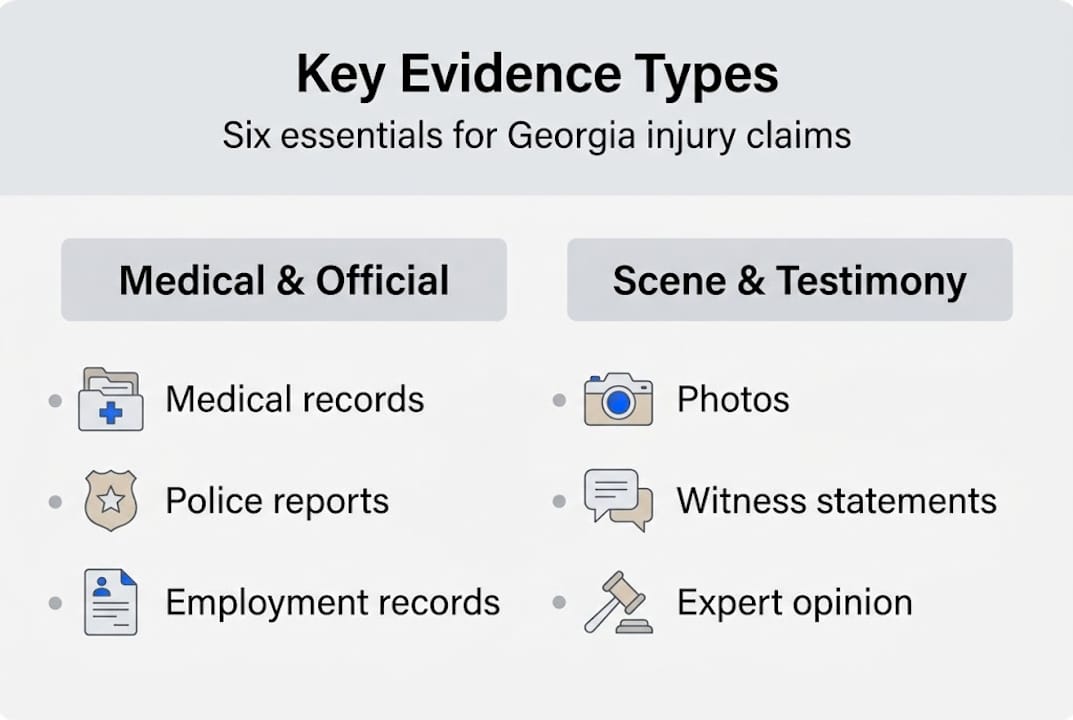
| Type of evidence | What it proves | Common pitfall |
|---|---|---|
| Medical records | Injury severity, treatment costs | Gaps in treatment weaken credibility |
| Police report | Official account of the accident | Missing report leaves facts disputed |
| Photos and video | Scene conditions, visible damage | Low quality or delayed photos lose impact |
| Witness statements | Third-party corroboration | Statements taken late may be unreliable |
| Employment records | Lost wages, earning capacity | Incomplete records reduce recovery |
| Expert testimony | Complex causation or damages | Must meet Georgia qualification standards |
Medical records are often the anchor of your case. They document your diagnosis, your treatment plan, and the cost of your care. They also create a timeline. If you waited two weeks to see a doctor after your accident, the insurer will argue your injuries weren’t serious. Consistent, prompt medical care tells a stronger story.
Police reports provide an official, neutral account. They name the parties involved, note witness information, and sometimes include an officer’s preliminary assessment of fault. In Georgia, these reports are taken seriously during negotiations.
Photos and videos are powerful because they can’t be argued with. A cracked windshield, a wet floor with no warning sign, or a bruise on your shoulder all become undeniable when captured clearly. These are the kinds of common injuries in Georgia accidents that photos help document before they heal.

Pro Tip: Take photos from multiple angles immediately at the scene, including wide shots of the full area and close-ups of specific damage or injuries. More is always better, and you can sort them later.
For slip and fall cases specifically, a detailed slip and fall evidence guide can help you understand what unique documentation those claims require. Knowing why evidence matters, let’s see exactly what kinds you’ll need and how each adds power to your claim.
How Georgia rules affect what evidence can be used
Collecting evidence isn’t enough on its own. Georgia law sets strict standards for what can actually be used in your case. Even strong evidence can be thrown out if it doesn’t meet the legal requirements.
Evidence must be relevant, reliable, and admissible under the Georgia Rules of Evidence, codified in O.C.G.A. Title 24. Relevant means the evidence directly relates to the facts of your case. Reliable means it was collected and maintained properly. Admissible means it clears all legal hurdles before a judge allows it in.
Here are the most common problems that get evidence excluded in Georgia injury cases:
- Hearsay. A statement made outside of court is generally not allowed unless it fits a recognized exception. For example, your friend telling the jury what someone said at the scene won’t fly without the right foundation.
- Broken chain of custody. Evidence that can’t be traced from collection to court may be challenged as tampered with or unreliable.
- Wrong or incomplete records. Medical records from the wrong provider, or records missing key dates, create gaps that insurers exploit.
- Overly prejudicial evidence. Under Rule 403, even relevant evidence can be excluded if its potential to unfairly sway a jury outweighs its actual value.
- Improper expert qualifications. Georgia courts require expert witnesses to meet specific standards before they can testify.
“Courts in Georgia apply a careful balancing test: evidence must add genuine insight to the case without crossing into unfair influence.”
Understanding these rules protects you in two ways. First, it helps you gather evidence correctly from the start. Second, it prepares you for what the other side might challenge. If you’re planning to file an injury lawsuit in Georgia, knowing these standards ahead of time prevents costly surprises. The types of compensation types in Georgia you can recover also depend in part on which evidence makes it through these filters. Even with the right evidence, you must meet Georgia’s legal standards and here’s how that works.
Practical steps for gathering and preserving evidence
Knowing what evidence matters is one thing. Collecting it properly is another. Here’s how to protect yourself from day one.
Prompt evidence gathering, including photos, witness contact, and immediate medical care, prevents what lawyers call spoliation. Spoliation means evidence is lost, destroyed, or altered, which can damage your credibility and give insurers a reason to dispute your version of events.
Follow these steps as soon as it’s safe to do so:
- Document the scene. Take photos and videos of everything: the vehicles, the road, weather conditions, any signage, and your visible injuries.
- Get contact information. Collect names, phone numbers, and insurance details from all parties involved, including witnesses.
- Call the police. Request an official report even for minor accidents. This creates an objective record.
- Seek medical attention immediately. Even if you feel okay, get evaluated. Some injuries take days to show symptoms. Waiting weakens your claim.
- Keep every record. Save all medical bills, prescriptions, therapy notes, and any correspondence with insurance companies.
- Write down your own account. Memory fades fast. Within 24 hours, write a detailed description of exactly what happened and how you felt.
- Contact an attorney. Share everything with your lawyer so they can advise on what to preserve and what to request through formal legal channels.
Pro Tip: Store photos, receipts, and notes in a dedicated cloud folder from day one. A single organized digital file makes it far easier for your attorney to build your case quickly.
Delays in any of these steps give insurance carriers room to question your story. Learning how to protect your rights after an accident and working quickly to hire an injury lawyer are the two most important moves you can make.
Here’s what delays commonly cost victims:
- Witness memories become less reliable
- Scene conditions change or are cleaned up
- Security camera footage gets overwritten
- Medical gaps create questions about injury severity
- Insurers use the delay itself as a defense
Now, let’s get practical: Here’s how to protect yourself with the right steps from day one.
What most guides miss: The strategy behind evidence
Most articles tell you to take photos and see a doctor. That’s good advice, but it’s only the beginning. What actually separates strong claims from weak ones is how strategically evidence is assembled and used.
Insurers minimize claims through gaps and independent medical exams (IMEs), while the strongest plaintiffs use multiple layered sources and local expert testimony to counter those tactics. An IME is a medical exam paid for by the insurance company. It’s designed to cast doubt on your injuries. Without strong, consistent medical records, an IME can seriously undercut your case.
The key insight: evidence isn’t just paperwork. It’s your main negotiating tool. Every document, photo, and statement you gather shifts the balance of power. Courts also apply a balancing test under Rule 403, so not every piece of evidence you collect will be presented. Knowing what holds the most weight with local adjusters and Georgia courts is where an experienced attorney earns their value.
Victims who maximize accident compensation consistently approach their case with a layered evidence strategy, not just a checklist. If you want a deeper foundation, reviewing a personal injury law guide written for South Atlanta victims can give you real clarity on where to focus.
How to get help with your injury evidence
Building a strong case takes more than good intentions. It takes experience, strategy, and a team that knows how Georgia courts and local insurers operate.

At Jewkes Law Firm, we help accident victims in South Atlanta and surrounding Georgia counties build cases from the ground up. We know what evidence local adjusters respect, what courts in our area require, and how to counter insurer tactics before they gain traction. Our team works on a contingency fee basis, meaning you pay nothing until we win. If you’re ready to protect your rights and pursue the maximum compensation you deserve, reach out today for a FREE CONSULTATION. We’re here to make sure your voice is heard.
Frequently asked questions
What evidence is most important for a Georgia injury claim?
Medical records, police reports, photos, and witness statements are the evidence types most likely to shape your outcome, as they establish both fault and the full extent of your damages.
Do I really need to gather evidence right after my accident?
Yes. Prompt evidence gathering prevents spoliation and reduces the window insurers have to dispute the facts of your case.
What if the other side challenges my evidence?
Challenged evidence must be relevant and admissible under Georgia’s Rules of Evidence, and your attorney can present arguments supporting its admissibility before the court.
Can I still win my case if I don’t have photos or reports?
You may still have options, but cases without objective evidence are significantly harder to win. Witness testimony and thorough medical records can help fill critical gaps in your claim.