

You’re shaken, injured, and overwhelmed after an accident in Georgia. The last thing you need is to make a mistake that costs you thousands of dollars in compensation. Yet every year, accident victims unknowingly hurt their own claims by missing deadlines, giving the wrong statements, or filing incomplete paperwork. The good news is that successful injury claims follow a clear, repeatable process. This guide walks you through every critical step, from the accident scene to final resolution, so your rights stay protected and your recovery stays on track.
Table of Contents
- Assessing the situation: Immediate steps after any accident
- Understanding your claim types in Georgia
- Key requirements, documents, and deadlines
- Step-by-step process for filing and managing your claim
- How Georgia law values your claim: Damages, negotiation, and expert help
- Avoiding common mistakes and maximizing your recovery
- Take the next step: Get help with your accident claim
- Frequently asked questions
Key Takeaways
| Point | Details |
|---|---|
| Act quickly | Immediate steps at the accident scene protect your rights and claim success. |
| Know your claim type | Auto, medical malpractice, and wrongful death claims in Georgia all have unique rules and requirements. |
| Documentation is crucial | Strong evidence and timely paperwork can make or break your case. |
| Expert input matters | Medical and wrongful death cases often require certified experts to validate your claim. |
| Professional help pays | Qualified Georgia attorneys maximize compensation and offer contingency fee representation. |
Assessing the situation: Immediate steps after any accident
The moments right after an accident are chaotic. But what you do in those first hours can shape the entire outcome of your claim. Taking the right initial steps can affect your claim’s outcome more than most people realize.
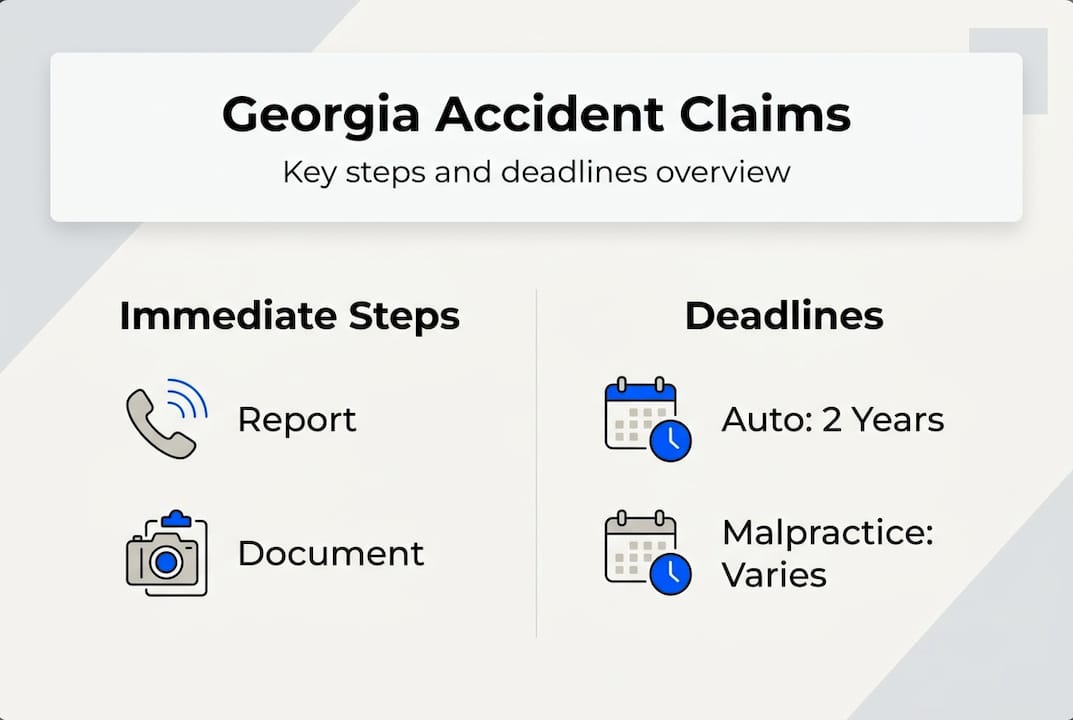
Here’s what to prioritize immediately:
- Check for injuries first. Call 911 right away. If it’s safe to move, get out of traffic or danger.
- Document everything at the scene. Take photos of vehicle damage, road conditions, injuries, and any relevant signage. Get the names and contact information of witnesses.
- Exchange information. Collect the other party’s insurance details, driver’s license number, and license plate.
- Never admit fault. Even a casual apology can be used against you later. Say nothing about who caused the accident.
- Seek medical attention immediately. Even if you feel fine, some injuries appear hours or days later. A medical record from the same day is powerful evidence.
- Notify your insurer. Report the accident, but avoid giving a detailed recorded statement before speaking with an attorney.
“The evidence you collect at the scene is often the foundation of your entire claim. Once it’s gone, it’s gone.”
Keep a dedicated folder, physical or digital, for every receipt, medical bill, and communication related to your accident. This habit pays off enormously later.
Understanding your claim types in Georgia
Once the basics are handled, it’s key to know exactly what type of claim you have. Georgia law treats auto accidents, medical negligence, and wrongful death very differently, and each path has its own rules.
| Claim type | Key requirement | Damages available | Complexity level |
|---|---|---|---|
| Auto accident | Police report, proof of negligence | Medical bills, lost wages, pain and suffering | Moderate |
| Medical malpractice | Expert affidavit required at filing | Same as above plus punitive in some cases | High |
| Wrongful death | Proof of negligence causing death | Full value of life, uncapped | Very high |
Under O.C.G.A. § 9-11-9.1, Georgia medical malpractice cases require an expert affidavit filed alongside your complaint. This is a sworn statement from a qualified medical professional confirming that the standard of care was breached. Skip it, and your case gets dismissed before it even starts.
Wrongful death claims in Georgia are calculated using the “full value of life” standard. This includes both the economic contributions and the intangible value of the deceased person’s life. There is no legal cap, but the calculation requires expert testimony to be credible in court.
You can review claim examples from South Atlanta victims to better understand how these categories play out in real cases. For a broader overview, the Georgia injury law guide covers the full legal landscape.
Key requirements, documents, and deadlines
Knowing your claim type, it’s time to gather everything you’ll need to make your case strong. Missing even one document or deadline can end your claim entirely.
Here are the documents you need to collect:
- Police or accident report from the responding officer
- All medical records related to your injuries, including emergency visits, follow-ups, and specialist notes
- Expense documentation including medical bills, prescription costs, and lost income records
- Photos and videos from the accident scene and your injuries
- Witness statements or contact information
- Expert affidavit (required for medical malpractice cases at the time of filing)
Deadlines matter enormously. Here’s a quick reference:
| Claim type | Standard deadline | Notes |
|---|---|---|
| Auto accident | 2 years from incident | Starts on date of accident |
| Medical malpractice | 2 years from discovery | 5-year absolute limit |
| Wrongful death | 2 years from date of death | Separate from personal injury |
Under the Georgia statute, failing to attach the expert affidavit in a medical malpractice case results in automatic dismissal. This is not a technicality courts overlook.
For a detailed walkthrough of the filing process, the injury lawsuit steps guide is a strong resource. You can also review South Atlanta claim filing examples to see how these requirements apply in practice.
Pro Tip: Start organizing your documents the same day as your accident. Create a folder and add to it every time you receive a bill, visit a doctor, or communicate with an insurer. Last-minute scrambles lead to missing records and weaker claims.
Step-by-step process for filing and managing your claim
Let’s walk through the actual claim process, step by step, so nothing is missed.
- Notify all relevant parties. This includes your insurance company, the at-fault party’s insurer, and any healthcare providers involved. Do this promptly.
- Gather and organize all documentation. Use the checklist from the previous section. Completeness matters.
- Consult a Georgia personal injury attorney. Complex claims, especially medical malpractice and wrongful death, require legal strategy from the start. Learn how to choose an injury attorney who fits your situation.
- File your claim before the deadline. For medical malpractice, attach the expert affidavit as legally required. Under O.C.G.A. § 9-11-9.1, neglecting this requirement gets the case dismissed outright.
- Document every interaction. Keep records of all calls, emails, and letters with insurers, attorneys, and medical providers. Dates and details matter.
- Respond to all requests promptly. Delays on your end can be used to question the seriousness of your claim.
- Negotiate or proceed to litigation. Most claims settle before trial, but being prepared to go to court strengthens your negotiating position.
When you’re ready to file your claim, having everything organized and filed correctly from the start prevents costly mistakes that can derail even strong cases.

Pro Tip: Filing with complete supporting evidence and following all procedural rules is not just good practice. It signals to insurers and courts that you are serious, organized, and prepared to fight for full compensation.
How Georgia law values your claim: Damages, negotiation, and expert help
After filing, you need to understand how your claim’s value is determined and how to negotiate the best outcome.
Georgia allows accident victims to seek three categories of damages:
- Economic damages: Medical bills, lost wages, future medical costs, and out-of-pocket expenses. These are calculated with documentation.
- Non-economic damages: Pain and suffering, emotional distress, and loss of enjoyment of life. These require persuasive presentation.
- Punitive damages: Awarded in cases of gross negligence or intentional misconduct. Less common but significant when applicable.
For wrongful death claims, Georgia’s “full value of life” standard means there is no cap on what families can recover. However, expert testimony is essential to establish that value credibly. The same principle applies to medical malpractice, where expert testimony directly shapes settlement amounts and jury awards.
“Insurance companies have teams of adjusters and lawyers working to minimize your payout. You need someone equally prepared in your corner.”
Negotiation is where many victims lose ground. Insurers often make early, low offers hoping you’ll accept before understanding your full damages. Never accept a settlement before your medical treatment is complete and your total losses are documented. A wrongful death attorney or personal injury lawyer can identify damages you may not have considered.
Victims who seek legal advice consistently achieve higher settlements than those who negotiate alone. The difference is often substantial.
Avoiding common mistakes and maximizing your recovery
To close out, here’s how to steer clear of costly missteps and ensure you get the full compensation you deserve.
These are the mistakes that most often damage or destroy valid claims:
- Delaying medical treatment. Gaps in care give insurers reason to argue your injuries weren’t serious or weren’t caused by the accident.
- Giving recorded statements too early. Insurers use these to find inconsistencies. Speak with an attorney first.
- Settling too quickly. Early offers rarely reflect the full value of your claim, especially before all medical costs are known.
- Missing filing deadlines. As noted, missing deadlines or submitting insufficient evidence can end an otherwise valid claim permanently.
- Posting on social media. Photos or comments about your activities can be used to undermine your injury claims.
- Skipping expert opinions. In medical malpractice and wrongful death cases, expert input is not optional. It’s legally required and strategically essential.
To maximize compensation, you need complete documentation, timely filing, and a clear understanding of what your claim is worth. The benefits of hiring an injury lawyer in South Atlanta go beyond legal knowledge. An experienced attorney levels the playing field against well-funded insurance companies.
Pro Tip: Most personal injury attorneys in Georgia work on contingency, meaning you pay nothing unless they win. There is no financial reason to navigate a complex claim alone.
Take the next step: Get help with your accident claim
You’ve worked through the process. Now it’s time to put that knowledge into action with the right support behind you.

The Jewkes Firm offers FREE consultations for accident victims across Georgia, including South Atlanta and surrounding counties. There are no upfront fees and no costs unless we win your case. Our team has recovered millions for clients injured in auto accidents, medical negligence situations, and wrongful death cases. We know Georgia law, we know the local courts, and we know how to build claims that get results. Whether you’re just starting out or need help with a claim already in progress, our personal injury lawyers are ready to review your situation and give you a clear, honest assessment. Don’t wait until a deadline passes. Call today for your FREE CONSULTATION and take the first step toward the compensation you deserve. Ready to file a claim? We’re here to guide you every step of the way.
Frequently asked questions
What is an expert affidavit and when is it required in Georgia accident claims?
An expert affidavit is a sworn statement from a certified professional confirming that the standard of care was violated. Under O.C.G.A. § 9-11-9.1, it must be filed alongside your complaint in any Georgia medical malpractice lawsuit.
How is compensation calculated in Georgia wrongful death cases?
Georgia uses the “full value of life” standard, which includes both economic contributions and intangible life value. There is no legal cap, but expert testimony is required to establish a credible figure.
What is the deadline for filing an accident claim in Georgia?
Most personal injury and wrongful death claims must be filed within two years of the incident, though medical malpractice has a discovery rule with a five-year absolute limit.
Can I get a free consultation for my accident claim?
Yes. Most Georgia personal injury attorneys, including The Jewkes Firm, offer free consultations and work on contingency, meaning you pay nothing unless your case is won.
What types of damages can I recover in an accident claim?
You may recover economic and non-economic losses including medical bills, lost wages, pain and suffering, and in cases of gross negligence, punitive damages as well.