

Specialized legal representation can increase your truck accident settlement by up to 40%, yet many victims in South Atlanta navigate Georgia’s complex claim process alone. Understanding the unique federal and state requirements for trucking claims is critical to securing fair compensation. This guide walks you through every step of filing a truck accident claim in Georgia, from immediate post-accident actions to final settlement, helping you avoid costly mistakes and maximize your recovery.
Table of Contents
- Introduction To Truck Accident Claims In Georgia
- Step-By-Step Truck Accident Claim Process
- Legal Deadlines And Statutes Affecting Claims In Georgia
- Differences Between Truck And Regular Auto Accident Claims
- Role And Benefits Of Legal Representation In Truck Accident Claims
- Understanding Compensation In Truck Accident Claims
- Get Expert Help With Your Truck Accident Claim
- Frequently Asked Questions
Key takeaways
| Point | Details |
|---|---|
| Act quickly on deadlines | Georgia’s two-year statute of limitations and immediate insurance notification requirements demand prompt action to preserve your claim. |
| Federal regulations complicate claims | Truck accidents involve Federal Motor Carrier Safety Regulations that don’t apply to regular auto claims, requiring specialized legal knowledge. |
| Evidence collection is critical | Driver logs, black box data, and maintenance records are essential documentation unique to truck accident claims. |
| Comparative fault still allows recovery | Georgia law permits you to recover damages even if partially at fault, with awards reduced proportionally. |
| Legal representation increases compensation | Expert attorneys navigate complex negotiations and regulatory requirements, significantly improving settlement outcomes. |
Introduction to truck accident claims in Georgia
Georgia’s highways see thousands of commercial trucking accidents annually, with Interstate 75 and Interstate 285 around South Atlanta being particularly high-risk corridors. These crashes differ fundamentally from typical car accidents due to overlapping federal and state regulations governing commercial vehicles.
Truck accident claims operate under a dual legal framework. While Georgia state law governs personal injury procedures and deadlines, Federal Motor Carrier Safety Regulations impose additional operational and liability standards on trucking companies and drivers. This complexity means victims often miss crucial claim steps or accept inadequate settlements without realizing their full rights.
Early consultation with a law firm experienced in trucking cases helps you navigate both regulatory systems effectively. Key benefits include:
- Preservation of time-sensitive evidence like electronic logging device data
- Proper identification of all liable parties including carriers, brokers, and maintenance providers
- Strategic claim filing that meets both state deadlines and federal documentation requirements
- Protection against insurance adjuster tactics designed to minimize payouts
Many accident victims underestimate how quickly critical evidence disappears. Trucking companies typically preserve driver logs and vehicle data for only limited periods, making immediate legal action essential to your claim’s success.
Step-by-step truck accident claim process
Navigating a truck accident claim requires methodical attention to each phase, from the crash scene through final resolution. Here’s what you need to do:
-
Secure the scene and seek immediate medical care. Call 911 to report the accident and request emergency medical services, even if injuries seem minor. Many serious injuries like internal bleeding or traumatic brain injuries show delayed symptoms. Georgia law enforcement will document the scene, creating an official accident report essential for your claim.
-
Document everything at the accident scene. If physically able, photograph vehicle damage, road conditions, traffic signs, skid marks, and visible injuries. Collect contact information from witnesses and note the truck’s company name, DOT number, and license plate. This evidence becomes critical when reconstructing the accident.
-
Notify your insurance company promptly. Georgia requires timely notification, typically within one to three days of the accident. Provide basic facts but avoid detailed statements or admitting fault before consulting an attorney. Insurance adjusters may use your words against you during negotiations.
-
Preserve trucking-specific evidence. Commercial vehicles contain electronic logging devices (ELDs) that record driving hours, speed, and braking patterns. Your attorney can issue preservation letters requiring the trucking company to maintain this data along with driver logs, maintenance records, and cargo manifests. These documents often reveal violations that strengthen your liability case.
-
File your claim within legal deadlines. Understanding filing personal injury claims in Georgia timelines is critical. You must initiate legal action within Georgia’s two-year statute of limitations. Starting early allows thorough investigation and evidence gathering. Learn more about filing injury claim in South Atlanta to maximize your compensation potential.
-
Negotiate settlement or prepare for litigation. Most truck accident claims settle through negotiation, but having litigation readiness strengthens your bargaining position. Your attorney will calculate total damages including future medical costs and lost earning capacity, then advocate for fair compensation.
Legal deadlines and statutes affecting claims in Georgia
Georgia’s legal framework imposes strict timeframes that can make or break your truck accident claim. Missing these deadlines often results in complete loss of your right to compensation.
The statute of limitations for personal injury claims is two years from your accident date. While this may seem generous, complex truck accident investigations often require months to complete. Starting late leaves insufficient time to gather evidence, identify all liable parties, and build a compelling case. Courts rarely grant exceptions to this deadline.

Georgia follows a comparative negligence system, meaning you can recover damages even if partially responsible for the accident. Your compensation reduces proportionally to your fault percentage. For example, if you’re found 20% at fault in a crash that caused $100,000 in damages, you can still recover $80,000. This rule applies unless you’re more than 50% responsible, which bars recovery entirely.
Additional timeframes impact your claim:
- Insurance notification deadlines typically range from one to three days after the accident
- Trucking companies must preserve electronic data for limited periods, often just six months
- Federal regulations require carriers to maintain driver qualification files and vehicle inspection records for specific durations
- Witness memories fade quickly, making early interviews essential
Understanding these deadlines empowers you to act decisively. Prompt action preserves your legal rights and strengthens your ability to prove liability and damages.
Differences between truck and regular auto accident claims
Truck accident claims involve layers of complexity absent from typical car crash cases. Recognizing these distinctions helps you appreciate why specialized legal expertise matters.
Federal Motor Carrier Safety Regulations impose operational requirements on commercial carriers that don’t apply to passenger vehicles. These include mandatory rest breaks, vehicle maintenance schedules, cargo securement standards, and driver qualification rules. Violations of these regulations establish negligence and strengthen your liability case.
Documentation requirements differ dramatically. While car accident claims rely primarily on police reports and medical records, truck accident claims require adherence to stricter liability and federal trucking regulations compared to regular auto claims. You need driver logs showing hours of service compliance, electronic logging device data, truck maintenance and inspection records, cargo weight documentation, and the driver’s qualification file including training certificates and drug test results.
| Aspect | Regular auto claim | Truck accident claim |
|---|---|---|
| Governing regulations | State traffic laws only | State laws plus federal FMCSRs |
| Insurance policy limits | Typically $25,000-$100,000 | Often $750,000-$1,000,000+ |
| Evidence required | Police report, medical records | Plus driver logs, ELD data, maintenance records, qualification files |
| Number of liable parties | Usually 1-2 drivers | Often multiple: driver, carrier, broker, maintenance company, cargo loader |
| Claim timeline | 3-6 months average | 9-18 months or longer |
| Investigation complexity | Basic accident reconstruction | Requires federal regulation analysis, corporate structure review, multiple expert witnesses |
Insurance negotiations become more complex with higher policy limits. Trucking companies carry substantial coverage due to federal requirements, but insurers fight harder to minimize payouts on large claims. They employ teams of adjusters, investigators, and attorneys to reduce liability.
Pro Tip: Request all electronic data within 30 days of your accident. Trucking companies often overwrite ELD information after six months, and waiting too long means losing critical evidence that could prove driver fatigue or other violations.
These distinctions underscore why general personal injury attorneys often lack the specialized knowledge needed for optimal truck accident claim outcomes.
Role and benefits of legal representation in truck accident claims
Hiring an experienced truck accident attorney dramatically improves your chances of fair compensation in Georgia’s complex legal landscape. The benefits extend far beyond simple paperwork assistance.
Attorneys specializing in trucking cases increase settlement success rates significantly. They understand how to navigate Federal Motor Carrier Safety Regulations, identify all potentially liable parties, and counter insurance company tactics designed to minimize payouts. This expertise translates directly into higher compensation for victims.
Contingency fee arrangements eliminate financial barriers to quality representation. You pay nothing upfront, and your attorney only collects fees if you win your case. This structure aligns your lawyer’s interests with yours, motivating aggressive advocacy for maximum settlement amounts.
Key advantages of legal representation include:
- Thorough investigation and evidence preservation including subpoenaing electronic logging device data and driver qualification files
- Expert witness coordination such as accident reconstructionists and medical specialists who strengthen your case
- Complex liability analysis identifying all responsible parties beyond just the truck driver
- Strategic negotiation leverage that prevents premature settlement acceptance and insurance company lowball offers
- Litigation readiness that pressures insurers to offer fair settlements rather than face trial
Your attorney handles all communication with insurance adjusters, protecting you from statements that could harm your claim. They calculate total damages including future medical needs and lost earning capacity that victims often overlook when negotiating alone.
Pro Tip: Consult an attorney before giving any recorded statement to insurance companies. Adjusters are trained to ask questions that elicit answers harmful to your claim, and these recordings become evidence used against you during settlement negotiations.
Early attorney engagement preserves critical evidence and strengthens your legal position. Waiting until after insurance denies your claim or offers an inadequate settlement leaves you at a significant disadvantage. Learn about hiring a personal injury lawyer benefits and explore our comprehensive guide to hiring injury lawyers to make informed decisions. Discover how legal advice after accident leads to higher settlements in Georgia.
Understanding compensation in truck accident claims
Truck accident victims in Georgia can pursue multiple forms of compensation depending on their case circumstances. Understanding these damage categories helps set realistic expectations for your claim outcome.
Economic damages compensate measurable financial losses. These include past and future medical expenses like emergency treatment, surgery, rehabilitation, and ongoing care. Lost wages cover income you couldn’t earn during recovery, while loss of earning capacity addresses permanent disabilities affecting your ability to work. Property damage reimburses vehicle repair or replacement costs and personal property losses.
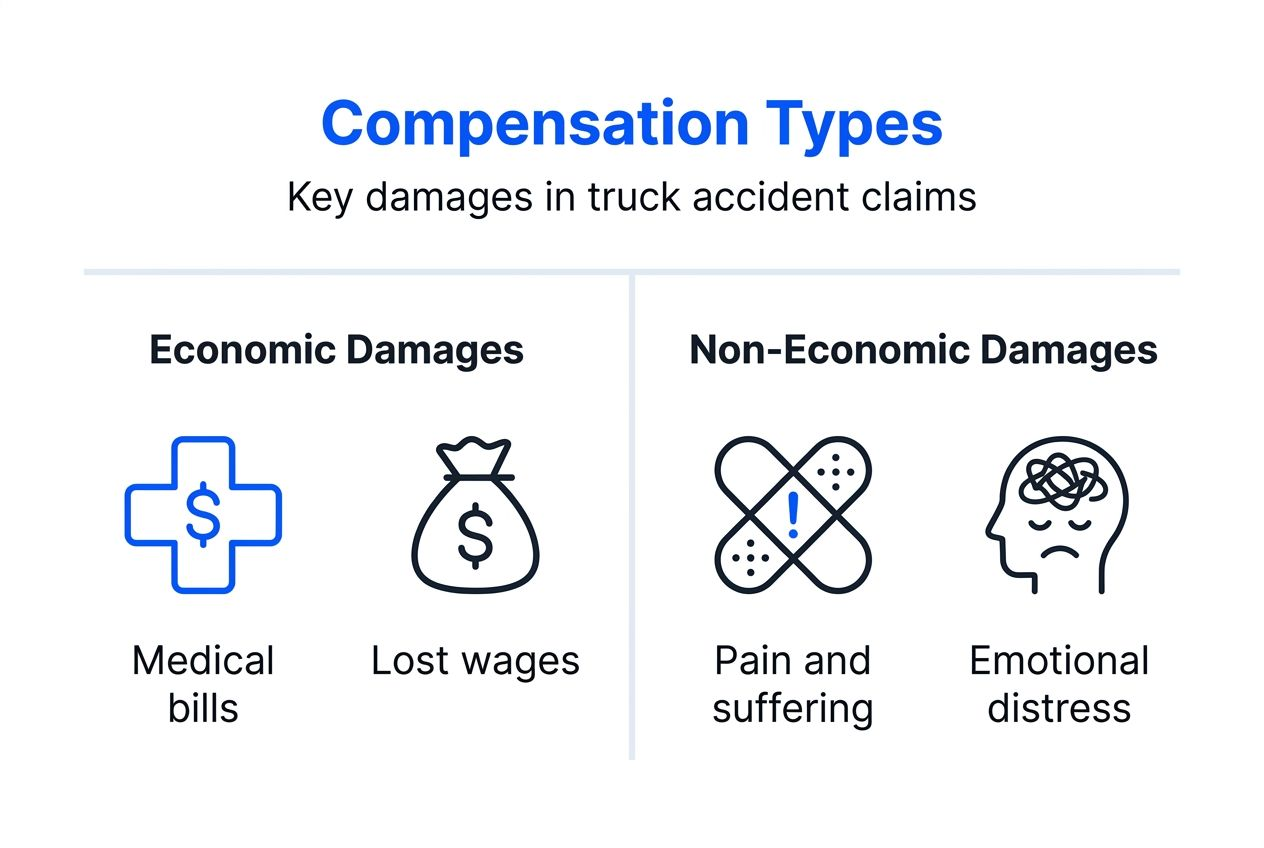
Non-economic damages address intangible harms that don’t have clear price tags. Pain and suffering compensation reflects physical discomfort and emotional distress caused by your injuries. Loss of enjoyment of life covers diminished ability to participate in activities you previously enjoyed. Permanent disfigurement or disability may warrant additional compensation for lasting physical changes.
Georgia’s comparative negligence rule directly impacts your compensation amount. If evidence shows you share fault for the accident, your total award reduces by your fault percentage. For instance, texting while driving before a truck merged into your lane might assign you 30% responsibility, reducing your $200,000 claim to $140,000. This system allows partial recovery but emphasizes the importance of strong evidence minimizing your fault.
Punitive damages become available in cases involving gross negligence or willful misconduct. If a trucking company knowingly allowed a driver with multiple DUI convictions to operate their vehicle, or falsified maintenance records leading to brake failure, courts may award punitive damages to punish the defendant and deter similar conduct. These awards are less common but can substantially increase total compensation.
Settlement amounts depend heavily on:
- Evidence strength including medical documentation and expert testimony
- Injury severity and permanence affecting future quality of life
- Clear liability with minimal comparative fault on your part
- Quality of legal representation and negotiation strategy
- Insurance policy limits available from all liable parties
Understanding these compensation forms helps you recognize whether settlement offers adequately address your full losses. Many victims accept initial offers without realizing they cover only immediate expenses, leaving future costs uncompensated.
Get expert help with your truck accident claim
Navigating Georgia’s truck accident claim process becomes significantly easier with experienced legal guidance. The stakes are too high to handle these complex cases alone.
Our Georgia personal injury lawyers specialize in trucking cases throughout South Atlanta and surrounding counties. We understand both state personal injury law and federal motor carrier regulations, giving us the expertise needed to build compelling claims against well-funded trucking companies and their insurers. Our contingency fee structure means you pay nothing unless we secure compensation for your injuries. Free consultations allow you to discuss your case details, understand your legal options, and make informed decisions without financial pressure. Don’t let insurance companies minimize your claim or complex regulations intimidate you. Understanding why hire a personal injury lawyer can transform your claim outcome. Contact us today to protect your rights and pursue the full compensation you deserve.
Frequently asked questions
What is the typical timeline for filing a truck accident claim in Georgia?
Georgia imposes a two-year statute of limitations for personal injury claims, meaning you must file within two years of your accident date. However, you should notify your insurance company within one to three days of the crash to preserve your coverage rights. Starting your claim early allows sufficient time for thorough investigation, evidence gathering, and negotiations before deadlines expire.
Can I still recover damages if I was partially at fault for the truck accident?
Yes, Georgia’s comparative negligence law allows you to recover compensation even when partially responsible for the accident. Your total damages reduce by your fault percentage rather than being eliminated entirely. You can only recover if you’re less than 50% at fault for the crash.
Why is it important to hire a specialized truck accident lawyer rather than a general personal injury attorney?
Truck accident claims involve Federal Motor Carrier Safety Regulations and complex documentation requirements that general personal injury attorneys may not fully understand. Specialized lawyers have experience identifying violations of federal rules, analyzing electronic logging device data, and negotiating with trucking company insurers who employ aggressive defense tactics. This expertise directly impacts your settlement amount and claim success rate.
What types of evidence are most important in truck accident claims?
Critical evidence includes electronic logging device data showing driver hours and vehicle operation, driver qualification files proving proper licensing and training, truck maintenance and inspection records revealing mechanical issues, cargo documentation establishing weight violations, and the official police accident report. Witness statements and scene photographs also strengthen your case by corroborating your version of events.
How long does it typically take to settle a truck accident claim in Georgia?
Truck accident claims usually take nine to eighteen months to resolve, significantly longer than regular auto accident cases. The extended timeline results from complex investigations, multiple liable parties, federal regulation analysis, and higher settlement amounts that insurers contest more aggressively. Cases requiring litigation may take two years or more to reach final resolution through trial or settlement.