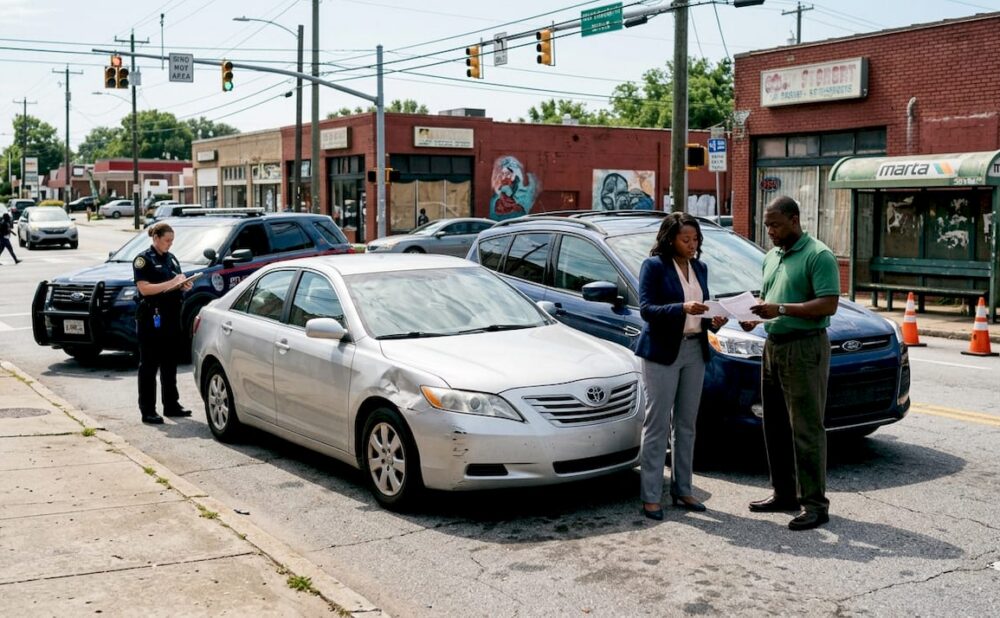

You’re sitting in the emergency room, your car is totaled, and your phone is already buzzing with calls from an insurance adjuster asking you to give a recorded statement. Medical bills are stacking up, and you have no idea what your rights are. This scenario plays out every day across Georgia, and the victims who come out ahead are the ones who know the process before they need it. This guide walks you through every critical step, from the scene of the accident to the final settlement, so you can protect your rights and pursue the compensation you deserve.
Table of Contents
- What to do immediately after an accident in Georgia
- Documenting evidence and proving fault
- Notifying parties and understanding special cases
- Filing your personal injury claim: step-by-step process
- Choosing the right Georgia injury attorney
- Why Georgia personal injury claims demand aggressive advocacy
- Get support for your Georgia injury claim
- Frequently asked questions
Key Takeaways
| Point | Details |
|---|---|
| Act quickly and document | Your actions and evidence at the scene shape your Georgia personal injury case from day one. |
| Fault matters most | Georgia’s 50% rule requires you to be less than half at fault to get any compensation. |
| Deadlines are strict | Special cases like government or medical claims have even shorter notification rules. |
| Legal help is crucial | The right Georgia attorney can navigate complex fault and maximize your recovery. |
What to do immediately after an accident in Georgia
With urgency and confusion at the scene, here are your most critical first steps.
Your health comes first. Call 911 immediately, even if injuries seem minor. Adrenaline masks pain, and some injuries like internal bleeding or concussions don’t show symptoms for hours. Getting emergency medical attention also creates an official medical record, which becomes one of your most important pieces of evidence later.
While you wait for help to arrive, start documenting everything you can safely reach:
- Photograph all vehicles from multiple angles, including license plates, damage, and final resting positions
- Capture the scene: road conditions, skid marks, traffic signs, and any contributing hazards
- Get contact information from every witness present, including names and phone numbers
- Do not admit fault or apologize, even casually. Stick to the facts when speaking with police
- Request a copy of the police report or note the report number so you can obtain it later
Georgia follows a modified comparative negligence rule under O.C.G.A. § 51-12-33: if you are found less than 50% at fault, you can recover damages reduced by your fault percentage, but being 50% or more at fault bars any recovery entirely. That rule makes your behavior at the scene legally significant. Anything you say can be used to assign you a greater share of fault.
“The moments right after a crash are the foundation of your entire claim. What you document, say, and do in those first hours can determine whether you recover thousands of dollars or nothing at all.”
Pro Tip: Download a notes app on your phone before you ever need it. After an accident, use it to record a voice memo describing exactly what happened while your memory is fresh. This contemporaneous account can be invaluable if your case goes to court months later.
For a broader overview of your rights, the accident claim essentials resource covers what Georgia victims often overlook in the immediate aftermath.
Documenting evidence and proving fault
Once the scene is secure, your next priority is capturing and organizing evidence.

Georgia’s fault system creates real financial stakes around every piece of evidence you gather. Because Georgia’s 50% fault bar creates high stakes in fault disputes, insurers actively push victim fault to reduce or eliminate payouts. Your job is to counter that strategy with hard evidence.
Here is a practical, numbered approach to building your evidence file:
- Preserve dashcam footage immediately. Overwrite cycles can erase critical recordings within 24 to 72 hours. Back up the footage to a computer or cloud storage as soon as possible.
- Request surveillance footage from nearby businesses, traffic cameras, or parking lots. Businesses typically overwrite footage within 30 days, so act fast.
- Gather medical records from every provider you visit, starting with the emergency room. Gaps in treatment can be used against you to argue your injuries weren’t serious.
- Obtain repair estimates from at least two certified shops. These documents establish the severity of the collision.
- Collect witness statements in writing. Ask willing witnesses to write a brief description of what they saw and sign it. Even a short, signed statement carries weight.
- Keep a daily injury journal. Record your pain levels, limitations, and how the injury affects your work and daily life. This personal record supports claims for pain and suffering.
Pro Tip: If you suspect the other driver was distracted or under the influence, note that in your journal and tell your attorney immediately. Cell phone records and toxicology reports can be obtained through the legal discovery process, but your attorney needs to request them early.
Accident reconstruction experts and biomechanical engineers can validate exactly how a crash occurred in complex or disputed cases. Their testimony often shifts the fault calculation significantly in your favor. Learn how making your evidence count can directly affect your settlement outcome.
Notifying parties and understanding special cases
Armed with evidence, you’ll need to navigate next required steps and watch for special deadlines.
Most people know about the standard two-year statute of limitations for Georgia personal injury claims. What many victims don’t realize is that certain types of accidents trigger much shorter and stricter deadlines that can end your claim entirely if missed.
| Claim type | Key requirement | Deadline |
|---|---|---|
| Standard auto accident | File lawsuit in civil court | 2 years from accident |
| Government entity claim | Ante litem notice required | 12 months from incident |
| Medical malpractice | Expert affidavit required at filing | 2 years from discovery |
| Trucking accident | Multi-party fault apportionment | 2 years, but notify early |
Georgia law requires special procedural steps for several categories of claims. Government claims need a 12-month ante litem notice, medical malpractice cases require an expert affidavit at the time of filing, and multi-party trucking accidents apportion fault among multiple defendants.
Key actions to take based on your accident type:
- Government vehicle or property involved? You must serve formal written notice on the correct government entity within 12 months. Missing this step typically bars your claim permanently.
- Medical malpractice suspected? Georgia requires a qualified expert to review your case and provide a signed affidavit before you can file. This takes time, so start early.
- Commercial truck involved? The trucking company, the driver, the cargo loader, and the truck’s owner may all share liability. Preserving the truck’s electronic logging device (ELD) data and black box records is time-sensitive.
“In trucking cases, evidence disappears fast. Federal regulations require carriers to retain certain records, but those retention windows are short. A prompt legal response is not optional—it is essential.”
Understanding how handling truck accident claims differs from standard auto claims can save your case before it even begins.
Filing your personal injury claim: step-by-step process
Now you’re ready to formally pursue compensation. Here’s the claim process in clear steps.
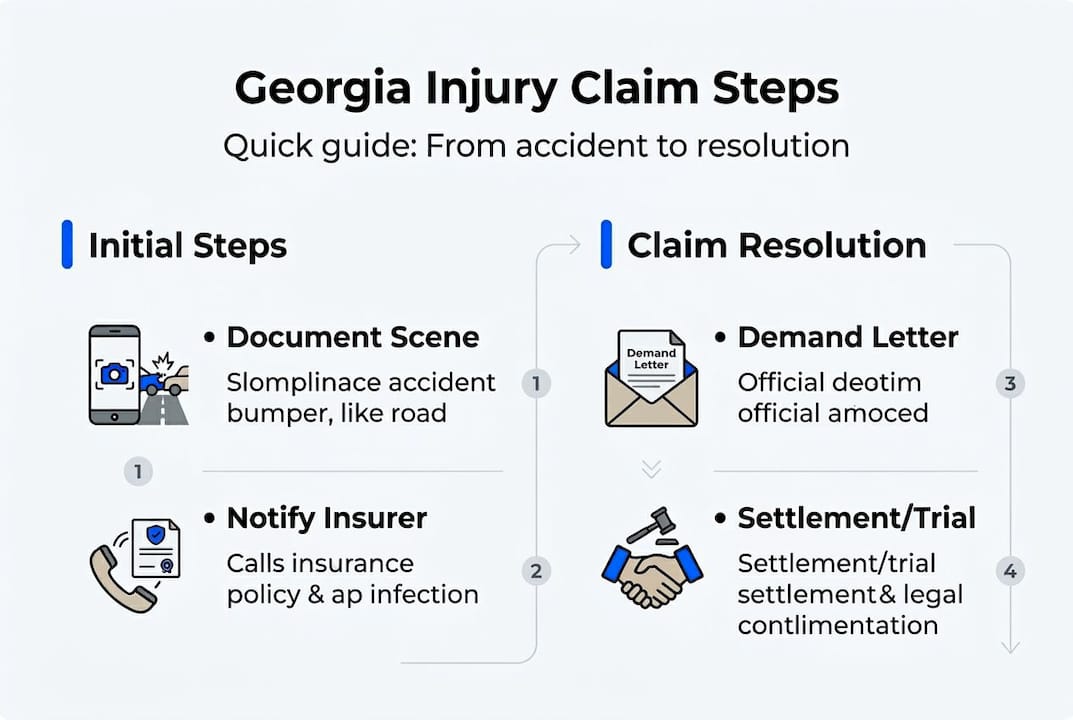
Step 1: Notify the insurance company. Report the accident to your own insurer promptly. Georgia is a fault-based state, meaning the at-fault party’s insurance is primarily responsible for damages. However, your own uninsured or underinsured motorist coverage may apply if the other driver lacks adequate coverage.
Step 2: Send a demand letter. Once your medical treatment reaches maximum medical improvement (the point where your condition has stabilized), your attorney will calculate your total damages and send a formal demand letter to the at-fault insurer. This letter outlines your injuries, evidence, and the compensation you are seeking.
Step 3: Negotiate the settlement. Insurers rarely accept the first demand. Expect counteroffers. Your attorney will evaluate each offer against your documented losses, including medical bills, lost wages, future care costs, and pain and suffering.
Step 4: File a lawsuit if necessary. If negotiations stall, filing a lawsuit in Georgia is the next step. Georgia’s statute of limitations gives you two years from the accident date, but filing earlier preserves leverage and keeps the process moving.
Step 5: Discovery and potential trial. Both sides exchange evidence, take depositions, and retain expert witnesses. Most cases settle during or after discovery, but some proceed to trial.
| Approach | Pros | Cons |
|---|---|---|
| Insurance negotiation | Faster resolution, lower cost | Insurers lowball offers |
| Mediation | Private, flexible, often faster | Requires compromise |
| Lawsuit and trial | Potentially higher award | Longer timeline, more stress |
Georgia’s modified comparative negligence rule under O.C.G.A. § 51-12-33 applies at every stage. Even during trial, the jury assigns fault percentages, and your recovery is reduced accordingly. This is why the evidence you gathered in the early stages directly determines your final payout.
Pro Tip: Never accept a settlement offer without consulting an attorney first. Insurance adjusters are trained negotiators working for their employer, not for you. A single phone call with a personal injury lawyer before you sign anything can be worth thousands of dollars.
For a detailed breakdown of paperwork and timelines, the claim filing success tips resource walks through each form and deadline you need to meet.
Choosing the right Georgia injury attorney
Legal representation is often the turning point. Here’s how to find your best advocate.
Not every personal injury attorney has the same depth of knowledge about Georgia’s specific rules. Local expertise matters enormously when your case involves government entities, commercial trucking companies, or medical providers. Georgia’s multi-party fault apportionment rules in trucking cases, for example, require an attorney who understands how to identify every liable party and build a coordinated case against all of them simultaneously.
When evaluating attorneys, ask these direct questions:
- How many Georgia personal injury cases have you handled in the last three years? Volume and recency matter.
- Have you handled cases similar to mine? Trucking, government, and medical malpractice cases each require distinct expertise.
- What is your fee structure? Reputable personal injury attorneys work on contingency, meaning you pay nothing unless they win.
- Who will actually handle my case? Some firms hand cases to junior staff after the initial consultation. Know who your primary contact will be.
- How do you communicate with clients? Regular updates and accessible communication are non-negotiable during a stressful process.
Pro Tip: Bring your police report, photos, and any correspondence from the insurance company to your first consultation. The more information an attorney has upfront, the more accurate their initial assessment will be.
The right attorney levels the playing field against well-funded insurance companies. Review attorney selection tips and the updated guide to choosing a Georgia injury lawyer to sharpen your criteria. For truck crash victims specifically, understanding why you need a trucking accident lawyer explains the critical differences from standard auto cases.
Why Georgia personal injury claims demand aggressive advocacy
Most guides focus on forms and deadlines. What they don’t tell you is that Georgia’s fault system is uniquely designed to reward the side that controls the narrative first.
Insurance companies understand Georgia’s 50% fault bar better than most victims ever will. Their adjusters are trained to gather statements, review social media, and build a file that assigns you as much fault as possible. The moment your fault percentage crosses 50%, their liability disappears entirely. That is not an accident of law. It is a financial incentive baked into every claim they handle.
The uncomfortable truth is that Georgia’s 50% fault bar creates a system where insurers are rewarded for being aggressive and victims are penalized for being passive. A victim who waits two weeks to hire an attorney, gives a recorded statement without counsel, or fails to preserve dashcam footage has already weakened their position before negotiations even begin.
Small details carry outsized weight here. The angle of a photograph. A witness who saw the light was green. A black box showing the other driver was speeding. These details can shift fault from 51% to 35%, and that shift is the difference between zero recovery and a six-figure settlement.
Our experience with South Atlanta clients shows that early preparation and bold representation consistently produce better outcomes than waiting to “see how negotiations go.” For a deeper look at how these dynamics play out locally, the South Atlanta injury law insights resource reflects what we see in real cases across our region.
The victims who recover the most are not always the ones with the most severe injuries. They are the ones who documented everything, hired the right attorney early, and refused to let the insurance company define the facts of their case.
Get support for your Georgia injury claim
You’ve done the research. Now it’s time to put it into action with experienced legal support behind you.

At The Jewkes Firm, we represent accident victims across South Atlanta and surrounding Georgia counties, handling auto accidents, commercial trucking crashes, medical malpractice, and government-involved claims. Our attorneys understand Georgia’s strict fault rules, the special procedural requirements for complex cases, and the insurance tactics designed to minimize your recovery. We work on a contingency fee basis, meaning you pay nothing unless we win your case. Your path to maximum compensation starts with a single conversation.
Call us today for a FREE CONSULTATION and let us review your claim, answer your questions, and build the strongest possible case on your behalf.
Frequently asked questions
What is the statute of limitations for personal injury claims in Georgia?
Georgia’s statute of limitations is generally two years from the date of the accident to file a personal injury claim in civil court.
Can I recover damages if I was partly at fault in a Georgia accident?
Yes, if you are less than 50% at fault you can recover damages, but those damages are reduced by your fault percentage. Under Georgia’s modified comparative negligence rule per O.C.G.A. § 51-12-33, being 50% or more at fault bars any recovery entirely.
What special steps are needed for claims against the government?
Georgia law requires an official ante litem notice within 12 months of the incident for claims involving government entities, as outlined under Georgia personal injury law requirements for edge cases including government claims, medical malpractice, and trucking accidents.
Why is fault assignment so critical in Georgia car accidents?
Georgia’s 50% fault bar means even a small shift in fault percentage can eliminate your entire recovery, which is why insurers aggressively push victim fault and why strong evidence is essential.
Do trucking accidents follow different rules?
Yes. Trucking accidents may involve multiple liable parties, including the driver, the carrier, and the cargo loader, with fault apportioned among all defendants under Georgia personal injury law.