

TL;DR:
- Medical negligence in Georgia requires proof that a healthcare provider failed to meet professional standards, causing harm. Establishing duty, breach, causation, and damages with proper evidence is essential, as not all bad outcomes qualify as negligence. Promptly gathering medical records and consulting an experienced attorney can help build a strong case within the law’s strict requirements.
When something goes wrong during medical treatment, it’s natural to wonder whether you have a case. But what is medical negligence, exactly, and does every bad outcome qualify? The answer, under Georgia law, is no. Medical negligence is a specific legal concept with defined elements that must all be proven before any claim succeeds. Understanding the definition of medical negligence before you take action can mean the difference between a strong case and a dismissed one. This guide breaks down exactly what Georgia law requires, in plain language, so you know where you stand.
Table of Contents
- Understanding medical negligence in Georgia
- The four elements of proving medical negligence in Georgia
- How breach of duty is determined in a medical negligence claim
- Causation and damages: linking breach to harm in Georgia cases
- Common challenges and next steps if you suspect medical negligence
- A fresh perspective on medical negligence claims in Georgia
- How The Jewkes Firm can help with your medical negligence case
- Frequently asked questions
Key Takeaways
| Point | Details |
|---|---|
| Medical negligence defined | Medical negligence involves a healthcare provider failing to meet the standard of care legally required in Georgia. |
| Four key elements | You must prove duty, breach, causation, and damages for a successful medical malpractice claim. |
| Breach means falling short | Breach is when a provider does less than a reasonably competent provider would under similar conditions. |
| Proof of harm required | Your injury must be directly caused by the breach and result in measurable damages. |
| Legal strategy matters | Organizing facts around legal elements rather than emotions strengthens malpractice claims. |
Understanding medical negligence in Georgia
Medical negligence is not simply a doctor making a mistake. It means a healthcare provider failed to deliver the level of care that the medical profession generally requires under similar conditions. Georgia law is specific on this point: malpractice is negligence when a provider fails to apply “that degree of care and skill which is ordinarily employed by the profession generally under similar conditions and like surrounding circumstances.”
That legal standard matters because it sets the bar. A provider is not expected to be perfect. They are expected to meet the accepted standard of their profession. When they fall short of that standard and you suffer harm as a result, the law may recognize a valid claim.
The provider-patient relationship is the foundation of this legal framework. When you see a doctor, surgeon, nurse, or other licensed provider in a clinical setting, a duty is created. That relationship establishes legal obligations for healthcare providers to deliver care meeting professional standards. Without that relationship, there is no duty, and without duty, there is no negligence claim.
Key facts about how Georgia defines medical negligence:
- The standard is based on what the profession generally does, not what any single provider believes
- Both action and inaction can qualify as negligence
- The harm must be directly connected to the failure in care
- Providers include physicians, surgeons, nurses, hospitals, and clinics
- Understanding medical malpractice in Georgia means understanding this foundational duty
The four elements of proving medical negligence in Georgia
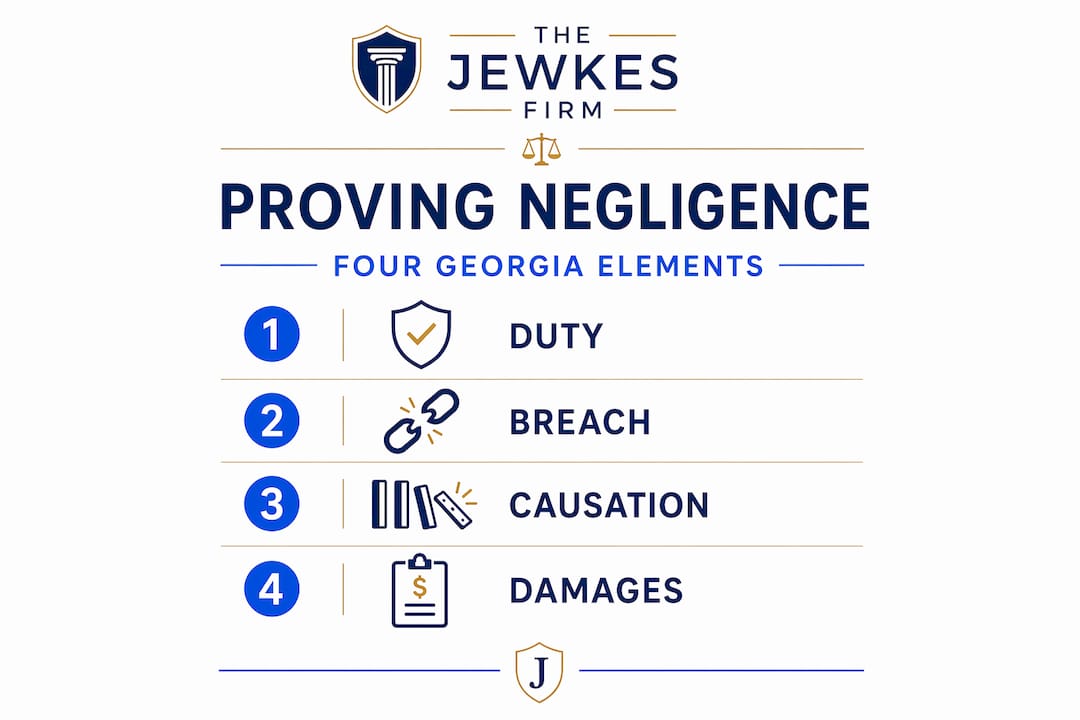
Georgia courts require proof of four core elements to establish a medical negligence claim. Georgia analyzes malpractice using duty, breach, causation, and damages. Miss even one, and the claim will not hold up. Here is what each element actually means for your case.
- Duty. A provider-patient relationship existed. You were under their care. This is usually the easiest element to prove, but it must be formally established.
- Breach. The provider failed to meet the accepted standard of care. They did something a reasonably skilled provider would not have done, or they failed to do something a competent provider would have done.
- Causation. The breach directly caused your injury. This is often the most contested element. The harm cannot be a pre-existing condition or a known risk of the procedure.
- Damages. You suffered real, measurable harm. Emotional upset alone is not enough. There must be physical injury, financial loss, disability, or another recognized category of loss.
Comparison of elements and what they require:
| Element | What you must show | Common evidence used |
|---|---|---|
| Duty | Provider-patient relationship existed | Medical records, appointment documentation |
| Breach | Provider fell below standard of care | Expert medical testimony |
| Causation | Breach directly caused the injury | Medical records, expert causation analysis |
| Damages | Real, measurable harm occurred | Bills, lost wages, medical reports |
Understanding the medical malpractice claim elements in this structured way helps you and your attorney evaluate exactly where your case is strong and where it needs more evidence.
Pro Tip: Do not wait to start gathering records. Request your complete medical file as soon as you suspect negligence. Delays can result in missing critical documentation and running into Georgia’s statute of limitations.
How breach of duty is determined in a medical negligence claim
Of all four elements, breach is often the most difficult to understand because it is contextual. Proving breach means showing the provider fell below what a reasonably prudent provider with similar training would do under similar circumstances. That phrase “similar circumstances” is doing a lot of work legally.

A surgeon operating in an emergency with limited resources is judged differently than one performing a scheduled procedure in a fully equipped facility. Breach is not absolute. It is contextual, evidence-based, and almost always requires expert testimony from another provider in the same or similar specialty.
Breach can occur in two forms:
- Acts of commission: The provider did something wrong, such as operating on the wrong site, prescribing a dangerous drug interaction, or performing an unnecessary procedure
- Acts of omission: The provider failed to do something necessary, such as ordering a follow-up test, recognizing warning signs, or obtaining informed consent before a procedure
Not every error rises to the level of breach. A misdiagnosis is not automatically negligence. If a provider followed standard diagnostic protocols and still missed a rare condition, that may not qualify as breach. What counts legally is whether the provider’s conduct fell outside the range of what the profession generally accepts. Filing an injury lawsuit in Georgia starts with understanding whether this threshold has actually been crossed.
Pro Tip: Expert witnesses are not optional in Georgia malpractice cases. Courts require testimony from qualified medical professionals to establish what the standard of care was and how the defendant provider fell short of it.
Causation and damages: linking breach to harm in Georgia cases
Even if a provider clearly breached the standard of care, your case still requires causation. This is the element that connects the wrongdoing to your injury. The breach must be the proximate cause of the injury sustained for liability to attach. In plain terms, the provider’s failure must be the direct reason you were harmed.
This distinction matters because patients often enter medical care already sick or injured. If you had a pre-existing heart condition and suffered a cardiac event after surgery, proving that the surgeon’s specific breach caused the event, rather than your underlying condition, requires careful expert analysis.
Compensable damages in Georgia medical negligence cases typically include:
- Economic damages: Past and future medical bills, rehabilitation costs, lost income, and home care expenses
- Noneconomic damages: Pain and suffering, emotional distress, and loss of enjoyment of life
- Wrongful death damages: In fatal cases, surviving family members may claim related financial and emotional losses
Types of damages and examples:
| Damage type | Examples | Notes |
|---|---|---|
| Medical expenses | Surgery, hospitalization, rehab | Both past and future costs covered |
| Lost income | Missed work, reduced earning capacity | Requires documentation |
| Pain and suffering | Chronic pain, emotional trauma | Subject to statutory caps |
| Wrongful death | Funeral costs, loss of companionship | Filed by surviving family |
Important: Proving causation is not optional. Georgia courts require a direct link between the provider’s breach and your harm. Without it, even the most clear-cut act of negligence will not produce a recovery.
Georgia law caps noneconomic damages in malpractice cases. Understanding those limits is part of maximizing compensation for injury and why working with an attorney who knows Georgia malpractice law makes a measurable difference in outcomes.
Common challenges and next steps if you suspect medical negligence
Most medical negligence claims in Georgia face serious challenges before they ever reach a courtroom. Many claims fail because plaintiffs argue negligence without establishing each malpractice element, especially duty, breach tied to the standard of care, and proximate cause. Knowing this in advance shapes how you build your case from day one.
Common obstacles include:
- Confusing a bad outcome with negligence. Not every complication is malpractice. Medicine involves risk, and providers are not liable for known complications that occurred despite proper care.
- Missing the statute of limitations. Georgia generally requires medical malpractice claims to be filed within two years of the date you discovered or reasonably should have discovered the injury.
- Lack of expert support. Without a qualified medical expert willing to testify that the provider breached the standard of care, the case has little chance of succeeding.
- Incomplete medical records. Gaps in documentation make it harder to establish what happened, when, and why.
- Confusing general negligence with medical malpractice. These are separate legal theories with different requirements. Understanding negligence versus malpractice distinctions is critical before deciding how to proceed.
If you believe you have been harmed by a provider’s failure, take these steps immediately: preserve all medical records, document your symptoms and how they have progressed, note every provider involved in your care, and consult a Georgia malpractice attorney before the statute of limitations runs.
Pro Tip: Write a detailed timeline of your treatment as soon as possible. Memory fades. A written chronology of events, providers, treatments, and symptoms gives your attorney a clearer picture and helps organize your facts around the legal elements your case will need.
A fresh perspective on medical negligence claims in Georgia
Here is something most people do not hear until it is too late: the strongest medical negligence cases are built on facts, not frustration. That sounds obvious, but it runs counter to how most people approach these situations. When something goes wrong medically, the emotional response is real and valid. But an emotional response is not a legal strategy.
The providers who get sued most successfully are not necessarily the worst doctors. They are the ones whose failures can be measured against a clear standard, connected to a specific harm, and documented with evidence. A provider can be genuinely terrible and still escape liability if the plaintiff cannot establish each element with proof. Equally, a provider who made one specific, documentable error in an otherwise strong career can face significant liability if the elements align.
Your first legal evaluation should organize facts around those elements rather than around emotions about the outcome. That is not cold or dismissive of your suffering. It is the most practical way to honor what you have been through by actually pursuing it effectively.
Most people who consult an attorney after a medical harm experience spend the first meeting explaining how wrong the outcome felt. The most useful clients spend that meeting explaining what the provider did, what they should have done differently, and what harm specifically resulted. That shift in framing is what separates claims that settle favorably from those that collapse.
Strategic legal evaluation of malpractice is not about minimizing your pain. It is about making sure your pain produces a result. That is the real value of understanding the legal elements before you walk into a consultation.
How The Jewkes Firm can help with your medical negligence case
If you believe a healthcare provider’s failure caused you harm, the next step is a legal evaluation by someone who knows Georgia malpractice law from the inside. At The Jewkes Firm, we evaluate medical negligence cases with the same structured approach this article describes: examining duty, breach, causation, and damages, and then giving you an honest assessment of where your claim stands.

We serve clients throughout South Atlanta and surrounding Georgia counties, and we work on a contingency fee basis, meaning you pay nothing unless we win. Our team is committed to making sure your voice is heard and your rights are fiercely protected. If you suspect medical negligence, do not wait. Contact The Jewkes Firm today for a FREE CONSULTATION and take the first step toward understanding your options. Learn more about your medical malpractice rights and let us help you build the strongest possible case.
Frequently asked questions
What are the four elements required to prove medical negligence in Georgia?
You must prove duty, breach, causation, and damages to have a valid medical negligence claim in Georgia. Georgia analyzes malpractice using all four core liability elements, and each must be established with evidence.
Is every medical error considered medical negligence under Georgia law?
No, not every medical error qualifies as negligence. The error must breach the accepted standard of care and directly cause harm, and breach means failing to meet what a reasonably prudent provider would do in similar circumstances.
What types of damages can I claim in a Georgia medical negligence lawsuit?
You can claim economic damages like medical bills and lost income, and noneconomic damages like pain and suffering, but Georgia law caps noneconomic damages in medical malpractice cases at $350,000 per healthcare provider.
How important is it to prove causation in a medical malpractice case?
Proving that the breach caused your injury is essential to any successful claim. The breach must be the proximate cause of the injury sustained, and without that direct connection, the claim will not succeed under Georgia law.
What should I do if I believe I have been a victim of medical negligence in Georgia?
Organize your facts around the four legal elements and consult a qualified Georgia malpractice attorney as soon as possible. Claims often fail when plaintiffs do not establish all malpractice elements, so early, organized legal guidance is critical.