

Key Takeaways
- Families often overlook the full scope of wrongful death damages, which include economic, non-economic, and sometimes punitive losses. Georgia law allows eligible parties to pursue comprehensive compensation, emphasizing the importance of evidence and timely action within a two-year statute of limitations. Understanding and documenting these damages helps families honor their loved ones and secure the justice they deserve.
Most families who lose a loved one to someone else’s negligence assume that wrongful death compensation is limited to funeral expenses. That assumption costs them dearly. Explaining damages in wrongful death is far more involved than a single line item on a bill. Georgia law recognizes a wide range of losses, from the income your family will never see to the guidance a child will never receive from a parent. This guide walks you through every category of damages you can pursue, how courts calculate them, and the steps that protect your family’s right to full recovery.
Table of Contents
- Understanding wrongful death damages in Georgia
- Types of damages in wrongful death lawsuits
- How courts calculate wrongful death damages in Georgia
- Practical steps for families claiming damages after a wrongful death in Georgia
- A fresh perspective: Why understanding damages beyond dollars matters in wrongful death cases
- Get the help you need for wrongful death damages in Georgia
- Frequently asked questions
Understanding wrongful death damages in Georgia
Before you can claim anything, you need to know who has the legal right to file. Georgia law is specific. Eligible parties usually include spouses, children, and financially dependent persons in wrongful death claims. If none of those parties exist, the right may pass to the estate.
A Georgia wrongful death lawsuit is a civil action, entirely separate from any criminal charges that may arise from the same incident. The goal is financial accountability, not punishment through incarceration. You do not need a criminal conviction to win a wrongful death case.
Georgia recognizes two distinct types of legal claims that often run alongside each other:
- Wrongful death claim: Pursued by surviving family members to recover the full value of the deceased’s life, including both economic and non-economic losses.
- Survival action: Filed by the estate to recover losses the deceased personally experienced before death, such as medical bills, lost wages during hospitalization, and pain and suffering.
Understanding Georgia wrongful death terms early in the process helps families avoid confusion when attorneys and courts discuss which claim covers what. These two tracks work together, and families often pursue both at the same time.
With a clear idea of who can file a wrongful death claim in Georgia, let’s explore the types of damages these families can recover.
Types of damages in wrongful death lawsuits
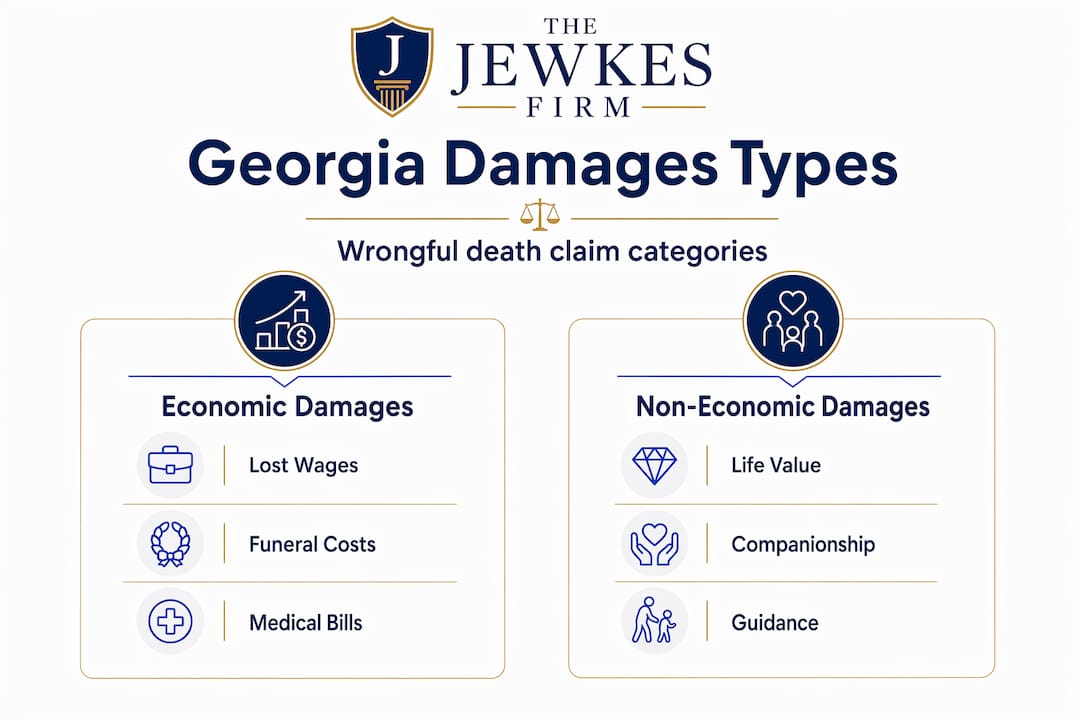
Wrongful death damages typically fall into economic losses, non-economic suffering, and occasionally punitive damages. Each category serves a different purpose and requires different types of evidence.

Economic damages
These are the losses you can attach a dollar figure to directly. They include:
- Lost income and benefits: What your loved one would have earned over their remaining working years, including salary, bonuses, retirement contributions, and health insurance.
- Medical expenses: Bills incurred from the moment of injury through death. These fall under the survival action, not the wrongful death claim itself.
- Funeral and burial costs: Georgia law allows families to recover reasonable funeral expenses.
- Household services: If the deceased cooked, cleaned, managed finances, or provided childcare, courts assign a market value to those contributions. This is often underestimated and undervalued by families.
Non-economic damages
These cover losses that do not come with a receipt but are very real. Georgia law recognizes them under the concept of the “full value of the life” of the deceased.
- Loss of companionship and love
- Loss of parental guidance and nurturing
- Loss of emotional support
- Loss of protection and care
Unlike some states, Georgia frames non-economic recovery around the value of the deceased’s life to the family, not just the family’s grief. That distinction matters significantly when an attorney presents your case.
Punitive damages
Punitive damages are reserved for cases involving willful misconduct, fraud, or gross negligence. A drunk driver who killed your family member at three times the legal limit? That may qualify. A distracted driver who ran a red light? Possibly not. Courts award punitive damages to punish the defendant and deter similar conduct, not to compensate the family directly.
Comparison of wrongful death damages types:
| Damages type | What it covers | Evidence needed |
|---|---|---|
| Economic | Lost wages, funeral costs, household services | Pay stubs, tax returns, expert testimony |
| Non-economic | Companionship, guidance, emotional support | Personal testimony, family statements |
| Punitive | Gross negligence or intentional harm | Police reports, toxicology, prior conduct |
Pro Tip: Do not assume your case lacks non-economic damages just because they are hard to quantify. An experienced attorney can work with forensic economists and counselors to build a compelling picture of what your family truly lost. Learn more about damages Georgia injury cases and how courts value each type.
For a broader look at compensation types Georgia cases involving personal injury, the legal structure shares key similarities worth understanding before your case begins.
How courts calculate wrongful death damages in Georgia
Calculating wrongful death compensation is not guesswork. Courts and attorneys follow a structured analysis shaped by the specific facts of each case. Factors shaping the final damages calculation include the deceased’s age, earning capacity, dependents, evidence strength, and defendant’s insurance coverage.
Here is how each factor typically plays out in a Georgia courtroom:
- Age and life expectancy: A 35-year-old with 30 working years ahead generates a far larger lost income projection than a retiree. Courts use actuarial life expectancy tables combined with career trajectory data.
- Earning capacity: Not just current salary but projected growth. A junior engineer killed at 28 may have been on track for a director-level salary within a decade. Forensic economists testify to these projections.
- Dependency level: A spouse who relied entirely on the deceased’s income receives a different apportionment than an adult child who was financially independent.
- Evidence quality: Documentation is everything. Gaps in financial records, missing medical reports, or inconsistent testimony can reduce an award significantly.
- Defendant’s insurance coverage: Practically speaking, the defendant’s policy limits often set a ceiling on recovery unless they have substantial personal assets. Attorneys investigate all available coverage, including umbrella policies.
Key factors and their impact on damages:
| Factor | Low impact scenario | High impact scenario |
|---|---|---|
| Age | Near retirement age | Young adult with decades ahead |
| Earnings | Minimal documented income | High earner with verified records |
| Dependents | No financial dependents | Spouse and minor children |
| Evidence | Limited documentation | Strong financial and medical records |
“The strength of your damages claim often comes down to the quality of evidence gathered in the weeks immediately following the loss. Families who act quickly protect their right to maximum recovery.”
Survival actions add another layer. If your loved one lived for days or weeks after the incident, medical bills and their pain and suffering during that period are separate recoverable losses under Georgia law. These are maximized through careful documentation from the very start.
Understanding Georgia wrongful death liability is equally important because who is legally responsible shapes how damages are pursued and collected.
Practical steps for families claiming damages after a wrongful death in Georgia
Knowing what damages exist is only useful if you know how to pursue them. Here is what Georgia families need to do, and when.
- Act within the statute of limitations. Georgia sets a two-year deadline from the date of death. Miss it and you lose the right to file entirely. There are narrow exceptions, but relying on them is risky.
- Gather financial records immediately. Tax returns, pay stubs, investment account statements, and employer benefit summaries all feed into the economic damages calculation. The more complete the picture, the stronger the claim.
- Document the relationship. Journals, photographs, school event records, medical appointments attended together. These details bring non-economic damages to life for a jury or in settlement negotiations.
- Preserve all medical and incident evidence. Request hospital records, autopsy reports, and police reports as soon as they become available. Some records have retention windows and can disappear.
- Consult an attorney before speaking with insurers. Insurance adjusters work for the defendant’s interests. A statement made without legal guidance can be used to minimize your claim.
Key documentation families should prioritize:
- Complete medical billing records from the incident through death
- Proof of financial dependency (bank accounts, mortgage statements)
- Employment records and career history of the deceased
- Written and recorded communications showing the relationship between family members and the deceased
Pro Tip: Hiring a wrongful death attorney early does more than just protect your legal rights. It lets you focus on grieving while professionals handle the legal complexity. The contingency fee model means most Georgia wrongful death attorneys charge nothing upfront.
Navigating wrongful death claims involves legal deadlines, evidence collection, and qualified attorney support to secure maximum compensation. Treating it as a checklist you can get to later is one of the costliest mistakes families make.
Settlement versus trial is another decision families face. Most cases settle before going to a jury. Settlements offer certainty and speed. Trials carry risk but sometimes yield higher awards. Your attorney should walk you through the realistic range for both options based on the specific facts of your case.
A fresh perspective: Why understanding damages beyond dollars matters in wrongful death cases
Here is something most articles about wrongful death compensation skip entirely. The legal system gives you a framework for financial recovery. But no damages calculation will ever fully capture what your family actually lost.
Courts assign numbers to companionship, guidance, and love. Those numbers are real and legally important. But the process of explaining those losses, of sitting with an attorney and describing what it was like when your father coached your daughter’s soccer team or when your spouse handled every family crisis with calm and humor, that process matters beyond the courtroom.
Many families who pursue wrongful death claims report that the process of documenting non-economic damages helped them articulate their grief in a way that felt like honoring their loved one. It forced them to put language to things they had never said out loud. That is not a small thing.
Attorneys who specialize in wrongful death understand this. The best ones do not just build a financial case. They help families tell the full story of a person’s life and impact. Courts respond to complete, human narratives. So do juries.
Our firm’s perspective is direct: families who view their wrongful death claim in Georgia as both a legal process and a form of justice are better prepared for the emotional demands of litigation. Approaching it only as a financial transaction often leads to frustration when the final number does not match the magnitude of the loss. Approaching it as an opportunity to hold someone accountable for the full weight of what they took from your family changes the experience entirely.
Get the help you need for wrongful death damages in Georgia
If you are facing the aftermath of a wrongful death in Georgia, you should not be navigating this process alone. Understanding what damages you can claim is just the beginning. Building a case that actually recovers them requires experience, resources, and unwavering dedication to your family’s interests.

Jewkes Firm represents Georgia families in wrongful death cases throughout South Atlanta and the surrounding counties. We offer free consultations so you can understand your rights and your options before committing to anything. Our attorneys work on a contingency fee basis, which means you pay nothing unless we win. From the moment you contact us, our focus is on making sure your family’s losses are fully seen, properly documented, and fiercely protected in every negotiation and courtroom. Contact Jewkes Firm today to schedule your free consultation.
Frequently asked questions
Who can file a wrongful death claim in Georgia?
Eligible parties usually include spouses, children, and financially dependent persons in wrongful death claims. If none of these parties exist, the right to file may pass to the deceased’s estate.
What types of damages can I recover in a Georgia wrongful death case?
You can pursue economic damages like lost income and funeral costs, non-economic damages such as loss of companionship, and in rare cases, punitive damages for gross negligence. Wrongful death damages typically fall into economic losses, non-economic suffering, and occasionally punitive damages.
How long do I have to file a wrongful death lawsuit in Georgia?
The statute of limitations for wrongful death lawsuits in Georgia is generally two years from the date of the loved one’s death. Missing this two-year deadline typically eliminates your right to file.
Can I recover damages for my emotional pain and grief?
Georgia law allows recovery for loss of companionship and emotional support, but emotional distress alone is usually not compensated without a tied non-economic damages category such as loss of society or guidance.
Why should I hire a wrongful death attorney in Georgia?
An experienced attorney helps navigate complex laws, gather evidence, meet deadlines, and maximize your family’s potential compensation. Hiring a qualified attorney promptly is one of the most important steps to supporting your claim.