

TL;DR:
- Losing a loved one due to negligence is heartbreaking, and filing a wrongful death claim helps hold responsible parties accountable.
- Eligibility requires appointment of a personal representative through probate court, with strict deadlines varying by state.
Losing someone because of another person’s negligence is devastating. And when the grief is still raw, the idea of filing legal paperwork can feel impossible. But understanding how to file a wrongful death claim is not just about seeking compensation. It is about holding the right people accountable and securing your family’s financial future. This guide walks you through every stage of the wrongful death claim process, from eligibility and legal requirements to filing the lawsuit and what happens after. You deserve clear answers, not legal jargon.
Table of Contents
- Key takeaways
- How to file a wrongful death claim: prerequisites first
- Steps to file a wrongful death claim
- Common mistakes in wrongful death claims
- What to expect after filing
- My honest take on wrongful death cases
- How Jewkesfirm can help your family
- FAQ
Key takeaways
| Point | Details |
|---|---|
| Know who can file | Only specific family members or an appointed personal representative can legally file a wrongful death claim. |
| Act before the deadline | The statute of limitations typically ranges from one to three years, and missing it permanently bars your claim. |
| Appoint a personal representative | Probate court must formally appoint a representative before any lawsuit can be filed. |
| Most cases settle before trial | Settlement during or after discovery is far more common than going to trial, often through mediation. |
| Hire an attorney early | Early legal counsel protects deadlines, builds evidence, and levels the playing field against insurers. |
How to file a wrongful death claim: prerequisites first
Before you can file anything, you need to understand who is legally allowed to bring this type of claim. Not every grieving family member has automatic standing in court.
Who can file
In most states, the people who can file a wrongful death claim include:
- A surviving spouse
- Biological or adopted children of the deceased
- Parents of the deceased, particularly when no spouse or children exist
- A personal representative acting on behalf of the estate
This is where a common and costly misconception comes in. Many families assume that any close relative can walk into court and file immediately. That is not how it works. The legal process requires an appointed personal representative, and that appointment must come from a probate court, not a simple agreement between family members.
The personal representative requirement
Appointing a representative through probate court is a mandatory prerequisite before filing your civil lawsuit. The petition typically costs a few hundred dollars, but the process takes time. Here is the part that catches many families off guard: the statute of limitations continues running during the probate process. Delays in appointing a representative have caused families to lose their right to sue entirely.
Pro Tip: Start the probate petition to appoint a personal representative as soon as possible after the death. Do not wait until you feel ready. The legal clock is already running.
Statute of limitations by state
| State | Statute of Limitations |
|---|---|
| Texas | 2 years from date of death |
| California | 2 years from date of death |
| Florida | 2 years from date of death |
| Maryland | 3 years from date of death |
| Tennessee | 1 year from date of death |
One clarification worth knowing: the clock starts at death, not at the date of the original injury or accident. If your loved one survived weeks after the incident before passing, your timeline begins at death, not the day of the crash or fall.
If the death involved a government entity, the window tightens dramatically. Administrative notice deadlines for government claims can be as short as 30 to 180 days after death. Missing these shorter windows bars the lawsuit completely, even if the broader statute of limitations has not expired.
Steps to file a wrongful death claim
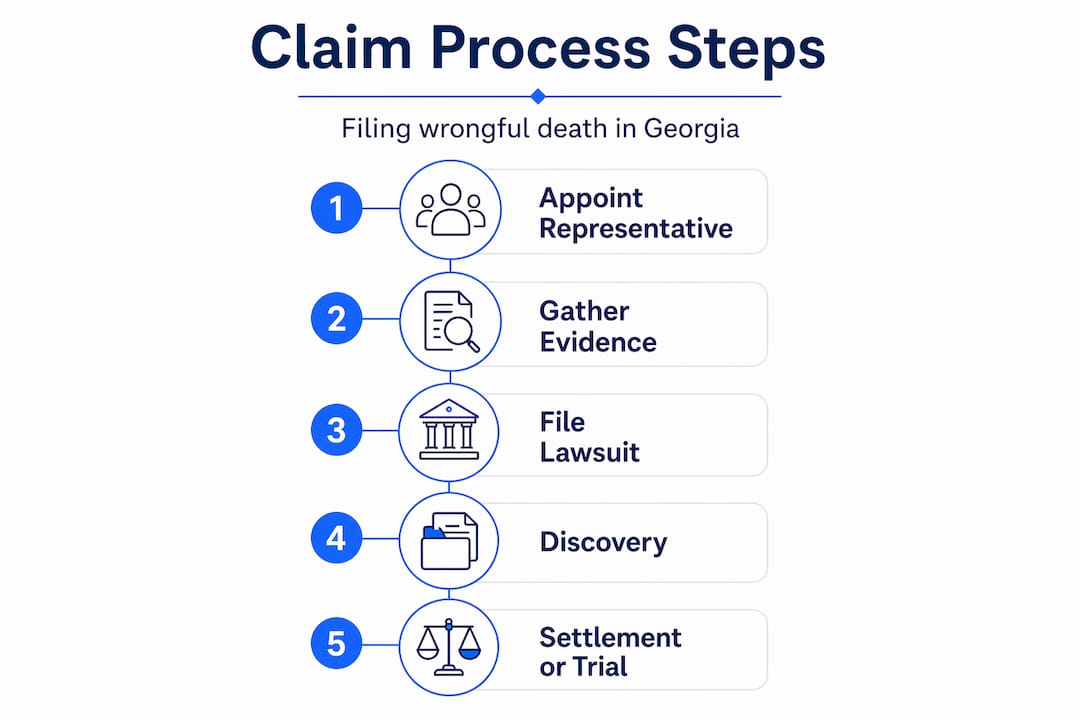
Once eligibility is clear and a personal representative is appointed, the formal filing process begins. Here is how it unfolds, step by step.
-
Consult with a wrongful death attorney. This is the first move, not an optional one. An experienced attorney evaluates your case, identifies liable parties, and tells you what evidence you need. More importantly, they protect you from inadvertently missing a deadline while you are focused on grieving.
-
Gather documentation and evidence. Your attorney will help collect medical records, death certificates, accident reports, employment records showing lost income, and any witness statements. Economic damages include lost future income, household services, funeral expenses, and medical bills. Non-economic damages cover loss of companionship and emotional suffering. Understanding the full scope of what your family lost is how you build a complete claim. The Georgia wrongful death guide covers recoverable damages in detail if you want a state-specific breakdown.
-
File the complaint in court. The personal representative files the formal complaint in civil court. This document names the defendant, outlines the facts, and states the damages sought. This is the official start of filing a wrongful death lawsuit.
-
Serve the defendant. After filing, the defendant must be formally served with the complaint. They typically have 20 to 30 days to respond. Their response often includes denials and affirmative defenses, which your attorney will address.
-
Enter the discovery phase. Discovery is the formal exchange of evidence between both sides. It includes written questions called interrogatories, requests for documents, and depositions where witnesses answer questions under oath. This phase can last several months to over a year, depending on case complexity.
-
Negotiate or prepare for trial. Most wrongful death cases settle during or after discovery. If a fair settlement is not reached, the case proceeds to trial.
Pro Tip: Do not accept the first settlement offer from an insurance company. Early offers almost always undervalue your claim. Your attorney’s job is to push back and maximize what your family receives.
The full personal injury case process in Georgia, including timeline details, is explained on the Georgia case timeline page if you want a broader picture of what to expect locally.
Common mistakes in wrongful death claims
Filing a wrongful death claim is harder than most families expect. Here are the pitfalls that most often derail cases.
-
Missing the statute of limitations. This is the most catastrophic mistake. Courts almost never grant exceptions. If you miss the deadline, your case is dismissed permanently, regardless of how strong the evidence is.
-
Delaying the probate petition. Because the statute of limitations keeps running while you go through probate, families who delay this step often find themselves dangerously close to the filing deadline before the lawsuit is even possible.
-
Failing to prove causation. It is not enough to show that someone died. You must prove that the defendant’s negligent or wrongful act directly caused the death. This requires expert witnesses, medical testimony, and thorough documentation.
-
Underestimating insurance company tactics. Insurance adjusters are trained to minimize payouts. They may approach your family early with what sounds like a generous offer. It rarely is. Independent investigations by attorneys uncover evidence that insurers overlook, including witness accounts, electronic records, and expert analysis that can significantly increase the value of your claim.
-
Missing government notice deadlines. Under the Federal Tort Claims Act, administrative claims must be filed within two years of the incident. After denial, you have six months to file suit. State government claims often have even shorter windows.
A wrongful death claim can provide financial relief and hold negligent parties accountable. But that outcome only happens when families act promptly and work with legal counsel who knows how to build the full case.
What to expect after filing
Filing the complaint is not the end of the road. For many families, it is where the real work begins.

Settlement vs. trial
| Outcome | Typical Timeline | Notes |
|---|---|---|
| Settlement during discovery | 6 to 18 months after filing | Most common outcome; mediation often facilitates agreement |
| Settlement after discovery | 12 to 24 months after filing | Happens when both sides have exchanged all evidence |
| Trial verdict | 1 to 3 years or longer | Necessary when settlement negotiations fail completely |
Most wrongful death cases resolve before ever reaching a jury. Mediation is increasingly common and reduces both the emotional strain and the unpredictability of trial. A neutral third-party mediator works with both sides to reach a number both can accept.
When cases go to trial
If mediation does not produce a fair result, your attorney takes the case to trial. The full litigation process from filing to verdict typically spans one to three years, and complex cases such as medical malpractice can take even longer due to court backlogs and expert witness schedules.
Your attorney should keep you informed at every stage. You should never feel like you are waiting in the dark. Ask your legal team for regular updates and clear explanations of each phase as it unfolds. The clearer your understanding of the process, the better decisions you will make when offers come to the table.
My honest take on wrongful death cases
I have seen how families approach wrongful death claims, and the pattern that troubles me most is this: people underestimate the complexity until they are already behind.
Most families think the hardest part is finding out who was responsible. In my experience, they already know who was at fault. The real difficulty is proving it in a way that holds up legally and financially. That requires a thorough independent investigation. Not the police report. Not the insurance company’s findings. An investigation conducted on your family’s behalf, with your interests as the only priority.
I have also seen families lose claims not because the evidence was weak, but because they waited too long to start the probate process or did not realize the clock was already counting down. Understanding why you need a wrongful death attorney early is not just about legal strategy. It is about protecting the one shot your family has to hold someone accountable.
Grief and legal deadlines do not pause for each other. That is an uncomfortable reality, but it is true. The families who get the best outcomes are not the ones with the strongest emotions or the clearest sense of injustice. They are the ones who moved quickly, got organized, and trusted a skilled advocate to fight on their behalf.
— Ali
How Jewkesfirm can help your family
When your family is dealing with the unthinkable, you should not have to figure out the legal system alone.

Jewkesfirm has a dedicated team with deep experience in wrongful death cases across South Atlanta and surrounding Georgia counties. From conducting independent investigations to handling every stage of the wrongful death claim process, the firm fights to make sure every liable party is identified and every dollar your family is owed is pursued. There are no upfront fees. You pay nothing unless they win. Contact Jewkesfirm today for a FREE CONSULTATION and take the first step toward getting your family the justice they deserve.
FAQ
Who is eligible to file a wrongful death claim?
Eligible filers typically include a surviving spouse, children, parents of the deceased, or a court-appointed personal representative. Eligibility varies by state law.
How long do you have to file a wrongful death claim?
The deadline varies by state, ranging from one to three years from the date of death. Most states enforce a two-year statute of limitations, and missing it permanently bars your claim.
What do you need to include in a wrongful death claim?
A wrongful death claim must include proof of the defendant’s negligence, evidence linking that negligence to the death, documentation of damages such as lost income and funeral costs, and the personal representative’s legal authority to file.
Can a wrongful death case settle without going to trial?
Yes. Most wrongful death cases settle before trial, often during or after discovery. Mediation is a common and effective way to reach a resolution without the emotional burden of a courtroom.
What if my loved one’s death involved a government entity?
Claims against government entities carry much shorter notice deadlines, sometimes as few as 30 to 180 days. You must consult an attorney immediately to avoid losing your right to file entirely.