
Causation in wrongful death is the legal requirement that a plaintiff prove the defendant’s wrongful conduct directly and foreseeably caused the victim’s death. Without establishing this connection, even clear negligence cannot result in legal liability. Two distinct components make up causation: actual cause (also called cause in fact) and proximate cause (also called legal cause). Both must be proven together. Understanding how courts analyze these elements is the most critical step any family can take before pursuing a wrongful death claim.
What is causation in wrongful death cases?
Causation is the legal bridge between what the defendant did wrong and the death that followed. Courts do not simply ask whether the defendant acted negligently. They ask whether that negligence was the recognized legal cause of the death. Proving negligence alone is insufficient. The law requires the plaintiff to show the defendant’s conduct is the type of cause it holds responsible.

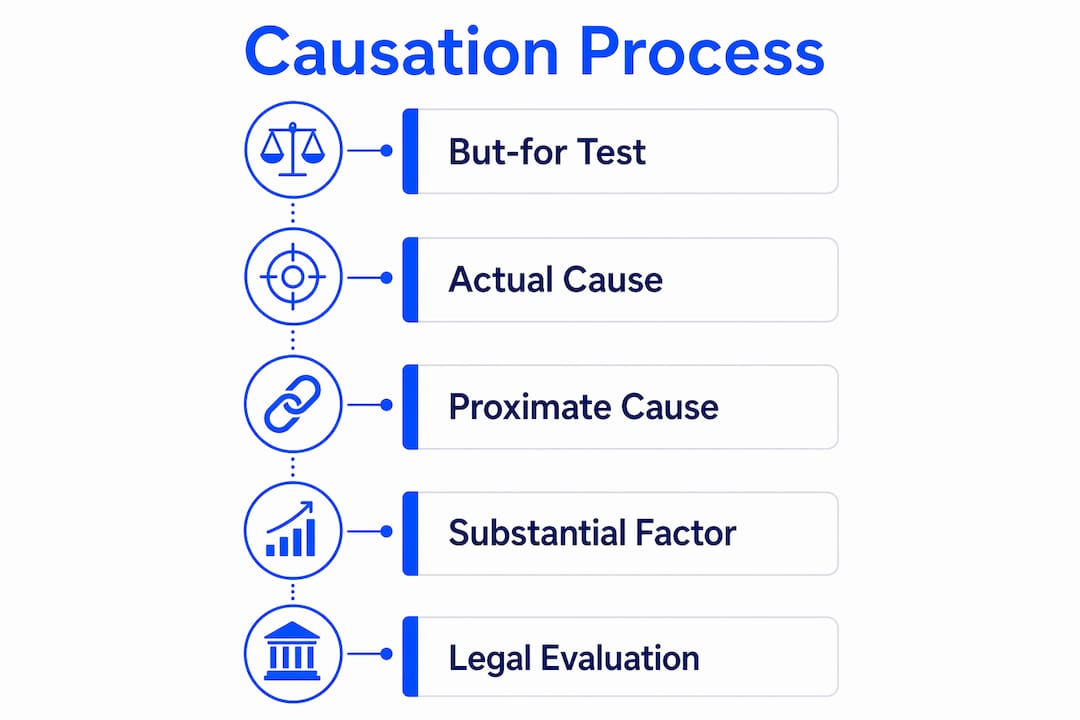
The two components work in sequence. Actual cause comes first. It answers a simple question: would the death have occurred without the defendant’s conduct? Proximate cause comes second. It asks whether the death was a foreseeable result of that conduct. Both tests must be satisfied before a court will hold a defendant liable.
This two-part structure matters because it filters out cases where a defendant’s conduct was technically connected to a death but not meaningfully responsible for it. A driver who ran a red light is negligent. But if the victim died hours later from an unrelated medical event, the driver’s conduct is not the legal cause of that death. Causation keeps liability tied to genuine responsibility.
| Component | Legal Test | Core Question |
|---|---|---|
| Actual cause (cause in fact) | But-for test | Would the death have occurred without the defendant’s conduct? |
| Proximate cause (legal cause) | Foreseeability test | Was the death a reasonably foreseeable result of the conduct? |
Pro Tip: If you are evaluating a potential wrongful death claim, write down the exact sequence of events from the defendant’s act to the death. If you cannot draw a clear, unbroken line between the two, causation may be the hardest element to prove.
How do courts evaluate causation evidence?
Courts apply the preponderance of evidence standard in wrongful death causation claims. This means the plaintiff must show it is more likely than not that the defendant’s conduct caused the death. The bar is not “beyond a reasonable doubt,” as in criminal cases. It is a balance of probabilities, which is a lower but still demanding threshold.
Expert witnesses play a central role when causation is not obvious. In toxic exposure cases, medical malpractice claims, or industrial accidents, qualified expert testimony is often required to explain how the defendant’s conduct produced the fatal harm. A jury of non-specialists cannot be expected to connect a chemical exposure to a specific cancer death without scientific guidance.
When multiple parties or events contributed to a death, courts shift to the substantial factor test. Under this standard, a defendant can be held liable if their conduct was a meaningful contributor to the harm, even if it was not the only cause. This matters enormously in cases involving multiple defendants, such as multi-vehicle crashes or construction site accidents.
The eggshell plaintiff rule adds another layer. Defendants must take the victim as found, meaning they cannot reduce liability because the victim had a preexisting condition that made the injury worse. If a defendant’s negligence triggered a fatal cardiac event in a victim with a known heart condition, the defendant is still fully liable.
Common causation challenges plaintiffs face include:
- Multiple contributing causes: Defendants argue their conduct was only one of several factors, making it difficult to isolate their role.
- Preexisting medical conditions: Defense teams claim the victim’s health, not the defendant’s conduct, was the real cause of death.
- Gaps in the medical record: Missing documentation between the incident and the death weakens the causal chain.
- Disputed expert opinions: Defense experts often present competing scientific theories to create doubt about causation.
- Delayed onset of harm: When death occurs weeks or months after the incident, defendants argue the connection is too remote.
Pro Tip: Preserve every piece of evidence immediately after a loved one’s death in a suspected wrongful death situation. Medical records, accident reports, witness statements, and surveillance footage all become harder to obtain with time. Early evidence collection is the foundation of a strong causation argument.
What legal challenges and defenses arise around causation?
Defense attorneys in wrongful death cases frequently attack causation rather than negligence. Proving a defendant acted carelessly is often easier than proving that carelessness caused the death. The most common defense strategy is introducing an intervening or superseding cause to break the chain of liability.
An intervening cause is an event that occurs between the defendant’s act and the death. If that event was foreseeable, it does not break the causal chain. If it was unforeseeable and independent, it becomes a superseding cause that can eliminate the defendant’s liability entirely. The distinction between intervening and superseding causes is one of the most contested issues in wrongful death litigation.
| Cause Type | Definition | Effect on Liability |
|---|---|---|
| Intervening cause | A foreseeable event occurring after the defendant’s act | Does not break the causal chain; defendant remains liable |
| Superseding cause | An unforeseeable, independent event occurring after the act | Breaks the causal chain; defendant may escape liability |
| Concurrent cause | Multiple acts contributing simultaneously to the death | Substantial factor test applies; shared liability possible |
Recent case law has sharpened the definition of proximate cause. The Texas Supreme Court, in Werner Enterprises, Inc. v. Blake, held that liability requires active, substantial causation, not merely being present at the scene or being a timing factor. A defendant who was conditionally involved but did not directly produce the harm cannot be held liable. This ruling reflects a broader trend in courts demanding that plaintiffs show the defendant’s conduct was an efficient and meaningful cause, not just a background circumstance.
Foreseeability also functions as a policy limit on liability. Proximate cause restricts liability to consequences that a reasonable person could have anticipated. A defendant who negligently caused a minor car accident is not liable if the victim was later struck by lightning while waiting for a tow truck. The lightning strike is unforeseeable and severs the legal connection. Understanding these limits helps families and their attorneys build a causation argument that courts will recognize.
Georgia families pursuing wrongful death claims should also understand how the state’s own wrongful death liability rules interact with these causation standards, particularly regarding the two-year filing deadline.
How does causation affect pursuing a wrongful death claim?
Causation is typically harder to prove than negligence, and it directly controls how much compensation a family can recover. Courts that find weak causation often reduce damages, even when negligence is clear. Families who understand this early can make smarter decisions about evidence gathering, expert retention, and settlement negotiations.
The practical impact of causation on a wrongful death case includes:
- Damages depend on causation strength: Courts award compensation for losses directly tied to the defendant’s conduct. Weak causation arguments lead to reduced awards, even in cases with obvious negligence.
- Early evidence is irreplaceable: Autopsy reports, toxicology results, accident reconstruction data, and medical records from the time of the incident are the building blocks of causation. Delays in securing this evidence can permanently weaken a case.
- Expert retention costs money upfront: In complex cases involving medical malpractice or toxic exposure, expert witnesses are not optional. Families need attorneys who can fund and manage expert testimony from the start.
- Settlement value reflects causation risk: Insurance companies and defense counsel evaluate causation when calculating settlement offers. A strong causation argument produces higher offers. A disputed causation argument invites lowball settlements.
Consulting a wrongful death attorney early is not just advisable. It is the single most effective step a family can take to protect the causation element of their claim. Attorneys know which experts to retain, which records to preserve, and how to frame the causal chain in terms courts recognize. Families who wait often find that critical evidence has been lost or that the statute of limitations has closed the door entirely.
The elements of a wrongful death claim extend beyond causation, but causation is the element that most often determines whether a case succeeds or fails at trial.
Key takeaways
Causation in wrongful death requires proving both actual cause and proximate cause, and courts will reject claims where the defendant’s conduct was not a substantial, foreseeable factor in the death.
| Point | Details |
|---|---|
| Two-part causation test | Both actual cause (but-for test) and proximate cause (foreseeability) must be proven together. |
| Preponderance standard | Plaintiffs must show it is more likely than not that the defendant’s conduct caused the death. |
| Substantial factor rule | In multi-cause cases, liability applies if the defendant’s conduct meaningfully contributed to the death. |
| Superseding causes matter | Unforeseeable independent events after the defendant’s act can break the causal chain and eliminate liability. |
| Early evidence is decisive | Medical records, expert witnesses, and accident documentation secured early form the foundation of causation proof. |
Why causation is the element families underestimate most
I have seen families walk into consultations convinced they have an airtight wrongful death case because the negligence is obvious. A driver ran a red light. A doctor missed a clear diagnosis. A property owner ignored a known hazard. The negligence is not in dispute. What they have not considered is whether they can prove that specific act caused the death, not just contributed to a chain of events that ended in tragedy.
Causation is where defense attorneys do their best work. They introduce competing medical theories, highlight preexisting conditions, and argue that a superseding event broke the chain. Families who have not preserved evidence or retained experts early find themselves on the back foot in these arguments.
The most important thing I can tell you is this: do not wait to build your causation case. The moment you suspect a loved one’s death was caused by someone else’s wrongful conduct, start documenting everything. Get the medical records. Find witnesses. Hire an attorney who has handled cases where causation was contested, not just cases where liability was obvious. The families who recover full compensation are almost always the ones who treated causation as seriously as negligence from day one.
Pursuing a wrongful death claim is never easy. But understanding what the law actually requires, and preparing for it, gives your family the best possible chance at the justice your loved one deserves.
— Ali
How Jewkesfirm can support your wrongful death case
If you are trying to understand whether causation can be proven in your loved one’s case, Jewkesfirm is ready to help. The firm’s attorneys have handled complex wrongful death claims across South Atlanta and surrounding Georgia counties, including cases where causation was disputed, multiple defendants were involved, or expert testimony was required to establish the causal link.

Jewkesfirm works on a contingency fee basis. You pay nothing unless the firm wins your case. The team will evaluate your evidence, identify the strongest causation arguments, and fight to recover the maximum compensation your family deserves. Contact Jewkesfirm today for a free case review and take the first step toward holding the responsible party accountable.
FAQ
What is causation in a wrongful death claim?
Causation is the legal requirement that the defendant’s wrongful conduct directly and foreseeably caused the victim’s death. It consists of two elements: actual cause (the but-for test) and proximate cause (foreseeability).
What is the but-for test in wrongful death cases?
The but-for test asks whether the death would have occurred without the defendant’s conduct. If the answer is no, the defendant’s conduct is the actual cause of the harm.
Can a defendant be liable if their conduct was only one of several causes?
Yes. Courts apply the substantial factor test in multi-cause cases, holding defendants liable if their conduct meaningfully contributed to the death, even if other causes were also present.
What breaks the chain of causation in a wrongful death case?
A superseding cause, defined as an unforeseeable and independent event occurring after the defendant’s act, can break the causal chain and eliminate the defendant’s liability for the death.
How hard is it to prove causation in a wrongful death case?
Causation is typically harder to prove than negligence because it requires connecting the defendant’s specific conduct to the death through evidence, expert testimony, and legal argument. Consulting a wrongful death attorney early significantly improves a family’s ability to build this proof.