

TL;DR:
- A catastrophic injury causes permanent disability and lifelong medical needs, significantly altering a person’s life. These injuries include traumatic brain injuries, spinal cord injuries, amputations, and severe burns, often requiring extensive long-term care. Legal claims demand detailed documentation and a formal life care plan to ensure fair compensation for the lifelong impacts.
A catastrophic injury is defined as any severe physical trauma that causes permanent disability, long-term functional impairment, and a lifetime of medical care needs. Unlike a broken arm or a soft tissue strain, these injuries permanently alter how a person lives, works, and cares for themselves. Traumatic brain injuries (TBI), spinal cord injuries (SCI), amputations, severe burns, and complex fractures all fall into this category. The legal and medical communities treat these injuries differently from standard personal injury claims because the financial and human stakes are far higher. Traumatic brain injuries occur over 283,000 times yearly in the U.S., and spinal cord injuries account for roughly 5,000 new cases annually. Those numbers represent real people facing permanent, life-changing consequences.
What is catastrophic injury under the law and medicine?
A catastrophic injury, in legal terms, requires proof of lifelong medical care needs, inability to perform daily living activities, and permanent impairment. No single federal statute defines the term. Instead, legal systems and courts apply a set of factors to decide whether an injury qualifies.
Legal frameworks focus on five factors: the seriousness of treatment required, the degree of long-term impairment, the impact on daily living activities, similarity to injuries recognized in statute, and whether the condition is incurable. A person who cannot perform sedentary work due to their injury often meets the legal threshold. Courts apply a permanence test, asking whether the person can return to their prior occupation or whether they now require a caregiver for basic daily tasks.
Medically, physicians classify injuries as catastrophic when they involve the central nervous system, result in loss of limb, cause severe disfigurement, or produce cognitive impairment. The medical diagnosis alone does not automatically create a legal catastrophic classification. Functional impact on autonomy drives the legal determination more than the injury label itself.
Pro Tip: Document every functional limitation from day one. Courts and insurers respond to evidence of what you can no longer do, not just what your medical records say happened to you.
The key factors courts and medical experts evaluate include:
- Permanent loss of physical or cognitive function
- Inability to perform activities of daily living without assistance
- Need for long-term or lifelong medical care and rehabilitation
- Permanent inability to return to prior employment
- Significant disfigurement or loss of a body part
What are the most common types of catastrophic injuries?
The most recognized types of catastrophic injuries share one trait: they permanently change how the body functions. Understanding each type helps victims and families recognize the scope of what they are facing.
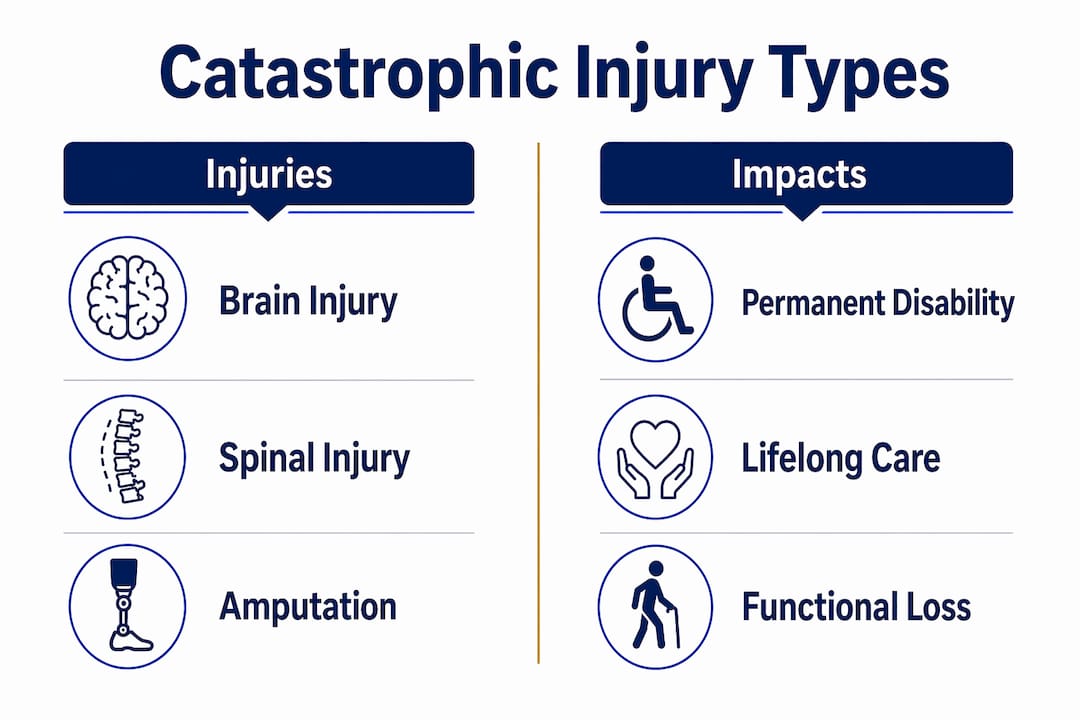
| Injury Type | Primary Impact | Typical Long-Term Care Needs |
|---|---|---|
| Traumatic Brain Injury (TBI) | Cognitive, emotional, and motor impairment | Neurological therapy, cognitive rehabilitation, personal care |
| Spinal Cord Injury (SCI) | Partial or full paralysis | Wheelchair, home modification, 24-hour care in severe cases |
| Amputation | Loss of limb, reduced mobility | Prosthetics, occupational therapy, psychological support |
| Severe Burns | Skin loss, nerve damage, disfigurement | Reconstructive surgery, wound care, long-term pain management |
| Complex Fractures / Polytrauma | Impaired mobility, chronic pain | Orthopedic surgery, physical therapy, assistive devices |
Traumatic brain injuries are the most common catastrophic injury type in the U.S. They range from moderate impairment to complete loss of independent function. Victims may lose the ability to regulate emotions, form memories, or coordinate movement. The effects are often invisible to outsiders, which makes legal documentation especially critical.

Spinal cord injuries produce paralysis at or below the injury site. A cervical injury can result in quadriplegia, while a lumbar injury may cause paraplegia. Medical costs for catastrophic injuries reached approximately $4.94 billion nationally in 2021, a figure that reflects the intensity of care these conditions demand.
Amputations and severe burns carry their own long-term burdens. Amputees require prosthetic fitting, repeated adjustments, and occupational therapy that can span decades. Burn survivors often undergo multiple reconstructive surgeries and face chronic pain, scarring, and psychological trauma. For a deeper look at complex injury cases and how they are handled legally, the context matters as much as the diagnosis.
What are the long-term costs and consequences of severe injuries?
The financial cost of a catastrophic injury is staggering and often underestimated at the time of settlement. Projected future medical costs range from $500,000 to $5 million depending on the injury type, the victim’s age, and the level of care required. That range requires expert witness testimony to establish in court.
“Life care planning is the critical element distinguishing catastrophic injury claims. Without it, victims routinely settle for far less than their actual lifetime needs.”
Life care plans are formal documents prepared by medical and rehabilitation specialists. They project every cost a victim will face over their lifetime, from medications and surgeries to home modifications and personal care hours. Failure to develop a life care plan leads directly to under-settled claims. Insurance companies know this, and they count on victims not having one.
Beyond the financial toll, catastrophic injuries reshape every aspect of daily life. Victims lose independence, career identity, and often their sense of self. Families absorb enormous caregiving burdens that affect their own employment, mental health, and relationships. The psychological consequences, including depression, anxiety, and post-traumatic stress disorder, are well-documented in TBI and SCI populations.
Pro Tip: Hire a certified life care planner before accepting any settlement offer. A well-constructed plan often reveals costs that neither the victim nor their attorney initially considered, including future surgeries, equipment replacements, and in-home care hours.
Understanding what damages Georgia injury victims can recover is a practical starting point for anyone trying to calculate the true value of a catastrophic injury claim.
How do catastrophic injuries differ from other personal injuries?
The core difference between a catastrophic injury and a standard personal injury is permanence. A broken wrist heals. A severed spinal cord does not. That distinction drives every legal and financial difference between the two categories.
| Factor | Standard Personal Injury | Catastrophic Injury |
|---|---|---|
| Recovery timeline | Weeks to months | Permanent or lifelong |
| Work impact | Temporary loss of income | Permanent career impairment |
| Medical costs | Thousands of dollars | Hundreds of thousands to millions |
| Legal complexity | Moderate | High, requiring expert witnesses |
| Life care plan needed | Rarely | Almost always |
The largest misconception is that “catastrophic” means only total paralysis or near-death outcomes. Any permanent, lifelong reduction in function or self-care ability qualifies. A person who loses the ability to work due to chronic cognitive impairment from a TBI has suffered a catastrophic injury, even if they can walk and speak.
Standard personal injuries, such as whiplash, minor fractures, or soft tissue damage, typically resolve with treatment. They produce economic damages like medical bills and lost wages, but they do not require lifelong care projections. Catastrophic injuries require a fundamentally different legal approach because the compensation must cover decades of future needs, not just past expenses.
Some injuries evolve into catastrophic status over time. A spinal injury initially classified as moderate may worsen and produce permanent disability years later. Early legal representation protects victims from settling before the full picture is clear.
What steps should you take after a catastrophic injury?
The actions you take in the weeks and months after a catastrophic injury directly affect your legal outcome. Medical billing records alone are not enough to build a strong claim.
- Seek immediate and ongoing medical care. Every gap in treatment gives insurers a reason to argue your injuries are less severe than claimed.
- Document functional changes in detail. Keep a daily journal of what you can no longer do. Early documentation of quality of life changes is often neglected and is one of the most powerful tools in a catastrophic injury claim.
- Hire an experienced personal injury attorney. Catastrophic cases require attorneys who understand life care planning, expert witnesses, and long-term damages. Review the legal steps for Georgia victims to understand what the process looks like from the start.
- Request a life care plan evaluation. This document will form the financial backbone of your claim.
- Avoid early settlement offers. Insurance companies move fast after catastrophic injuries. Early offers rarely account for lifetime care costs.
- Preserve all evidence. Accident reports, photographs, witness statements, and employer records all support your claim.
Pro Tip: Use the personal injury checklist to track every document and deadline from the moment of injury. Missing a single step can reduce your compensation significantly.
Key Takeaways
Catastrophic injuries are permanent, life-altering conditions that require lifelong medical care, expert legal representation, and a formally documented life care plan to pursue fair compensation.
| Point | Details |
|---|---|
| Legal definition requires permanence | Courts focus on inability to work or perform daily tasks, not just the injury diagnosis. |
| Costs reach millions | Future medical costs for catastrophic injuries commonly range from $500,000 to $5 million. |
| Life care plans are non-negotiable | Without a formal life care plan, victims routinely settle for far less than their actual lifetime needs. |
| Documentation starts at day one | Recording functional limitations early is one of the most powerful tools in building a strong claim. |
| Not all catastrophic injuries are obvious | Any permanent reduction in self-care or work capacity qualifies, not just paralysis or brain damage. |
What I’ve learned from watching catastrophic injury cases unfold
The cases that trouble me most are not the ones with the worst injuries. They are the ones where the victim had a strong case and still walked away with far less than they needed. That happens for one reason: the claim was built around the medical diagnosis instead of the person’s actual life.
Courts and juries respond to stories. They respond to a father who can no longer coach his daughter’s soccer team, or a nurse who spent 20 years on her feet and now cannot stand for more than five minutes. The injury type matters far less than the human cost. Attorneys who understand this build claims that hold up under pressure.
The other pattern I see constantly is victims accepting early settlements before the full scope of their condition is known. A spinal injury that looks moderate at six months can look very different at two years. Settling early is almost always a mistake in catastrophic cases. The permanence test cuts both ways: it protects victims who wait for the full picture to emerge.
Families also underestimate their own role in these cases. Caregiver burden is real, documentable, and compensable. The spouse who left their job to provide full-time care has suffered an economic loss that belongs in the claim. Recognizing the full human and financial picture is what separates adequate compensation from genuinely fair compensation.
— Ali
Jewkesfirm is ready to fight for your recovery
Catastrophic injuries demand legal representation that matches the complexity of the case. Jewkesfirm has handled serious personal injury claims across South Atlanta and the surrounding Georgia counties, recovering millions for clients facing lifelong medical needs.

When your injury is permanent, your legal team needs to think in decades, not months. Jewkesfirm works with life care planners, medical experts, and economic analysts to build claims that reflect your true lifetime costs. The firm operates on a contingency fee basis. You pay nothing unless they win. If you or someone you love has suffered a severe injury due to someone else’s negligence, contact Jewkesfirm today for a FREE CONSULTATION.
FAQ
What is the legal definition of a catastrophic injury?
A catastrophic injury is one that causes permanent disability, requires lifelong medical care, and prevents the victim from performing daily living activities or returning to prior employment. No single federal definition exists, so courts apply a functional impairment test.
What are common catastrophic injury examples?
Traumatic brain injuries, spinal cord injuries causing paralysis, amputations, severe burns, and complex fractures that result in permanent mobility loss all qualify as catastrophic injuries.
How much does a catastrophic injury claim typically pay?
Future medical costs alone commonly range from $500,000 to $5 million, depending on injury type and the victim’s age. Total compensation can exceed these figures when lost income and quality of life damages are included.
Do I need a life care plan for my catastrophic injury claim?
A life care plan is critical for any catastrophic injury claim. It projects every future medical, rehabilitative, and personal care cost and forms the financial foundation of your compensation demand.
How is a catastrophic injury different from a regular personal injury?
Standard personal injuries heal within weeks or months. Catastrophic injuries are permanent, require lifelong care, and involve far higher legal and financial complexity, including expert witnesses and life care planning.