

TL;DR:
- Punitive damages are awarded to punish egregious conduct and deter similar behavior but are only given in about 5% of civil verdicts.
- They require higher proof standards and are subject to constitutional ratio limits, with most courts favoring single-digit ratios to stay within due process.
Punitive damages are a monetary award added on top of compensatory damages, not to reimburse your losses, but to punish a defendant whose conduct was especially egregious and to deter others from similar behavior. If you were harmed by someone’s deliberate fraud, malice, or reckless disregard for your safety, punitive damages may be available, but they are far from automatic.
Three quick facts to know up front:
- Courts award punitive damages in roughly 5% of civil verdicts in the United States, making them the exception, not the rule.
- Most jurisdictions require a higher burden of proof than the standard “preponderance of the evidence” used for compensatory claims.
- Punitive awards are generally taxable as income under IRS rules, even when your compensatory damages are not.
Pro Tip: Start preserving evidence of the defendant’s conduct immediately. Communications, internal policies, and records showing deliberate or reckless decision-making are exactly what courts look for when evaluating punitive claims.
Table of Contents
- What are punitive damages and why does U.S. law allow them?
- When courts award punitive damages: the grounds that matter
- Who decides punitive damages and what standard of proof applies
- How courts calculate the amount of punitive damages
- How states differ on punitive damages: caps and restrictions
- How to request punitive damages and what evidence you need
- Tax treatment of punitive damages and why settlement allocation matters
- Constitutional limits on punitive damages: due process and Supreme Court precedent
- Practical next steps if punitive damages may apply to your case
- Key Takeaways
- A practitioner’s perspective on punitive claims in Georgia
- Jewkesfirm is ready to evaluate your case at no cost to you
- Authoritative sources and further reading
What are punitive damages and why does U.S. law allow them?
Punitive damages exist because some wrongdoing is so deliberate or so callous that simply reimbursing the victim is not enough. The law’s answer is an award that punishes the wrongdoer and sends a clear message to others who might consider the same conduct.
Legal scholars and courts have long described punitive damages as “quasi-criminal” in nature. They function like private fines: the money goes to the plaintiff, but the purpose is societal condemnation and deterrence, not compensation. That distinction separates them from every other civil remedy.
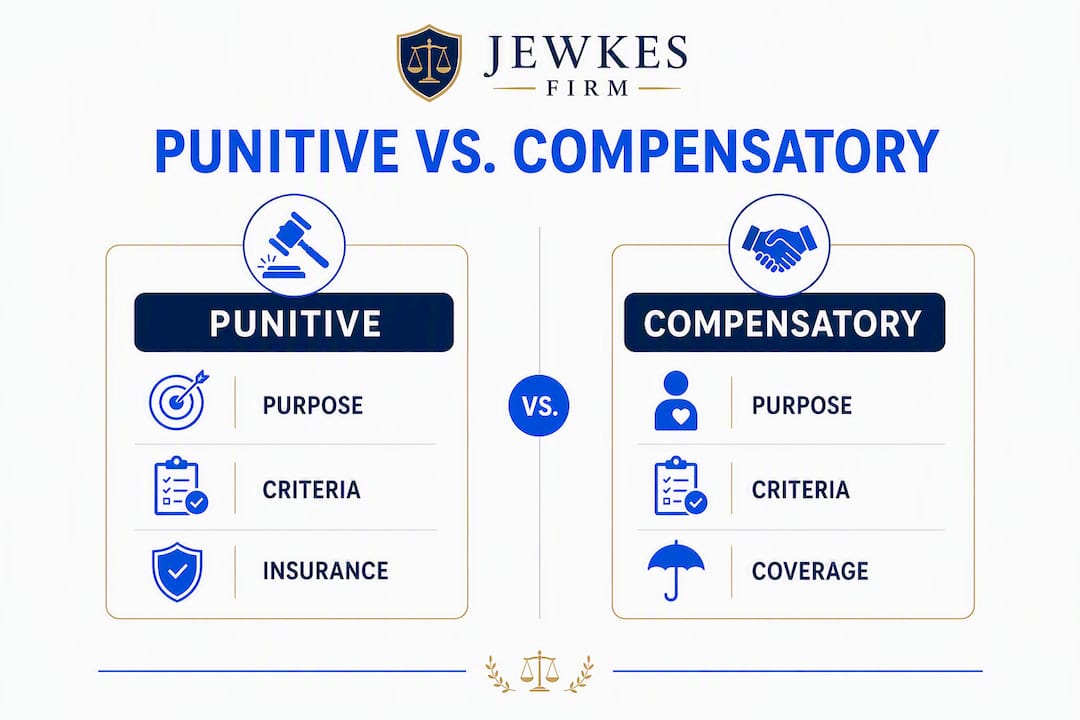
The difference between punitive and compensatory damages is fundamental. Compensatory damages cover your actual losses: medical bills, lost wages, pain and suffering. Punitive damages are layered on top, calculated not by your harm but by the defendant’s conduct and financial position. A drunk driver who causes a crash may owe you $80,000 in compensatory damages for your injuries. If the evidence shows extreme recklessness, a court might add punitive damages to drive home that the behavior was unacceptable.
Punitive awards are also typically not covered by liability insurance policies, because insuring against intentional or malicious conduct would undermine the deterrent purpose entirely. That practical reality matters when you are evaluating whether a punitive claim is worth pursuing.
When courts award punitive damages: the grounds that matter
Punitive damages are not available just because someone was careless. The conduct has to cross a higher threshold. Courts and statutes typically require proof of one of the following:
- Malice: The defendant intended to harm you or acted with conscious disregard for your rights.
- Fraud: Deliberate misrepresentation that caused your injury — for example, a manufacturer knowingly concealing a defect.
- Oppression: Conduct that subjects a person to cruel and unjust hardship in conscious disregard of their rights.
- Wanton or willful misconduct: Behavior so reckless it shows a conscious indifference to consequences — a drunk driver with multiple prior DUIs, for instance.
- Gross negligence (in elevated circumstances): Not ordinary negligence, but a degree of carelessness so extreme it approaches intentional conduct.
- Intentional torts: Assault, battery, or deliberate property destruction where the defendant acted on purpose.
Contract cases are a different story. Punitive damages are rarely available for a simple breach of contract. Courts generally reserve them for tort claims, and even then only when the conduct rises well above ordinary negligence. An employer who knowingly ignores OSHA safety requirements and an employee is seriously hurt may face punitive exposure; an employer who simply miscalculates overtime pay typically will not.
Who decides punitive damages and what standard of proof applies
The burden of proof for punitive damages is higher than the standard used for compensatory claims. In most U.S. jurisdictions, a plaintiff must prove entitlement to punitive damages by “clear and convincing evidence” — a standard that sits between the civil “preponderance” threshold and the criminal “beyond a reasonable doubt” bar. Some states use a preponderance standard; a few require proof beyond a reasonable doubt for punitive awards specifically.

In a jury trial, the jury decides both whether to award punitive damages and the amount, subject to the judge’s review. In a bench trial, the judge makes both determinations. On appeal, courts conduct de novo review of the constitutional reasonableness of the award, meaning an appellate court can reduce or eliminate a punitive award without deference to the jury’s number.
Procedurally, several courts bifurcate punitive damage issues — meaning liability and compensatory damages are tried first, and punitive damages are addressed in a separate phase. This protects defendants from having inflammatory punitive-conduct evidence color the jury’s compensatory findings. Pleading requirements also matter: most jurisdictions require specific factual allegations in the complaint that identify the conduct claimed to be malicious, fraudulent, or oppressive. A generic “defendant acted recklessly” allegation usually will not survive a motion to dismiss.
How courts calculate the amount of punitive damages
No formula produces a punitive damages number. Courts weigh several factors, and the U.S. Supreme Court has provided constitutional guardrails that shape the analysis.
The principal factors courts consider
- Comparable civil or criminal penalties — what the law authorizes for similar misconduct.
Supreme Court ratio guidance
The Court’s clearest guidance comes from State Farm Mutual Automobile Insurance Co. v. Campbell, where the justices stated that single-digit ratios of punitive to compensatory damages are more likely to satisfy due process. A 4:1 or 9:1 ratio is generally defensible; a 145:1 ratio (as the trial court awarded in State Farm before the Supreme Court reduced it) is not.
| Standard | Ratio Guidance | Notes |
|---|---|---|
| Typical defensible range | 1:1 to 9:1 (punitive to compensatory) | Single-digit ratios preferred by Supreme Court |
| Borderline | 4:1 to 9:1 | Requires strong reprehensibility justification |
| Struck down as excessive | higher ratios with constitutional scrutiny | State Farm reduced 145:1 to roughly 1:1 |
When compensatory damages are already substantial, even a 1:1 ratio may satisfy the punishment goal. When compensatory damages are small but the conduct was especially dangerous, courts have occasionally allowed higher ratios — but always with constitutional scrutiny.
For a deeper look at how compensatory amounts are calculated before punitive damages are layered on, the damages calculation guide at Jewkesfirm walks through the foundational math.
How states differ on punitive damages: caps and restrictions
State law governs punitive damages in most cases, and the variation is significant. Where your case is filed can determine whether punitive damages are available at all, and how large an award can be.
Four broad categories of state approaches:
- No statutory cap: The jury and judge exercise discretion, subject only to constitutional due process limits. Awards can be large, but appellate courts still review for excessiveness.
- Ratio-based caps: Some states limit punitive damages to a multiple of compensatory damages — two times, three times, or four times the compensatory award, for example.
- Flat dollar caps: A ceiling regardless of compensatory damages, often in the range of several hundred thousand dollars or tied to the defendant’s net worth.
- Categorical restrictions: Several states cap or prohibit punitive damages in specific claim types, such as wrongful death, medical malpractice, or product liability.
A small number of states, including Nebraska and Washington, have historically limited or refused punitive damages in most civil cases, treating punishment as a matter for the criminal system. Louisiana has its own civil law tradition that approaches punitive damages differently from common-law states.
Georgia, where Jewkesfirm practices, allows punitive damages in tort cases but requires clear and convincing evidence of willful misconduct, malice, fraud, wantonness, oppression, or conscious indifference to consequences. Georgia also caps punitive damages at $250,000 in most cases, with exceptions for product liability and cases involving specific intent to harm. For a full breakdown of what Georgia injury victims can recover, the Georgia damages guide at Jewkesfirm covers the specifics.
Pro Tip: Before assuming punitive damages are available in your case, confirm the applicable state statute with an attorney. The same conduct that supports a punitive claim in one state may be capped, barred, or subject to different pleading rules in another.
How to request punitive damages and what evidence you need
Pleading punitive damages is not a formality. Courts require specific factual allegations, and the evidence you gather early in the case will determine whether the claim survives.
Steps to plead punitive damages
- Include specific factual allegations in the complaint that describe the defendant’s malicious, fraudulent, or wanton conduct — not just the harm you suffered.
- Cite the applicable state statute if your jurisdiction requires it; many states have a specific punitive damages statute with required language.
- Give the defendant notice of the punitive claim early, since some jurisdictions require a separate motion or amended pleading to add punitive damages after initial filing.
- Request targeted discovery focused on the defendant’s knowledge, intent, internal communications, and prior similar conduct.
Evidence checklist
- Contemporaneous communications: Emails, texts, and memos showing the defendant knew of the risk and proceeded anyway.
- Internal policies and violation records: Documents showing safety protocols were ignored or that management overrode safety concerns.
- Prior incidents: Evidence of similar conduct by the same defendant, which speaks directly to reprehensibility and likelihood of recurrence.
- Witness statements: Employees, bystanders, or experts who can testify to the defendant’s state of mind or pattern of conduct.
- Expert testimony: In complex cases (medical negligence, product liability), an expert who can explain why the conduct fell so far below the standard of care that it crossed into recklessness.
The evidence guide for wrongful death cases at Jewkesfirm offers a practical framework for evidence preservation that applies equally to punitive damage claims.
Tax treatment of punitive damages and why settlement allocation matters
Punitive damages are taxable. The IRS is explicit: under IRC Section 104(a)(2), compensatory damages received on account of a physical injury or physical sickness are generally excludable from gross income — but punitive damages are not, regardless of the underlying claim. IRS Publication 4345 instructs recipients to report punitive awards as “Other Income” on Form 1040, Schedule 1.
That distinction creates a real planning problem in settlements. A plaintiff who receives $500,000 in compensatory damages for a physical injury pays no federal income tax on that amount. The same plaintiff who receives an additional $300,000 in punitive damages owes income tax on the full $300,000. At a 37% marginal rate, that is a significant reduction in net recovery before attorney fees are even considered.
Settlement allocation also matters for attorney fees. When punitive damages or interest make up a significant portion of a verdict, the allocation of contingent fees between taxable and non-taxable portions of the recovery can create unexpected tax consequences for the plaintiff.
Statistic to know: Under IRS rules, punitive damages are taxable even when the underlying compensatory damages are fully tax-exempt — a distinction that can reduce net recovery by tens of thousands of dollars on a large award.
Pro Tip: Before signing any settlement agreement, insist on clear allocation language that separately identifies compensatory and punitive amounts. Then consult a tax advisor — not just your injury attorney — to model the after-tax recovery before you accept.
For a broader look at how settlement negotiations unfold, the Georgia personal injury settlement guide at Jewkesfirm covers the key steps from demand to final agreement.
Constitutional limits on punitive damages: due process and Supreme Court precedent
The Due Process Clause of the Fourteenth Amendment places a ceiling on punitive awards. A grossly excessive punitive award is an arbitrary deprivation of property and violates the Constitution. Two Supreme Court cases define the framework every court now applies.
BMW of North America, Inc. v. Gore (1996) established three “guideposts” courts must consider: the degree of reprehensibility of the defendant’s conduct, the ratio of punitive to compensatory damages, and the difference between the punitive award and civil penalties authorized for comparable misconduct. The Court struck down a $4 million punitive award against BMW for a paint-refinishing policy that caused only $4,000 in actual harm.
State Farm v. Campbell (2003) sharpened the ratio guidance. The Court reduced a $145 million punitive award to match the $1 million compensatory award, stating that few awards exceeding a single-digit ratio will satisfy due process. The case also limited the use of out-of-state conduct to inflate a punitive award.
Remittitur is the procedural tool courts use to bring excessive awards into constitutional range. A judge can order a new trial on damages or condition the verdict on the plaintiff’s acceptance of a reduced amount. Appellate courts review the constitutional reasonableness of punitive awards de novo, meaning no deference to the jury. A plaintiff who wins a $50 million punitive award at trial may receive a fraction of that after appellate review.
The practical takeaway: extreme punitive awards are vulnerable. Building a case around a realistic, well-supported ratio is better strategy than hoping a large jury verdict survives appeal.
Practical next steps if punitive damages may apply to your case
If you believe the conduct that harmed you rises to the level required for punitive damages, these steps protect your claim from day one.
- Preserve all communications immediately. Do not delete texts, emails, or voicemails from or about the defendant. Request a litigation hold if corporate records are involved.
- Document the defendant’s conduct, not just your injuries. Photographs, videos, and written notes about what the defendant did — and when — are as important as your medical records.
- Record witness details now. Names, contact information, and a brief summary of what each witness observed. Memories fade and people move.
- Gather any publicly available corporate records. Prior regulatory violations, OSHA citations, consumer complaints, or news coverage of similar incidents can support a reprehensibility argument.
- Ask your attorney to evaluate punitive-claim viability early. Punitive damages must typically be pleaded in the original complaint or added by amendment with court approval. Waiting too long can waive the claim.
- Request discovery targeted to intent and knowledge. Interrogatories and document requests should specifically seek internal communications, risk assessments, and prior incident reports.
- Plan for tax consequences before settlement. Once you understand the likely punitive component, bring in a tax advisor to model net recovery under different allocation scenarios.
Pro Tip: At your first consultation, ask the attorney directly: “Does the defendant’s conduct support a punitive claim under this state’s statute?” That single question will tell you whether the attorney has analyzed the facts carefully or is giving you a generic answer.
Key Takeaways
Punitive damages are awarded on top of compensatory damages to punish egregious misconduct and deter others, but they appear in only about 5% of U.S. civil verdicts and carry significant tax and constitutional constraints.
| Point | Details |
|---|---|
| Definition and purpose | Punitive damages punish malicious or reckless conduct and deter others; they do not compensate for losses. |
| Rarity and burden | Courts award punitive damages in roughly 5% of civil verdicts; most states require clear and convincing evidence. |
| Supreme Court ratio guidance | Single-digit punitive-to-compensatory ratios are preferred; ratios above 9:1 face serious constitutional scrutiny. |
| Tax consequences | Punitive damages are taxable as income under IRS rules, even when compensatory damages for physical injury are tax-exempt. |
| Jewkesfirm | Jewkesfirm evaluates punitive damage viability in personal injury cases across Georgia, including wrongful death and trucking crashes, on a contingency fee basis. |
A practitioner’s perspective on punitive claims in Georgia
Punitive damage claims are powerful, but they are also fragile. The cases where they succeed share a common thread: the plaintiff’s attorney started building the punitive record on day one, not after discovery closed. The evidence that wins a punitive award — internal emails showing a company knew about a defect, a driver’s prior DUI history, a hospital’s pattern of ignored safety protocols — is exactly the evidence that disappears if you wait.
At Jewkesfirm, the approach to punitive claims starts at the intake stage. When the facts suggest deliberate or reckless conduct, the focus shifts immediately to preserving corporate records, identifying prior incidents, and pleading the claim with the specificity Georgia courts require. Settlement strategy follows the same logic: a well-documented punitive claim changes the negotiation entirely, because the defendant’s exposure is no longer just your medical bills.
The tax piece is where clients are most often caught off guard. A large punitive award looks very different after federal income tax and attorney fees. Structuring the settlement allocation correctly — with clear language separating compensatory and punitive amounts — is not optional. It is part of getting the full value of your case.
Pro Tip: Before your first meeting with any attorney, write down every detail you remember about the defendant’s conduct: what they said, what they did, and what they knew or should have known. That narrative is the foundation of a punitive claim.
Jewkesfirm is ready to evaluate your case at no cost to you
If the conduct that injured you or your family was deliberate, reckless, or fraudulent, you may have grounds for punitive damages on top of your compensatory recovery. Jewkesfirm represents personal injury clients across South Atlanta and Georgia in auto accidents, trucking crashes, medical negligence, slip and fall injuries, and wrongful death claims — all on a contingency fee basis, meaning you pay nothing unless the firm wins your case.

A free case evaluation with Jewkesfirm covers whether punitive damages are viable under Georgia law, what evidence you need to preserve, and how a potential award would be structured for maximum net recovery. Bring any communications, incident reports, photographs, or records related to the defendant’s conduct. The more detail you bring, the more precise the evaluation.
Schedule your free consultation today and get a clear answer on what your case is actually worth.
Authoritative sources and further reading
The following primary authorities and government resources were used in preparing this article. For jurisdiction-specific questions, always verify current state statutes and consult a licensed attorney in your state.
- IRS Publication 4345: Settlements — Taxability — IRS guidance on how punitive damages and other settlement components are taxed.
- IRS: Tax Implications of Settlements and Judgments — Explains IRC Section 104(a)(2) and the exclusion for physical injury compensatory damages, with the explicit carve-out for punitive awards.
- State Farm Mutual Automobile Insurance Co. v. Campbell, 538 U.S. 408 (2003) — The leading Supreme Court case on due process limits and single-digit ratio guidance for punitive awards.
- BMW of North America, Inc. v. Gore, 517 U.S. 559 (1996) — Established the three constitutional guideposts for evaluating whether a punitive award is excessive.
- Punitive Damages — Wex Legal Dictionary, Cornell LII — Plain-language definition and overview of punitive damages in U.S. law.
- Punitive Damages — Britannica — Overview of the policy rationale and state-by-state variation.
- Ninth Circuit Model Jury Instruction 5.5: Punitive Damages — The standard federal jury instruction language on punitive damages, including the prohibition on bias and passion.
This article provides general legal information about punitive damages in the United States. It is not legal advice. Laws vary by state and change over time. Consult a licensed attorney in your jurisdiction and a qualified tax professional before making decisions about your case or settlement.