

TL;DR:
- A Tyrone slip-and-fall claim holds property owners legally responsible for negligence causing injuries.
- Proving duty, breach, causation, and damages within a two-year filing deadline is essential for success.
A Tyrone slip and fall claim is a Georgia personal injury claim that holds a property owner legally responsible for negligence that caused your fall and resulting injuries. If you slipped on someone else’s property in Tyrone or the surrounding Peach County area, you may have the right to recover compensation for medical bills, lost wages, and pain and suffering. Under O.C.G.A. § 9-3-33, you generally have from the date of your accident to file a personal injury lawsuit in Georgia. Miss that window, and your right to sue is almost certainly gone.
If you were just in an accident, do these things right now:
- Get medical attention immediately, even if you feel fine. Symptoms often appear hours later.
- Photograph the hazard from multiple angles before it is cleaned up or repaired.
- Collect names and phone numbers of any witnesses at the scene.
- Report the incident to the property owner, manager, or store supervisor and ask for a written report.
- Keep the shoes and clothing you were wearing. Place them in a bag without washing them.
- Write down everything you remember while details are fresh.
Contact Jewkesfirm for a free consultation. The firm works on a contingency-fee basis, meaning you pay nothing unless they recover compensation for you.
Table of Contents
- What legally counts as a slip-and-fall claim in Tyrone
- Who can be held responsible for your fall in Tyrone
- Common hazards that cause slip-and-fall accidents in Tyrone
- Evidence that builds a strong Tyrone slip-and-fall claim
- Georgia rules that directly affect your Tyrone claim
- How a Tyrone slip-and-fall claim typically moves from incident to resolution
- Types of compensation available in Tyrone slip-and-fall cases
- When you should contact a Tyrone slip-and-fall attorney
- How Jewkesfirm helps Tyrone-area clients pursue their claims
- Key Takeaways
- What Georgia slip-and-fall cases taught me about what actually matters
- Authoritative sources to verify Georgia law and attorney credentials
What legally counts as a slip-and-fall claim in Tyrone
A Tyrone premises liability claim arises when a property owner’s failure to maintain safe conditions leads directly to your injury. Georgia law requires you to prove four elements to establish negligence.

Duty. The property owner owed you a legal duty of care. That duty depends on your status as a visitor. Invitees (customers in a store, guests at a business) receive the highest level of protection. Licensees (social guests on private property) receive a moderate duty. Trespassers receive the least protection, though property owners still cannot willfully harm them. Most Tyrone slip and fall cases involve invitees, where the duty of care is strongest.
Breach. The owner failed to meet that duty. A wet floor with no warning sign, a broken stair left unrepaired for weeks, or a parking lot light that burned out months ago all represent potential breaches. Constructive notice is key here: if the owner knew or should have known about the hazard, that satisfies the notice element. Prior complaints, maintenance logs, and inspection records can all prove constructive notice.
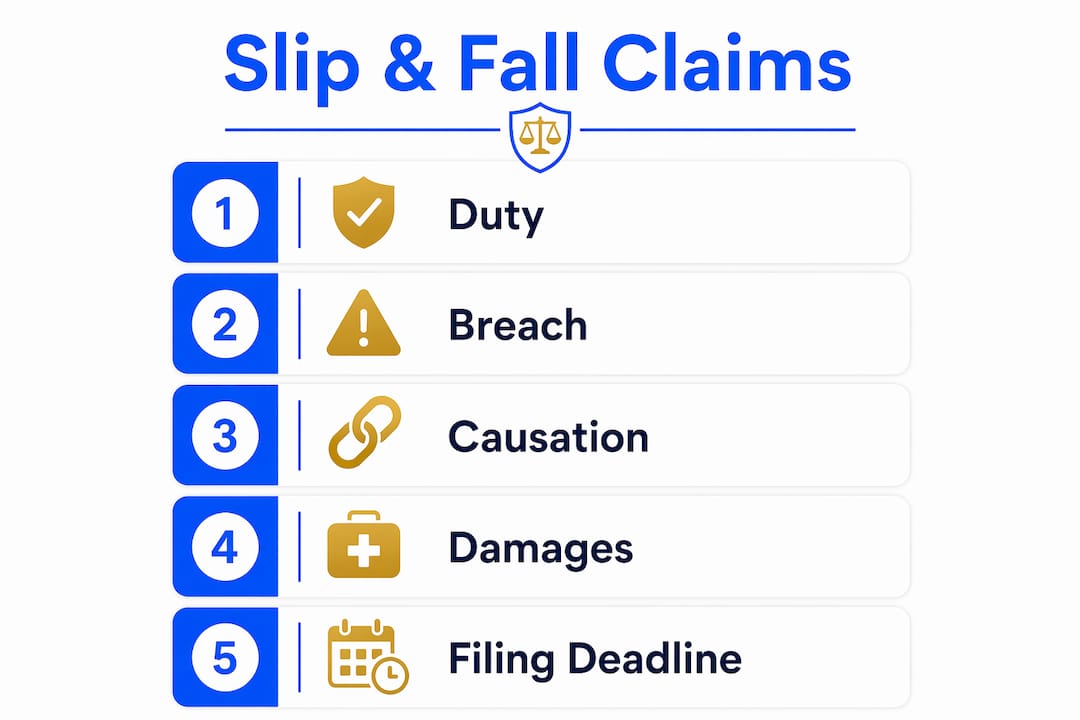
Causation. The breach directly caused your fall and injuries. A gap in medical treatment or a pre-existing condition can complicate this element, which is why same-day medical care matters so much.
Damages. You suffered actual, documented harm. Medical bills, lost wages, and documented pain all qualify. Without provable damages, there is no claim worth pursuing.
Who can be held responsible for your fall in Tyrone
Identifying the right defendant is one of the first things an attorney does in a Tyrone slip and fall case. More than one party can share liability.
- Property owner. The most common defendant, whether it is a commercial landlord, homeowner, or business property owner.
- Tenant or business operator. A store that leases its space may be responsible for hazards inside the premises, even if the building owner is separate.
- Property management company. Third-party managers who handle maintenance and inspections can be named when their negligence contributed to the hazard.
- Maintenance or cleaning contractor. A contractor who mopped a floor and left it wet without signage, or who failed to salt an icy walkway, may share liability.
- Municipality or government entity. Falls on public sidewalks, parks, or government buildings involve special rules. Government claims in Georgia often require different notice procedures and shorter filing windows.
In many cases, the property owner and a contractor are both responsible. Naming all liable parties early protects your full recovery.
Pro Tip: If your fall happened on public property in Tyrone, do not assume the two-year statute of limitations applies without checking. Government-entity claims can have shorter notice requirements. Consult an attorney as soon as possible.
Common hazards that cause slip-and-fall accidents in Tyrone
Recognizing the type of hazard that caused your fall helps establish that the property owner should have known about it. These are the most common causes in Georgia premises liability cases:
- Wet or mopped floors with no warning cones or signage, especially in grocery stores and restaurants.
- Unmarked spills on retail floors that sat unaddressed long enough to create constructive notice.
- Icy or wet sidewalks and parking lots, particularly in winter months when property owners in Tyrone fail to treat surfaces after freezing rain.
- Torn or bunched carpeting in hotels, apartment buildings, and commercial spaces.
- Broken or uneven stairs and missing or loose handrails.
- Poor or failed lighting in stairwells, parking garages, and building entrances.
- Cracked or raised pavement in parking lots and walkways.
Seasonal hazards carry extra weight in a claim. When ice or standing water is a foreseeable risk and a property owner takes no preventive steps, foreseeability strengthens your argument that the breach was unreasonable. A hazard that has been reported before and never fixed is even stronger evidence. For local context on community safety conditions in the Peach County and Middle Georgia area, regional reporting can sometimes document recurring hazards at specific locations.
Evidence that builds a strong Tyrone slip-and-fall claim
The strength of a Tyrone personal injury claim often comes down to what you documented in the first 24 hours. Immediate, meticulous documentation creates the leverage that turns a sympathy story into a provable case.
At the scene:
- Photograph the exact hazard from multiple angles. Capture any warning signs (or the absence of them), the surrounding area, and any visible substance on the floor or ground.
- Note the date and time on your phone’s camera or in a text message to yourself.
- Get the full name and contact information of every witness.
- Ask for the manager’s name and request a written incident report. Get a copy before you leave.
- If security cameras are visible, send a written request immediately demanding that the footage be preserved. Courts treat lost footage as damaging to a defendant who failed to preserve it after a preservation request.
Physical evidence:
- Place the shoes and clothing you were wearing in a sealed bag without washing them. Forensic analysis of residue, tread patterns, or fabric damage can corroborate the slipping surface and is frequently overlooked by claimants.
Medical documentation:
- See a doctor the same day when possible. Tell your provider exactly how the fall happened and describe every symptom, even minor ones. Continuity of care converts your symptoms into a medical narrative that links the fall to specific injuries.
- Keep all bills, imaging results, prescriptions, and follow-up records.
Ongoing records:
- Maintain a single folder, physical or digital, with dated entries for every expense and appointment.
- Keep a daily pain and symptom log. Organized documentation of bills, receipts, and employer letters increases settlement credibility and speeds case evaluation.
Pro Tip: Request cleaning logs, maintenance tickets, and inspection schedules from the property owner or manager as early as possible. Missing or inconsistent logs help establish a pattern of ignored hazards and can be decisive in proving constructive notice.

Georgia rules that directly affect your Tyrone claim
Two legal rules shape nearly every Tyrone slip and fall case: the statute of limitations and Georgia’s modified comparative negligence standard.
Statute of limitations. Under O.C.G.A. § 9-3-33, personal injury actions in Georgia must be filed within two years of the date the cause of action accrues. For most slip and fall injuries, that clock starts on the day of the accident. Filing after the two-year deadline almost always bars recovery entirely. Limited tolling exceptions exist for minors and individuals with legal incapacity, but they are narrow. Government-entity claims may have even shorter windows.
Modified comparative negligence. Georgia follows a modified comparative fault rule. You can recover damages as long as your share of fault is less than 50%. If you are found 30% at fault, your recovery is reduced by 30%. If you are found 50% or more at fault, you recover nothing. Property owners and their insurers routinely argue that you were distracted, wearing improper footwear, or ignored an obvious hazard. How your attorney frames the evidence directly affects where fault lands.
Common defenses include the open-and-obvious hazard doctrine and assumption of risk. Georgia treats both as factors in the comparative negligence analysis rather than automatic bars to recovery. That distinction matters for how your attorney builds the case. For a deeper look at how Georgia’s filing deadlines interact with your claim, Jewkesfirm’s blog covers the specifics in detail.
How a Tyrone slip-and-fall claim typically moves from incident to resolution
Understanding the slip and fall compensation process helps you set realistic expectations and avoid the mistakes that stall or sink claims.
- Immediate medical care. Your health comes first, and your medical records become the foundation of your claim.
- Incident report and evidence gathering. As described above, document everything at the scene and preserve physical evidence.
- Claim filed with the property owner’s insurer. Your attorney notifies the insurer and submits a formal claim. The insurer assigns an adjuster who will investigate liability, review medical records, and look for gaps in treatment or pre-existing conditions.
- Investigation phase. The insurer reviews photos, maintenance logs, witness statements, and any video footage. This phase typically takes several weeks.
- Demand letter and negotiation. Once your medical treatment reaches a stable point, your attorney sends a demand letter outlining damages and liability. Negotiation follows, often over several months.
- Lawsuit if no fair settlement is reached. If the insurer refuses a reasonable offer, your attorney files suit in the appropriate Georgia court. Cases that go to litigation take longer, but the two-year statute of limitations still controls when suit must be filed.
Insurers specifically look for gaps in treatment, inconsistent statements, and evidence that the hazard was open and obvious. Your medical timeline and consistency of care directly affect how the adjuster values your claim. For more on how insurance coverage works in these cases, Jewkesfirm’s resource explains what is typically covered and what gets denied.
Types of compensation available in Tyrone slip-and-fall cases
A successful Tyrone accident injury claim can recover several categories of damages. The value of any specific case depends on the facts, the severity of the injury, and how fault is allocated.
- Past and future medical expenses. Emergency care, surgery, physical therapy, imaging, medications, and projected future treatment costs.
- Lost wages. Income you missed while recovering, documented with employer letters and pay stubs.
- Loss of earning capacity. If the injury affects your ability to work long-term, that future income loss is recoverable.
- Pain and suffering. Physical pain and the emotional toll of the injury and recovery.
- Emotional distress. Anxiety, depression, and psychological harm caused by the accident.
- Out-of-pocket costs. Transportation to appointments, assistive devices, home care, and childcare during recovery.
- Loss of consortium. In severe cases, a spouse may have a separate claim for loss of companionship and support.
No honest attorney can promise a specific dollar figure without reviewing your case. Severity of injury, permanency, objective medical evidence, and the strength of liability all drive settlement value in different directions. A South Atlanta compensation guide from Jewkesfirm walks through the factors that typically affect recovery amounts in this region.
When you should contact a Tyrone slip-and-fall attorney
Some slip and fall cases are straightforward enough to handle without counsel. Many are not. These situations strongly suggest you need an attorney:
- You were hospitalized or required surgery.
- Your medical bills are significant or treatment is ongoing.
- The property owner or insurer disputes liability.
- The insurer’s first offer feels low relative to your actual losses.
- Your injury is permanent or has affected your ability to work.
- A government entity owns the property where you fell.
Questions to ask at your first consultation:
- How much experience do you have with Georgia slip-and-fall and premises liability cases?
- Have you handled cases in Peach County or the Tyrone area courts?
- What is your honest assessment of liability in my case?
- Who will handle my case day-to-day?
- What is your contingency-fee percentage, and what costs, if any, might I owe if the case does not settle?
What to bring:
- All photos and videos from the scene.
- The incident report, if you obtained one.
- Medical records and bills received so far.
- Names and contact information for witnesses.
- Pay stubs or employer documentation of missed work.
On contingency fees: your attorney is paid a percentage of the recovery only if the case succeeds. If there is no recovery, you typically owe no attorney’s fee. Some costs (filing fees, expert witnesses) may be handled differently, so confirm the specifics at your consultation.
How Jewkesfirm helps Tyrone-area clients pursue their claims
When you have been hurt in a slip and fall in Tyrone or the surrounding Georgia counties, you need an attorney who knows Georgia premises liability law and is ready to fight for maximum compensation from day one.

Jewkesfirm offers free consultations for slip-and-fall and premises liability cases throughout South Atlanta and the surrounding Georgia counties. The firm works on a contingency-fee basis: you pay nothing unless they win your case. At your free case review, the team evaluates liability, reviews your documentation, and gives you an honest assessment of your options before you commit to anything.
Bring your photos, medical records, incident report, witness information, and any bills you have received. Jewkesfirm’s attorneys look for strong liability evidence, clear causation, and documented damages during early case screening. The firm has recovered millions for Georgia injury victims and brings that experience to every premises liability case it takes on.
Ready to find out whether you have a claim? Request a free case review today and let Jewkesfirm’s team evaluate your situation with no obligation.
Key Takeaways
A Tyrone slip-and-fall claim requires proving duty, breach, causation, and damages under Georgia law, and the two-year filing deadline under O.C.G.A. § 9-3-33 is the single most important date to protect.
| Point | Details |
|---|---|
| Two-year filing deadline | Georgia’s O.C.G.A. § 9-3-33 gives you two years from the accident date to file; missing it almost always bars recovery. |
| Comparative fault matters | Georgia’s modified comparative negligence rule bars recovery if you are 50% or more at fault; partial fault reduces your award proportionally. |
| Document immediately | Dated photos, witness names, an incident report, and preserved clothing are the evidence that turns a fall into a provable claim. |
| Medical care is non-negotiable | Seeing a doctor the same day and maintaining consistent treatment creates the medical narrative that links the fall to your injuries. |
| Jewkesfirm offers free consultations | The firm handles Tyrone-area slip-and-fall cases on a contingency-fee basis, meaning no fees unless they recover compensation for you. |
What Georgia slip-and-fall cases taught me about what actually matters
The conventional wisdom says the most important thing after a fall is to “get a lawyer fast.” That is not wrong, but it misses the real point. The cases that resolve well are almost never the ones where the attorney arrived first. They are the ones where the client did three things in the first 48 hours: got medical care, preserved the physical evidence, and did not post anything on social media.
The mistakes that hurt claims most are not legal mistakes. They are human ones. People wait a week to see a doctor because they hope the pain goes away. They throw away the shoes they were wearing. They accept the manager’s apology and leave without getting a written incident report. They post a photo of their bruised ankle on Instagram with a caption that the defense attorney will use to argue they were not seriously hurt.
What an attorney actually does in these cases is level the playing field against an insurer that has handled thousands of claims and knows exactly how to minimize yours. Early evidence preservation, a demand that accurately values all categories of loss, and a willingness to file suit when the insurer lowballs you: those are the practical differences legal representation makes. The law in Georgia is not especially complicated. The execution is where cases are won or lost.
Authoritative sources to verify Georgia law and attorney credentials
Use these resources to read the primary law, check filing requirements, and verify that any attorney you consult is licensed in Georgia.
- O.C.G.A. § 9-3-33 — The official Georgia statute setting the two-year personal injury filing deadline. Read the exact statutory language before relying on any summary.
- Justia — Georgia Code § 9-3-33 — A reliable secondary source for the statute text, with annotations and case citations.
- Nolo — Georgia Slip and Fall Laws — Plain-language explanation of visitor categories, comparative fault, and common defenses under Georgia law.
- Georgia Trial Lawyers Association (GTLA) — The state bar association for plaintiff’s personal injury attorneys; useful for finding qualified Georgia counsel and verifying credentials.
- Tyrone Municipal Court — Official court information for the Town of Tyrone, including contact details and filing guidance for local matters.
- Georgia State Bar — Verify any attorney’s active license and disciplinary history at the State Bar of Georgia’s online directory before signing a fee agreement.
- Legal Reader — Proving Negligence in Georgia — Practical guidance on organizing evidence, requesting inspection logs, and building a negligence case in Georgia.
This article is general information about Georgia personal injury law, not legal advice for your specific situation. Confirm current rules and deadlines with a licensed Georgia attorney or the primary sources above before making any legal decisions.