

Most people assume they can file an injury claim whenever they feel ready. That assumption is wrong, and in Georgia, it can cost you everything. The state sets a firm legal deadline for slip and fall claims, and once that window closes, no amount of evidence or injury severity will get your case heard. Whether you slipped on a wet floor at a grocery store or tripped on a broken sidewalk, understanding Georgia’s statute of limitations is the single most important step you can take to protect your right to compensation.
Table of Contents
- What is the statute of limitations for slip and fall cases in Georgia?
- How and when the clock starts: injury date vs. discovery rule
- Special deadlines for claims against Georgia government entities
- What happens if you miss the statute of limitations?
- Key steps to take after a Georgia slip and fall injury
- Connect with Georgia slip and fall attorneys for timely help
- Frequently asked questions
Key Takeaways
| Point | Details |
|---|---|
| Georgia’s deadline | You have two years from the injury date to file most slip and fall lawsuits in Georgia. |
| Government property rules | Special notice deadlines—six months for city, twelve months for state—apply when suing the government. |
| Missing deadlines | If you file late, your claim will almost always be dismissed and you lose the right to compensation. |
| Act quickly | Preserving evidence and contacting a lawyer early improves your chances of a successful case. |
What is the statute of limitations for slip and fall cases in Georgia?
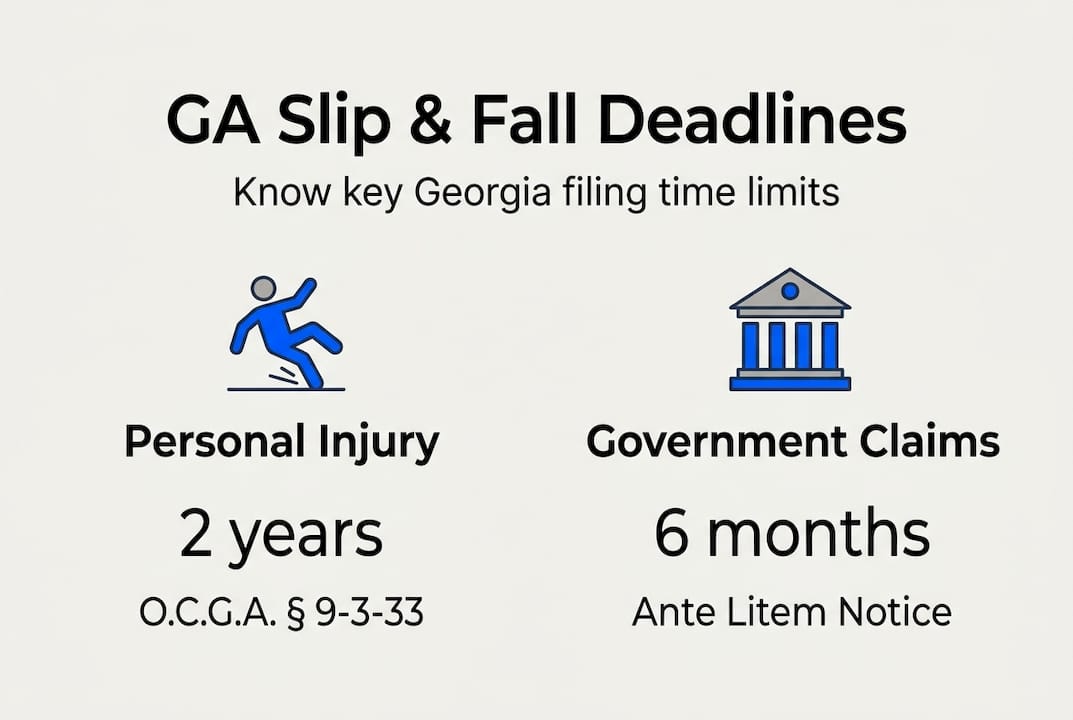
A statute of limitations is simply a legal deadline. Miss it, and your case is gone, regardless of how strong it might be. For slip and fall injuries in Georgia, the deadline is 2 years from the date of your injury. That might sound like plenty of time, but between medical treatment, recovery, and daily life, two years can disappear faster than you expect.
Georgia classifies slip and fall claims as personal injury under negligence, governed by O.C.G.A. § 9-3-33. This means the same two-year rule that applies to car accidents also applies when you fall on someone else’s property. The law does not make exceptions for how serious your injuries are or how clear the property owner’s fault may be.
Key stat: You have exactly 730 days from the date of your fall to file a lawsuit in Georgia. Not one day more.
Here is a quick overview of how Georgia’s slip and fall deadline compares to other common personal injury claims:
| Claim type | Deadline | Governing statute |
|---|---|---|
| Slip and fall (personal injury) | 2 years | O.C.G.A. § 9-3-33 |
| Property damage | 4 years | O.C.G.A. § 9-3-30 |
| Wrongful death | 2 years | O.C.G.A. § 9-3-33 |
| Medical malpractice | 2 years | O.C.G.A. § 9-3-71 |
| Government entity (municipality) | 6 months notice | O.C.G.A. § 36-33-5 |
Understanding the settlement process for slip and fall cases early gives you a clearer picture of how these timelines affect your potential payout. The sooner you act, the more leverage you have in negotiations.
Pro Tip: Do not wait until you feel “ready” to contact a lawyer. The two-year clock starts on the day you fall, not the day you decide to pursue a claim.
For a deeper look at how fault is assigned in these cases, the guide on slip and fall liability in Georgia breaks down what property owners are legally responsible for and what you need to prove.
How and when the clock starts: injury date vs. discovery rule
In almost every Georgia slip and fall case, the clock starts ticking on the exact day you are injured. You fell on March 5th? Your deadline is March 5th, two years later. Simple, but critically important to track.

There is a narrow exception called the discovery rule. This rule allows the deadline to start from the date you discovered your injury rather than the date of the fall. However, the discovery rule applies only in limited cases, such as when an internal injury was not immediately apparent and could not have been found through reasonable diligence. Most slip and fall victims do not qualify.
Here is what you should do immediately after any fall to protect your timeline:
- Write down the exact date, time, and location of the incident
- Photograph the hazard that caused your fall before it is repaired or removed
- Get the names and contact information of any witnesses
- Seek medical attention the same day, even if you feel fine
- Request a copy of any incident report filed at the scene
- Keep every medical bill, prescription receipt, and treatment record
Proper gathering of evidence for injury claims from day one can mean the difference between a strong case and a dismissed one. Courts look at when you knew or should have known about your injury, so a same-day medical visit creates a clear, documented record.
“The limitations period begins on the date of injury or when the plaintiff discovers or should have discovered the injury.” Georgia Legal Services Authority
Pro Tip: If you are unsure whether the discovery rule might apply to your situation, an attorney can assess your specific facts quickly. Do not assume it applies without getting a professional opinion first.
Special deadlines for claims against Georgia government entities
Standard cases follow the general two-year window, but claims against government entities are much less forgiving. If you slipped and fell on a city sidewalk, in a public school, at a government building, or on any state-owned property, you face a completely different set of rules.
Georgia law requires what is called an ante litem notice, which is a formal written notification to the government entity before you can file a lawsuit. Think of it as a mandatory warning shot. Without it, your case cannot proceed, even if you file within the two-year window.
The ante litem deadlines are:
- Municipal claims (cities and counties): Written notice must be filed within 6 months of the injury
- State entity claims: Written notice must be filed within 12 months of the injury
- The notice must include specific details: the date, location, nature of the injury, and the amount of damages claimed
- The notice must be delivered to the correct government office, not just any city hall or state building
- After notice is accepted, you still must file your actual lawsuit within the standard two-year window
Critical stat: A slip and fall victim who waits 7 months to notify a city loses the right to sue, even if the injury was severe and the city was clearly at fault.
For a full breakdown of how these cases work, the guide on state and municipal slip and fall cases covers the procedural steps in detail. You should also review the reporting requirements for Georgia slip and falls to make sure you follow every required step.
Government claims are where most people make costly mistakes. The shorter deadlines catch victims off guard, especially when they are still recovering from their injuries.
What happens if you miss the statute of limitations?
Knowing the deadlines is vital, but understanding what happens when you miss them is equally important. The answer is blunt: missing the deadline bars your claim permanently. Georgia courts will dismiss your case almost automatically if the statute of limitations has expired. The defendant’s attorney will file a motion to dismiss, the judge will grant it, and your case ends before it begins.
There are rare situations where the deadline can be paused, a legal concept called tolling. Tolling may apply in these specific circumstances:
- The injured person was a minor at the time of the fall (the clock may not start until they turn 18)
- The victim was legally incapacitated and unable to manage their own affairs
- The property owner committed fraud to conceal the hazard or prevent you from filing
- The defendant was absent from Georgia for a period after the incident
These exceptions are genuinely rare. Courts do not grant tolling simply because you were unaware of the deadline or were still negotiating with an insurance company.
“Filing a complaint with the court stops the clock. Reporting to the property owner, calling an insurance company, or sending a demand letter does not.”
This is a point that trips up many injury victims. You might spend 18 months going back and forth with an insurance adjuster, feel like progress is being made, and then realize you have only 6 months left to actually file. Learn more about personal injury deadlines in Georgia and understand exactly what actions count legally. When you are ready to move forward, knowing how to file a personal injury claim step by step will help you avoid procedural errors that could derail your case.
Key steps to take after a Georgia slip and fall injury
To make the most of your rights, follow these proven steps after any incident. Acting quickly is not just good advice; it is legally necessary.
- Document everything immediately. Take photos of the hazard, the scene, your injuries, and any contributing factors like poor lighting or missing warning signs.
- Get medical care the same day. Even if you feel minor pain, a same-day medical visit creates a documented record that links your injuries directly to the fall.
- Report the incident formally. Notify the property owner or manager in writing and request a copy of any incident report. For government properties, begin the ante litem notice process right away.
- Preserve all evidence. Keep your clothing and footwear from the day of the fall. Save all medical records, bills, and correspondence with the property owner or their insurer.
- Contact a qualified attorney promptly. An attorney can calculate your exact deadline, identify whether any tolling exceptions apply, and handle government notice requirements on your behalf.
Acting immediately after injury to preserve evidence and meet deadlines is not optional; it is the foundation of a successful claim. The more time that passes, the harder it becomes to gather witness statements, obtain surveillance footage, and document the hazardous condition before it is repaired.
For guidance on collecting and preserving evidence after a fall, there are practical checklists that walk you through exactly what to gather. When you are ready to take formal legal action, a step-by-step guide to filing an injury lawsuit in Georgia will help you understand the full process.
Pro Tip: Do not assume your injuries are minor and wait to see how you feel in a few weeks. Soft tissue injuries, spinal issues, and internal injuries often worsen over time. A medical record from day one protects you if symptoms escalate later.
Connect with Georgia slip and fall attorneys for timely help
Professional help can make the difference between a rejected claim and full compensation. Navigating Georgia’s strict deadlines, ante litem requirements, and tolling exceptions is not something you should handle alone while recovering from an injury.

At The Jewkes Firm, we work with slip and fall victims across South Atlanta and surrounding Georgia counties. We handle deadline calculations, government notice filings, and evidence preservation from day one. Our team works on a contingency fee basis, meaning you pay nothing unless we win your case. If you want to understand how to maximize your slip and fall compensation, we can walk you through your options in a free consultation. Do not let a missed deadline take away your right to recover. Reach out today and let us protect your claim.
Frequently asked questions
Can the statute of limitations for slip and fall in Georgia be extended?
The statute can sometimes be extended, or “tolled,” for minors, incapacitated victims, or cases involving fraud, but these exceptions are rare and require an attorney to argue successfully on your behalf.
Do I have more time to sue if I didn’t discover my injury right away?
In limited cases, the deadline starts when you discover the injury, but most Georgia claims must still be filed within 2 years of the actual incident date.
Is the deadline shorter for slip and fall injuries on city or state property?
Yes. You must file written ante litem notice within 6 months for city claims and within 12 months for state entity claims before you can file a lawsuit.
Does reporting my slip and fall to the property owner count as filing a claim?
No. Only filing a court complaint within the legal deadline satisfies the statute of limitations. Reporting to the owner or contacting their insurance company does not stop the clock.
How soon should I contact a lawyer after a slip and fall?
Contact a lawyer as soon as possible, ideally within days of the incident, to ensure all deadlines are met and your claim is properly handled from the start.