

TL;DR:
- Understanding wrongful death law in Georgia requires families to grasp key terms like damages, liability, and beneficiaries to navigate the process effectively. The two-year statute of limitations from the date of death is critical, and missing this deadline can forfeit your right to seek justice. Familiarity with industry terminology empowers families to communicate confidently with attorneys, understand legal documents, and protect their claim’s validity.
Losing a loved one is devastating enough without facing a wall of confusing legal language. Many Georgia families discover too late that misunderstanding a single term, like confusing the “date of injury” with the “date of death,” can cost them their right to pursue justice entirely. Legal terminology in wrongful death cases is not just academic. It shapes every decision, every deadline, and every dollar your family may recover. This guide breaks down the key industry terms you will encounter, explains the critical deadlines Georgia law sets, and gives you the tools to move forward with confidence and clarity.
Table of Contents
- What is a wrongful death claim in Georgia?
- Essential industry terms for wrongful death claims
- The statute of limitations: What Georgia families must know
- Applying industry terminology to your claim
- Our perspective: Why mastering legal terminology is your best defense
- Get help understanding wrongful death claims
- Frequently asked questions
Key Takeaways
| Point | Details |
|---|---|
| Statute of limitations | Wrongful death claims in Georgia must be filed within two years of the date of death. |
| Terminology matters | Understanding legal language helps families avoid costly mistakes and work more effectively with attorneys. |
| Deadline calculation | Always use the date of death—not the incident—to determine your legal filing window. |
| Practical empowerment | Mastery of terms allows families to confidently navigate communication and paperwork throughout their claim. |
What is a wrongful death claim in Georgia?
Georgia law defines wrongful death as a claim that arises when one person’s negligence, recklessness, or intentional conduct causes the death of another person. In practical terms, this means a family can pursue legal action against the party whose actions or failure to act resulted in their loved one’s death. This is different from a criminal case. A wrongful death claim is a civil action, meaning your family seeks financial compensation rather than criminal punishment for the responsible party.
Understanding this distinction matters because it changes who can file, what evidence you need, and what outcomes are possible. Wrongful death claims are separate from estate claims, too. An estate claim covers expenses like medical bills and funeral costs. A wrongful death claim covers the loss of the person’s life value itself. Both types of claims can sometimes be filed together in Georgia, but they serve different legal purposes.
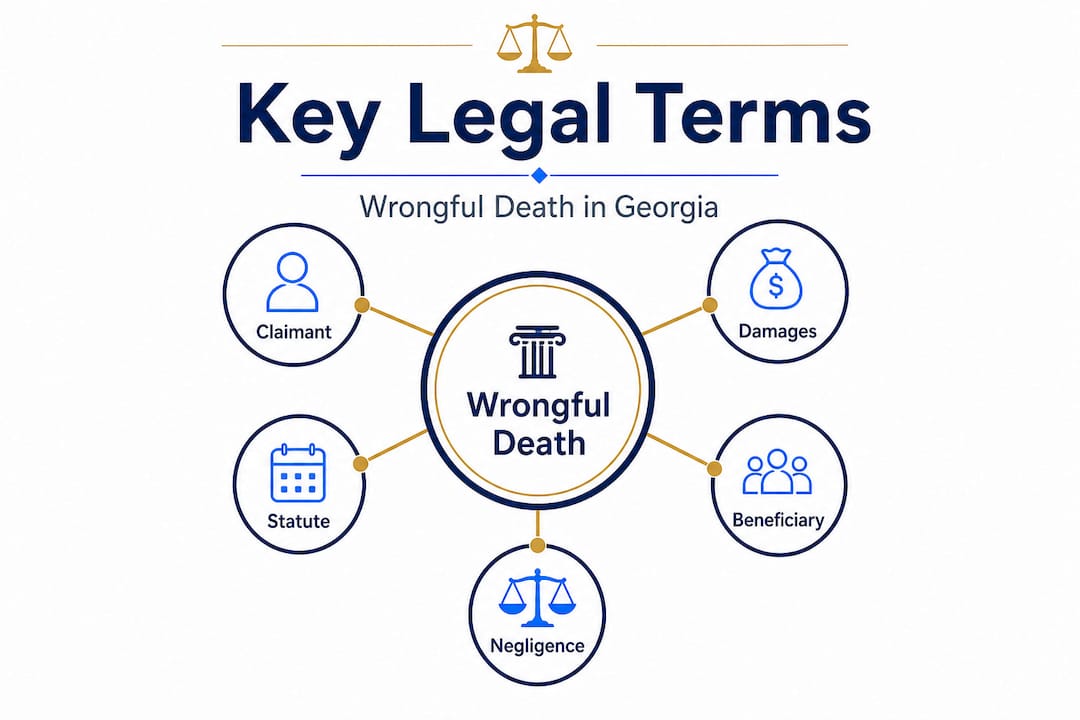
You will encounter several core terms right from the start:
- Decedent: The person who died as a result of another’s wrongful conduct.
- Claimant: The person or persons filing the wrongful death claim on behalf of the decedent’s estate or family.
- Liability: Legal responsibility. Proving liability means showing the other party caused the death.
- Damages: The money sought as compensation for the loss suffered.
- Beneficiaries: The family members legally entitled to share in any wrongful death recovery.
One of the most important terms you need to understand immediately is statute of limitations. This is the legally enforced deadline by which a claim must be filed. Georgia wrongful death cases carry a statute of limitations of two years from the date of death, not the date of the accident or incident that caused the death. This distinction trips up many families and can be catastrophic if overlooked.
“The clock starts ticking the moment your loved one passes away, not when the accident happened. Missing that two-year window generally means losing your right to file a claim, regardless of how strong your case is.”
For a thorough overview, our wrongful death guide walks through each stage of the claims process in Georgia. Learning the wrongful death lawsuit essentials will also help you understand what the formal legal process looks like once you decide to pursue action. Attorneys who specialize in this area understand how proper legal intake for wrongful death cases works and will guide you through every step.
Essential industry terms for wrongful death claims
With the basic concepts defined, it is crucial to decode the key industry terms that shape every wrongful death claim in Georgia. These are the words and phrases you will see in documents, hear in meetings with attorneys, and encounter when dealing with insurance companies. Knowing what they mean gives you power in every conversation.
Here is a clear reference table to anchor these definitions:
| Term | Definition | Practical implication |
|---|---|---|
| Statute of limitations | Legal deadline to file a claim | Missing it bars your claim permanently |
| Damages | Financial compensation sought | Includes economic and non-economic losses |
| Beneficiaries | Family members entitled to recovery | Determines who shares in the settlement |
| Executor | Person managing the decedent’s estate | May file the estate claim alongside wrongful death claim |
| Claimant | Person filing the lawsuit | Must have legal standing under Georgia law |
| Decedent | The person who died | Central figure in all legal documents |
| Liability | Legal responsibility for causing death | Must be proven by a preponderance of evidence |
| Negligence | Failure to act with reasonable care | Most common basis for wrongful death claims |
Each of these terms carries real weight. For example, damages in a wrongful death case include both economic losses, such as the income your loved one would have earned over their lifetime, and non-economic losses, such as the emotional pain and suffering their family experiences. Georgia law also recognizes the full value of the person’s life, which goes beyond simple financial calculations.

Beneficiaries are specifically defined under Georgia law. A surviving spouse has the primary right to file. If there is no surviving spouse, surviving children may file. If there are no children, surviving parents may step forward. This order matters legally. It affects who controls the case and who receives compensation.
Key points to keep in mind about these terms:
- The executor handles estate claims, not the wrongful death claim itself. These roles can overlap but are legally distinct.
- Negligence must be proven, meaning you need evidence that the responsible party failed to meet a reasonable standard of care.
- Damages can be calculated using expert testimony, financial records, and life expectancy data.
- Your claimant status must be established early. An attorney can confirm your legal standing before you begin.
Pro Tip: Always verify the exact date of death on the death certificate. That date, not the accident date, starts the two-year deadline clock under Georgia’s statute of limitations. Many families assume the clock starts at the accident, which can lead to filing too late. Understanding wrongful death liability in Georgia also helps you identify which parties may share responsibility.
The statute of limitations: What Georgia families must know
Now that the key terms are in focus, let’s look closely at one of the most critical concepts of all, the statute of limitations, and its practical effects on your claim. This is where many families make a costly mistake, and understanding it clearly can be the difference between justice and no recourse at all.
Georgia’s wrongful death statute of limitations gives families a strict two-year window from the date of death to file their claim. This is not a suggestion. It is a hard legal cutoff. After two years, courts will almost always dismiss a claim as time-barred, meaning you lose your right to sue no matter how strong your case might be.
Here is how different Georgia civil claims compare for context:
| Type of claim | Standard deadline | Starting point |
|---|---|---|
| Wrongful death | 2 years | Date of death |
| Personal injury | 2 years | Date of injury |
| Medical malpractice | 2 years | Date of injury or discovery |
| Product liability | 2 years | Date of injury |
| Slip and fall | 2 years | Date of injury |
The deadlines look similar, but the starting point for wrongful death is unique. Most personal injury claims count from the date of the incident. Wrongful death claims count from the date the person passed away. If your loved one survived the accident for days, weeks, or even months before dying, that gap matters enormously for your deadline calculation.
Here is a step-by-step approach to calculating your filing deadline:
- Obtain the official death certificate. Confirm the exact date of death.
- Mark that date on a calendar. Count exactly two years forward from that date.
- Subtract at least 60 to 90 days. This gives your attorney time to prepare and file properly.
- Contact an attorney immediately. Do not wait until the deadline is close. Evidence can disappear quickly.
- Ask about exceptions. Certain situations, such as cases involving minors or government entities, may have modified deadlines.
Protecting your right to maximize compensation in Georgia starts with protecting your deadline. Similarly, understanding how the slip and fall statute compares to wrongful death deadlines shows just how important it is to know which clock applies to your specific situation.
Pro Tip: Even if you are not sure you have a case, consult an attorney well before the two-year mark. A free consultation costs nothing, but missing the deadline could cost everything.
Applying industry terminology to your claim
Armed with the right understanding and deadline awareness, families can now apply terminology to real-world conversations and processes. Knowing these terms is not just about passing a vocabulary test. It is about being an active, informed participant in your own case.
When you walk into a meeting with an attorney, the conversation is more productive when you understand what is being discussed. You can ask sharper questions, catch potential issues, and make decisions with real confidence. Attorneys working on wrongful death cases appreciate clients who understand the basics. It leads to better communication and, ultimately, better outcomes.
Here are the most important ways knowing industry terminology helps your claim:
- Communicating with your attorney: When you understand terms like “liability” and “damages,” you can have direct conversations about the strength of your case rather than getting lost in translation.
- Reading legal documents: Contracts, demand letters, and court filings use specific terms. Recognizing them prevents misunderstandings that could affect your case.
- Dealing with insurance companies: Insurers use technical language strategically. Knowing what “settlement,” “subrogation,” and “policy limits” mean helps you avoid being misled.
- Preparing your questions: Before every meeting or phone call, write down your questions using the correct terms. It signals to legal professionals that you are engaged and serious.
- Organizing your records: Label documents clearly using legal terminology. This keeps your case file organized and makes your attorney’s job easier.
Understanding the steps to file an injury lawsuit in Georgia will also help you anticipate what comes next at each stage. When you are ready to take that step, knowing how to go about hiring a wrongful death attorney in South Atlanta ensures you find the right advocate for your family. Working with legal intake specialists who understand wrongful death cases makes the initial process smoother and less overwhelming.
Georgia wrongful death terminology around deadlines, claimants, and damages is consistent throughout the legal process. Families who know these terms from the beginning avoid surprises and stay better organized through what is already an emotionally difficult experience.
Pro Tip: Keep a personal glossary. Write down every new term you encounter with a simple definition in your own words. Review it before every meeting, phone call, or document review. This one habit saves time and reduces stress at every stage of your claim.
Our perspective: Why mastering legal terminology is your best defense
Conventional wisdom says you just need a good lawyer and everything will be handled for you. We respectfully disagree. While a dedicated attorney is absolutely essential, families who take the time to understand key legal terms consistently achieve better results. They ask better questions. They notice inconsistencies. They stay more engaged throughout a process that often takes months or years.
The statute of limitations is where we see the hardest lessons. Families who wait, assuming they have time because they are counting from the accident date rather than the date of death, sometimes discover too late that their window has closed. We have seen cases where strong evidence existed, liability was clear, and damages were significant, but the claim could not proceed because the deadline passed. That outcome is preventable. Every time.
Legal terminology can feel intimidating at first. Words like “decedent,” “subrogation,” and “beneficiary” do not come up in everyday conversation. But they are learnable. Most families who invest even a few hours in understanding these terms come to their consultations completely transformed. They shift from feeling powerless to feeling like participants in their own case.
Our detailed wrongful death overview is designed specifically to bridge that gap. It explains every stage of the process in plain language while keeping the legal accuracy you need to make informed decisions. The families who use it as a reference throughout their case consistently tell us it made one of the hardest experiences of their lives more manageable.
The bottom line is this: mastering the language of your case is not optional. It is one of the most powerful things you can do for your family.
Get help understanding wrongful death claims
Facing a wrongful death claim without guidance is overwhelming. The terminology alone can feel like a foreign language, and the stakes could not be higher for your family. Understanding the terms is the first step, but having an experienced, dedicated legal team by your side is what truly levels the playing field.

At The Jewkes Firm, we are committed to walking Georgia families through every stage of the wrongful death claims process with clarity, compassion, and fiercely dedicated advocacy. Our team handles the complexity so you can focus on your family. We offer free consultations with no upfront costs and work on a contingency fee basis, meaning you pay nothing until we win. If you are ready to take the next step or simply have questions, contact The Jewkes Firm today and let us help you pursue the justice your loved one deserves.
Frequently asked questions
What is the deadline to file a wrongful death claim in Georgia?
The deadline is typically two years from the date of death, not from the date of injury or incident. Starting your claim early gives your attorney time to gather evidence and build the strongest possible case.
What does ‘statute of limitations’ mean in a wrongful death case?
It refers to the legal deadline for filing a claim, and Georgia’s two-year limit means missing it generally ends your right to sue, regardless of how strong the case is.
Which family members are eligible to file a wrongful death claim?
Georgia law prioritizes the surviving spouse first, followed by surviving children, and then surviving parents if no spouse or children exist.
How does knowing industry terminology help my claim?
It helps you communicate more clearly with legal professionals, catch potential errors in documents, and make confident, informed decisions at every stage of the process.
Can I still file a claim if the incident happened over two years ago?
You likely cannot file if more than two years have passed since the date of death, unless a recognized legal exception applies to your specific situation. Consult an attorney immediately if you are unsure.