
TL;DR:
- Incomplete injury documentation often leads accident victims to lose rightful compensation, as insurers scrutinize vague or disorganized records. Thorough, consistent evidence collection—such as photos, symptom journals, and medical records—can significantly strengthen a claim and demonstrate injury progression. Taking proactive steps immediately after the crash, including using proper tools and maintaining organized records, is essential for building a compelling case.
Incomplete injury documentation is one of the most common reasons accident victims in South Atlanta lose out on the compensation they deserve. Insurance companies are skilled at questioning vague or disorganized records, and even a minor gap in your injury timeline can give adjusters the justification they need to minimize your payout. The good news is that thorough, consistent documentation can fundamentally shift the outcome of your claim. This guide walks you through exactly what to collect, how to capture it, and how to make every record count when it matters most.
Table of Contents
- What you need before you start documenting
- Step-by-step guide to documenting your injuries
- How to make your medical records work for you
- Common mistakes and how to avoid them
- The overlooked link between injury details and your settlement
- Take the next step: Get expert help with your injury claim
- Frequently asked questions
Key Takeaways
| Point | Details |
|---|---|
| Start early | Begin documenting injuries immediately after an accident for the best evidence. |
| Photograph progression | Take photos over several days to show how bruising and swelling develop. |
| Medical record accuracy | Make sure your healthcare providers document accident causes and all symptoms. |
| Avoid common mistakes | Don’t delay documentation or forget follow-up updates—these errors weaken claims. |
| Expert help matters | A qualified attorney can ensure no detail is missed and maximize your claim potential. |
What you need before you start documenting
To begin proper documentation, make sure you have the right tools and materials prepared. Arriving at this process unprepared costs you time and evidence. The moment after a crash is chaotic, but taking a few seconds to reach for the right tool can mean the difference between a strong claim and a dismissed one.
Essential tools to have on hand
- Smartphone with a timestamp camera app: Your phone’s built-in camera is enough, but enabling location and time stamps adds a layer of authenticity that insurers and attorneys recognize immediately.
- A small notebook and pen: Not everything can be captured in photos. Symptoms like dizziness, radiating pain, or numbness need written descriptions with dates and times.
- A photo storage folder on your phone: Create a dedicated album labeled with the accident date. Keep it separate from your everyday photos so nothing gets accidentally deleted.
- Your insurance card and ID: These need to be accessible at the scene for the police report and any immediate exchanges.
- The police report number: This document anchors your entire claim. Every insurer and attorney will want it.
- A list of witnesses: Names and phone numbers from bystanders can validate your account of the crash.
Here is a quick reference table comparing what each tool does for your case:
| Tool | Primary purpose | Legal value |
|---|---|---|
| Timestamped photos | Visual injury proof | High |
| Written symptom journal | Pain and limitation record | High |
| Police report | Official incident record | Very high |
| Medical records | Clinical injury confirmation | Very high |
| Witness contact info | Third-party corroboration | Medium to high |
| Insurance documents | Claim filing and coverage scope | High |
Using an accident victim checklist from the start helps you stay organized through what is often a stressful and confusing process.
Pro Tip: Go into your phone’s camera settings right now and turn on location services and timestamp display. If your phone does not offer this natively, download a free timestamp camera app. This small step adds powerful authenticity to every photo you take, because photographing injuries promptly and re-documenting over time creates a visual record consistent with real injury progression.
Step-by-step guide to documenting your injuries
With the essentials ready, you can now follow a specific process to capture evidence effectively. Think of this as a timeline of proof. The earlier you start, the stronger your record becomes.
The immediate documentation phase (within the first hour)
- Photograph the scene before anything moves. Capture skid marks, traffic signals, weather conditions, and road signage. These details establish context for how the crash happened.
- Take full-body photos of yourself. Even if you feel fine, your body may show early signs of trauma that you have not yet felt. Shock can mask pain for hours.
- Take close-up photos of any visible injuries. Cuts, bruising, swelling, and abrasions need multiple angles under good lighting. Do not edit or filter these images.
- Photograph your vehicle damage. The severity of the damage often correlates with the severity of your injuries in legal proceedings.
- Write down how you feel physically. Any pain, pressure, dizziness, blurred vision, or nausea should be recorded immediately with the exact time.
The ongoing documentation phase (days one through seven)
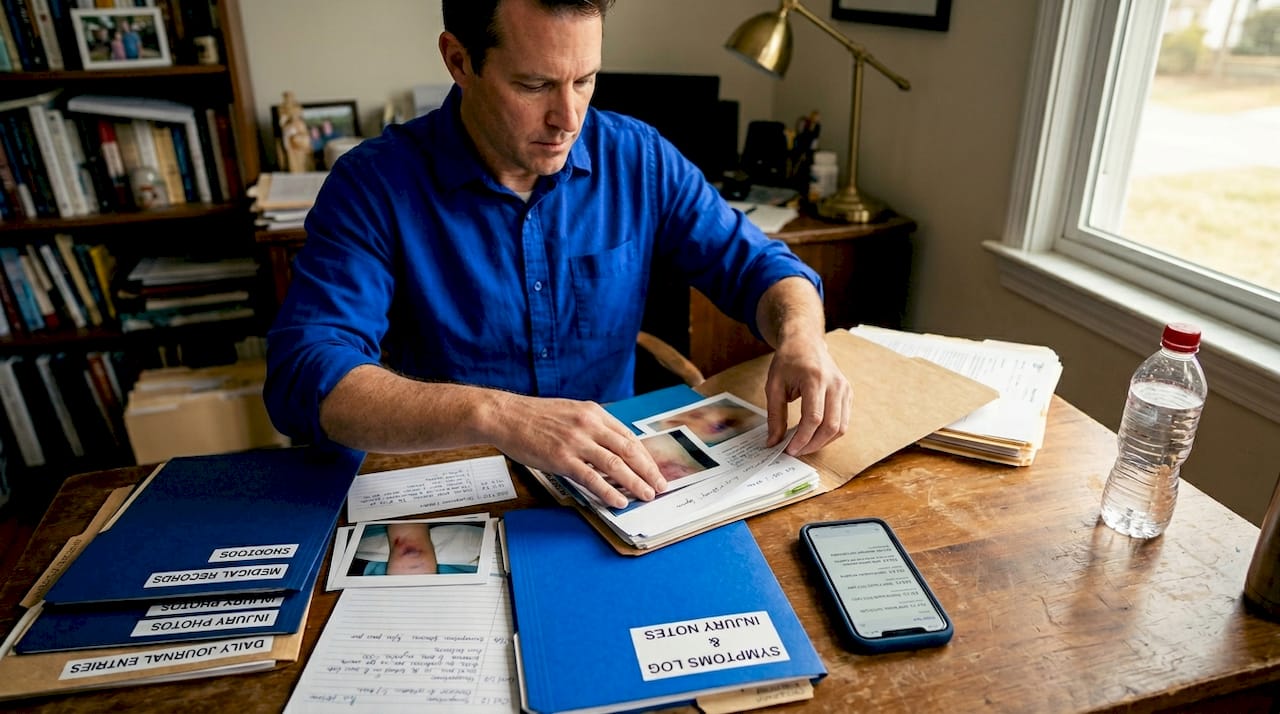
This is where most people fail. They photograph their injuries once and then stop. But bruising often deepens over 48 to 72 hours, and swelling can peak days after the impact. As noted in guidance on how to document evidence after car accidents, re-photographing over time as bruising and swelling develops shows progression consistent with real injury severity.
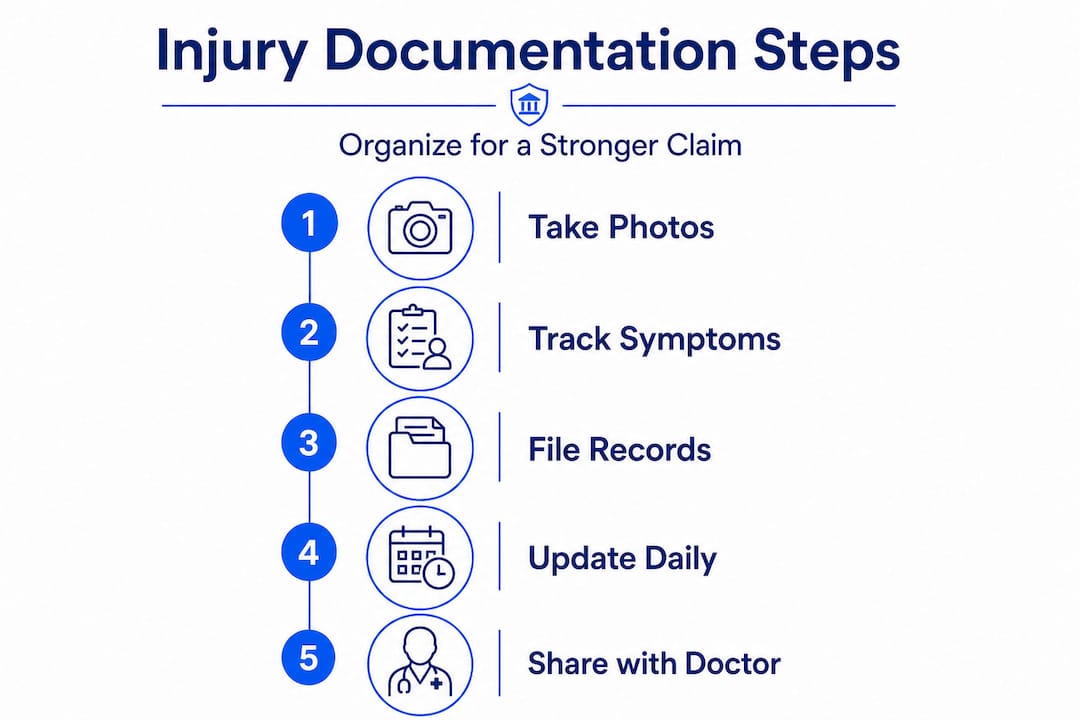
- Re-photograph injuries every 24 to 48 hours for at least a week. Label each set by date in your dedicated folder.
- Journal your symptoms daily. Note pain levels on a scale of one to ten, activities you cannot perform, sleep disruptions, and emotional changes like anxiety or depression related to the crash.
- Track all medical appointments, prescriptions, and diagnoses. Every date, every provider, every treatment. This builds the continuity that insurers look for.
“The most powerful injury evidence is not a single photograph. It is a visual and written timeline that shows how your injuries developed, peaked, and persisted. Consistency in documentation tells a story that a single snapshot never can.”
Here is a comparison of weak versus strong injury documentation approaches:
| Documentation type | Weak approach | Strong approach |
|---|---|---|
| Photos | One set taken the day of the crash | Daily or every-other-day photos for one week or more |
| Symptom records | Nothing written down | Dated daily journal with pain scale entries |
| Medical visits | One ER visit, no follow-up | Consistent care with documented symptom progression |
| Evidence storage | Scattered across phone and email | Organized folder labeled by incident date |
Understanding how to protect your rights after a car accident starts with this kind of structured, consistent approach. You should also familiarize yourself with common accident injuries so you know what symptoms to watch for and document in the days following the crash.
Pro Tip: Create a dedicated folder on your phone labeled “Accident [Date]” and add a subfolder for each day. Every photo, note, and document related to your injury goes in there. This makes sharing evidence with your attorney fast, clean, and organized.
How to make your medical records work for you
Beyond your personal documentation, medical records are a critical part of substantiating your injuries. Your doctor’s notes are often the most trusted form of evidence in a personal injury claim. But here is the reality: physicians are busy, and they do not always know what details matter for your legal case unless you tell them.
What your medical records must include
- The cause of your injury: Your doctor should specifically note that your injuries are consistent with a motor vehicle accident. Generic language like “patient reports pain” is far weaker than “patient sustained injuries in a rear-end collision on [date].”
- A complete symptom timeline: Every visit should reference when symptoms began, how they have changed, and what treatments are being prescribed.
- All diagnoses, even minor ones: Soft tissue injuries, nerve impingement, anxiety related to the crash, and sleep disturbance all have value in a claim.
- Test results and imaging reports: X-rays, MRIs, CT scans, and specialist referrals should all be requested as copies for your own records.
- Functional limitations: If your injuries prevent you from working, driving, or performing daily tasks, ask your doctor to document those limitations explicitly.
Research on medical record systems shows that cause-of-injury coding is often incomplete. The practical implication for accident victims is clear: you cannot rely on medical staff to automatically record what happened to you. You must advocate for yourself in every appointment.
The risk is real. Incomplete or vague medical records give insurance adjusters a powerful argument that your injuries were pre-existing, unrelated to the crash, or exaggerated. That argument directly reduces your settlement value.
Your personal injury guide covers how Georgia law treats medical evidence in injury claims, which is essential reading before you finalize your documentation strategy.
Pro Tip: Bring your photo journal and symptom notes to every medical appointment. Show your doctor the photos. Walk them through your symptom timeline. This helps them create accurate, detailed records that reflect the true nature and progression of your injuries.
Common mistakes and how to avoid them
Even the best plans can go off track. Here are the pitfalls to watch for and expert tips to stay on course.
The most damaging documentation errors
- Waiting too long to photograph injuries. Bruising and swelling can fade within a week. If you wait three days to start photographing, you may miss the peak of visible injury evidence entirely.
- Stopping documentation after the first visit. One set of photos and one doctor’s visit looks thin to insurers. Ongoing records show a persistent, genuine injury pattern.
- Missing medical appointments. Gaps in treatment are one of the first things insurance adjusters look for. A two-week break in care will prompt questions about whether you were truly injured or whether your recovery was complete.
- Not asking for copies of your records. Your provider keeps records for their purposes. You need your own copies organized and accessible for your attorney.
- Failing to record non-visible symptoms. Headaches, dizziness, memory issues, emotional distress, and difficulty sleeping are real injuries. Write them down with dates even if they cannot be photographed.
- Posting injury-related content on social media. Insurance companies actively monitor your profiles. A photo of you at a cookout during your recovery period can be used to challenge the severity of your injuries.
Understanding how evidence makes or breaks an injury claim in Georgia puts these mistakes in sharp legal perspective. There is also a deeper case for why documenting accident evidence from the very beginning strengthens your position at every stage of the process.
“Failing to document the progression of your injuries does not just weaken your case. It creates gaps that insurance companies are trained to exploit. Every missing photo, every skipped appointment, and every undocumented symptom is an opening they will use to reduce your compensation.”
For a closer look at how complete injury documentation supports the full legal process, it helps to understand how attorneys use that evidence to build and present your case.
Pro Tip: Print or digitally save a documentation checklist and review it every evening for the first two weeks after your accident. Include prompts for photos, symptom notes, medical appointments, prescription records, and any communication with insurance companies. Consistent habits produce the kind of detailed records that hold up under legal scrutiny.
The overlooked link between injury details and your settlement
Most accident victims understand they need some documentation. What they underestimate is the difference between basic documentation and strategic documentation.
Insurance companies do not just look at whether you have records. They look at the quality, consistency, and specificity of those records. An adjuster reviewing a claim with 47 dated photos, a daily symptom journal, and clearly annotated medical records showing injury cause and progression will treat that claim very differently from one supported by two blurry photos and a single ER discharge note.
We have seen cases at The Jewkes Firm where clients came to us with strong liability facts but fragile documentation. The at-fault driver clearly caused the crash. The injuries were real and serious. But because the client stopped documenting after a few days and missed two follow-up appointments, the insurer disputed the severity. That documentation gap became the entire battleground of the negotiation.
Contrast that with clients who followed a disciplined documentation process from day one. Their claims moved faster, their settlement values were higher, and there was far less room for the insurer to challenge the core facts.
The most overlooked element is the symptom journal. Attorneys use daily pain records to demonstrate how injuries affected your ability to work, care for your family, and live your life. This is called “pain and suffering” damages, and it can represent a significant portion of your total recovery. Without a written record created in real time, those damages are difficult to prove and easy to challenge.
If you are considering filing a Georgia injury lawsuit, the strength of your documentation from the earliest days after the crash will shape every stage of that process, from initial demand letters through trial preparation.
The bottom line: meticulous, ongoing injury records are not just helpful. They are the foundation your entire claim is built on.
Take the next step: Get expert help with your injury claim
Detailed records are powerful, but expert legal support can maximize their benefit. Having the right attorney review your documentation ensures nothing critical is missed and that your evidence is presented in the most compelling way possible.

At The Jewkes Firm, we work with South Atlanta accident victims every day to build strong, well-documented cases that stand up to insurer scrutiny. We offer a FREE consultation to review your documentation, evaluate your claim, and give you an honest assessment of your options. Our team works on a contingency fee basis, which means you pay nothing unless we win your case. You focus on healing. We handle the legal fight. Call us today or visit jewkesfirm.com to GET A FREE CASE REVIEW and put an experienced advocate in your corner.
Frequently asked questions
What should I photograph after a car accident?
You should photograph visible injuries, the accident scene, vehicle damage, and re-take photos over the following days to show how bruising and swelling changes, since re-photographing over time creates a visual record consistent with real injury severity.
How soon should I see a doctor after an accident?
You should seek medical care as soon as possible, ideally within 24 hours, even for minor aches, and ask your doctor to explicitly record the cause and full symptom picture in your visit notes.
What if my medical records are incomplete?
Request that your provider add clear notes about the injury mechanism and symptom progression, since cause-of-injury coding is often incomplete in standard medical record systems and must be actively supplemented with clear narrative documentation.
Can I use my own notes and photos as evidence?
Yes, personal notes and dated photos as evidence can be crucial supporting evidence for your claim, especially when they show injury progression over time and are paired with consistent medical records.