
TL;DR:
- A trucking accident injury checklist guides victims through immediate steps to preserve evidence, seek medical care, and protect legal rights. Early documentation, expert evidence collection, and legal strategies are essential for maximizing claim outcomes against complex multi-party liability and aggressive insurer tactics. Engaging an attorney promptly ensures critical evidence is preserved and claims are effectively pursued within the legal deadlines.
A trucking accident injury checklist is a step-by-step guide that helps you secure medical care, preserve evidence, and protect your legal rights after a crash with a commercial truck. These accidents are not like standard car collisions. Multiple parties carry liability, federal regulations govern the evidence, and insurance companies deploy specialized risk teams within hours of the crash. Every action you take in the first days after the accident either strengthens or weakens your claim. This guide walks you through each critical step, from the scene to settlement, so nothing gets missed.

1. What are the first steps to take immediately after a trucking accident?
The first 72 hours are the most critical window for evidence preservation and medical evaluation. What you do in this period shapes the entire trajectory of your claim.
On-scene priorities:
- Move to a safe location if you can do so without worsening injuries.
- Call 911 immediately. An official police report is a foundational document for any claim.
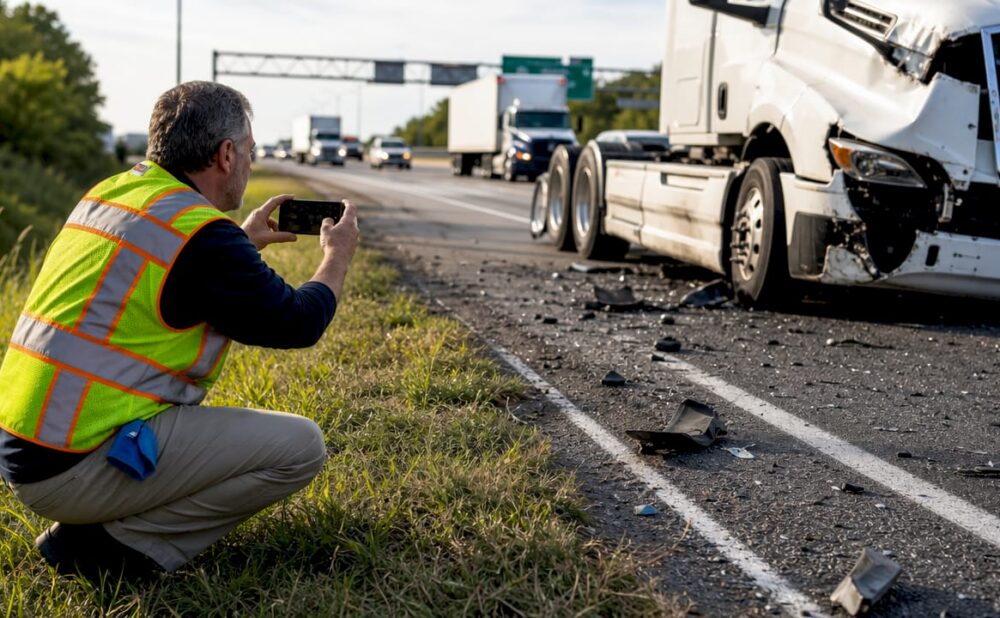
- Photograph the truck, your vehicle, road conditions, skid marks, traffic signs, and any visible injuries.
- Collect the truck driver’s name, license number, carrier name, and insurance information.
- Get names and contact details from every witness present.
- Note the truck’s DOT number, which appears on the cab door.
Do not give a recorded statement to the trucking company’s insurer at the scene or in the days that follow. Their representatives are trained to minimize payouts, not to help you.
Pro Tip: Take a short video walking around both vehicles. Video captures angles and details that still photos often miss, and timestamps confirm the scene conditions.
Seek medical attention the same day, even if you feel fine. Adrenaline is a powerful pain suppressant, and serious injuries can go unnoticed for hours or days.
2. How to properly document injuries and preserve medical evidence
Adrenaline can mask serious injuries like traumatic brain injury or spinal damage, which may not present symptoms until days after the accident. That delay is one of the most common reasons claims get disputed.
Follow these steps to build a solid medical record:
- Get a full evaluation on the day of the accident. Visit an emergency room or urgent care clinic, even for minor symptoms.
- Report every symptom to your doctor. Headaches, dizziness, neck stiffness, and blurred vision all matter. Minor symptoms become major evidence.
- Request copies of all records. Collect hospital records, X-rays, MRI results, and any specialist referrals. Medical records and imaging are the primary proof of injury in any claim.
- Start an injury journal the same day. Write down your symptoms, pain levels, medications, and how the injuries affect your daily life.
- Attend every follow-up appointment. Gaps in treatment give insurers grounds to argue your injuries were not serious or were caused by something else.
- Keep all receipts. Prescriptions, medical equipment, physical therapy, and transportation to appointments are all compensable expenses.
Pro Tip: Use a dated notes app on your phone for your injury journal. Digital entries are automatically timestamped, which adds credibility if the records are ever questioned.
Consistent documentation protects you. It also gives your attorney the concrete evidence needed to calculate the full value of your damages.
3. Which types of evidence must be secured for a trucking accident claim?
Trucking accident claims require a category of evidence that does not exist in standard car accident cases. Federal law governs commercial carriers, and the records they maintain are often decisive in determining liability.
Critical evidence categories:
- ELD data: Electronic Logging Devices record driver hours of service and rest breaks. This data proves driver fatigue or hours-of-service violations, which are common causes of trucking crashes.
- Black box records: The Crash Event Data Recorder captures vehicle speed, braking force, and steering inputs in the seconds before impact. Black box data is one of the most powerful tools for establishing liability.
- Driver qualification files: These include the driver’s license history, training records, and drug and alcohol test results.
- Vehicle maintenance logs: Brake failures and tire blowouts caused by poor maintenance create direct carrier liability.
- Dispatch communications: Text messages and radio logs between the driver and dispatch can reveal pressure to violate safety rules.
- Dashcam footage: Many commercial trucks carry forward and rear-facing cameras. This footage must be preserved before it is overwritten.
| Evidence Type | What It Proves | Who Controls It |
|---|---|---|
| ELD data | Driver fatigue, hours violations | Carrier |
| Black box records | Speed, braking before impact | Carrier |
| Driver qualification files | Training, licensing, drug tests | Carrier |
| Maintenance logs | Vehicle defects, neglect | Carrier or maintenance firm |
| Dashcam footage | Crash sequence, road conditions | Carrier |
A spoliation letter sent promptly by your attorney legally obligates the trucking company to preserve all of this evidence. Without that letter, carriers can legally overwrite or discard records within days.
4. What are the common legal pitfalls and how to avoid them?
Trucking accident claims involve multiple liable parties, including the driver, the carrier, maintenance contractors, and freight brokers. That complexity is exactly what insurers count on to delay and reduce payouts.
Mistakes that cost victims their claims:
- Giving a recorded statement. The trucking company’s insurer will contact you quickly. Decline any recorded statement until you have spoken with an attorney.
- Accepting the first settlement offer. Accepting an early offer is one of the most costly mistakes victims make. Insurance companies complete their damage assessment long before you know the full extent of your injuries.
- Posting on social media. Photos or comments about the accident, your activities, or your recovery can be used to contradict your injury claims.
- Repairing your vehicle too soon. Repairing your vehicle before your attorney documents the damage destroys physical evidence.
- Missing the statute of limitations. Georgia law sets a two-year deadline for personal injury claims. Missing it ends your case permanently.
“Insurance companies use specialized risk management teams from the moment a trucking accident is reported. Victims who engage an attorney early level the playing field against those resources.”
Federal regulations require commercial trucks to carry a minimum of $750,000 in liability insurance. Many large fleets carry policies of $1 million to $5 million or more. That scale of coverage explains why insurers fight these claims aggressively. You need an equally prepared response.
5. How multi-party liability changes your claim strategy
Trucking accident claims are not resolved the same way a two-car collision is. Liability in trucking cases often extends to the carrier, a separate maintenance company, a freight broker, and sometimes the cargo loader. Each party carries its own insurer and legal team.
This complexity means your attorney must investigate multiple defendants simultaneously. Driver error alone rarely tells the full story. A brake failure caused by a negligent maintenance contractor, combined with a fatigued driver pushed by a dispatcher to skip rest breaks, creates a layered liability picture that requires extensive documentation review.
Understanding this structure early helps you avoid settling with one party before the full picture is clear. Partial settlements can release other defendants from liability if the release language is too broad. An experienced trucking accident attorney reviews every settlement document before you sign.
6. What ongoing steps should you follow during recovery and claim resolution?
Managing your claim through recovery requires the same discipline as the immediate post-accident steps. Consistency in documentation and communication protects your rights throughout the process.
- Track every expense. Document all accident-related costs including medical bills, lost wages, transportation, and home care. Keep every receipt.
- Attend all medical appointments. Missed appointments create gaps that insurers use to argue your injuries have resolved.
- Continue your injury journal. Record daily pain levels, limitations on work and personal activities, and emotional impacts. This record supports pain and suffering damages.
- Communicate through your attorney. Direct contact with the trucking company or its insurer without legal guidance creates risk. Route all communications through your legal representative.
- Understand your state’s deadline. Georgia’s two-year statute of limitations for personal injury claims is firm. Your attorney tracks this, but you should know it too.
- Evaluate settlement offers carefully. Do not accept any offer before your treating physicians confirm your maximum medical improvement. Settling too early forfeits future medical costs.
Pro Tip: Create a dedicated folder, physical or digital, for every document related to the accident. Organized records speed up the claims process and reduce attorney preparation time.
Key takeaways
A successful trucking accident claim depends on immediate evidence preservation, consistent medical documentation, and early legal engagement before insurers control the narrative.
| Point | Details |
|---|---|
| Act within 72 hours | Call 911, seek medical care, and photograph the scene before evidence disappears. |
| Document every symptom | Report all injuries to your doctor the same day, even minor ones, and maintain a dated journal. |
| Preserve carrier records | Have your attorney send a spoliation letter immediately to protect ELD data, black box records, and driver files. |
| Avoid early settlements | Do not accept any offer before reaching maximum medical improvement and full damage assessment. |
| Engage an attorney early | Early legal involvement increases evidence preservation and maximizes your claim outcome. |
What I’ve learned watching victims navigate trucking claims
The single most damaging mistake I see is waiting. Victims assume they have time to recover before worrying about legal steps. Trucking companies do not wait. Their adjusters and legal teams are on the scene or on the phone within hours of a crash. By the time a victim feels ready to act, critical ELD data has been overwritten and dashcam footage has been deleted.
The second pattern I see is underreporting symptoms. People feel embarrassed describing a headache or mild neck stiffness to a doctor when they walked away from a crash. Those symptoms are often the early signs of a traumatic brain injury or cervical spine damage. Reporting them on day one creates the medical record that supports a serious claim months later. Staying quiet on day one creates a gap that insurers exploit.
Emotional injuries are also consistently overlooked. Anxiety, sleep disruption, and post-traumatic stress after a violent crash are real, compensable damages. They belong in your injury journal and in your medical records. A doctor cannot document what you do not report.
My strongest advice is this: contact a qualified trucking accident attorney before you speak to any insurer. The consultation costs nothing. The information you get in that first meeting protects everything that follows.
— Ali
Jewkesfirm is ready to protect your claim from day one
Trucking accident claims move fast, and so do the companies responsible for them. Jewkesfirm represents trucking accident victims across South Atlanta and surrounding Georgia counties, handling the evidence preservation, insurer negotiations, and legal filings so you can focus on recovery.
Jewkesfirm works on a contingency basis. You pay nothing unless they win your case. Their attorneys send spoliation letters immediately, secure carrier records before they disappear, and build the full liability picture across every responsible party. If you were injured in a trucking crash, the time to act is now. Visit Jewkesfirm for a FREE CONSULTATION and let their team protect your rights from the first call.
FAQ
What is a trucking accident injury checklist?
A trucking accident injury checklist is a structured list of steps covering medical care, evidence collection, and legal actions that victims should follow immediately after a crash with a commercial truck.
How soon should I see a doctor after a trucking accident?
See a doctor the same day as the accident. Adrenaline can hide serious injuries like spinal damage or traumatic brain injury, and delayed treatment creates gaps that insurers use to dispute your claim.
What evidence is most important in a trucking accident claim?
ELD data, black box records, driver qualification files, and vehicle maintenance logs are the most critical evidence. Your attorney must send a spoliation letter quickly to prevent carriers from destroying these records.
Can I handle a trucking accident claim without an attorney?
You can, but trucking claims involve multiple liable parties, federal regulations, and specialized insurer teams. Early attorney involvement significantly improves evidence preservation and claim outcomes.
How long do I have to file a trucking accident claim in Georgia?
Georgia law sets a two-year statute of limitations for personal injury claims. Missing this deadline permanently bars you from recovering compensation, regardless of how strong your case is.