

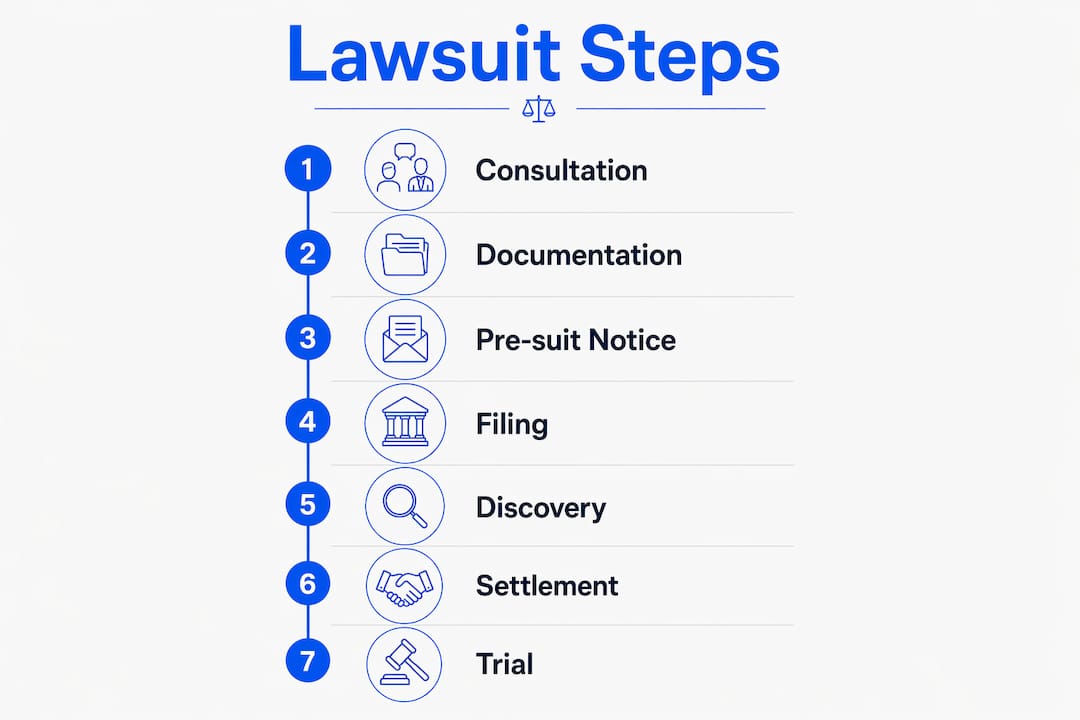
A medical negligence lawsuit is a legal claim that a healthcare provider’s failure to meet the accepted standard of care caused measurable harm to a patient. This step by step medical negligence lawsuit guide covers every stage of the medical malpractice claim process, from confirming your claim’s validity to filing, discovery, settlement, and trial. Four legal elements form the foundation of every case: duty, breach, causation, and damages. Understanding these elements early protects your rights and shapes every decision you make. Jewkesfirm has helped clients across South Atlanta and surrounding Georgia counties pursue maximum compensation through exactly this process.
How do you confirm a valid medical negligence claim?
Proving negligence requires establishing four elements by a preponderance of the evidence, meaning greater than 50% probability. That standard sounds straightforward, but each element carries its own burden.
- Duty: The provider owed you a professional obligation. A treating physician always owes this duty; a doctor you met at a dinner party generally does not.
- Breach: The provider’s conduct fell below the accepted standard of care. This is measured against what a reasonably competent provider in the same specialty would have done.
- Causation: The breach directly caused your harm. This is the most disputed element. You must show the injury would not have occurred “but for” the provider’s negligence.
- Damages: You suffered a real, measurable loss, whether physical, financial, or both.
Many states require a Certificate of Merit from a qualified medical expert before you can even file. This sworn statement confirms a licensed professional reviewed your records and found merit in the claim. Without it, courts in those states dismiss the case immediately.
Statutes of limitations add another layer of urgency. Deadlines range from one year in states like Kentucky and Louisiana to four years in others. Missing the deadline ends your case regardless of its strength.
Pro Tip: The discovery rule pauses the statute of limitations until you reasonably knew, or should have known, about the injury and its negligent cause. Document the exact date you first connected your harm to a provider’s error. That date can be the difference between a live claim and a dismissed one.
What documentation do you need before filing?
Strong preparation separates claims that survive early motions from those that collapse at the first challenge. Complete medical records from every provider involved in your care are the starting point. Collect billing records, pharmacy logs, imaging results, and any written communications with the provider.

Build a detailed timeline. List every appointment, symptom, complaint, test result, and conversation in chronological order. This timeline becomes the backbone of your attorney’s case theory and helps your expert witness understand the sequence of events clearly.
Pro Tip: Request records in writing and keep copies of every request and response. Providers sometimes lose or delay records. A paper trail of your requests protects you if records go missing later.
Many states impose pre-suit requirements before you can file. The table below outlines the most common ones.
| Pre-suit requirement | What it involves | Why it matters |
|---|---|---|
| Notice of intent | Written notice to the defendant provider | Triggers a mandatory waiting period for investigation |
| Waiting period | Typically 90 days in many states | Gives defendants time to review and respond before litigation |
| Certificate of Merit | Sworn statement from a qualified expert | Confirms claim merit; required in nearly 30 states |
| Medical records request | Formal written request to all providers | Establishes the evidentiary record for your claim |
| Financial records | Bills, lost wages, out-of-pocket costs | Documents the damages element of your claim |
A mandatory 90-day pre-suit notice to defendants is common across many states. That waiting period is not dead time. Use it to finalize your expert selection, organize your timeline, and review your damages calculation.
Understanding the types of medical negligence your case involves also shapes which records matter most. Surgical errors require different documentation than misdiagnosis or medication mistakes.
How does filing the lawsuit actually work?
Once pre-suit requirements are satisfied, the formal litigation process begins. The steps follow a defined procedural sequence.
- Draft the complaint. Your attorney prepares a formal legal document naming the defendants, stating the facts, identifying each element of negligence, and specifying the damages sought.
- File with the court. The complaint is filed in the appropriate court, typically the county where the alleged negligence occurred. Filing fees are paid and the case receives a docket number.
- Serve the defendants. Each named defendant must receive formal notice through service of process. Methods include personal delivery by a process server or certified mail, depending on state rules.
- Wait for the response. Defendants typically have 20–30 days to respond. Their answer will admit, deny, or claim insufficient knowledge of each allegation.
- Expect preliminary motions. Defendants often file motions to dismiss or motions for a more definite statement. These challenge the complaint’s legal sufficiency before discovery begins.
- Track every deadline. Courts set scheduling orders with firm deadlines for discovery, expert disclosures, and dispositive motions. Missing one can result in sanctions or dismissal.
For a detailed walkthrough of this procedural phase, the medical malpractice claim filing guide at Jewkesfirm covers Georgia-specific requirements in depth.
What happens during discovery, settlement talks, and trial prep?
The discovery phase is where cases are won or lost. Depositions, document exchanges, and interrogatories reveal the strength of both sides’ positions. Most attorneys treat discovery as the true trial, because what surfaces here determines whether a case settles or proceeds.
Key discovery tools include:
- Interrogatories: Written questions each side must answer under oath. They establish facts, identify witnesses, and narrow the disputed issues.
- Document requests: Formal demands for records, policies, protocols, and communications. Hospital policies on the procedure in question are particularly valuable.
- Depositions: Sworn oral testimony from witnesses, including the defendant provider, nurses, and your own experts. Deposition transcripts become powerful impeachment tools at trial.
Expert witnesses carry the case through this phase and into trial. Expert witnesses must be practicing physicians in the same specialty as the defendant to credibly establish the standard of care. A general surgeon cannot testify about a neurosurgeon’s breach. Specialty alignment is not optional.
Approximately 90–95% of medical malpractice claims settle before trial, often after or during discovery. Settlement talks gain traction once both sides see the strength of the evidence. Defendants settle when their exposure becomes clear. Plaintiffs settle when a fair offer removes the risk of a defense verdict.
Pro Tip: Do not reject a settlement offer without a full damages analysis. Calculate future medical costs, lost earning capacity, and non-economic damages like pain and suffering before deciding. A number that feels low today may be fair when projected losses are included.
When settlement fails, trial preparation shifts into focus. Your attorney organizes exhibits, prepares witnesses, and develops a narrative that makes the breach and causation clear to a jury with no medical background. Simplicity wins at trial. Juries respond to timelines, visual aids, and plain-language expert testimony.
Common mistakes that can derail your claim
Procedural errors kill otherwise strong cases. Knowing the pitfalls in advance keeps your claim on track.
- Missing the statute of limitations. Statutes vary from one year to four years depending on the state. Waiting too long, even by one day, ends your right to sue permanently.
- Failing to secure a Certificate of Merit. Nearly 30 states require this document before filing. Skipping it results in automatic dismissal.
- Choosing the wrong expert witness. An expert outside the defendant’s specialty lacks the authority to establish the standard of care. Courts exclude unqualified experts, and the case collapses.
- Posting on social media. Defense attorneys monitor plaintiffs’ social media accounts. A photo of you at a family event can undermine claims of pain, disability, or emotional distress.
- Delaying legal consultation. Early consultations focus on collecting facts and records, not immediate strategy. The sooner you consult an attorney, the more time you have to preserve evidence and meet pre-suit deadlines.
Reviewing common malpractice claims and their typical timelines helps you set realistic expectations for your own case.
Key Takeaways
A successful medical negligence lawsuit requires proving four legal elements, meeting strict procedural deadlines, and building an expert-supported evidentiary record before and during litigation.
| Point | Details |
|---|---|
| Confirm all four elements | Duty, breach, causation, and damages must all be proven by a preponderance of the evidence. |
| Meet pre-suit requirements | File a notice of intent and secure a Certificate of Merit before the complaint is submitted. |
| Build your record early | Collect all medical and financial records immediately; a complete timeline strengthens every phase. |
| Use the right expert | Your expert witness must practice in the same specialty as the defendant to establish standard of care. |
| Treat discovery as decisive | Most cases settle during or after discovery; thorough deposition and document work drives outcomes. |
Why procedural discipline matters more than you think
People pursuing a medical negligence claim often focus on the injustice of what happened to them. That focus is understandable. But courts do not reward moral outrage. They reward evidence, procedure, and preparation.
I have seen strong cases fail because a plaintiff missed a 90-day pre-suit notice window by two weeks. I have also seen cases with modest injuries settle for significant sums because the attorney built an airtight record before filing. The difference was never the severity of the harm. It was the quality of the preparation.
Realistic timelines matter too. Medical malpractice lawsuits typically take two to three years to resolve. That is not a failure of the system. It reflects the complexity of proving causation in a medical context, where defendants have institutional resources and experienced defense counsel. Going in with that expectation protects you emotionally and helps you make better decisions at each stage.
Consult an attorney before you do anything else. Early consultations are about gathering facts, not filing papers. The attorney who reviews your records in week one is the same attorney who will know exactly what your case needs in month eighteen.
— Ali
Jewkesfirm is ready to protect your rights
If you believe a healthcare provider’s negligence caused you harm, the time to act is now. Every day that passes brings you closer to a filing deadline that cannot be extended.

Jewkesfirm represents medical negligence clients across South Atlanta and surrounding Georgia counties. The firm operates on a contingency fee basis, meaning you pay nothing unless they win your case. From your first free consultation through discovery, settlement negotiations, and trial, Jewkesfirm’s attorneys work to protect your rights and pursue the maximum compensation you deserve. Contact Jewkesfirm today to schedule your free case review and take the first step toward holding negligent providers accountable.
FAQ
What are the four elements of a medical negligence claim?
The four elements are duty, breach, causation, and damages. All four must be proven by a preponderance of the evidence, meaning greater than 50% probability, for a claim to succeed.
How long do I have to file a medical malpractice lawsuit?
Statutes of limitations range from one year in states like Kentucky and Louisiana to four years in others. The discovery rule may pause this deadline until you reasonably knew about the injury and its cause.
What is a Certificate of Merit in a malpractice case?
A Certificate of Merit is a sworn statement from a qualified medical expert confirming your claim has legal merit. Nearly 30 states require it before a complaint can be filed, and missing it results in dismissal.
Do most medical malpractice cases go to trial?
Approximately 90–95% of medical malpractice claims settle before trial, typically during or after the discovery phase. Settlement becomes likely once both sides assess the strength of the evidence.
How do I choose the right attorney for a medical negligence case?
Choose an attorney with direct experience in medical malpractice, not just general personal injury. The guide to choosing a personal injury attorney at Jewkesfirm outlines the key criteria to evaluate before signing a representation agreement.