

Appeals in Georgia personal injury cases are the legal mechanism that allows parties to challenge a trial court’s decision based on alleged legal errors, not factual disagreements. The role of appeals in Georgia injury cases is narrowly defined: the Georgia Court of Appeals reviews whether the trial court applied the law correctly, not whether the jury reached the right conclusion. Both plaintiffs and defendants can file appeals under Georgia law, governed primarily by O.C.G.A. Title 5. Understanding this process protects your rights and shapes realistic expectations about what an appeal can and cannot accomplish for your case.
What are the valid grounds for appealing a personal injury case in Georgia?
Disagreement with a jury verdict is not enough to win an appeal. Successful appeals require demonstrating reversible legal errors, meaning mistakes that were serious enough to affect the fairness or outcome of the trial. Georgia appellate courts do not re-weigh evidence or reassess witness credibility. They look strictly at whether the trial court made a legal or procedural error.
Common grounds for appeal in Georgia injury cases include:
- Improper jury instructions: The judge gave the jury incorrect or misleading legal guidance that affected their verdict.
- Evidentiary rulings: The trial court wrongly admitted or excluded evidence that materially impacted the case.
- Procedural errors: Violations of court rules or due process that denied a party a fair hearing.
- Errors of law: Misapplication of Georgia statutes or case law during the trial.
One critical but often overlooked requirement is issue preservation. You must raise an objection at trial to preserve that issue for appeal. If your attorney did not object to a flawed jury instruction during trial, the appellate court will generally refuse to consider it later.
Under O.C.G.A. § 5-6-35, some Georgia appeals require a discretionary application rather than an automatic right to appeal. The court can deny that application without explanation, leaving the trial court’s decision intact. This distinction matters enormously when planning your appellate strategy.
Pro Tip: Document every objection your attorney makes during trial. That trial record becomes the foundation of any future appeal, and gaps in it can close off entire arguments before the appellate court.
How does the Georgia appellate process work in injury cases?
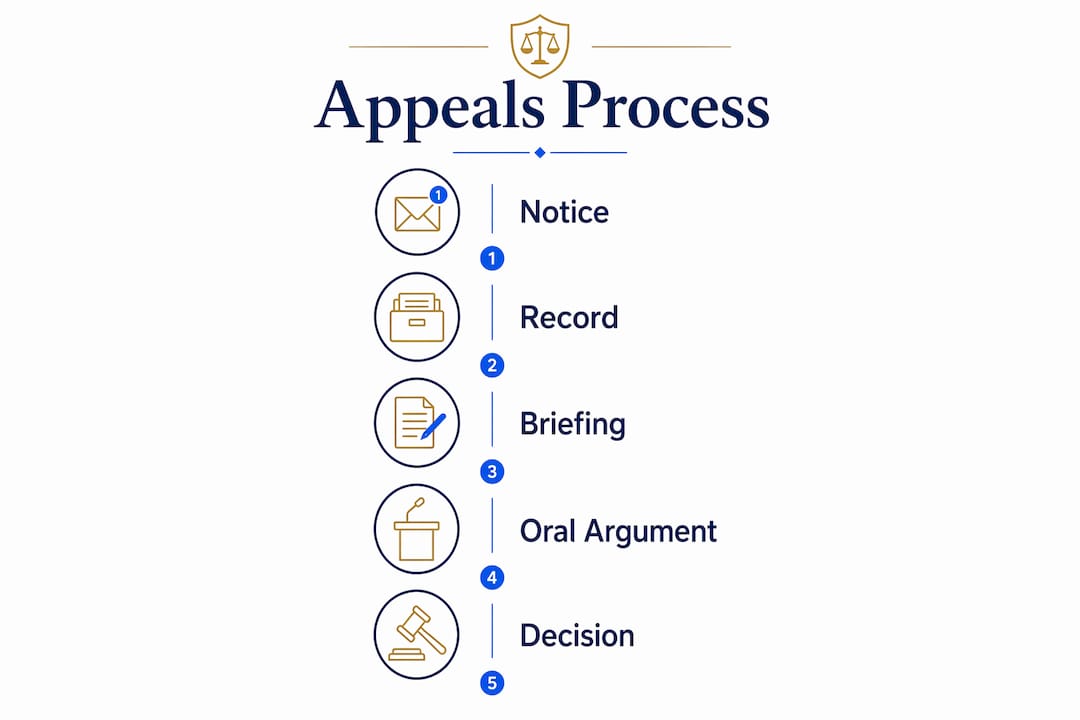
The Georgia appellate process follows a structured sequence after a trial court issues its final judgment. Here is how the process unfolds:
- File the notice of appeal. This document formally notifies the trial court and the opposing party that you are appealing. Missing this deadline can result in automatic dismissal of your appeal.
- Compile the trial record. The appellate court reviews only the record from the trial court. No new witnesses testify and no new evidence is introduced.
- Submit the appellate brief. This written argument explains the legal errors you are challenging. Georgia Court of Appeals Rule 24 limits main briefs to 8,400 words and reply briefs to 4,200 words, with strict formatting requirements including one-inch margins and page numbering.
- Respond to the opposing brief. The other party files their own brief defending the trial court’s decision.
- Oral argument (if granted). The court may allow attorneys to present short oral arguments, though many appeals are decided on the written briefs alone.
- Receive the written decision. The appellate court issues a written opinion explaining its ruling.
An appellate brief must include a statement of jurisdiction, an enumeration of errors, a statement of the case facts, and legal arguments supported by citations. Errors that are inadequately supported in the brief may be deemed abandoned by the court. That means a poorly written brief can cost you an otherwise valid argument.
| Stage | What happens |
|---|---|
| Notice of appeal | Filed in trial court; triggers appellate jurisdiction |
| Record preparation | Trial transcripts and exhibits sent to appellate court |
| Briefing | Both parties submit written legal arguments |
| Oral argument | Optional; court may or may not grant it |
| Decision | Court affirms, reverses, or remands the case |

Pro Tip: Hire an attorney who specializes in appellate work as early as possible. Appellate briefs require a different skill set than trial advocacy, and the word limits under Georgia Court of Appeals Rule 24 demand precise, focused writing.
What impact do appeals have on the timeline and outcome of Georgia injury cases?
Appeals extend case timelines significantly. A Georgia personal injury case that reaches the appellate stage can take an additional one to three years before a final resolution. That delay affects your ability to collect any damages awarded at trial, since enforcement of a judgment is typically stayed while an appeal is pending.
The Georgia Court of Appeals reviews decisions for legal or procedural errors but does not conduct new trials or hear new evidence. This means the appellate court rarely disturbs factual findings made by a jury. The bar for reversal is high, and most appeals do not result in a changed outcome.
“The appellate court’s role is to ensure consistency and correct application of law rather than retry the case, emphasizing legal standards over factual assessments. Parties who expect a second chance to argue the facts are almost always disappointed by the appellate process.”
Strategic considerations for injury claimants and defendants include:
- For plaintiffs: An appeal may make sense if the trial court excluded critical evidence that would have significantly increased your damages award.
- For defendants: An appeal may be worth pursuing if the damages verdict was based on a flawed legal instruction that inflated the award.
- For both parties: Weigh the cost of appellate litigation against the realistic probability of reversal before committing to an appeal.
Understanding how compensation types work in Georgia injury cases helps you evaluate whether the potential gain from an appeal justifies the added time and expense.
What are the key standards of review applied in Georgia injury case appeals?
The standard of review is the single most important factor in predicting whether an appeal will succeed. Appellate success depends heavily on which standard applies to each issue, because some standards give the trial court enormous deference while others allow the appellate court to decide independently.
| Standard of review | What it means | Example issues |
|---|---|---|
| De novo | Court decides independently, no deference to trial court | Questions of law, statutory interpretation |
| Abuse of discretion | Reversal only if trial court acted unreasonably | Evidentiary rulings, case management decisions |
| Clearly erroneous | Factual findings stand unless plainly wrong | Bench trial fact findings |
The “abuse of discretion” standard is the most common and the hardest to overcome. Under this standard, the appellate court will not reverse simply because it might have ruled differently. The trial court’s decision must have been clearly unreasonable or arbitrary. By contrast, pure legal questions receive de novo review, meaning the appellate court applies no deference and decides the issue fresh.
Framing your appellate arguments under the most favorable standard of review is a core skill of experienced appellate counsel. An argument framed as a legal question receives de novo review and stands a better chance of reversal than the same argument framed as a discretionary ruling. This is why evidence strategy and legal framing matter from the very first day of trial, not just at the appellate stage.
How should plaintiffs and defendants prepare for appeals in Georgia injury cases?
Preparation for a Georgia injury appeal begins at trial, not after the verdict. The decisions made during trial directly determine what arguments are available on appeal. Waiting until after a verdict to think about appellate strategy is one of the most common and costly mistakes parties make.
Key preparation steps include:
- Preserve every issue at trial. Object on the record to any ruling you believe is incorrect. An unpreserved error is almost impossible to raise on appeal.
- Retain the full trial record. Transcripts, exhibits, and all filed documents form the exclusive record the appellate court will review.
- Meet every deadline without exception. Filing deadlines for notices of appeal and briefs are strictly enforced. Missing a deadline can result in dismissal of the entire appeal.
- Consult an appellate specialist early. Trial attorneys and appellate attorneys have different strengths. Bringing in appellate counsel before or during trial can improve issue preservation and brief quality.
- Set realistic expectations. Most appeals affirm the trial court’s decision. Appellate relief is the exception, not the rule.
Pro Tip: Ask your trial attorney to identify potential appellate issues before the verdict. Proactive identification of legal errors during trial gives you a stronger record and more options if you need to appeal.
Key Takeaways
Appeals in Georgia injury cases correct legal errors in the trial record, not factual disputes, and the applicable standard of review determines whether reversal is realistic.
| Point | Details |
|---|---|
| Valid grounds required | Appeals must show reversible legal errors, not just disagreement with the verdict. |
| Issue preservation is critical | Objections must be raised at trial or the issue cannot be appealed later. |
| Strict procedural rules apply | Georgia Court of Appeals Rule 24 limits briefs to 8,400 words with strict formatting. |
| Standards of review shape outcomes | De novo review favors appellants; abuse of discretion makes reversal much harder. |
| Appeals extend timelines | Appellate proceedings typically add one to three years before final resolution. |
What I’ve learned about appeals that most injury clients never hear
Most people who contact me after a trial loss believe an appeal is essentially a do-over. It is not. The appellate court will not listen to new witnesses, reconsider the credibility of the ones who testified, or decide whether the jury made the right call on the facts. That misconception causes real harm because it leads people to invest time and money in an appeal that was never going to succeed.
What I have seen work is the opposite approach: treating the appeal as a precision legal argument, not an emotional retry. The cases where appellate courts actually reverse trial court decisions almost always involve a clear, documented legal error that was properly preserved at trial. The attorney who spotted that error during trial and objected on the record gave the client a real appellate argument. The attorney who stayed quiet hoping the jury would fix it left the client with nothing to work with.
The other thing I want injury clients to understand is that the standard of review is not a technicality. It is the entire ballgame. If your issue is reviewed under the abuse of discretion standard, you are fighting uphill. If it is a pure legal question reviewed de novo, you have a real shot. Knowing the difference before you file changes everything about how you frame your brief and whether you file at all.
Clients going through this process deserve honest counsel about their odds. The personal injury law guide for South Atlanta victims covers the broader litigation picture, but on appeals specifically, my advice is simple: get an appellate specialist involved early, preserve your issues at trial, and go in with clear eyes about what the process can realistically deliver.
— Ali
Trusted legal guidance for your Georgia injury appeal
Navigating a Georgia personal injury appeal requires precise legal knowledge and strict attention to procedure. One missed deadline or a poorly framed argument can end an otherwise valid appeal before it begins.

Jewkesfirm represents injury victims across South Atlanta and surrounding Georgia counties, with experience handling the full lifecycle of personal injury cases from initial claim through appellate review. If you believe a legal error affected your trial outcome, or if you are facing an appeal filed by the other side, Jewkesfirm offers a FREE CONSULTATION to evaluate your options. Visit Jewkesfirm’s personal injury practice to connect with a dedicated attorney who will fiercely protect your rights and help you understand exactly where you stand.
FAQ
What is the role of appeals in Georgia injury cases?
Appeals allow parties to ask the Georgia Court of Appeals to review a trial court’s decision for legal or procedural errors. The court does not retry the case or hear new evidence.
How long does a Georgia personal injury appeal take?
A Georgia injury appeal typically adds one to three years to a case timeline. The process involves briefing, record review, and a written decision from the appellate court.
What grounds are needed to appeal a personal injury verdict in Georgia?
You must show a reversible legal error, such as an improper jury instruction or a wrongful evidentiary ruling. Disagreement with the jury’s factual findings is not a valid ground for appeal.
What happens if the Georgia Court of Appeals grants an appeal?
The court can affirm, reverse, or remand the case. A remand sends the case back to the trial court for further proceedings consistent with the appellate court’s ruling.
Can a defendant appeal a personal injury verdict in Georgia?
Yes. Both plaintiffs and defendants have the right to appeal under Georgia law. Defendants often appeal when they believe the damages award was based on a flawed legal instruction or an improper evidentiary ruling.