

Key Takeaways
- Medical reports are essential evidence in Georgia injury claims because they connect injuries directly to accidents with professional authority.
- Ensuring comprehensive, accurate records from treatment, imaging, and physician summaries enhances claim value and prevents insurance disputes.
Medical reports are not background paperwork. In Georgia personal injury cases, they are often the single most powerful piece of evidence you have. Yet most accident victims treat them as an afterthought, not realizing that a vague diagnosis, a missed follow-up appointment, or an incomplete record can shrink or destroy a claim that should have been worth far more. If you were injured in South Atlanta or the surrounding Georgia counties, understanding exactly how medical documentation works in your favor, and how gaps can work against you, could be the difference between real financial recovery and walking away with almost nothing.
Table of Contents
- Why medical reports are the backbone of your injury claim
- How Georgia law shapes access and use of medical reports
- Common mistakes and pitfalls with medical documentation
- Building a stronger case: Making medical reports work for you
- A Georgia lawyer’s perspective: What most claimants and even lawyers miss
- How we help injury victims in South Atlanta and beyond
- Frequently asked questions
Key Takeaways
| Point | Details |
|---|---|
| Medical reports are critical | Accurate, detailed medical documentation is essential for maximizing compensation in Georgia injury claims. |
| Georgia law supports access | Georgia regulations give you the right to timely copies of your records for claim support. |
| Clarity beats volume | Clear and consistent reports carry more weight than large, confusing files. |
| Avoid common pitfalls | Missed details or ambiguous language can delay or damage your legal claim. |
| Expert guidance helps | An experienced lawyer can help you request, review, and use medical reports for the best outcome. |
Why medical reports are the backbone of your injury claim
When an insurance adjuster opens your claim file, the first thing they reach for is your medical documentation. Not your photos. Not witness statements. Your medical records. This is true whether you were hurt in a car crash on I-285, a slip and fall at a Fulton County store, or a trucking collision on I-75 south of the city.
Medical reports do something no other evidence can do: they connect your injury to the accident with documented, professional authority. A doctor’s diagnosis, treatment plan, and follow-up notes create an objective timeline that insurers, opposing attorneys, and jurors can all evaluate. Without that documentation, your claim is a story. With it, your claim becomes a provable case.
“Medical records are also central to requests for and preparation of medical opinions used in claims evaluation; however, an edge case is that ambiguity in IME documentation can create delays and clarifications rather than straightforward decision-making.”
This matters because making or breaking your claim often comes down to the quality, not just the quantity, of your medical evidence. Insurance companies are skilled at finding gaps. They look for inconsistencies between what you reported to the ER and what you told your follow-up physician. They flag long gaps in treatment as signs that your injuries were not serious. Every ambiguity becomes a negotiation point they use against you.
Here is a comparison of strong versus weak medical documentation and how each affects your claim:
| Documentation type | Strong example | Weak example | Impact on claim |
|---|---|---|---|
| ER visit records | Detailed injury description, imaging results | Vague “pain” notation, no imaging | Adjusters reduce injury severity rating |
| Diagnosis notes | Specific diagnosis with ICD codes | General “musculoskeletal injury” | Harder to prove severity or causation |
| Follow-up records | Regular appointments, updated progress notes | Missed appointments, no follow-up | Suggests injuries resolved quickly |
| Treatment plan | Documented physical therapy, specialist referrals | No plan stated | Limits projected future damages |
| Physician summary | Written opinion connecting accident to injury | No summary letter | Causation becomes disputed |
The types of records that matter most include:
- Emergency room visit reports and triage notes
- Initial diagnosis records and imaging (X-rays, MRIs, CT scans)
- Follow-up treatment notes with your primary care or specialist
- Physical therapy session logs
- Prescription records related to your injuries
- Any independent medical examination (IME) reports
Understanding the full personal injury claim process helps you see why gathering all of these records from the very start is so important.
How Georgia law shapes access and use of medical reports
Georgia law gives you strong rights when it comes to your own medical records. Under O.C.G.A. § 31-33-2, you are entitled to copies of your complete medical records. This applies to hospital records, physician notes, imaging results, lab reports, and specialist evaluations. The law is clear: your records belong to you, and you have the right to obtain them.
Georgia’s HIPAA-aligned processes govern exactly how claimants must request medical records, including imaging and visit notes that directly support your claim file. The process is not complicated, but there are steps you must follow carefully to avoid delays.
Here is how to request your medical records in Georgia:
- Identify every provider who treated you for injuries related to the accident, including urgent care centers, hospitals, specialists, and physical therapists.
- Submit a written request to each provider’s medical records department. Many have their own forms, but a signed, dated letter will also work.
- Complete a HIPAA authorization form if required by the provider. This gives them legal permission to release your records.
- Specify exactly what you need: all records from a specific date range, imaging studies, physician notes, billing records, and any written reports.
- Request records in a usable format: both paper and digital copies are acceptable under Georgia law. Digital records can make it easier for your attorney to review them.
- Follow up if you do not receive records within 30 days. Providers are legally required to respond within that window.
Here is a quick reference summary of key Georgia record access provisions:
| Provision | Details |
|---|---|
| Legal authority | O.C.G.A. § 31-33-2 |
| Response deadline | 30 days from written request |
| Authorization required | HIPAA form or signed written request |
| Allowable fees | Reasonable copying fees permitted |
| Types covered | All medical records including imaging, notes, billing |
Pro Tip: Once you receive your records, review every page for accuracy. Check that dates match your appointments, that your injury descriptions are consistent, and that no pages are missing. Errors or missing pages caught early can be corrected before they cause problems during the claims process.
If you are thinking about filing an injury lawsuit, having complete, accurate records ready before you file gives your attorney a significant advantage. Our guide to Georgia injury law walks through each step of the process for South Atlanta area victims.

Common mistakes and pitfalls with medical documentation
Even victims who did everything right at the scene of an accident often make critical errors with their medical records afterward. These mistakes do not just weaken a claim. They can make a valid injury case nearly impossible to win.
The most damaging mistakes include:
- Delaying medical treatment. Waiting days or weeks after an accident tells insurers your injuries were not serious. Seek treatment immediately, even if you feel fine at first.
- Missing follow-up appointments. Each missed appointment is a data point insurers use to argue you recovered faster than you claim.
- Giving inconsistent injury descriptions. If you told the ER your neck was sore but told your follow-up physician your back was the main problem, that inconsistency will be challenged.
- Failing to mention all symptoms. Patients often minimize pain or forget to report certain symptoms. Every injury and symptom should be clearly reported and documented.
- Not requesting IME reports. If the insurance company orders an independent medical examination, you have a right to that report. Do not ignore it.
- Assuming your records are complete. Providers make administrative mistakes. Pages go missing. Records get misfiled. Always verify completeness.
One nuance that surprises many claimants: not every causation question requires formal expert testimony in Georgia. Whether your treating physician needs to testify as a formal expert witness depends on whether the medical question goes beyond what a reasonable juror could understand on their own. For straightforward injuries, a clear treating physician report may be all you need. For complex cases involving disputed causation, a formal expert witness opinion becomes essential.
The evidence issues that affect claims in Georgia are well-documented. Research into IME documentation shows that narrative ambiguity in these reports regularly causes delays in the claims review process, forcing clarifications that slow down resolution and give insurers additional leverage during negotiations.
Pro Tip: Ask your doctor to use specific, concrete language when documenting your injuries. Phrases like “patient reports moderate to severe neck pain rated 7/10” are more useful than “patient in discomfort.” This level of detail protects your claim.
You can find specific local claim examples showing how documentation errors affected outcomes for South Atlanta area claimants.
Building a stronger case: Making medical reports work for you
Now that you know what can go wrong, here is how to actively use your medical records to build the strongest possible claim.
“The value of medical records depends on clarity and consistency. Gaps or reliance on narrative ambiguity can weaken evaluation or force clarifications that delay resolution and reduce claim value.”
— Georgia injury case analysis
This is exactly right, and it points to a proactive strategy every injured person in Georgia should follow.
- Attend every scheduled appointment. Consistent treatment creates a consistent record. Courts and adjusters look favorably on patients who follow their doctor’s advice without interruption.
- Describe your pain at every visit. Do not downplay symptoms because you feel slightly better on a good day. Report exactly how you feel, including your worst days.
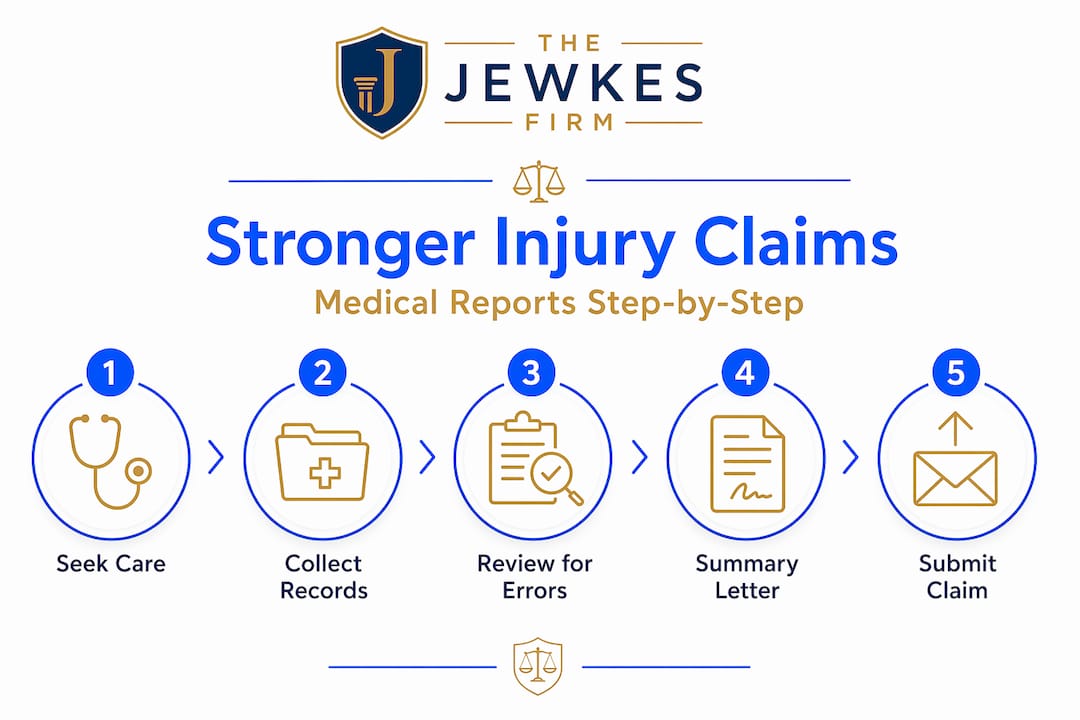
- Ask your treating physician for a written summary opinion. This is a letter or report where your doctor explicitly states the nature of your injuries, the treatment provided, and their professional opinion that the accident caused your condition.
- Correct errors immediately. If you spot a wrong date, a missing diagnosis, or an inaccurate description in your records, contact the provider right away and request a formal correction or addendum.
- Share all records with your attorney early. The sooner your legal team reviews your documentation, the sooner they can identify gaps and advise on how to fill them before they become a problem.
- Keep your own personal injury journal. Document how your injuries affect your daily life. While not a formal medical record, these notes provide context and corroborate your doctor’s findings.
Working with an attorney to maximize your claim means having someone in your corner who knows exactly which medical records an adjuster will scrutinize and how to present them effectively. Following step-by-step compensation strategies gives you a clear roadmap through what can otherwise feel like an overwhelming process.
Pro Tip: Request that your treating physician write a brief summary opinion letter that directly connects your injuries to the accident. This one document can dramatically clarify causation for adjusters and judges alike, reducing the chance of disputes.
A Georgia lawyer’s perspective: What most claimants and even lawyers miss
Here is a reality that does not get enough attention: more records do not automatically mean a stronger case. We have seen claimants arrive with hundreds of pages of medical documentation that, when examined closely, actually hurt their position. Why? Because volume without clarity creates confusion, and confusion benefits the insurance company, not you.
The most effective medical evidence is targeted. It is a clean narrative that starts at the accident, moves through treatment, and ends with a clear professional opinion about your long-term prognosis. One well-written physician summary can outperform a disorganized stack of records every time.
Another underappreciated point: some causation questions are actually within common knowledge, meaning you may not need to pay for a costly expert witness. A juror does not need a medical expert to understand that a rear-end collision can cause whiplash. Spending thousands on an expert for a case that does not require one is a waste of money that reduces your net recovery.
What really matters is persistence. Providers are busy. Records get delayed or misplaced. Following up consistently with your doctor’s office, making sure all documentation reflects the full scope of your injuries, and working with your attorney to address ambiguities before they become problems. That is where cases are won or lost. Not in the courtroom, but in the detailed preparation that happens long before anyone steps in front of a judge.
We have seen cases in Clayton County, Henry County, and Fayette County where adjusters tried to use a single missed appointment or one vague clinical note to argue a client had fully recovered. Persistent, well-organized medical records turned those arguments around every time. If you are navigating legal steps after an injury, do not underestimate how much the details of your documentation matter.
How we help injury victims in South Atlanta and beyond
Medical documentation challenges are one of the most common reasons personal injury claims stall or get undervalued. Our team at Jewkes Firm understands exactly how to review, organize, and present medical evidence in a way that gives your claim the strongest possible foundation. We know which records Georgia adjusters focus on, how to address ambiguities before they become liabilities, and how to coordinate with your physicians to ensure your documentation tells the complete story of your injuries.
If you are dealing with incomplete records, a denied claim, or simply are not sure whether your medical documentation is strong enough to support what you deserve, we are here to help. The South Atlanta injury legal team at Jewkes Firm offers FREE CONSULTATIONS with no obligation and no upfront cost. You pay nothing unless we win your case. Call us today and let us review your situation, so you can focus on your recovery while we focus on fighting for maximum compensation.
Frequently asked questions
What records do I need for a Georgia injury claim?
You need ER reports, diagnoses, follow-up treatment notes, any imaging, and a physician’s summary to support your claim. Georgia law and HIPAA processes guide exactly how to obtain each of these documents from your providers.
How soon must my provider give me my records in Georgia?
By law, providers must supply copies within 30 days after receiving your written request and any applicable fees. Failure to comply with this timeline is a violation of your rights under O.C.G.A. § 31-33-2.
What if my medical report is unclear or incomplete?
You should request a clarification or supplemental report to avoid delays or valuation problems in your claim. Ambiguity in IME documentation is a documented cause of claim delays and reduced settlement offers.
Do I need an expert witness for my Georgia accident case?
Not always. If causation is obvious, your treating doctor’s records may be sufficient, and only complex causation questions require formal expert testimony under Georgia law.
Can a lawyer help if my claim was denied for medical report issues?
Yes, an experienced personal injury attorney can help obtain missing records, request clarifications from providers, and present a stronger, more organized body of medical evidence to challenge a denial or undervalued settlement offer.