

Atlanta bicycle accident liability is defined as the legal responsibility assigned to one or more parties for injuries and damages caused by a bike crash under Georgia law. Fault allocation controls whether you receive compensation and how much. Georgia applies a modified comparative negligence standard under O.C.G.A. § 51-12-33, which means your percentage of fault directly reduces your payout. Understanding bicycle accident liability in Atlanta before you speak to an insurer or sign anything can be the difference between a fair settlement and nothing at all.
What is Atlanta bicycle accident liability and how does Georgia law define it?
Bicycle accident liability in Atlanta is the legal determination of who caused a crash and to what degree. Georgia law requires every road user, including drivers and cyclists, to exercise a reasonable duty of care toward others. When someone breaches that duty and causes an injury, they are legally negligent and may owe damages.

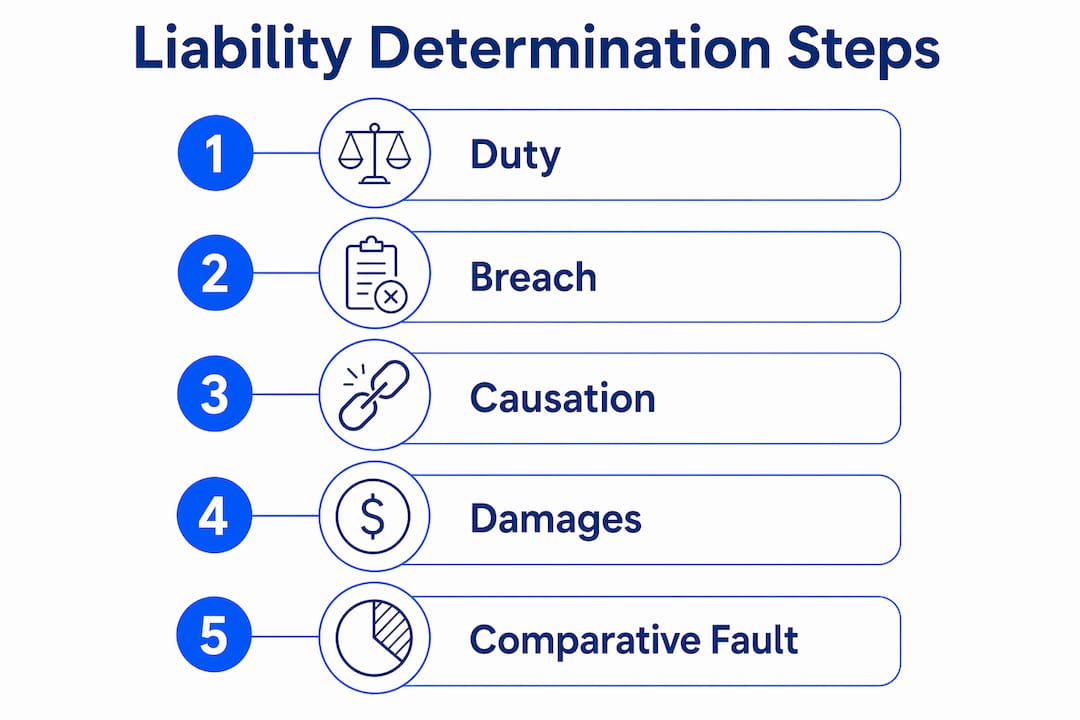
Negligence in a bike accident case rests on four elements: duty, breach, causation, and damages. A driver who runs a red light and hits a cyclist has breached their duty of care. The cyclist’s injuries are the direct result of that breach. All four elements must be present for a valid claim.
Georgia’s modified comparative negligence standard under O.C.G.A. § 51-12-33 allows injured parties to recover damages only if their fault is less than 50%. That single threshold is the most consequential rule in Georgia personal injury law. Damages are reduced proportionally by your fault percentage, but once you reach 50% fault, you recover nothing.
Georgia injury claims cover both economic and non-economic damages. Economic and non-economic damages include medical expenses, lost wages, future care costs, diminished earning capacity, and pain and suffering. In limited cases involving extreme misconduct, punitive damages are also available.
How is fault determined in Atlanta bicycle accidents?
Fault is determined by examining evidence, applying Georgia’s duty of care standard, and weighing each party’s contribution to the crash. No single piece of evidence controls the outcome. Investigators, insurers, and courts look at the full picture.
Key evidence types that shape fault decisions
- Police reports: Officers document the scene, note traffic violations, and sometimes assign preliminary fault. Reports carry weight with insurers but are not the final word on civil liability.
- Witness statements: Independent witnesses who saw the crash provide some of the most credible evidence in a claim. Their accounts can confirm or contradict each driver’s version of events.
- Traffic citations: A citation issued at the scene signals a rule violation. However, traffic citations are criminal charges and do not directly determine fault in a civil injury claim. A guilty plea to a traffic violation can be used as an admission against interest, but the absence of a ticket does not bar your claim.
- Photos and video: Dashcam footage, surveillance cameras, and photos taken at the scene often provide the clearest account of what happened.
- Physical evidence: Skid marks, bicycle damage, and road conditions all help reconstruct the sequence of events.
Georgia’s modified comparative negligence system means fault is rarely assigned 100% to one party. Insurers and attorneys negotiate percentages, and those percentages determine your final compensation.
Pro Tip: Request a copy of the police report within 72 hours of the crash. Errors in early reports are common, and correcting them quickly protects your claim.
The distinction between criminal traffic citations and civil liability matters more than most cyclists realize. A driver can receive no ticket at the scene and still be found fully liable in a civil claim. Conversely, a citation issued to a driver does not guarantee you will win your case. Civil liability is its own separate standard, built on evidence and legal argument.
What does it mean to be partially at fault in a bicycle accident in Atlanta?
Partial fault means both parties contributed to the crash, and your compensation is reduced by your share of responsibility. Georgia’s 50% fault threshold is the single most important factor in injury litigation. A shift of just 1% from 49% to 50% fault eliminates your right to any compensation.
Here is how partial fault plays out in practice:
- Fault percentages are assigned. After reviewing evidence, the insurer or court assigns a fault percentage to each party. If you are found 20% at fault and the driver is 80% at fault, your damages are reduced by 20%.
- Damages are calculated. If your total damages equal $100,000 and you are 20% at fault, you recover $80,000.
- The 50% cutoff is applied. If your fault reaches 50% or more, you receive nothing, regardless of how severe your injuries are.
- Adjusters negotiate percentages. Insurance adjusters are trained to inflate cyclist fault percentages during negotiations, often using minor rule infractions as leverage to push your share toward or past the 50% mark.
- Defense attorneys focus on the threshold. Defense counsel specifically targets the 50% line. Crossing it ends your claim entirely.
A common scenario: a cyclist is hit by a driver who ran a stop sign, but the cyclist was also riding slightly outside the designated bike lane. The driver’s insurer argues the cyclist’s lane position contributed to the crash and assigns 35% fault to the cyclist. That reduces a $50,000 claim to $32,500. If the insurer pushes that number to 50%, the cyclist walks away with nothing.
Understanding Georgia’s fault allocation rules before you negotiate with an insurer gives you a real advantage. Knowing the 50% threshold exists means you can push back when an adjuster inflates your share without justification.
What legal options do Atlanta cyclists have after a bicycle accident?
Injured cyclists in Atlanta have the right to file a personal injury claim against any at-fault party. Acting quickly and methodically protects that right.
Steps to protect your claim after a crash
- Document everything immediately. Photograph the scene, your injuries, the vehicles involved, and any road conditions that contributed to the crash. Time-stamped photos are harder to dispute.
- Request a traffic citation. Requesting a citation at the scene can assist insurance negotiations, even though it does not change the civil liability standard. Clearly state your version of events to the responding officer.
- Seek medical attention the same day. Delayed treatment gives insurers grounds to argue your injuries were not caused by the crash.
- Preserve all records. Keep every medical bill, prescription receipt, and communication with insurers in one place. A post-accident documentation checklist helps you stay organized from day one.
- File your claim before the deadline. The statute of limitations for personal injury claims in Georgia is 2 years from the date of injury. Filing a claim does not toll that deadline. If you miss the two-year window, you lose the right to sue.
- Consult a personal injury attorney early. An attorney who handles bicycle accident claims in Atlanta can assess your fault exposure, identify all liable parties, and negotiate with insurers on your behalf.
Pro Tip: Never give a recorded statement to the at-fault driver’s insurer without speaking to an attorney first. Adjusters use recorded statements to lock in details that can later be used to inflate your fault percentage.
The two-year deadline feels distant right after a crash, but building a strong claim takes time. Medical records, expert opinions, and witness statements all require coordination. Starting early gives your attorney room to build the strongest possible case.
How does evidence impact liability and settlement outcomes in Atlanta bicycle accident claims?
Strong evidence is the foundation of every successful bicycle accident claim. The quality and variety of your evidence directly shapes how fault is assigned and what settlement you receive.
Types of evidence and their weight in civil claims
- Photos and video: Scene photos and dashcam or surveillance footage provide objective records that are difficult to dispute. Capture road conditions, traffic signals, skid marks, and vehicle positions.
- Witness accounts: Independent witnesses carry significant credibility. Collect names and contact information at the scene before anyone leaves.
- Police reports: Reports document the officer’s observations and any citations issued. They assist insurers but do not control civil outcomes.
- Medical records: Detailed medical documentation connects your injuries directly to the crash. Gaps in treatment weaken this connection.
- Admissions against interest: If the at-fault driver makes statements at the scene acknowledging fault, those statements are admissible in civil proceedings. Admissions against interest can significantly strengthen your liability argument.
The table below shows how different evidence types compare in terms of their typical influence on civil liability decisions:
| Evidence type | Influence on civil liability |
|---|---|
| Dashcam or surveillance video | Very high. Objective and difficult to dispute. |
| Independent witness statements | High. Credible third-party accounts carry weight. |
| Police report | Moderate. Useful but not controlling in civil claims. |
| Traffic citation | Limited. Signals a violation but does not determine civil fault. |
| Medical records | High. Directly links injuries to the crash event. |
Independent evidence such as photos, videos, and witness statements often outweighs police citations in proving negligence in civil cases. A cyclist with strong independent evidence can win a claim even when no ticket was issued at the scene. The reverse is also true: a citation alone rarely wins a case without supporting documentation.
Key Takeaways
Atlanta bicycle accident liability turns on Georgia’s 50% modified comparative negligence threshold, making fault allocation the most critical factor in every claim.
| Point | Details |
|---|---|
| Georgia’s 50% fault rule | You recover nothing if your fault reaches 50% or more under O.C.G.A. § 51-12-33. |
| Citations vs. civil liability | Traffic tickets signal violations but do not determine civil fault outcomes. |
| Independent evidence wins claims | Photos, video, and witness statements carry more weight than police reports alone. |
| Two-year filing deadline | Georgia’s statute of limitations is 2 years from injury; missing it ends your right to sue. |
| Adjusters inflate fault percentages | Insurers strategically push cyclist fault toward 50% to deny or reduce claims. |
Why the 50% threshold changes everything about how you handle your claim
Most cyclists I speak with after a crash focus on who was “obviously” at fault. They assume the driver who hit them will be held responsible, and they expect the insurance process to reflect that. That assumption is the most dangerous one you can make after a bicycle accident in Atlanta.
Georgia’s 50% fault threshold means the entire negotiation is a numbers game. An insurer does not need to prove you caused the crash. They only need to push your fault percentage to 50%. A minor infraction, like riding slightly outside a bike lane or not wearing a helmet, becomes a tool to inflate your share of blame. I have seen cases where a cyclist was clearly struck by a distracted driver, but a recorded statement made early in the process gave the insurer enough material to argue 50% fault. The claim was denied.
The practical lesson is this: protect your fault percentage the same way you protect your injuries. Document everything, say nothing to opposing insurers without counsel, and understand that every detail you share can be used to shift that percentage. Consulting an attorney early is not about being litigious. It levels the playing field against adjusters who negotiate these cases every day. You deserve the same expertise on your side.
— Ali
Jewkesfirm is ready to protect your rights after an Atlanta bicycle accident
If you were injured in a bicycle crash in Atlanta or the surrounding Georgia counties, Jewkesfirm is here to help you understand your rights and pursue the compensation you deserve.

Jewkesfirm handles bicycle accident claims across South Atlanta and surrounding counties, with a track record of recovering millions for injured clients. The firm works on a contingency fee basis, meaning you pay nothing unless they win your case. A free consultation costs you nothing and gives you a clear picture of your legal options before you make any decisions. Contact Jewkesfirm today for your FREE CASE REVIEW and make sure your voice is heard.
FAQ
What is bicycle accident liability in Atlanta?
Bicycle accident liability in Atlanta is the legal determination of who is responsible for injuries and damages after a bike crash, governed by Georgia’s modified comparative negligence standard under O.C.G.A. § 51-12-33.
Who is liable for bike accidents in Georgia?
Any party whose negligence contributed to the crash can be held liable, including drivers, government entities responsible for road conditions, or other cyclists. Fault is assigned as a percentage to each party.
What happens if I am partially at fault for my Atlanta bicycle accident?
Your compensation is reduced by your fault percentage. If your fault reaches 50% or more, Georgia law bars you from recovering any damages at all.
How long do I have to file a bicycle accident claim in Georgia?
Georgia’s statute of limitations for personal injury claims is 2 years from the date of injury. Missing this deadline eliminates your right to sue for damages.
Do traffic citations prove fault in a Georgia bicycle accident claim?
Traffic citations signal a rule violation but do not determine civil liability. Independent evidence like photos, video, and witness statements carries more weight in civil proceedings.