

If you suspect evidence tied to your accident could be altered, lost, or destroyed, send a preservation letter now. A spoliation letter formally notifies the other side to stop deleting or discarding relevant evidence. Georgia law can impose this duty before you ever file suit, so waiting risks losing proof you need. Suspend any deletion policies on your end and contact an attorney immediately.
TL;DR:
- Sending a preservation letter early is crucial because Georgia law broadens the duty to preserve evidence once litigation becomes reasonably foreseeable, not just after filing.
- Courts can impose sanctions such as unfavorable presumptions, jury instructions, or dismissals if evidence is lost through bad faith or negligence, with the harshest penalties reserved for bad-faith destruction.
- Digital evidence like emails, GPS data, and cloud accounts must be preserved immediately by suspending auto-deletion, while physical evidence should be documented and stored securely before any handling.
- Constructive notice triggers preservation obligations even before formal legal action if a serious incident prompts internal reviews, incident reports, or safety logs.
- Experienced attorneys recommend sending specific, timely preservation letters via certified mail and maintaining proof of delivery to strengthen your case and reduce disputes over evidence preservation.
Table of Contents
- What Does Spoliation Mean Under Georgia Law?
- When Should You Send a Preservation Letter in Georgia?
- What Should a Georgia Spoliation Letter Include?
- How Do You Preserve ESI and Physical Evidence After an Accident?
- What Sanctions Can a Georgia Court Impose for Spoliation?
- What Should You Do If Evidence Has Already Been Destroyed?
- What Do Georgia Attorneys See Go Wrong With Preservation?
- How Jewkesfirm Helps Protect Your Evidence in Georgia
- Sources
What Does Spoliation Mean Under Georgia Law?
Spoliation happens when a party destroys, alters, or fails to preserve evidence relevant to a claim. Georgia’s rules on this are more demanding than many expect, and Georgia Supreme Court decisions define how the duty works.
O.C.G.A. § 24-14-22 allows courts to presume that missing evidence would have hurt the party who lost it. That presumption is rebuttable, meaning the other side can try to explain the loss, but the burden shifts against them once you show evidence disappeared under their control.
Phillips v. Harmon changed the timing question. The Georgia Supreme Court significantly broadened the duty to preserve, ruling that the obligation kicks in once litigation becomes reasonably foreseeable, not just after a lawsuit is filed. That single holding is why sending a letter early matters so much in Georgia.
Cooper Tire & Rubber Co. applies that same foreseeability standard to plaintiffs and defendants alike, but the court emphasized trial-level discretion in deciding whether the duty actually arose. Judges weigh several factors when deciding constructive notice:
- The severity of the injury or incident
- Whether an internal investigation or incident report was opened
- Prior communication from an insurer, employer, or counsel
- Industry practice around retaining similar records
When Should You Send a Preservation Letter in Georgia?
Notice comes in two forms, and the distinction decides how strong your position is later. Actual notice is unambiguous: a filed lawsuit, a demand letter, or direct contact from an attorney. Constructive notice is murkier and depends on foreseeability factors courts developed after Phillips v. Harmon.
Constructive notice tends to attach quickly in a few recurring scenarios:
- A hospital opens an internal review after a serious injury
- An employer files an incident report following a workplace accident
- An insurance adjuster contacts a claimant within days of a crash
- A trucking company’s safety department logs a collision internally
Each of those triggers can start the clock even before anyone hires a lawyer. Sending your letter early, rather than waiting for a formal claim, sharply reduces the odds of a later fight over whether the other side even had a duty to preserve. Recent Georgia practice commentary reinforces this: send the letter broadly and early, and sort out relevance later.
What Should a Georgia Spoliation Letter Include?
A preservation letter works only if it’s specific enough that the recipient can’t claim confusion later. Vague language gives the other side an easy defense.
- Incident details. Date, location, parties involved, and a brief factual summary.
- Exact items and systems to preserve. Name devices, vehicles, servers, or accounts rather than describing them generally.
- Explicit instruction to suspend automatic deletion. Call out auto-purge policies, recycling schedules, and routine IT maintenance by name.
- A request for written confirmation that preservation steps have been taken.
- Contact information for the recipient’s counsel or claims representative.
- Delivery method and proof of receipt, so you can show the letter actually arrived.
Adapt the tone depending on the recipient. A trucking company needs specific instructions about telematics and driver logs. An individual defendant might just need plain language about a phone or a vehicle. A vendor or insurer often needs named custodians and date ranges to avoid arguing the request was overbroad.
Send the letter by certified mail with a return receipt, and follow up by email so there’s a timestamped digital trail too. When both sides already have attorneys, counsel-to-counsel delivery with a read confirmation works well.

Pro Tip: Keep a copy of every delivery confirmation in its own file. If the case ever reaches a spoliation motion, proof that the letter arrived on a specific date is often more persuasive than the letter’s content.
How Do You Preserve ESI and Physical Evidence After an Accident?
Electronic evidence disappears faster than physical evidence, often within days if nobody intervenes. Georgia practice guidance repeatedly flags this as the single biggest source of avoidable spoliation problems.
Handle digital evidence first:
- Suspend auto-deletion settings on phones, dash cams, and cloud accounts immediately
- Request telematics, GPS, and event data recorder downloads from any commercial vehicle involved
- Preserve email and text threads without editing or forwarding them, which can alter metadata
- Ask for server or device images when a company or institution controls the source
Physical evidence needs different handling. Photograph items exactly where they are before anyone moves them. Store damaged parts, clothing, or defective products somewhere secure, and avoid repairs or cleaning that could erase evidence of the failure. Document who handled each item and when, since chain-of-custody gaps give opposing counsel an opening.
When requesting preservation from a third party like an employer or insurer, name specific custodians and date ranges rather than asking generally for “relevant records.” Vague requests invite an argument that the request was speculative, which weakens your position if the evidence later goes missing anyway.
What Sanctions Can a Georgia Court Impose for Spoliation?
Georgia courts have real remedies available, but they don’t hand them out casually. Under O.C.G.A. § 24-14-22, a judge can order:
- A rebuttable presumption that the missing evidence was unfavorable to the party who lost it
- Exclusion of related testimony or exhibits
- An adverse jury instruction telling jurors they may infer the evidence would have hurt that party
- Dismissal or default judgment in the most severe cases
Courts weigh several factors before choosing a remedy: how much prejudice the loss caused, whether that prejudice can be cured another way, whether the destruction looks like bad faith or ordinary negligence, and how important the lost evidence actually was to the case. Georgia commentary consistently cautions that the harshest sanctions are reserved for bad faith; simple negligence usually draws a lighter response. If you’re the one alleging spoliation, document the prejudice specifically and request an evidentiary hearing rather than resting on paper filings alone.
What Should You Do If Evidence Has Already Been Destroyed?
Losing evidence doesn’t end your case, but it changes your strategy immediately. Move fast on what’s left before it disappears too.
- Write down everything you remember about the evidence that’s gone, including who had access to it
- Preserve whatever remains, even partial records or secondary copies
- Gather witness statements and timestamps while memories are still fresh
- Build a simple timeline connecting the incident, the loss, and any notice the other side had
- Send a preservation letter anyway, covering related items that might still exist
- Ask your attorney whether the facts support requesting an evidentiary hearing
Experienced counsel will pick up from there, documenting the chain-of-custody gap, pursuing discovery aimed at how and when the evidence vanished, and building the record needed to argue for sanctions or defend against a spoliation claim if you’re on the other side.
Pro Tip: Write your timeline the same day you notice evidence is missing. Details fade fast, and a same-day account carries more weight with a judge than one written weeks later.
What Do Georgia Attorneys See Go Wrong With Preservation?
The mistakes are almost always about timing. Clients wait to see how a case develops before sending anything, and by the time they call, the dash cam footage has recorded over itself or the phone has been reset. Evidence loss often traces back to inaction, not bad intent, but Georgia courts don’t always care about the difference once the record is gone.
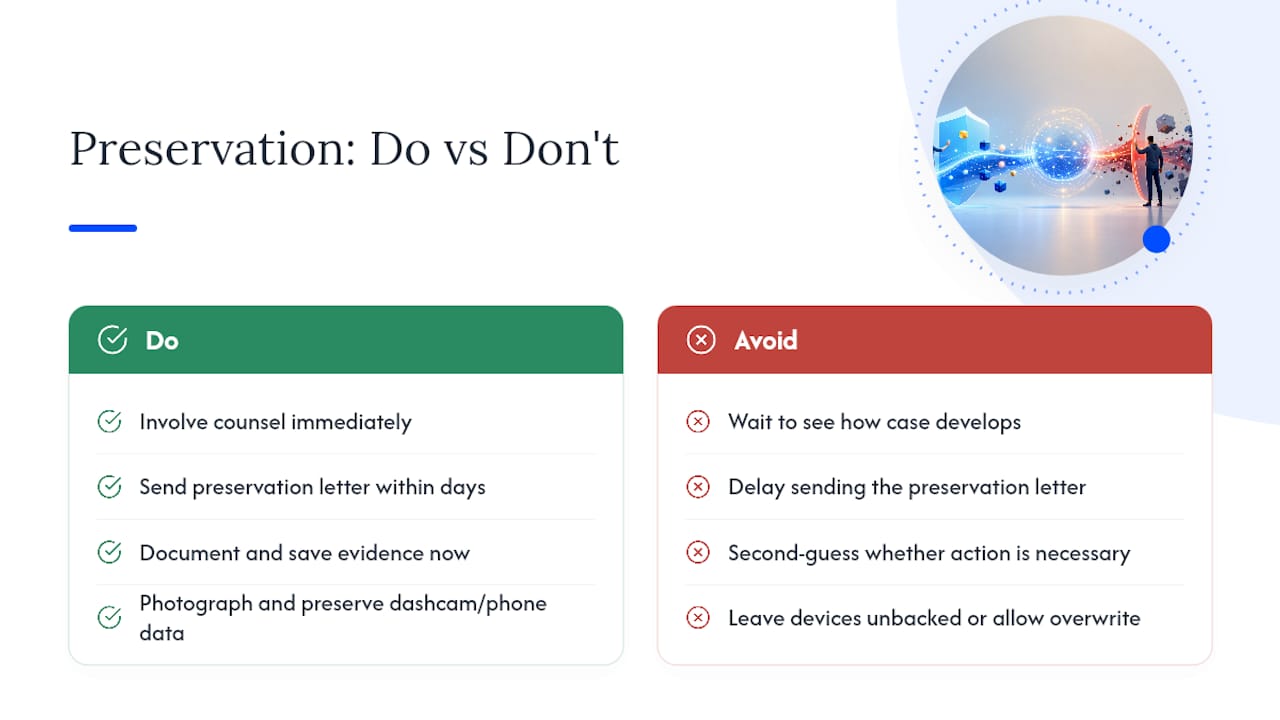
Early counsel involvement changes outcomes more than almost anything else. An attorney who sends a preservation letter within days of an incident, rather than weeks, forces the other side onto the record about what they knew and when. That timestamp becomes leverage if evidence disappears later anyway.
Document everything now to ensure your claim is supported by proper evidence, as explained in Why documenting accident evidence matters for your claim. Photograph it, save it, and get the letter out before you second-guess whether it’s necessary.
— Ali
How Jewkesfirm Helps Protect Your Evidence in Georgia
Jewkesfirm is the direct alternative to guessing your way through a preservation problem alone. We draft and send preservation letters, coordinate ESI collection with vendors and carriers, and handle the litigation strategy that follows when evidence gets contested, all across South Atlanta and the surrounding Georgia counties.

A free consultation gets you a real answer about what to preserve, who to notify, and how fast. We work on contingency, so you pay nothing unless we recover for you. If you’re weighing whether your evidence could make or break your claim, don’t wait for a second opinion to run out the clock on deleted footage or purged records. Reach out through Jewkesfirm today and get a case review started while evidence is still recoverable.
This article is general information, not a substitute for advice from a qualified lawyer. Consult a qualified legal professional about your own circumstances before acting on anything here.
Sources
- Justia — O.C.G.A. § 24-14-22
- National Law Review — Georgia Supreme Court significantly broadens duty to preserve evidence
- Georgia State University Law Review / practice guidance — preserving ESI and metadata