

TL;DR:
- Evidence forms the foundation of wrongful death claims, requiring families to act quickly in preserving crucial documentation.
- Medical records, autopsy reports, eyewitness testimony, expert opinions, and financial documents support legal elements like causation and damages.
Evidence is the foundation of every wrongful death claim. Without it, even the most devastating loss cannot translate into legal accountability. The role of evidence in wrongful death cases is to prove, under the civil standard known as preponderance of the evidence, that the defendant’s negligence more likely than not caused your loved one’s death. That standard requires just over 50% probability, which is a lower bar than criminal court but still demands specific, admissible proof. To succeed, that proof must support four legal elements: duty, breach, causation, and damages. The evidence categories that do this work include medical records, autopsy reports, witness testimony, expert opinions, accident reports, and financial documents.
What are the essential types of evidence in wrongful death claims?
Four critical elements must be proven in every wrongful death case: duty, breach, causation, and damages. Each element requires a different category of evidence, and gaps in any one of them can sink an otherwise strong claim. Understanding what each type of evidence does gives your family a clearer picture of what your attorney is building.
Medical records and autopsy reports are the backbone of causation. Autopsy reports provide detailed forensic data including cause and manner of death, injuries, toxicology results, and the medical examiner’s reconstruction of the sequence of events. This clinical data is objective and difficult for the defense to dismiss outright, though it can be challenged through alternative cause arguments. Medical records from hospitals, treating physicians, and emergency responders fill in the timeline between the incident and death.

Accident and police reports establish the circumstances of the incident. These official documents record the scene, identify parties involved, note any citations or violations, and often include the responding officer’s initial assessment of fault. They directly support the duty and breach elements by showing what the defendant was required to do and where they failed.
Eyewitness statements and surveillance footage provide factual grounding for disputed timelines. Digital and visual evidence like surveillance video, photographs, and recorded footage has become increasingly vital to building objective case narratives. A witness who saw a truck run a red light or a camera that captured a defective product in use can corroborate facts that no document alone can prove.
Expert testimony bridges the gap between raw data and jury understanding. Medical experts, accident reconstruction specialists, and economists translate complex technical findings into clear conclusions that non-specialist jurors can evaluate. Their opinions carry significant weight, particularly on causation and damages.
Financial records prove the economic dimension of your loss. Pay stubs, tax returns, employment contracts, and projections of future earnings document what your family has lost financially. These records support the damages element and directly influence the compensation your family may recover.
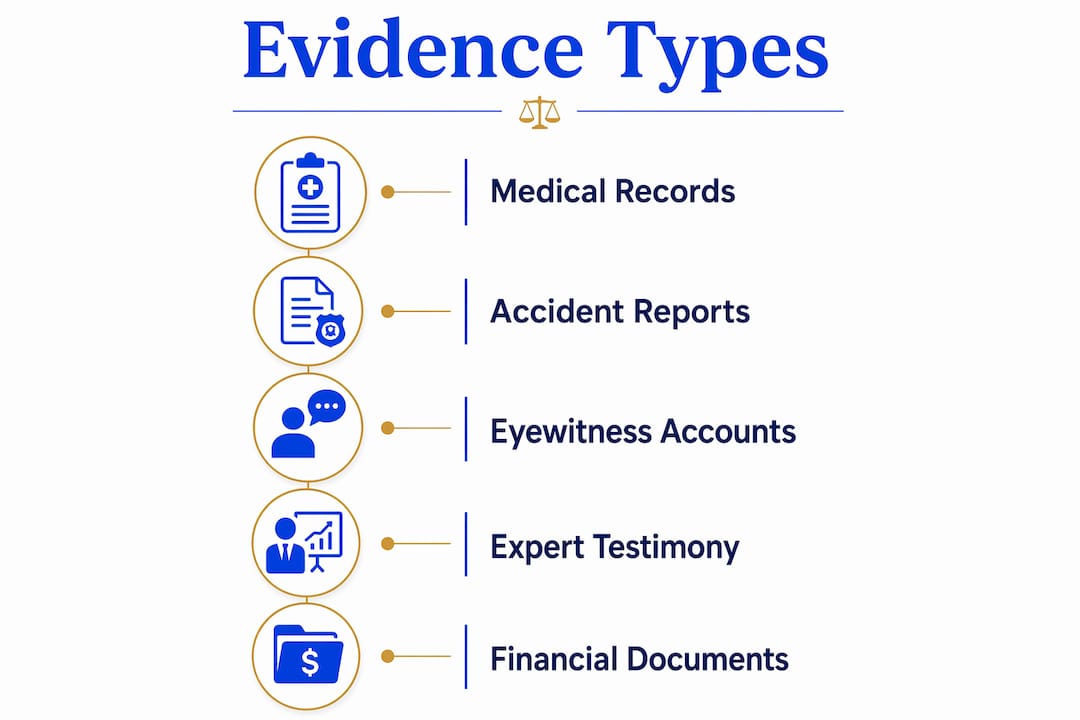
Here is a quick comparison of how each evidence type maps to the legal elements:
| Evidence type | Legal element supported |
|---|---|
| Medical records and autopsy reports | Causation |
| Accident and police reports | Duty and breach |
| Eyewitness statements and surveillance footage | Breach and causation |
| Expert testimony | Causation and damages |
| Financial records | Damages |
How is evidence evaluated and presented in court?
Collecting evidence is only half the work. Getting it admitted and understood by a jury requires careful legal strategy. Federal evidence principles allow all relevant evidence unless it is excluded for reasons such as unfair prejudice or jury confusion. This means your attorney must not only gather strong evidence but also anticipate what the defense will challenge and why.
Judges act as gatekeepers. Under Rule 403, a judge may exclude evidence that is technically relevant if its prejudicial effect substantially outweighs its probative value. Relevant evidence may be excluded when it risks misleading the jury or creating unfair bias. This is why experienced wrongful death attorneys spend considerable time preparing evidence for admissibility, not just collection.
Demonstrative aids are a powerful tool for organizing complex information. Timelines, charts, and 3D accident reconstructions help juries process medical sequences or crash dynamics that would otherwise be overwhelming. However, demonstrative tools like timelines are considered illustrative rather than substantive evidence, and courts limit their role during jury deliberations. They support the underlying evidence but cannot replace it.
Pro Tip: Ask your attorney to walk you through the demonstrative aids they plan to use before trial. Families who understand the visual presentation of their case are better prepared to support their attorney’s narrative and provide additional context if needed.
Courtroom technology also requires advance coordination. Attorneys must confirm that the courtroom is equipped for video playback, digital exhibits, or 3D models. A technical failure during a critical moment of evidence presentation can disrupt the jury’s focus and weaken the impact of otherwise compelling proof.
What challenges arise in proving causation?
Causation is consistently the most contested element in wrongful death litigation. The defense will argue that the death resulted from a pre-existing condition, a natural disease progression, or an unrelated intervening event rather than the defendant’s conduct. Overcoming those arguments requires a specific, well-built evidentiary strategy.
Medical expert testimony is vital to connecting autopsy reports and treatment records to the defendant’s breach as the cause of death. Experts interpret complex medical data to prove, under the preponderance standard, that the breach caused the death rather than some other factor. Without this expert layer, raw medical records are often too technical for a jury to interpret correctly.
Here is how attorneys typically build a causation argument:
- Establish the baseline. Use medical records from before the incident to document the deceased’s health status and rule out pre-existing conditions as the primary cause of death.
- Map the injury timeline. Medical experts build timelines using hospital treatment records, diagnostic results, surgeries, and documented deterioration to show a clear progression from the defendant’s breach to death.
- Apply the “but for” test. The expert must testify that but for the defendant’s negligent act, the death would not have occurred when and how it did.
- Counter the defense’s alternative cause theory. Attorneys use the same timeline to show that any pre-existing condition was stable or manageable before the incident and that the defendant’s breach was the decisive factor.
- Address foreseeability. Evidence must show that the type of harm that occurred was a foreseeable consequence of the defendant’s conduct, not a remote or unrelated outcome.
This structured approach to proving causation in wrongful death cases is where many claims are won or lost. Families should understand that their attorney’s investment in expert witnesses is not optional. It is the mechanism that turns medical facts into legal proof.
How can families gather and preserve evidence effectively?
Time works against families in wrongful death cases. Surveillance footage gets overwritten. Witnesses’ memories fade. Medical records become harder to obtain as institutions archive or restrict access. Early, organized action protects the evidence your case depends on.
- Request medical records immediately. Contact every hospital, clinic, and emergency provider involved in your loved one’s care. Request complete records, including nursing notes, diagnostic images, and discharge summaries. These documents form the foundation of your causation argument.
- Secure the autopsy report. If a medical examiner’s autopsy was performed, obtain a certified copy as soon as it is available. This report is often the single most objective piece of evidence in the case.
- Preserve digital evidence. Notify any business, government agency, or private party that may have surveillance footage of the incident. Send a written preservation request immediately, since many systems overwrite footage within 30 to 72 hours.
- Document financial losses from day one. Keep records of funeral expenses, lost income, and any financial support the deceased provided. Collect pay stubs, tax returns, and employer records that establish earning history.
- Record witness information. Write down the names, phone numbers, and addresses of anyone who witnessed the incident or its aftermath. Your attorney will contact them for formal statements.
Pro Tip: Do not post anything about the incident or your loved one’s death on social media. Defense attorneys routinely monitor plaintiffs’ social media accounts and use posts out of context to challenge damages or emotional distress claims.
Working with a wrongful death attorney from the earliest possible stage gives your family the best chance of preserving critical evidence before it disappears. Attorneys know which records to request, which experts to retain, and which deadlines apply under Georgia law.
Key takeaways
Strong evidence is the deciding factor in wrongful death cases, requiring families to act quickly, document thoroughly, and rely on expert testimony to connect the defendant’s breach to the death.
| Point | Details |
|---|---|
| Burden of proof standard | Families must prove negligence caused death by a preponderance of the evidence, just over 50% probability. |
| Four legal elements | Every wrongful death claim requires evidence supporting duty, breach, causation, and damages. |
| Expert testimony is non-negotiable | Medical experts translate autopsy and treatment records into legally admissible causation proof. |
| Causation is most contested | Defense teams target causation by arguing pre-existing conditions or intervening events caused the death. |
| Early evidence preservation | Surveillance footage, witness contacts, and medical records must be secured within days of the incident. |
What families deserve to know about evidence and justice
I have seen families come to attorneys months after a loss, convinced that the facts of their case speak for themselves. They do not. Emotional narratives alone do not establish wrongful death liability. Courts require a full evidence package that addresses every legal element with documentation and expert explanation. Grief is real and valid, but it does not substitute for a medical expert who can explain why the defendant’s conduct, not a pre-existing condition, caused the death.
What I find most underappreciated is the role of expert witnesses. Families often see them as an expensive formality. In reality, they are the translators between clinical data and jury understanding. A jury of twelve people without medical training cannot be expected to read an autopsy report and independently conclude that a surgical error caused a fatal infection. The expert makes that connection credible and legally defensible.
The families who navigate this process most effectively are the ones who act early and stay organized. They secure records before institutions archive them. They write down witness names the same week as the incident. They work with their attorney to understand the evidence timeline rather than waiting passively for trial. That proactive posture does not just strengthen the case. It gives families a sense of agency during one of the most difficult periods of their lives.
You can learn more about the Georgia wrongful death process to understand what your family should expect at each stage of litigation.
— Ali
How Jewkesfirm supports families through wrongful death cases
Losing a loved one to someone else’s negligence is devastating. Building a legal case in the middle of that grief should not fall entirely on your shoulders.
Jewkesfirm has helped Georgia families pursue wrongful death claims with dedicated, thorough case preparation. From securing medical records and retaining qualified expert witnesses to presenting evidence clearly in court, the firm handles every step with care and precision. Jewkesfirm works on a contingency fee basis, meaning you pay nothing unless they win. If your family is ready to understand your options, contact Jewkesfirm today for a FREE consultation. Your loved one’s story deserves to be heard, and the right evidence makes sure it is.
FAQ
What is the burden of proof in a wrongful death case?
The burden of proof in a wrongful death civil case is preponderance of the evidence, meaning it is more likely than not that the defendant’s negligence caused the death. This standard requires just over 50% probability, which is lower than the criminal standard of beyond a reasonable doubt.
What types of evidence are most important in wrongful death lawsuits?
Medical records, autopsy reports, accident reports, expert testimony, and financial documents are the core evidence requirements in wrongful death claims. Each type supports a specific legal element: causation, breach, or damages.
Why is causation so difficult to prove in wrongful death cases?
Causation is contested because defense attorneys argue that pre-existing conditions or unrelated events caused the death rather than the defendant’s conduct. Medical expert testimony is required to interpret clinical records and establish that the breach was the decisive cause.
How soon should families start gathering evidence?
Families should begin preserving evidence immediately after the incident. Surveillance footage can be overwritten within 72 hours, and witness memories fade quickly. An attorney can send formal preservation notices and request records on your behalf from day one.
Can a wrongful death case succeed without expert witnesses?
In most cases, no. Medical experts are critical to explaining how the defendant’s breach caused the death rather than natural disease progression, and their testimony is often the deciding factor in disputed causation arguments.