

TL;DR:
- Filing a medical malpractice claim involves strict procedural deadlines, expert testimony, and thorough documentation of negligence elements. Preparing carefully before filing, including gathering records and understanding state requirements, significantly improves your chances of success. Rushing to file without proper evidence and expert support risks case dismissal and forfeiting your right to compensation.
Filing a medical malpractice claim is the legal process by which you seek financial compensation for injuries caused by a healthcare provider’s failure to meet the accepted standard of care. Known formally as a medical negligence claim, this process involves strict procedural requirements, expert testimony, and state-specific deadlines that can permanently bar your case if missed. Understanding how to file a medical malpractice claim correctly from the start is the difference between recovering what you deserve and losing your right to sue entirely. This guide walks you through every step, from gathering records to filing the complaint.
What do you need before filing a medical malpractice claim?
Strong preparation is the foundation of every successful malpractice case. Before you file a single document, you need to have the right evidence, legal guidance, and an understanding of your state’s rules.

Documents and evidence to gather first
Collect the following before your first attorney consultation:
- Complete medical records from every provider involved, including hospital charts, test results, surgical notes, and discharge summaries
- Billing records that reflect the treatment you received and the costs you incurred
- A written timeline of events, including dates, symptoms, and conversations with medical staff
- Photographs of visible injuries or physical changes resulting from the treatment
- Contact information for any witnesses, including family members present during care
- Records of lost wages or out-of-pocket expenses caused by the injury
These documents form the factual backbone of your claim. Without them, even the strongest legal argument collapses under scrutiny.
Deadlines you cannot afford to miss
The statute of limitations for medical malpractice claims typically ranges between 1 and 3 years depending on your state. Missing this window results in permanent loss of your right to sue, regardless of how strong your case is. Georgia, for example, generally sets a two-year limit from the date of injury.
Many states also require a certificate of merit before a malpractice suit can proceed. This document is a sworn statement from a qualified medical expert confirming that negligence likely occurred. It filters out frivolous claims and is a mandatory pre-filing step in states like Georgia, Texas, and Florida.
Pro Tip: Consult a medical malpractice attorney before you attempt to gather records on your own. Attorneys know exactly which records to request and can prevent providers from withholding critical documentation.
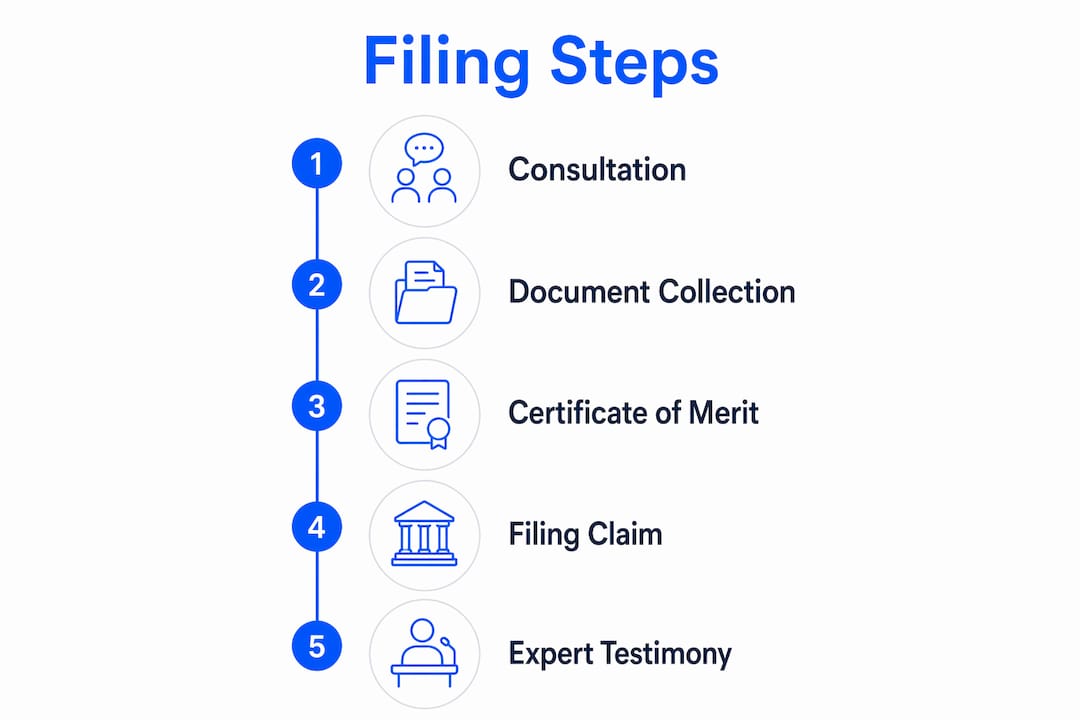
How to file a medical malpractice claim: step-by-step
The medical malpractice claim process moves through several distinct phases. Each phase builds on the last, and skipping any step can derail your entire case.
-
Initial attorney consultation (Week 1–2). Meet with a qualified personal injury attorney for a case evaluation. Most consultations last 30–60 minutes and are free. The attorney assesses whether your case meets the legal threshold for negligence.
-
Medical records collection (Weeks 2–10). Your attorney formally requests all relevant records. This phase typically takes up to 8 weeks because providers have legal timeframes to respond. Delays here are common and expected.
-
Independent expert review (Months 3–8). A qualified medical expert reviews your records and renders an opinion on whether the standard of care was breached. This phase takes 4–6 months on average. The expert’s opinion determines whether your case moves forward.
-
Pre-suit requirements. Pre-suit notices and certificates of merit are strictly required in many states. Skipping these steps causes immediate case dismissal. Your attorney files these documents on your behalf.
-
Drafting and filing the complaint. Your attorney drafts the formal civil complaint, which names the defendant, describes the negligent act, and states the damages sought. Filing fees typically run $200–$500, and the complaint is submitted to the appropriate civil court.
-
Serving the defendant. The defendant, whether a physician, hospital, or clinic, must be formally served using court-approved methods. This officially starts the legal clock on their response period.
-
Discovery, negotiation, and potential trial. Both sides exchange evidence, depose witnesses, and negotiate settlement. Most claims settle before trial, but the full process can last up to 36 months.
| Phase | Typical Timeframe |
|---|---|
| Attorney consultation | Week 1–2 |
| Medical records collection | Weeks 2–10 |
| Expert medical review | Months 3–8 |
| Pre-suit filings | Before complaint |
| Complaint filed and served | Month 8–12 |
| Settlement or trial | Month 12–36 |
Pro Tip: Ask your attorney about Georgia’s specific pre-suit affidavit requirements under O.C.G.A. § 9-11-9.1 before any documents are filed. Missing this step in Georgia results in automatic dismissal.
For more on how to build a strong foundation for your case, the personal injury claim guide from Jewkesfirm covers the documentation process in detail.
How to prove medical negligence to win your claim
Proving medical negligence requires demonstrating four specific legal elements. You must establish all four to succeed.
- Duty of care. The provider owed you a duty of care. This is established simply by showing a doctor-patient relationship existed.
- Breach of standard of care. The provider’s actions fell below what a reasonably competent peer would have done in the same situation. Expert testimony is mandatory in nearly all jurisdictions to establish this element.
- Causation. The breach directly caused your injury. This is the most contested element in most claims.
- Damages. You suffered measurable harm, including physical injury, financial loss, or emotional suffering.
The standard of proof is a preponderance of evidence, meaning greater than 50% probability that negligence occurred. That sounds achievable, but causation is where most cases stall.
Most claimants mistakenly believe that proving a medical error alone guarantees winning. Establishing direct causation is often the most contested element in any malpractice case. Legal Clarity
Jurors are not medical experts. The quality of your independent expert’s testimony largely determines whether the jury understands and accepts your version of events. A credible expert who explains clinical standards in plain language is your single most valuable asset in court. Tools like ChartInsight can help legal teams organize and summarize complex medical records before expert review, reducing preparation time significantly.
Understanding what qualifies as negligence under Georgia law is covered in depth in Jewkesfirm’s guide on medical negligence in Georgia.
What mistakes can sink a medical malpractice case?
Even strong cases fail when claimants make avoidable procedural errors. These are the most common pitfalls and how to avoid them.
- Missing the statute of limitations. This is the most fatal mistake. Once the deadline passes, no attorney can save your case. Start the process as soon as you suspect negligence.
- Skipping pre-suit requirements. Pre-suit notices and certificates of merit are not optional. Courts dismiss cases immediately when these filings are absent or defective.
- Representing yourself. Filing pro se is legally allowed but rarely succeeds. Most self-represented claimants cannot meet the expert testimony requirements that courts demand.
- Misunderstanding contingency fees. No win, no fee agreements eliminate upfront costs, but success fees around 25% are typically deducted from your final settlement. Read every fee agreement before signing.
- Failing to try internal resolution first. Contacting hospital patient advocacy or ombudsman departments can sometimes resolve issues without litigation. This approach occasionally results in waived bills or corrective treatment, and it costs nothing to try.
- Poor documentation habits. Gaps in your personal records weaken your attorney’s ability to build a timeline. Write down everything as it happens, not weeks later from memory.
Pro Tip: If you are unsure whether your experience qualifies as malpractice, use a psychiatric or medical record review service to get an independent clinical assessment before committing to litigation.
Jewkesfirm’s resource on medical malpractice rights in Georgia outlines the most frequent misunderstandings that lead to case dismissals in the state.
Key takeaways
Filing a medical malpractice claim requires meeting strict procedural deadlines, securing qualified expert testimony, and building a documented record of all four negligence elements before a complaint is filed.
| Point | Details |
|---|---|
| Deadlines are absolute | The statute of limitations is 1–3 years by state; missing it ends your case permanently. |
| Expert testimony is required | Courts demand independent medical experts to establish breach and causation in nearly every jurisdiction. |
| Pre-suit filings are mandatory | Certificates of merit and notices of intent must be filed before the complaint in many states, including Georgia. |
| Causation is the hardest element | Proving the breach directly caused your injury is the most contested part of any malpractice claim. |
| Professional representation matters | Pro se claimants rarely succeed due to complex evidentiary and procedural requirements. |
What i’ve learned after watching hundreds of malpractice cases
After years of working alongside personal injury attorneys and reviewing how malpractice claims unfold, one pattern stands out clearly. Claimants who invest heavily in the front-loaded investigative phase win more often than those who rush to file.
The instinct after a serious medical injury is to act fast and get into court. That instinct is understandable, but it often backfires. The cases that succeed are the ones where the attorney spent months building an airtight expert opinion before a single court document was filed. Rushing that phase to meet a self-imposed deadline, rather than the legal one, produces weak expert reports that opposing counsel tears apart.
Causation is where I have seen the most heartbreak. A client can have a clear error on record, a sympathetic injury, and a credible timeline, and still lose because the defense successfully argues the injury would have occurred regardless of the provider’s actions. That argument works more often than people expect. The only counter is a deeply prepared expert who can speak to probability with clinical precision.
My honest advice: treat the first consultation not as the start of a lawsuit, but as the start of an investigation. Ask your attorney what the expert review process looks like, how they select their experts, and what their track record is with causation arguments specifically. Those questions separate attorneys who file cases from attorneys who win them.
— Ali
How Jewkesfirm can help you pursue your claim
If you believe you have experienced medical negligence in South Atlanta or the surrounding Georgia counties, Jewkesfirm is ready to evaluate your case at no cost to you.

Jewkesfirm handles medical malpractice claims on a contingency fee basis, meaning you pay nothing unless they win. Their team manages every stage of the process, from records collection and expert coordination to pre-suit filings and courtroom representation. Jewkesfirm has recovered millions for injured clients across Georgia and brings the same dedicated, client-first approach to every case. Contact Jewkesfirm today for a free case evaluation and take the first step toward the compensation you deserve.
FAQ
How long do i have to file a malpractice claim in georgia?
Georgia’s statute of limitations for medical malpractice is generally two years from the date of injury. Missing this deadline permanently eliminates your right to sue.
What does a certificate of merit require?
A certificate of merit is a sworn statement from a qualified medical expert confirming that negligence likely occurred. Georgia requires this document to be filed alongside or shortly after the complaint.
Can i file a medical malpractice claim without an attorney?
Filing pro se is legally permitted but rarely succeeds because claimants cannot typically meet the expert testimony requirements courts demand.
How long does the full claim process take?
The medical malpractice claim process typically takes 12–36 months from initial consultation to resolution. Most cases settle before trial, but complex cases involving disputed causation can take longer.
What compensation can i recover in a malpractice claim?
You can recover medical expenses, lost wages, pain and suffering, and in some cases punitive damages. The total amount depends on the severity of your injury and the strength of the causation evidence your expert provides.