

Losing a loved one is devastating. When that loss happens because of someone else’s negligence, the grief is compounded by anger and confusion. Many families in Georgia assume that any accidental death automatically qualifies as a wrongful death claim. That is not how the law works. Georgia has a specific legal definition, strict eligibility rules, and firm deadlines that determine whether a family can pursue justice. If you have lost someone and suspect another party was responsible, understanding those rules is the first step toward protecting your rights and your family’s future.
Table of Contents
- What is wrongful death under Georgia law?
- Who can file a wrongful death claim in Georgia?
- What incidents qualify as wrongful death?
- Filing deadlines and practical steps for Georgia families
- What most families miss about defining wrongful death
- Get support for your wrongful death claim in Georgia
- Frequently asked questions
Key Takeaways
| Point | Details |
|---|---|
| Georgia’s strict definition | Not every accidental death qualifies as wrongful death; specific legal criteria must be met. |
| Filing eligibility order | Only certain family members can file, starting with the spouse, then children, then parents. |
| Common qualifying incidents | Negligence, reckless acts, and some crimes are the usual causes behind wrongful death claims. |
| Act quickly | Georgia families generally have only two years to file a wrongful death claim. |
| Get legal help | Working with a knowledgeable attorney avoids costly mistakes and protects your rights. |
What is wrongful death under Georgia law?
Georgia’s wrongful death law is found in O.C.G.A. § 51-4-1 and it draws a clear legal line. Not every death that involves tragedy or fault qualifies. As defined under Georgia legal standards, wrongful death is a death caused by another party’s negligent, reckless, intentional, or criminal actions. That definition may sound straightforward, but each word carries real legal weight.
“Wrongful death is a death caused by another party’s negligent, reckless, intentional, or criminal actions.” The law exists to give surviving families a path to accountability and financial recovery when a preventable death occurs.
The law was designed to protect families who suffer catastrophic loss because another person or entity failed in their legal duty of care. That duty of care can apply to drivers, doctors, property owners, product manufacturers, and even employers. When that duty is broken and a person dies as a result, Georgia law gives eligible family members the right to seek compensation.
To succeed in a wrongful death claim, certain legal elements must be proven. These are not technicalities. They are the foundation of the entire case.
Key elements required for a Georgia wrongful death claim:
- A person died
- The death was caused by another party’s negligent, reckless, intentional, or criminal conduct
- The surviving family members suffered measurable damages as a result
- The deceased would have had the right to sue for personal injury had they survived
Every one of these elements must be established with evidence. Missing even one can undermine an otherwise valid claim. Negligence, for instance, requires showing that the at-fault party had a duty, breached that duty, and that the breach directly caused the death. Recklessness involves a conscious disregard for the safety of others. Intent covers deliberate harmful acts. Criminal conduct, such as a DUI fatality, may satisfy this standard even without a criminal conviction.
Understanding where your situation fits within these categories shapes the entire strategy for your case. The Georgia wrongful death lawsuit guide provides deeper insight into how these legal elements apply to real-world situations families face.
Who can file a wrongful death claim in Georgia?
Once you know what wrongful death means, it is equally important to understand who can actually file a claim under Georgia law. The state follows a specific statutory order of priority, and only certain people have the legal right to bring the case forward.
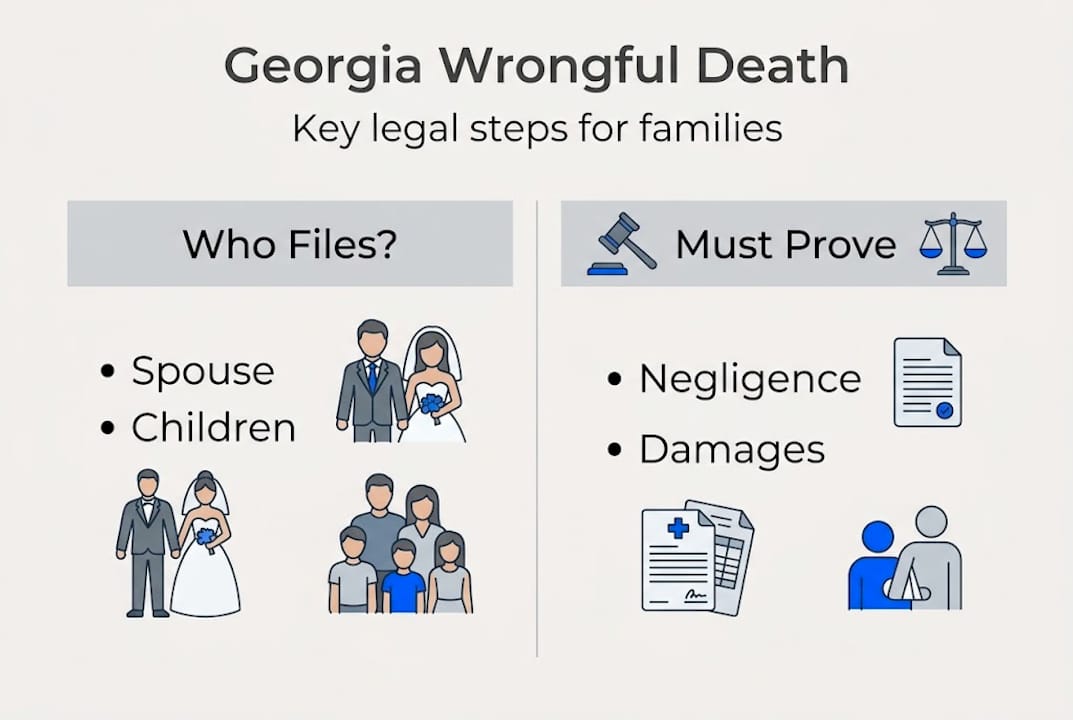
Georgia law prioritizes the surviving spouse, then children, then parents, and finally the estate. This hierarchy is not flexible. It determines not only who files but also how any recovered compensation is distributed.

| Priority | Who Can File | Rights and Responsibilities |
|---|---|---|
| 1st | Surviving spouse | Files on behalf of themselves and any children; controls the claim |
| 2nd | Children | Can file if no surviving spouse exists; share equally in recovery |
| 3rd | Parents | Eligible only if no spouse or children survive the deceased |
| 4th | Estate administrator | Files when no qualifying family member exists; proceeds go to estate |
When a surviving spouse exists, they hold the primary right to file and manage the claim. However, they also carry a responsibility to protect the children’s share of any recovery. Children do not file separately. Their interests are represented through the spouse’s claim, and any compensation must be fairly allocated.
If there is no surviving spouse, adult or minor children step into that role. Parents can file only when neither a spouse nor children survive. The estate administrator becomes the last resort when the deceased had no surviving spouse, children, or parents.
Family situations are often complicated. Blended families, estranged relatives, and disputes over who qualifies can create real obstacles. Legal disagreements between eligible parties can slow down or even derail a claim. Exploring who the parties eligible to file are in your specific situation is one of the most important early steps.
Pro Tip: When family members disagree on how to handle a wrongful death claim, an experienced attorney can serve as a neutral guide who keeps the focus on the evidence and the legal process rather than personal conflict.
What incidents qualify as wrongful death?
Now that eligibility is clear, it is worth looking at what types of tragedies actually meet Georgia’s definition of wrongful death. Common causes for wrongful death lawsuits include car accidents, medical malpractice, defective products, and criminal acts. But qualifying goes beyond the type of incident. The connection between another party’s conduct and the death must be established.
| Incident type | Key qualifying factor |
|---|---|
| Car or truck accident | Driver negligence, recklessness, or DUI |
| Medical malpractice | Breach of standard of care leading to death |
| Defective product | Manufacturer knew or should have known of danger |
| Slip and fall | Property owner failed to address known hazard |
| Criminal act | Intentional violence resulting in death |
Common qualifying scenarios in Georgia wrongful death cases:
- A driver runs a red light at high speed and kills another motorist
- A surgeon makes a preventable error during a routine procedure
- A child’s toy contains a choking hazard that the manufacturer concealed
- A store fails to fix a broken staircase and a customer falls to their death
- A person is killed during an armed robbery or assault
Not every fatal incident qualifies. Pure accidents with no element of negligence or wrongdoing do not meet the legal standard. This is one of the most common misconceptions families carry. A tragic outcome alone is not enough.
There are also notable exceptions. Workplace deaths often fall under Georgia workers’ compensation rules, which can limit a family’s ability to sue an employer directly. Government entities may be protected by sovereign immunity, though exceptions exist. Understanding negligence and injury rights in Georgia is essential before assuming a case qualifies. Reviewing the specifics with an attorney ensures you do not miss a valid claim or pursue one that faces significant legal barriers.
Filing deadlines and practical steps for Georgia families
With a clear understanding of who can file and what qualifies, families need to know when and how to start the process in Georgia. Time is one of the most critical factors in any wrongful death case.
In Georgia, families generally have two years from the date of death to file a wrongful death claim. That deadline is called the statute of limitations, and missing it almost always means losing the right to compensation permanently. Two years can feel like a long time when you are grieving. It is not.
Certain circumstances can pause or “toll” the deadline. For example, if the deceased’s estate takes time to appoint an administrator, the clock may be adjusted. If the at-fault party is a government entity, shorter notice deadlines often apply, sometimes as little as six months. Cases involving minors may also have different timelines. The 2-year deadline guide breaks down these exceptions in detail.
Immediate steps Georgia families should take after a wrongful death:
- Preserve all records related to the incident, including police reports, medical records, and any correspondence
- Document the scene and gather witness contact information if possible
- Avoid making any statements to insurance companies without legal guidance
- Consult a wrongful death attorney as soon as possible
- Do not wait to “see how things unfold” since evidence can disappear quickly
- Review the Georgia lawsuit step-by-step process to understand what comes next
Evidence degrades. Witnesses forget details. Surveillance footage gets overwritten. Acting fast is not just about meeting a legal deadline. It is about building the strongest possible case before critical information is lost.
Pro Tip: Contacting an attorney in the first weeks after a loss does not mean you are rushing the grieving process. It means you are protecting your family’s ability to hold the right people accountable before the window closes.
What most families miss about defining wrongful death
Here is something many families learn too late: the legal definition of wrongful death is not just wording. It is the standard your case will be judged against, and vague assumptions can cost you everything.
Families often delay consulting an attorney because they believe justice is obvious. If someone died because of another person’s careless act, the case should be clear. But insurance companies and defense attorneys do not see it that way. They challenge every element. They question causation, contest the extent of damages, and argue shared fault.
The families who come out ahead are the ones who hire a wrongful death attorney early, preserve evidence before it disappears, and let experienced legal professionals shape the narrative. Waiting to “see if it settles” without counsel is one of the most common and costly mistakes grieving families make.
The definition matters because proving it is the job. Every element of negligence, causation, and damages must be supported by solid evidence. Understanding that reality changes how you approach the aftermath of a loss.
Get support for your wrongful death claim in Georgia
If you are navigating this kind of loss, you do not have to figure out the legal system alone.

The Georgia wrongful death attorneys at The Jewkes Firm understand what families in South Atlanta and across Georgia are facing. Our team is dedicated to clarifying the law, protecting your rights, and guiding you through every step of the process. We offer FREE consultations and work on a contingency fee basis, meaning you pay nothing unless we win. Your family deserves experienced, compassionate advocates who will fight for the accountability and compensation you are owed. Reach out today and let us help you understand your options.
Frequently asked questions
What counts as wrongful death in Georgia?
Wrongful death in Georgia is a death caused by another party’s negligence, recklessness, or intentional act. Under Georgia law, all four conduct types must be carefully evaluated to determine whether a claim exists.
Who has the right to file a Georgia wrongful death lawsuit?
Georgia law gives filing priority to the surviving spouse, then children, parents if no spouse or children survive, and finally the estate administrator. The hierarchy of claimants is established by state statute and is not subject to personal preference.
How long do you have to file a wrongful death claim in Georgia?
You generally have two years from the date of death to file, but exceptions can apply depending on your circumstances. Reviewing the two-year statute of limitations with an attorney ensures you do not miss a critical deadline.
Do all fatal accidents qualify as wrongful death?
Not every accidental death is a wrongful death. The death must be connected to another party’s legal negligence or misconduct for a claim to move forward under Georgia law.
Can multiple family members file separate wrongful death lawsuits?
No. Georgia law controls both who can file and how compensation is shared among relatives. Filing rules and compensation allocation are governed by the same statutory hierarchy that determines eligibility.