
Atlanta’s roads are more dangerous than ever. Reported accidents rose 15% in the first half of 2026 compared to the same period last year, and South Atlanta residents are feeling it firsthand. If you were recently hurt in a crash, a slip and fall, or any other accident, understanding the legal landscape right now is not optional. It is essential. The trends reshaping personal injury law in 2026 directly affect how much you can recover, what evidence matters, and how quickly your case resolves. This guide breaks down what you need to know before taking your next step.
Table of Contents
- Atlanta’s accident surge and what it means for victims
- Legal settlements, jury awards, and the new tech landscape
- The rise of mental health claims and social factors in 2026
- Navigating reforms, technology, and getting reliable help
- Our take: Why Atlanta victims must stay ahead of legal trends
- Ready for your next step? Get expert help for your claim
- Frequently asked questions
Key Takeaways
| Point | Details |
|---|---|
| Accidents on the rise | Atlanta saw a 15% jump in traffic crashes and injuries in early 2026, raising both financial and emotional costs. |
| Tech shapes your claim | Wearables, AI, and telematics play a big role in how evidence is gathered and claims are decided in 2026. |
| Mental health matters | Courts and insurers are increasingly recognizing PTSD and emotional distress as compensable injuries. |
| Legal expertise is critical | Filing with an experienced local lawyer maximizes your compensation by leveraging the latest trends and laws. |
Atlanta’s accident surge and what it means for victims
The numbers are hard to ignore. Total Atlanta crashes rose 15% in the first half of 2026, with the average cost per serious injury reaching nearly $58,000. That figure does not capture the full picture. Lost wages, ongoing therapy, vehicle replacement, and long-term disability costs can push the real financial burden far higher for many victims.
Here is a breakdown of what serious injury victims typically face:
| Cost Category | Estimated Impact |
|---|---|
| Emergency medical care | $10,000 to $30,000+ |
| Follow-up treatment and therapy | $5,000 to $20,000+ |
| Lost wages (short term) | $3,000 to $15,000+ |
| Long-term disability or lost earning capacity | Varies widely |
| Mental health treatment | $2,000 to $10,000+ |
These figures make one thing clear: a serious accident in South Atlanta is not just a physical crisis. It is a financial one.
“The surge in Atlanta’s accident rate has translated directly into higher claim values and greater demand on the legal system. Victims who understand these trends are far better positioned to recover what they deserve.”
Beyond the bills, there is a psychological cost that many victims overlook. Anxiety, depression, and post-traumatic stress disorder are common after serious collisions. These conditions can prevent people from returning to work and disrupt every part of daily life. Knowing how to document and pursue these damages matters more in 2026 than it ever did before.
For victims trying to understand what happened to them legally, reviewing local injury claim examples can provide real context. It also helps to get familiar with the most common accident injuries Georgia courts see, so you know what to document from day one.
Legal settlements, jury awards, and the new tech landscape
Most people assume personal injury cases go to trial. In reality, 95% of PI cases settle before they ever reach a jury. Auto accidents represent 52% of all personal injury filings, and that share is growing as Atlanta roads get busier. Pre-trial settlement is usually faster and less costly for victims, but it does not mean you should accept the first offer.
Here is how the resolution process typically works:
- Your attorney investigates the accident and gathers evidence.
- A demand letter is sent to the at-fault party’s insurer.
- Negotiations begin, often over several weeks or months.
- If a fair amount is reached, you settle and receive payment.
- If negotiations fail, your attorney prepares for trial.
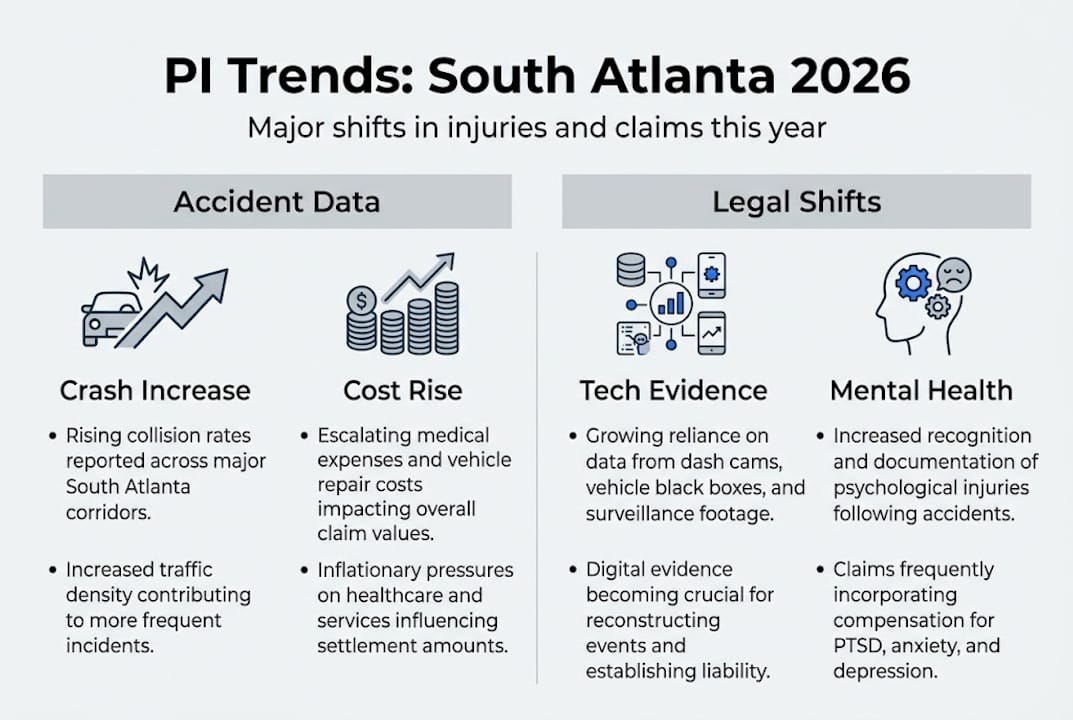
One major shift in 2026 is how technology shapes every step of this process. AI is now used by 79% of PI firms for case evaluation, evidence review, and even predicting settlement ranges. This is not just a tool for lawyers. Insurance companies are using AI too, which means your claim is being evaluated by algorithms from the moment it is filed.
Wearable devices, vehicle telematics (the data your car generates), and social media posts are now accepted as evidence in many Georgia courts. A fitness tracker showing reduced activity after your injury can support your claim. But a photo of you at a family event posted online can be used against you.
The industry-wide PI case data shows a clear trend called “social inflation,” where jury awards are growing because jurors are increasingly skeptical of large corporations and insurers. Average verdicts in metro Atlanta have climbed notably in the past two years.
Pro Tip: Lock down your social media accounts the moment you file a claim. Defense teams routinely scan public profiles for anything that could minimize your injuries.
Understanding filing a claim in Georgia is the first step. If you are not sure where to begin locally, reading about how to file in South Atlanta can help clarify the process.
The rise of mental health claims and social factors in 2026
Physical injuries are visible. Emotional ones are not. That has historically made mental health claims harder to win. But 2026 is different.

42% of serious accident victims develop PTSD following a crash, and courts in Georgia are increasingly treating psychological harm as a compensable injury when it is properly documented. This is a meaningful shift for victims who struggle long after their physical wounds have healed.
Here is what courts and juries now look at when evaluating mental health claims:
- Formal diagnosis from a licensed mental health professional
- Documented treatment history, including therapy and medication
- Wearable data showing sleep disruption, elevated stress indicators, or reduced physical activity
- Testimony from family members or coworkers about behavioral changes
- Journal entries or personal records kept after the accident
Growing recognition of mental health claims and the use of social media evidence is actively changing how damages are awarded across the country, and Georgia is no exception.
“Invisible injuries are no longer invisible in the courtroom. The legal system has caught up to the science, and juries are increasingly willing to award meaningful compensation for documented psychological harm.”
Jury attitudes play a critical role here. Georgia does not cap most non-economic damages in personal injury cases, which means jurors have real discretion. A well-documented mental health claim can result in a significantly larger award. On the other hand, insurers are more aggressively disputing these claims, using social media content and surveillance footage to argue that victims are not as impaired as claimed.
The lesson is clear: build your case from day one. Keep records. Seek treatment immediately. Do not give insurers the ammunition they need to undermine your claim. For a closer look at how local PI law changes affect mental health awards specifically, that resource is worth your time.
Navigating reforms, technology, and getting reliable help
Legislative reforms in 2026 are trying to balance two competing goals: protecting injured victims and reducing what critics call the “tort tax,” estimated at $1,415 per person annually across the U.S. Some reforms limit certain types of damages. Others create new procedural requirements. None of this makes your path to recovery easier without guidance.
Here are practical steps every South Atlanta accident victim should take right now:
- Document everything immediately. Photos, medical records, police reports, and witness information are the foundation of any claim.
- Seek medical care right away. Delays in treatment give insurers grounds to argue your injuries were not caused by the accident.
- Preserve digital evidence. Save dashcam footage, screenshots, and any messages related to the incident.
- Avoid recorded statements to insurers. They can and will use your words against you.
- Consult a local personal injury attorney early. The earlier you get advice, the better protected your rights are.
Technology works both ways. Telematics data from your vehicle might prove the other driver was speeding. But it could also reveal your own driving behavior. Georgia workers’ compensation insurance rules add another layer of complexity for victims injured on the job.
Pro Tip: Do not wait to see if your injuries “get better” before calling a lawyer. The statute of limitations in Georgia is generally two years for personal injury claims, but critical evidence can disappear fast.
Knowing when and how to seek legal advice after an accident can directly affect your outcome. The benefits of hiring a local lawyer in South Atlanta go beyond familiarity with local courts. A local attorney understands the specific tendencies of regional insurance adjusters and juries. If you are still weighing the decision, understanding why hire a personal injury lawyer at all can remove the uncertainty.
Our take: Why Atlanta victims must stay ahead of legal trends
Here is something we see too often. A victim comes to us months after an accident, having followed advice that made sense two or three years ago. They did not document their mental health treatment. They accepted a quick settlement. They posted on social media without thinking. And now they are left with a fraction of what they deserved.
The personal injury landscape shifts every year. In 2026, the pace of that change has accelerated dramatically. AI is evaluating your claim before a human adjuster even reads the file. Jury attitudes are shifting in ways that can either multiply your award or reduce it, depending on how your case is built.
Waiting and seeing is not a strategy. It is a risk. Victims who maximize compensation in South Atlanta share one thing in common: they moved quickly, stayed informed, and worked with attorneys who understood the current environment. Outdated advice is not neutral. It costs you money, time, and leverage. Stay ahead of the trends. Your recovery depends on it.
Ready for your next step? Get expert help for your claim
The 2026 legal landscape is not the one from two years ago. Mental health claims, AI-driven evaluations, tech-based evidence, and evolving reforms mean your claim needs to be handled by someone who understands what is happening right now, not what was standard practice years ago.

At The Jewkes Firm, we work exclusively with accident victims in South Atlanta and surrounding Georgia counties. We offer free consultations with no obligation, and you pay nothing unless we win your case. Our attorneys are current on every trend covered in this article and ready to put that knowledge to work for you. Call us today for a FREE CASE REVIEW and let us protect your rights from day one.
Frequently asked questions
What are the main personal injury trends impacting South Atlanta in 2026?
Atlanta accident rates rose 15% in early 2026, and the most significant trends include greater recognition of mental health claims, widespread use of tech-based evidence, and steady increases in both settlement values and jury awards.
How does technology affect personal injury claims today?
AI is used by 79% of PI firms for case analysis, and evidence from wearables, vehicle telematics, and social media is now routinely used by both plaintiff attorneys and insurers to build or challenge claims.
Are mental health injuries, like PTSD, compensated in injury cases?
Yes. 42% of serious accident victims develop PTSD, and Georgia courts increasingly award compensation for documented psychological harm when supported by professional diagnosis and treatment records.
Do I need a lawyer to file a personal injury claim in South Atlanta in 2026?
You are not legally required to hire one, but claims succeed 3.5x more often with proper legal guidance, and the growing complexity of tech-based evidence and legislative reforms makes experienced local representation more valuable than ever.