

How the Atlanta injury settlement process works
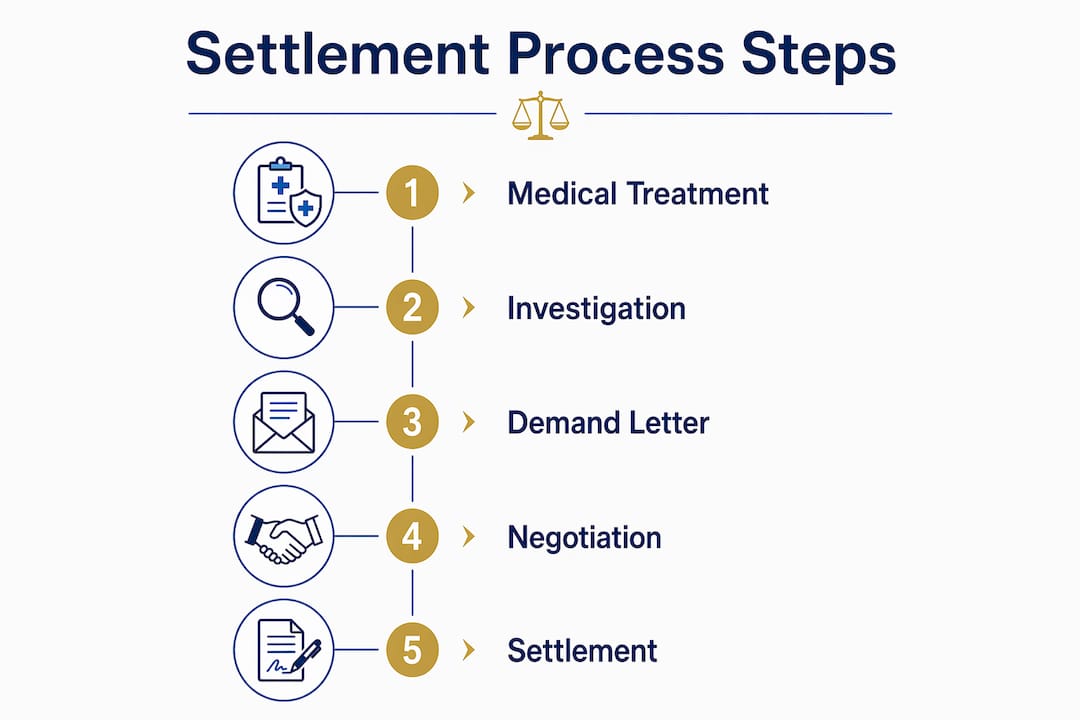
The Atlanta personal injury settlement process follows a defined sequence: you get hurt, seek medical care, gather evidence, file a claim, negotiate with the insurer, and either reach a settlement or go to trial. Most straightforward cases resolve within several months. Complex cases involving serious injuries, disputed liability, or multiple parties can take a year or longer.
Here is what the process looks like at a glance:
- Immediate post-accident phase: Seek medical care, document the scene, and report the incident to your insurer.
- Medical treatment phase: Continue all prescribed treatment until you reach maximum medical improvement (MMI), the point at which your condition has stabilized.
- Investigation phase: Your attorney and the insurer independently gather evidence, police reports, witness statements, and medical records.
- Demand phase: Your attorney submits a formal demand letter to the at-fault party’s insurer outlining damages and a settlement figure.
- Negotiation phase: Both sides exchange offers and counteroffers, often over several weeks or months.
- Resolution: Either a settlement agreement is signed, or the case moves to litigation.
- Post-settlement: Liens are resolved, attorney fees are deducted, and the net proceeds are distributed to you.
The key players throughout this process are you (the claimant), the at-fault party’s insurance adjuster, and your personal injury attorney. Understanding each stage puts you in a far stronger position to protect your rights and your compensation.

Step-by-step stages in the Atlanta personal injury settlement process
Every Atlanta injury claim moves through the same core stages, though the pace varies. Knowing what happens at each step prevents surprises and helps you make decisions with confidence.
-
Seek immediate medical attention. Go to a doctor, urgent care, or emergency room within 24–48 hours of the accident. Insurers routinely deny claims with delayed care by arguing the injury was not caused by the accident. A same-day or next-day medical record anchors your claim to the incident.
-
Document the accident scene. Photograph vehicle damage, road conditions, visible injuries, and any contributing hazards. Collect names and contact information for witnesses. If law enforcement responded, obtain the official police report number.
-
Notify your insurer. Report the accident promptly. Georgia policies typically require notice within 30 days. Missing that window gives adjusters grounds to question coverage or delay processing.
-
Retain a personal injury attorney. An attorney preserves evidence, issues spoliation letters to prevent destruction of records, and takes over all communication with the insurer. Consulting legal counsel early is especially important when liability is contested or injuries are serious. Jewkesfirm offers free consultations with no upfront cost, so there is no financial barrier to getting that guidance.
-
Complete medical treatment. Your attorney will advise you to continue all prescribed treatment and reach MMI before settling. Accepting an offer before your treatment is complete means you may not recover costs for surgery, physical therapy, or long-term care that surfaces later. Early low offers rarely account for those future expenses.
-
Investigation and evidence gathering. Your attorney builds the liability case by collecting accident reconstruction reports, surveillance footage, medical records, employment records showing lost wages, and expert opinions. The insurer conducts its own parallel investigation, pulling police reports, medical histories, and recorded statements.
-
Calculate total damages. Once you reach MMI, your attorney compiles a full damages picture: medical bills to date, projected future medical costs, lost income, diminished earning capacity, pain and suffering, and any property damage.
-
Submit the demand letter. Your attorney sends a formal written demand to the at-fault insurer. The letter details liability, documents every category of damages, and states a settlement figure. This letter officially opens negotiations.
-
Negotiate with the insurer. The adjuster responds with an initial offer, which is almost always lower than the demand. Your attorney counters with supporting documentation. This back-and-forth can span several weeks or several months depending on the complexity of the case and the insurer’s responsiveness.
-
Evaluate settlement offers carefully. Your attorney compares each offer against the full documented damages, long-term medical prognosis, and litigation risk. You make the final decision on whether to accept.
-
Sign the settlement agreement. Once both parties agree on a figure, you sign a release of all claims. This document is binding. You cannot reopen the claim later, which is why settling before MMI is so risky.
-
Resolve liens and deductions. Medical providers, health insurers, and Medicare or Medicaid may hold liens against your settlement. Your attorney negotiates those liens down where possible before funds are distributed.
-
Receive your settlement check. After the release is signed, the insurer typically issues payment within a few weeks. Your attorney deposits the check into a trust account, deducts fees and resolved liens, and disburses the net amount to you.
For a detailed walkthrough of filing an injury lawsuit in Georgia, Jewkesfirm has published a step-by-step resource that covers procedural requirements specific to Atlanta and surrounding counties.
What slows down your settlement and what speeds it up
The timeline for resolving an Atlanta injury claim is not fixed. Several factors push cases toward a faster resolution, while others create months of additional delay.
Factors that extend the timeline:
- Severity of injury. Serious injuries require longer treatment, and you should not settle until you reach MMI. A broken wrist may resolve in weeks; a spinal injury can take a year or more to stabilize.
- Disputed liability. When the at-fault party denies responsibility or argues comparative fault, the insurer investigates more aggressively and offers less. Georgia follows a modified comparative fault rule, meaning your compensation is reduced by your percentage of fault, and you recover nothing if you are found 50% or more at fault.
- Inconsistent statements. Claims with inconsistent statements take 25–35% longer to resolve. Contradictions between your initial account, the police report, and your medical records give adjusters justification to delay and devalue.
- Missing or incomplete documentation. Gaps in medical records, missing wage documentation, or absent witness statements force additional rounds of information requests.
- Insurance company workload. Adjusters often handle 30–60 claims per month. Large caseloads mean your file may sit while the adjuster manages higher-priority or more complex cases.
- Litigation. If negotiations fail and the case goes to trial, the timeline extends significantly. Georgia civil courts can take one to three years to reach a trial date.
Factors that accelerate resolution:
- Prompt medical treatment with consistent, documented records.
- Clear, undisputed liability supported by police reports and witness statements.
- Complete documentation of all damages from the start.
- An experienced attorney who responds quickly to insurer requests and keeps negotiations moving.
- A willingness to negotiate in good faith while holding firm on documented damages.
Pro Tip: Keep a personal injury journal from day one. Record your pain levels, physical limitations, missed activities, and emotional impact daily. This contemporaneous record strengthens pain and suffering claims and fills gaps that medical records alone cannot capture.

Financial aspects of Atlanta injury settlements you need to understand
Settlement proceeds are not simply handed to you in full. Several deductions and legal considerations shape what you actually take home, and Georgia law adds specific nuances that affect how those funds are treated.
How settlement amounts are calculated:
- Economic damages: Medical bills, future medical costs, lost wages, and diminished earning capacity. These are calculated from documented records.
- Non-economic damages: Pain and suffering, emotional distress, and loss of enjoyment of life. Georgia does not cap these damages in most personal injury cases, though the strength of your documentation directly affects the amount.
- Property damage: Vehicle repair or replacement costs, typically handled separately from bodily injury claims.
Attorney fees and deductions:
Personal injury attorneys in Georgia typically work on a contingency fee basis, meaning you pay nothing unless they recover compensation for you. Contingency fees generally range from 33% to 40% of the gross settlement, with the percentage often increasing if the case proceeds to litigation. After attorney fees, case expenses (filing fees, expert witness costs, medical record retrieval) are also deducted from the settlement.
Medical liens:
Hospitals, health insurers, and government programs like Medicaid can place liens on your settlement for treatment costs they covered. Your attorney negotiates these liens before distribution, which can meaningfully increase your net recovery.
Georgia law and divorce:
Georgia courts parse settlement proceeds into distinct categories when marital property is at issue. Under Georgia case law, including Campbell v. Campbell, pain and suffering damages are treated as separate property belonging solely to the injured spouse. Reimbursements for medical expenses and lost wages, however, may be classified as marital property subject to division in a divorce proceeding.
Georgia courts recognize that pain and suffering damages are deeply personal. They compensate the injured individual for their own physical and emotional experience, not a shared marital loss. That distinction, established in Campbell v. Campbell, means those funds belong to the injured party alone.
Why documentation drives financial recovery:
Every dollar you recover depends on what you can prove. Detailed billing records, wage documentation, physician-imposed work restrictions, and objective findings like imaging reports all translate directly into settlement value. Vague or incomplete records give adjusters room to dispute amounts and reduce offers.
What to say and what to avoid during settlement negotiations
How you communicate after an accident can protect or seriously damage your claim. Insurance adjusters are trained to find inconsistencies, and a single careless statement can be used to reduce your settlement or deny your claim entirely.
What to avoid:
- Admitting fault or apologizing. Even polite phrases like “I’m sorry this happened” can be treated as an admission of responsibility and used against your claim. Stick to factual reporting only.
- Giving a recorded statement without counsel. Adjusters use recorded statements to lock you into an account that may contradict later medical findings. You are not legally required to give a recorded statement to the other party’s insurer.
- Minimizing your injuries. Saying “I’m fine” or “it’s not that bad” creates a documented contradiction when you later submit medical bills. Describe symptoms factually and refer the adjuster to your medical records.
- Discussing settlement expectations. Never tell an adjuster what number you are hoping for or what minimum you would accept. Once the insurer knows your floor, they build offers around it.
- Posting on social media. Photos or posts about physical activity can be used out of context during litigation to dispute injury severity. Keep your accident and recovery off all social platforms.
What effective communication looks like:
State facts tied to documentation. “I reported 7/10 neck pain on the date of the accident and was prescribed physical therapy” is far stronger than “my neck has been killing me.” Provide dates, locations, and objective findings. Keep calls brief, log every interaction with the adjuster’s name, company, date, and the questions asked, and follow up in writing.
Pro Tip: Let your attorney handle all direct communication with the insurer whenever possible. When you must speak, use these phrases: “Please speak with my attorney,” “All details are in the accident report,” and “My medical provider will document symptoms and treatment.” These responses are factual, non-committal, and protect your claim.
Adjusters actively look for credibility gaps between your statements and your medical records. Inconsistencies give them documented justification to devalue or delay your claim. Consistent, factual communication is one of the most direct ways to protect your settlement value.
How Jewkesfirm fights for Atlanta injury victims
Jewkesfirm is a personal injury law firm serving clients in South Atlanta and the surrounding Georgia counties. The firm handles auto accidents, trucking crashes, medical malpractice, slip and falls, wrongful death, and other complex injury cases. Every client receives a free initial consultation, and the firm works exclusively on contingency, meaning you pay nothing unless Jewkesfirm wins your case.
The firm’s approach is built around two commitments: thorough preparation and direct client advocacy. Attorneys at Jewkesfirm take over all communication with insurers from the start, preserving evidence, managing deadlines, and preventing the kinds of missteps that reduce settlement value. That hands-on involvement levels the playing field against insurance companies whose adjusters handle dozens of files at a time.
At Jewkesfirm, every client’s voice is heard. The firm’s attorneys bring unwavering dedication to each case, fighting to recover the maximum compensation you deserve while guiding you through every step of the process.
Jewkesfirm has recovered millions of dollars for injured clients across South Atlanta and Georgia. The firm’s track record spans cases ranging from straightforward auto accidents to multi-party trucking collisions and catastrophic injury claims. That depth of experience means the attorneys understand how Georgia courts and local insurers operate, and they use that knowledge to your advantage.
Beyond individual representation, Jewkesfirm publishes educational resources, including blogs and podcasts, to help Atlanta residents understand their legal rights before they ever need an attorney. If you are weighing whether to hire an injury lawyer in South Atlanta, that resource walks through exactly what an attorney does and why it matters for your specific claim.
Common challenges that arise during settlement and how to handle them
Even well-documented claims run into obstacles. Knowing the most common disputes in advance helps you respond effectively rather than reactively.
Disputed liability. The at-fault party’s insurer may argue you share responsibility for the accident. In Georgia, if you are found 50% or more at fault, you recover nothing. An attorney counters this by building a clear liability case with police reports, witness statements, accident reconstruction, and physical evidence before negotiations begin.
Lowball initial offers. Insurers set early reserves based on limited information, and initial offers often reflect those early estimates rather than the full value of your claim. Accepting too quickly means you forfeit compensation for treatment costs that surface later. Your attorney’s job is to document the complete damages picture and counter with evidence, not emotion.
Delayed settlement checks. After a settlement agreement is signed, payment typically arrives within a few weeks. Delays occur when lien resolution takes longer than expected, when the insurer’s internal processing is slow, or when there are disputes over the release language. Your attorney tracks these timelines and follows up directly with the insurer.
Pre-existing condition disputes. Insurers frequently argue that your injuries predated the accident. Georgia law allows you to recover for aggravation of a pre-existing condition, but you need medical documentation showing the accident worsened your condition. Your attorney presents that evidence clearly so the insurer cannot use your medical history against you.
Uninsured or underinsured drivers. Georgia requires insurers to offer uninsured motorist (UM) coverage, though drivers can reject it in writing. If the at-fault driver has no insurance or insufficient coverage, your own UM policy may be the primary source of recovery. An attorney identifies all available coverage sources early in the process.
For practical examples of how these challenges play out in real Atlanta cases, Jewkesfirm has published South Atlanta injury claim examples that illustrate how different fact patterns affect outcomes.
How insurance companies shape the settlement process
Understanding how insurers operate changes how you approach every interaction. Insurance companies are not neutral parties. Their adjusters work to close files at the lowest defensible cost, and their tools and tactics are designed with that goal in mind.
How adjusters evaluate your claim:
Adjusters investigate accidents, obtain police and medical records, set financial reserves, and negotiate settlements. Those reserves, set early in the process based on initial information, shape the entire negotiation range. An adjuster who sets a low reserve has internal justification for a low offer, and changing that reserve requires new documented evidence.
Recorded statements as a tool:
Adjusters use recorded statements to lock claimants into an early account. If your medical treatment later reveals injuries not mentioned in that initial statement, the adjuster points to the discrepancy as evidence the injury is exaggerated or unrelated. Declining a recorded statement to the other party’s insurer is your right, and your attorney can provide a written statement instead.
Early settlement offers:
Initial offers often reflect early reserves built on limited information, not the full value of ongoing treatment or lost income. Accepting a quick offer before your medical prognosis is clear closes the door on any future compensation, regardless of how your condition develops.
How attorneys counter insurer tactics:
An experienced attorney controls the information flow. Rather than letting the adjuster set the narrative, your attorney presents a fully documented damages package, responds to lowball offers with evidence, and manages all deadlines. That approach shifts the leverage back toward you. Jewkesfirm’s attorneys understand how Georgia insurers operate and use that knowledge to push for the compensation their clients actually deserve.
What are your options if a settlement offer is inadequate or rejected?
A settlement offer you cannot accept is not the end of the road. You have real legal options, and knowing them gives you negotiating power.
Reject and counter. You are never required to accept an offer. Your attorney submits a counteroffer with supporting documentation explaining why the offer falls short. This is the most common response to a lowball offer, and it often produces a better result without litigation.
Demand mediation. Mediation brings both parties before a neutral third-party mediator who facilitates negotiation. It is less expensive and faster than trial, and many Georgia personal injury cases resolve at mediation. Either party can request it, and courts sometimes order it before allowing a case to proceed to trial.
File a lawsuit. If negotiations stall or the insurer refuses to make a reasonable offer, your attorney files a civil lawsuit in Georgia Superior Court or State Court, depending on the damages amount. Filing a lawsuit does not mean the case goes to trial. The majority of lawsuits settle during the discovery phase, once both sides have exchanged evidence and deposed witnesses.
Georgia’s statute of limitations. Under Georgia law, you generally have two years from the date of the injury to file a personal injury lawsuit. Missing that deadline almost always bars your claim entirely, regardless of how strong it is. This is one of the most important reasons to consult an attorney early rather than waiting to see how negotiations develop.
Trial. If the case does not settle, it proceeds to a jury trial. Your attorney presents the liability case, damages evidence, and expert testimony. Juries in Georgia can award economic damages, non-economic damages, and in cases involving egregious conduct, punitive damages. Trial carries risk for both sides, which is why most cases settle before reaching that stage.
If you are at the point of evaluating whether to protect your injury claim or push toward litigation, Jewkesfirm’s attorneys can walk you through the specific facts of your case and give you an honest assessment of your options.
Key Takeaways
The Atlanta personal injury settlement process moves from medical treatment through investigation, demand, and negotiation, with your documentation and communication quality directly determining your final recovery.
| Point | Details |
|---|---|
| Seek care within 24–48 hours | Delayed medical treatment gives insurers grounds to dispute injury causation and deny claims. |
| Never settle before reaching MMI | Early offers rarely cover future surgery or extended care; signing a release closes the claim permanently. |
| Inconsistent statements cost you | Claims with inconsistent statements take 25–35% longer to resolve and give adjusters leverage to reduce offers. |
| Pain and suffering is separate property | Under Georgia case law, pain and suffering damages belong solely to the injured party and are not divisible in divorce. |
| Georgia’s statute of limitations is two years | Missing the filing deadline almost always bars your claim entirely, regardless of its merits. |